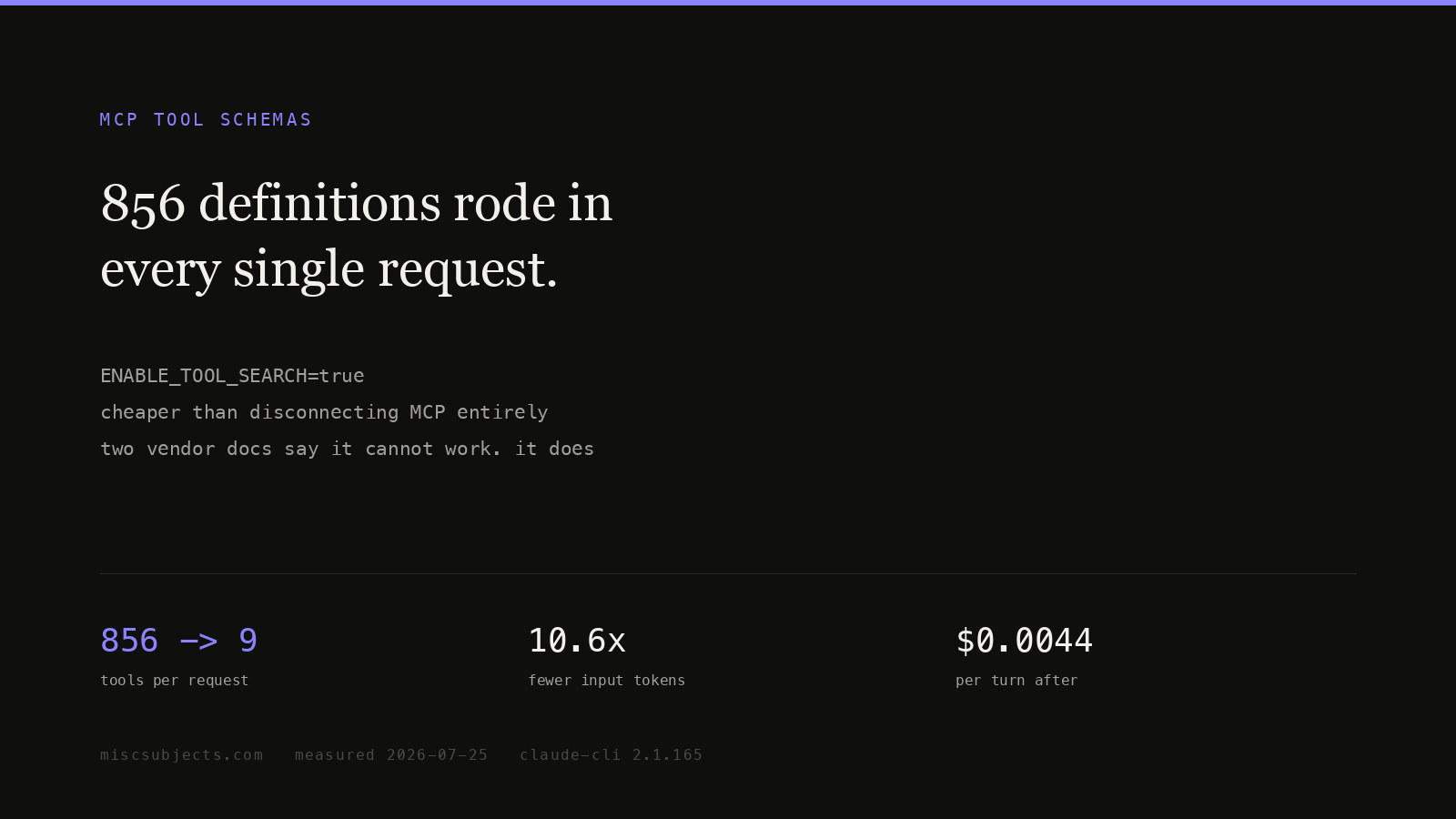
MCP definitions use 10.6× more input tokens until tool search defers them
A live catalogue of 831 MCP tools measures 127,440 tokens of definitions; deferring them cut one measured turn from 149,187 input tokens to 14,109. The commands to measure your own, and the five filed cases where deferral leaves the bill in place.
A connected MCP server costs nothing while its tools sit idle, and costs on every request, because the definitions travel with the request. MCP — Model Context Protocol — is the wire format an agent uses to discover and call tools on an external server. Its discovery call, tools/list, returns one object per tool: a name, a description, and a JSON Schema for the arguments. A client that keeps those objects in the request pays for all of them every turn, whether the model calls one or none.
Evidence status
Observed marks first-party measurements or runtime receipts from the named environment. Derived marks arithmetic calculated from cited inputs. Specified marks vendor or standards documentation. Implemented and deployed name code and live-state evidence, respectively. Reproduced means the stated procedure was rerun. Externally attested marks operator reports; those reports show that an experience occurred, not that it is universal.
A definition is a name, a sentence and a schema, and the schema is the part that grows
One live tool object, from POST https://miscsubjects.com/api/mcp with {"jsonrpc":"2.0","id":1,"method":"tools/list"}:
That object is 264 tokens by the o200k_base tokenizer: 11 for the name, 22 for the description, 231 for argument names, types, defaults and one enum of eleven strings.
A description is written once by a human and stays a sentence. A schema grows with the API behind it — every optional filter, enum member and nested object — and nothing prunes it. The MCP specification requires it: tools/list returns name, optional title, description and inputSchema per tool, so there is no conforming way to publish a tool without publishing its argument surface.
Across the whole 831-tool catalogue on 2026-07-26, names cost 4,064 tokens, descriptions 54,596, schemas 54,465. Level in aggregate, which is not the folklore. Split by size and the folklore returns:
Slice of the catalogue
Tools
Tokens
Share that is schema
Definitions under 300 tokens
800
109,856
39%
Definitions 300 tokens or more
31
17,584
67%
The 20 most expensive definitions
20
13,963
75%
The single most expensive, CF_OBSERVABILITY_QUERY_WORKER_OBSERVABILITY
1
1,803
95%
Cheap tools are mostly prose; expensive tools are almost entirely schema. A catalogue's bill is set by its handful of query-shaped tools, not its median row. An independent measurement on a different server found the same tail: G-Core's MCP server at GCORE_TOOLS=* advertises 741 tools for about 488,013 tokens, an average of 659 per tool, one tool alone at about 7,046 tokens of schema.
Measure it three ways, cheapest first
1. /context, in a running session. Breaks the window into system prompt, system tools, MCP tools, memory, skills and messages. Free, one second. Read the contradiction section before trusting a zero.
2. The usage field of any API response. Every Messages API response carries usage.input_tokens, usage.output_tokens and the cache counters. Send the same one-word prompt twice, with the servers attached and without, and subtract. The only method that measures what you are billed for.
3. A capture server, for what the client puts on the wire. A local HTTP server that speaks enough of the Messages API to answer, and logs every request:
bash
1
2
3
git clone https://github.com/redacted/claude-code-cloudflare-gateway
cd claude-code-cloudflare-gateway
node tools/capture-gateway.mjs      # listens on :8787, appends capture.jsonl
Line 3, Column 1Shell Script
It records n_tools, tool_names, system_chars, system_cache_control, metadata and the model per request, redacting authorization and x-api-key. Point the client at it twice, changing one variable:
bash
1
2
3
4
5
ANTHROPIC_BASE_URL=http://localhost:8787 ANTHROPIC_AUTH_TOKEN=x \
  ENABLE_TOOL_SEARCH=false claude -p "say ok"

ANTHROPIC_BASE_URL=http://localhost:8787 ANTHROPIC_AUTH_TOKEN=x \
  ENABLE_TOOL_SEARCH=true claude -p "say ok"
Line 5, Column 1Shell Script
Read the two tool counts out of the log:
bash
1
2
3
4
5
6
7
python3 -c "
import json
for line in open('capture.jsonl'):
    r = json.loads(line)
    if r.get('n_tools') is not None:
        print(r['model'], 'tools=', r['n_tools'])
"
Line 7, Column 1Shell Script
Two lines. On claude-cli 2.1.165 against that server on 2026-07-25: tools= 856 and tools= 9 — the nine being Agent, AskUserQuestion, Bash, Edit, Read, Skill, ToolSearch, Workflow, Write.
To price a catalogue without running the client, count the tokens the server publishes. The command behind the 831-tool figures above, good against any HTTP MCP server that answers tools/list:
bash
1
2
3
4
5
6
7
8
9
10
11
12
curl -s -X POST https://miscsubjects.com/api/mcp \
  -H "Authorization: Bearer $MCP_TOKEN" -H 'content-type: application/json' \
  -d '{"jsonrpc":"2.0","id":1,"method":"tools/list"}' -o tools.json

python3 -m venv /tmp/tokvenv && /tmp/tokvenv/bin/pip install tiktoken
/tmp/tokvenv/bin/python -c "
import json, tiktoken
enc = tiktoken.get_encoding('o200k_base')
t = json.load(open('tools.json'))['result']['tools']
tot = sum(len(enc.encode(json.dumps(x))) for x in t)
print('tools', len(t), 'tokens', tot, 'mean', round(tot/len(t), 1))
"
Line 12, Column 1Shell Script
Output on 2026-07-26: tools 831 tokens 127440 mean 153.4, from a 434,636-byte response. o200k_base is OpenAI's tokenizer, not Anthropic's — treat it as a close estimate and billed usage as the truth. They agree to about 12% here: 149,187 billed input tokens for 856 definitions plus a system prompt and a short user message is 174.3 tokens per definition against the tokenizer's 153.4.
Three configurations, same catalogue, same day
Same machine, same catalogue of 891 capabilities, same trivial prompt, @cf/moonshotai/kimi-k2.7-code through a Cloudflare AI Gateway, 2026-07-25. Tokens and cost read from the gateway's own log rows.
Configuration
Tool definitions in the request
Input tokens
Cost per turn
Every directory row projected as an MCP tool, definitions in context
856
149,187
$0.02852109
Same catalogue, ENABLE_TOOL_SEARCH=true
9, one of them ToolSearch
14,109
$0.00443075
No MCP server attached, the same 891 capabilities reached over HTTP
9 built-in tools
14,071
$0.00456265
149,187 input tokens is 74.6% of a 200,000-token window, spent before the user's sentence is read. Deferring the definitions cuts that 10.6-fold, 135,078 tokens a turn.
The third row decides architecture: tool search on is as cheap as having no MCP server at all — 14,109 against 14,071, a 0.3% difference — with every tool still reachable. The tools were never the cost. The definitions were.
The dollar column is the gateway's own accounting and is an estimate; the token counts are measured at both ends and the argument rests on them.
That 14,071-token row is still readable. Fetched 2026-07-26 from the AI Gateway logs REST endpoint (GET /accounts/<account_id>/ai-gateway/gateways/default/logs?per_page=3&order_by=created_at&order_by_direction=desc):
metadata.tools is what the client sent: nine, not 856, with the same catalogue attached.
The attribution line was worth more than 12,000 cached tokens a turn
Claude Code prepends an attribution block — client version and prompt fingerprint — to the start of the system prompt. A prompt cache keys on an exact prefix, so a value that changes per request, at the front, means the prefix never matches and nothing before it is ever a hit. Anthropic's environment-variable reference: set CLAUDE_CODE_ATTRIBUTION_HEADER to 0 to omit the block, "Disabling it improves prompt-cache hit rates when routing through an LLM gateway. Caching on a direct connection to the Anthropic API is unaffected either way."
Measured on the rows above, cached input went from 64 tokens to 12,480 tokens per turn once the line was dropped — 88% of a 14,109-token turn arriving from cache instead of priced as fresh.
bash
1
export CLAUDE_CODE_ATTRIBUTION_HEADER=0
Line 1, Column 1Shell Script
Anthropic's gateway protocol reference adds the version detail and the right place to fix it: from v2.1.181 the block is stable for the lifetime of a conversation behind a custom base URL, and "If your gateway must reshape system content, set CLAUDE_CODE_ATTRIBUTION_HEADER=0 so Claude Code omits the block… omit it at the client rather than stripping or moving it in the gateway." Stripping it gateway-side breaks attribution downstream; omitting it at the client does not.
Deferred tool search: names stay, schemas arrive on request
Anthropic's documentation describes the mechanism: "When tool search is active, tool definitions are withheld from the context window. The agent receives a summary of available tools and searches for relevant ones when the task requires a capability not already loaded. Up to five of the most relevant tools are loaded into context by default." A discovered tool stays available for later turns; if compaction removes it, the model searches again.
Deferred by default — but loaded upfront when ANTHROPIC_BASE_URL points at a non-first-party host, or on Google Cloud's Agent Platform
true
Always defer, and send the beta header even through a proxy. Requests fail on proxies that do not support tool_reference blocks
auto
Load upfront if the definitions fit within 10% of the context window, defer the overflow
auto:N
Same with a custom percentage, e.g. auto:5
false
Load every definition upfront, every turn
Two costs come with it, both small. The search tool's own definition stays in the request — it is one of the nine measured above, and Anthropic's API reference is explicit that "At least one tool, normally the tool search tool itself, must stay non-deferred." And the first use of an unseen tool costs an extra round-trip; below roughly ten tools, loading everything upfront is faster.
The API-side mechanism differs from the client-side one in a way that matters if you are building a gateway. With defer_loading: true on the Messages API, "You still send every tool's full definition in the tools array on every request, including the deferred ones. The API needs them server-side to run the search." The saving there is context, not bytes. The capture above shows the client doing the other thing — sending nine definitions — because behind a non-first-party base URL Claude Code resolves the search itself. Both are called tool search. Only one shrinks what leaves your machine.
Five ways the definitions stay in the bill anyway
What still costs
Where it was observed
The report
First-party servers exempt from deferral
Claude Desktop, anthropics/claude-code issue 76372, 2026-07-10
With tool search active, third-party MCP tools defer to names only, but "three Desktop built-in servers load complete schemas upfront every session" — about 3,900 tokens with no opt-out, isolated by reading message.usage from session JSONL across 6 sessions
Servers invisible to the search index
Claude Code 2.1.114, anthropics/claude-code issue 57033, 2026-05-07
Servers added at claude.ai/settings/connectors show Connected in /mcp, yet "Any ToolSearch query that should match a claude.ai MCP tool returns zero results". Local .mcp.json and plugin servers index fine
Threshold computed from the wrong model
hermes-agent issue 57520, 2026-07-03
The auto-gate reads the configured default model, not the session model, so "the gate is scaled to the wrong window" — a 98,304-token local model gets a 25,600-token threshold derived from a 256K cloud model instead of 9,830, and takes the whole payload inline
"codex exec can silently finish with no assistant message when an explicitly configured MCP tool is deferred behind tool_search" — the server stays healthy and registered but is only reachable through deferral, and the harness accepts the empty turn
Lazy loading invalidating the prompt cache
Hacker News, 2026-03-01
"The main problem with this approach at the moment is it busts your prompt cache, because LLMs expect all tool definitions to be defined at the beginning of the context window"
The cache row cuts the other way for the deferred case. Anthropic's caching page puts tool definitions in the system-prompt layer, so the cache invalidates when the set of definitions changes between turns — but with deferred tools, "a server connecting, disconnecting, or changing its tool list only appends new content and doesn't disturb anything already cached", while with tools in the prefix "any change to them invalidates the cache". A gateway is named as one place where deferral is off and the prefix is therefore fragile: a stdio process exiting, an HTTP session expiring or an automatic reconnect invalidates the whole cached prefix with nobody touching a keyboard.
An operator who ran it and was not convinced, on Hacker News on 2026-03-15: "And no, the tool search function recently introduced by Anthropic does not completely solve this problem."
One harness reports zero tokens per tool. Others publish tables of tens of thousands
Zero, filed against Claude Code as issue 23228 on 2026-02-05: "When running the /context command to check token usage, the output includes a long list of all MCP tool definitions (28 in my case), each showing '0 tokens'."
Not zero, filed on 2026-03-01 with a per-server breakdown: "The main agent context burns 16.9k tokens (8.5% of 200k) loading 68 MCP tool schemas at session start. Most are never called by the main agent — they're used by subagents." That author's table attributes 6.0k to one server's 25 tools, 3.3k to another's 14. Two more, independently: 741 tools at about 488,013 tokens on a G-Core server, and 250-plus definitions across 9 servers at "~40,000-70,000 tokens of tool definitions loaded upfront".
Both can be true, and the mechanism is documented. /context reports what is in the context window, category by category. Deferred definitions are by construction not in the window — Anthropic's cost guidance: "MCP tool definitions are deferred by default, so only tool names enter context until Claude uses a specific tool." A per-tool row of 0 tokens is then accurate, and the residual cost lands under another heading. The tables of tens of thousands come from sessions where the definitions were not deferred — an older client, a false setting, a non-first-party base URL, alwaysLoad, an exempt built-in server — and from harnesses that count the catalogue rather than ask the client.
Which to trust for a decision: neither, over the usage field of your own responses./context reports placement, not billing, and its zero is silent about the 3,900 tokens of exempt built-in schemas in issue 76372. A tokenizer table reports the size of a catalogue, not what your client chose to send — the capture above shows a client sending 9 of 856. Only usage.input_tokens, differenced across two otherwise identical runs, answers the question being asked.
One dissent earns its place, from Hacker News on 2026-05-30: "The idea that MCP tool definitions take up a certain number of tokens is laughable. That's an implementation detail of the agent harness." Correct about the protocol, beside the point about the invoice: the protocol mandates no loading strategy, and the client you are running has already picked one and is billing you for it.
The arithmetic at 200 turns a day
200 model turns in a working day, 30 days in a month. Substitute your own turn count; the multiplication is the same.
Configuration
Cost per turn
× 200 turns = per day
× 30 days = per month
856 definitions in every request
$0.02852109
$5.70
$171.13
ENABLE_TOOL_SEARCH=true
$0.00443075
$0.89
$26.58
No MCP server, capabilities over HTTP
$0.00456265
$0.91
$27.38
One environment variable is worth $4.82 a day and $144.54 a month on one machine, one catalogue, these rates. In tokens, which do not depend on anyone's pricing: 135,078 fewer input tokens per turn, 27,015,600 fewer per day.
Two effects the table does not price. The definitions occupied 74.6% of a 200,000-token window, so the ceiling on what a session can hold moves further than the invoice does. And tool-selection accuracy is documented to degrade "with more than 30-50 tools loaded at once" — a quality cost with no line item.
Five responses, ranked by what they cost you to adopt
1. Turn tool search on. One variable, no code, every tool still reachable, measured 10.6× fewer input tokens. Trade-off: an extra round-trip on first use of an unseen tool; unavailable behind a base URL that cannot forward tool_reference blocks; below ten tools it is slower than loading them.
2. Scope servers per project. Enable a server only in the repository that needs it. An operator on Hacker News, 2026-07-12: "I enable tools specific to each project only in that project, and have very very few in my global config. Like <5k tokens worth." Trade-off: manual, and it fails the way manual hygiene always fails — the day you forget.
3. Collapse many tools into few. Replace N tools with one or two that take a name and arguments and dispatch internally. From the operator who built it: "This basically takes your APIs, databases, and docs and compresses them into 2 MCP tools (~1,000 tokens) instead of N tools (100K+ tokens)." A minimal version of the same idea, reported at about 60 tokens: one bare tool with a one-line description that unlocks the rest when called. Trade-off: you have rebuilt tool search without the harness's search quality, and the model must learn your dispatch convention.
4. Take the catalogue out of the prompt entirely. Publish capabilities behind an HTTP contract the model reads on demand, keep only the built-in tools. Measured at 14,071 input tokens with 891 capabilities reachable — the same number as tool search, a different structure, because catalogue size is no longer a term in the per-turn equation and no host support is required. Trade-off: your capabilities are not MCP tools, so anything that consumes MCP does not see them. Dimension by dimension in Tool search versus a catalogue as data, the data layer in Tooling as data, the three exposures side by side in MCP as a projection.
5. Do nothing. Defensible at a small tool count: under about ten tools, upfront loading is faster and the search round-trip is pure overhead. At 150–200 tools, two reports show the limit: one one-word prompt produced a request with "prompt_tokens: 154,367"; in the other, roughly 200 tool schemas exceeded a 32k window so completely that "/compact succeeded in producing a summary, but the very next request still failed."
Symptom, cause, fix
Symptom
Cause
Fix
Input tokens in the tens of thousands before your first word
Every definition in the prefix, every turn
ENABLE_TOOL_SEARCH=true
Setting it changed nothing, tools still all loaded
CLAUDE_CODE_DISABLE_EXPERIMENTAL_BETAS is set — it "keeps tool search off, and ENABLE_TOOL_SEARCH can't override it"
Unset it, or accept upfront loading
Request fails after enabling it, behind a proxy
The proxy does not forward tool_reference blocks; errors of the form "Unexpected value(s) for the anthropic-beta header" or "Extra inputs are not permitted"
Fix the proxy to pass the beta header through, or set ENABLE_TOOL_SEARCH=false
Deferred by default on a direct connection, upfront through a gateway
Deferral is off by default "when ANTHROPIC_BASE_URL points to a non-first-party host"
Set ENABLE_TOOL_SEARCH=true explicitly
Tool search finds nothing for a server that /mcp shows Connected
claude.ai-hosted connectors are not in the search index (issue 57033)
Add the server via local .mcp.json instead
A scripted run ends with no assistant message
The required tool was deferred and the harness accepted an empty turn (codex issue 24536)
Mark that server alwaysLoad, or pin it non-deferred
One server must never need a search step
Deferral applies to every server by default
"alwaysLoad": true on that server in .mcp.json — every one of its tools then loads at session start regardless of ENABLE_TOOL_SEARCH
Cached input near zero behind a gateway
The attribution block changes the prefix per request
CLAUDE_CODE_ATTRIBUTION_HEADER=0 at the client, never stripped in the gateway
Cache misses mid-session for no visible reason
A server connected, disconnected or pushed a tool-list change while definitions sat in the prefix
Defer the tools, so a server change "only appends new content"
/context shows every MCP tool at 0 tokens
Deferred definitions are not in the window; /context reports placement, not billing
Difference usage.input_tokens across two runs instead
Tool search on and the bill barely moved
Built-in or alwaysLoad servers are exempt (issue 76372, about 3,900 tokens)
Audit with a capture server; n_tools in the log is the ground truth
input tokens per turn with 856 MCP tool definitions in the request
14,109
input tokens for the same catalogue with ENABLE_TOOL_SEARCH=true
831
tool definitions the live server publishes, measured at 127,440 tokens
74.6%
of a 200,000-token context window spent on definitions before the first user sentence
$144.54
saved per month at 200 turns a day by one environment variable
64 → 12,480
cached input tokens per turn after dropping the attribution line
References (34)
Claude Code environment variables — ENABLE_TOOL_SEARCH and CLAUDE_CODE_ATTRIBUTION_HEADER — Anthropic, Jul 26, 2026“Set to `0` to omit the attribution block (client version and prompt fingerprint) from the start of the system prompt. Disabling it improves prompt-cache hit rates when routing through an LLM gateway. Caching on a direct connection to the Anthropic API is unaffected either way”
Connect Claude Code to tools via MCP — scale with MCP tool search — Anthropic, Jul 26, 2026“Tool search keeps MCP context usage low by deferring tool definitions until Claude needs them. Only tool names and server instructions load at session start, so adding more MCP servers has minimal impact on your context window.”
How Claude Code uses prompt caching — what invalidates a cached prefix — Anthropic, Jul 26, 2026“Deferred tools, the default on supported models: a server connecting, disconnecting, or changing its tool list only appends new content and doesn’t disturb anything already cached. Tools loaded into the prefix: any change to them invalidates the cache. This happens when tool search is unavailable or disabled, such as on Google Cloud’s Agent Platform or with a custom ANTHROPIC_BASE_URL gateway.”
Gateway protocol reference — where to disable the attribution block — Anthropic, Jul 26, 2026“If your gateway must reshape system content, set `CLAUDE_CODE_ATTRIBUTION_HEADER=0` so Claude Code omits the block. Anthropic and the cloud providers’ Claude endpoints read the block for attribution, so omit it at the client rather than stripping or moving it in the gateway.”
Debug your configuration — what /context actually reports — Anthropic, Jul 26, 2026“The `/context` command shows everything occupying the context window for the current session, broken down by category: system prompt, system tools, MCP tools, custom subagents with the source each loaded from, memory files, skills, and conversation messages.”
Scale to many tools with tool search — the mechanism and its break-even point — Anthropic, Jul 26, 2026“When tool search is active, tool definitions are withheld from the context window. The agent receives a summary of available tools and searches for relevant ones when the task requires a capability not already loaded. Up to five of the most relevant tools are loaded into context by default.”
Model Context Protocol specification — tools/list — Model Context Protocol, Jun 18, 2025“{ "name": "get_weather", "title": "Weather Information Provider", "description": "Get current weather information for a location", "inputSchema": { "type": "object", "properties": { "location": { "type": "string", "description": "City name or zip code" } }, "required": ["location"] } }”
Tool search tool — defer_loading controls context, not the request body — Anthropic, Jul 26, 2026“You still send every tool’s full definition in the `tools` array on every request, including the deferred ones. The API needs them server-side to run the search and expand `tool_reference` blocks.”
capture-gateway.mjs — the logging server behind these wire measurements — Jul 25, 2026“tools/capture-gateway.mjs — a local Anthropic-compatible server that logs every request, recording n_tools, tool_names, system_chars, system_cache_control and metadata, with authorization and x-api-key redacted”
tiktoken harness against a live MCP server: 741 tools, ~488,013 tokens — GitHub, Jul 11, 2026“with `GCORE_TOOLS=*` it advertises **741 tools / ~488,013 tokens** (659/tool) — that exceeds a 200K context window on its own, so the full config can’t actually be used with most models.”
/context shows 28 MCP tool definitions, each at 0 tokens — GitHub, Feb 5, 2026“When running the `/context` command to check token usage, the output includes a long list of all MCP tool definitions (28 in my case), each showing "0 tokens".”
16.9k tokens on 68 MCP tool schemas, broken down per server — GitHub, Mar 1, 2026“The main agent context burns **16.9k tokens (8.5% of 200k)** loading 68 MCP tool schemas at session start. Most are never called by the main agent — they’re used by subagents.”
9 MCP servers, 250+ definitions, 40-70k tokens on every message — GitHub, Jul 5, 2026“With 9 MCP servers connected (project-tools, supabase, agent-browser, chrome-devtools, playwright, memory, context7, sequential-thinking, fetch), this results in ~40,000-70,000 tokens of tool definitions loaded upfront”
ToolSearch does not index claude.ai-hosted servers — GitHub, May 7, 2026“the `ToolSearch` deferred-tool discovery mechanism does NOT include them in its index. Any `ToolSearch` query that should match a claude.ai MCP tool returns zero results”
The deferral threshold is computed from the wrong model — GitHub, Jul 3, 2026“For any session running a model *other than* the configured default (e.g. `--model qwen3.6-27b --provider llamacpp`, or a model switched via `/model` in the TUI), the gate is scaled to the wrong window.”
Loading tools lazily busts the prompt cache — Hacker News, Mar 1, 2026“The main problem with this approach at the moment is it busts your prompt cache, because LLMs expect all tool definitions to be defined at the beginning of the context window.”
Collapsing an API into two MCP tools: 100K+ tokens down to ~1,000 — Hacker News, Apr 2, 2026“This basically takes your APIs, databases, and docs and compresses them into 2 MCP tools (~1,000 tokens) instead of N tools (100K+ tokens). Claude was burning tokens (and a lot of them for me) on just tool definitions.”
A hand-rolled gate tool at about 60 tokens — Hacker News, Apr 10, 2026“That first tool consumes only about 60 tokens. As long as the LLM doesn’t need the tools, it takes almost no space.”
A unified-API vendor measured 50,000+ tokens before the first user message — Hacker News, Mar 16, 2026“We built a unified API with a large surface area and ran into a problem when building our MCP server: tool definitions alone burned 50,000+ tokens before the agent touched a single user message.”
Schema overhead that /compact cannot recover — GitHub, Jul 19, 2026“`/compact` succeeded in producing a summary, but the **very next request still failed** — the non-compactable overhead (system prompt + ruflo tool schemas + plugin agent/skill listings) alone exceeded the limit.”
First-party: one real definition, 264 tokens, and where the tokens sit — Jul 26, 2026“CF_AI_GATEWAY_LIST_LOGS = 264 tokens: 11 name, 22 description, 231 schema. Across the catalogue, the 20 most expensive definitions are 13,963 tokens and 75% schema; the single most expensive, CF_OBSERVABILITY_QUERY_WORKER_OBSERVABILITY, is 1,803 tokens and 95% schema.”
First-party: a gateway log row, nine tools, 14,071 input tokens — Jul 26, 2026“{"created_at":"2026-07-26T03:43:18.667Z","model":"@cf/moonshotai/kimi-k2.7-code","metadata":{"via":"claude-code","shim":"api/aig","tools":9},"tokens_in":14071,"tokens_out":170,"cost":0.00456265,"usage_metadata":{"input_cached_tokens":12480}}”
First-party: 856 definitions become 9 on the wire — Jul 25, 2026“ENABLE_TOOL_SEARCH=false tools=856 | ENABLE_TOOL_SEARCH=true tools=9 [‘Agent’,‘AskUserQuestion’,‘Bash’,‘Edit’,‘Read’,‘Skill’,‘ToolSearch’,‘Workflow’,‘Write’]”
{
"schema":"http://google-preview.miscsubjects.com/schemas/jarticle.json",
"status":"published",
"slug":"mcp-tool-search-cost",
"title":"MCP definitions use 10.6× more input tokens until tool search defers them",
"kind":"essay",
"summary":"A live catalogue of 831 MCP tools measures 127,440 tokens of definitions; deferring them cut one measured turn from 149,187 input tokens to 14,109. The commands to measure your own, and the five filed cases where deferral leaves the bill in place.",
"created":"2026-07-26T03:31:41.249Z",
"body": [
"A connected MCP server costs nothing while its tools sit idle, and costs on every request, because the definitions travel with the request. **MCP** — Model Context Protocol — is the wire format an agent uses to discover and call tools on an external server. Its discovery call, `tools/list`, returns one object per tool: a name, a description, and a JSON Schema for the arguments. A client that keeps those objects in the request pays for all of them every turn, whether the model calls one or none.\n\n## Evidence status\n\n**Observed** marks first-party measurements or runtime receipts from the named environment.\n**Derived** marks arithmetic calculated from cited inputs. **Specified** marks vendor or standards\ndocumentation. **Implemented** and **deployed** name code and live-state evidence, respectively.\n**Reproduced** means the stated procedure was rerun. **Externally attested** marks operator reports;\nthose reports show that an experience occurred, not that it is universal.\n\n## A definition is a name, a sentence and a schema, and the schema is the part that grows\n\nOne live tool object, from `POST https://miscsubjects.com/api/mcp` with `{\"jsonrpc\":\"2.0\",\"id\":1,\"method\":\"tools/list\"}`:\n\n```json\n{\n \"name\": \"CF_AI_GATEWAY_LIST_LOGS\",\n \"description\": \"List Logs MCP: https://ai-gateway.mcp.cloudflare.com/sse [fn · cf_ai_gateway]\",\n \"inputSchema\": {\n \"type\": \"object\",\n \"properties\": {\n \"gateway_id\": { \"type\": \"string\", \"description\": \"The gateway ID.\" },\n \"page\": { \"default\": 1, \"type\": \"integer\" },\n \"per_page\": { \"default\": 20, \"type\": \"integer\" },\n \"order_by\": { \"default\": \"created_at\", \"type\": \"string\",\n \"enum\": [\"created_at\",\"provider\",\"model\",\"model_type\",\"success\",\n \"cached\",\"cost\",\"tokens_in\",\"tokens_out\",\"duration\",\"feedback\"] },\n \"order_by_direction\": { \"default\": \"desc\", \"type\": \"string\", \"enum\": [\"asc\",\"desc\"] },\n \"start_date\": { \"type\": \"string\" },\n \"end_date\": { \"type\": \"string\" },\n \"feedback\": { \"type\": \"number\" },\n \"success\": { \"type\": \"boolean\" },\n \"cached\": { \"type\": \"boolean\" },\n \"model\": { \"type\": \"string\" },\n \"provider\": { \"type\": \"string\" }\n },\n \"required\": [\"gateway_id\"]\n }\n}\n```\n\nThat object is **264 tokens** by the `o200k_base` tokenizer: 11 for the name, 22 for the description, 231 for argument names, types, defaults and one `enum` of eleven strings.\n\nA description is written once by a human and stays a sentence. A schema grows with the API behind it — every optional filter, enum member and nested object — and nothing prunes it. The MCP specification requires it: `tools/list` returns `name`, optional `title`, `description` and `inputSchema` per tool, so there is no conforming way to publish a tool without publishing its argument surface.\n\nAcross the whole 831-tool catalogue on 2026-07-26, names cost 4,064 tokens, descriptions 54,596, schemas 54,465. Level in aggregate, which is not the folklore. Split by size and the folklore returns:\n\n| Slice of the catalogue | Tools | Tokens | Share that is schema |\n| --- | --- | --- | --- |\n| Definitions under 300 tokens | 800 | 109,856 | 39% |\n| Definitions 300 tokens or more | 31 | 17,584 | 67% |\n| The 20 most expensive definitions | 20 | 13,963 | 75% |\n| The single most expensive, `CF_OBSERVABILITY_QUERY_WORKER_OBSERVABILITY` | 1 | 1,803 | 95% |\n\nCheap tools are mostly prose; expensive tools are almost entirely schema. A catalogue's bill is set by its handful of query-shaped tools, not its median row. An independent measurement on a different server found the same tail: G-Core's MCP server at `GCORE_TOOLS=*` advertises 741 tools for about 488,013 tokens, an average of 659 per tool, one tool alone at about 7,046 tokens of schema.\n\n## Measure it three ways, cheapest first\n\n**1. `/context`, in a running session.** Breaks the window into system prompt, system tools, MCP tools, memory, skills and messages. Free, one second. Read the contradiction section before trusting a zero.\n\n**2. The `usage` field of any API response.** Every Messages API response carries `usage.input_tokens`, `usage.output_tokens` and the cache counters. Send the same one-word prompt twice, with the servers attached and without, and subtract. The only method that measures what you are billed for.\n\n**3. A capture server, for what the client puts on the wire.** A local HTTP server that speaks enough of the Messages API to answer, and logs every request:\n\n```bash\ngit clone https://github.com/redacted/claude-code-cloudflare-gateway\ncd claude-code-cloudflare-gateway\nnode tools/capture-gateway.mjs # listens on :8787, appends capture.jsonl\n```\n\nIt records `n_tools`, `tool_names`, `system_chars`, `system_cache_control`, `metadata` and the model per request, redacting `authorization` and `x-api-key`. Point the client at it twice, changing one variable:\n\n```bash\nANTHROPIC_BASE_URL=http://localhost:8787 ANTHROPIC_AUTH_TOKEN=x \\\n ENABLE_TOOL_SEARCH=false claude -p \"say ok\"\n\nANTHROPIC_BASE_URL=http://localhost:8787 ANTHROPIC_AUTH_TOKEN=x \\\n ENABLE_TOOL_SEARCH=true claude -p \"say ok\"\n```\n\nRead the two tool counts out of the log:\n\n```bash\npython3 -c \"\nimport json\nfor line in open('capture.jsonl'):\n r = json.loads(line)\n if r.get('n_tools') is not None:\n print(r['model'], 'tools=', r['n_tools'])\n\"\n```\n\nTwo lines. On `claude-cli 2.1.165` against that server on 2026-07-25: `tools= 856` and `tools= 9` — the nine being `Agent`, `AskUserQuestion`, `Bash`, `Edit`, `Read`, `Skill`, `ToolSearch`, `Workflow`, `Write`.\n\n**To price a catalogue without running the client**, count the tokens the server publishes. The command behind the 831-tool figures above, good against any HTTP MCP server that answers `tools/list`:\n\n```bash\ncurl -s -X POST https://miscsubjects.com/api/mcp \\\n -H \"Authorization: Bearer $MCP_TOKEN\" -H 'content-type: application/json' \\\n -d '{\"jsonrpc\":\"2.0\",\"id\":1,\"method\":\"tools/list\"}' -o tools.json\n\npython3 -m venv /tmp/tokvenv && /tmp/tokvenv/bin/pip install tiktoken\n/tmp/tokvenv/bin/python -c \"\nimport json, tiktoken\nenc = tiktoken.get_encoding('o200k_base')\nt = json.load(open('tools.json'))['result']['tools']\ntot = sum(len(enc.encode(json.dumps(x))) for x in t)\nprint('tools', len(t), 'tokens', tot, 'mean', round(tot/len(t), 1))\n\"\n```\n\nOutput on 2026-07-26: `tools 831 tokens 127440 mean 153.4`, from a 434,636-byte response. `o200k_base` is OpenAI's tokenizer, not Anthropic's — treat it as a close estimate and billed `usage` as the truth. They agree to about 12% here: 149,187 billed input tokens for 856 definitions plus a system prompt and a short user message is 174.3 tokens per definition against the tokenizer's 153.4.\n\n## Three configurations, same catalogue, same day\n\nSame machine, same catalogue of 891 capabilities, same trivial prompt, `@cf/moonshotai/kimi-k2.7-code` through a Cloudflare AI Gateway, 2026-07-25. Tokens and cost read from the gateway's own log rows.\n\n| Configuration | Tool definitions in the request | Input tokens | Cost per turn |\n| --- | --- | --- | --- |\n| Every directory row projected as an MCP tool, definitions in context | 856 | 149,187 | $0.02852109 |\n| Same catalogue, `ENABLE_TOOL_SEARCH=true` | 9, one of them `ToolSearch` | 14,109 | $0.00443075 |\n| No MCP server attached, the same 891 capabilities reached over HTTP | 9 built-in tools | 14,071 | $0.00456265 |\n\n149,187 input tokens is 74.6% of a 200,000-token window, spent before the user's sentence is read. Deferring the definitions cuts that 10.6-fold, 135,078 tokens a turn.\n\nThe third row decides architecture: **tool search on is as cheap as having no MCP server at all** — 14,109 against 14,071, a 0.3% difference — with every tool still reachable. The tools were never the cost. The definitions were.\n\nThe dollar column is the gateway's own accounting and is an estimate; the token counts are measured at both ends and the argument rests on them.\n\nThat 14,071-token row is still readable. Fetched 2026-07-26 from the AI Gateway logs REST endpoint (`GET /accounts/<account_id>/ai-gateway/gateways/default/logs?per_page=3&order_by=created_at&order_by_direction=desc`):\n\n```json\n{\"created_at\":\"2026-07-26T03:43:18.667Z\",\"model\":\"@cf/moonshotai/kimi-k2.7-code\",\n \"metadata\":{\"via\":\"claude-code\",\"shim\":\"api/aig\",\"tools\":9},\n \"tokens_in\":14071,\"tokens_out\":170,\"cost\":0.00456265,\n \"usage_metadata\":{\"input_cached_tokens\":12480}}\n```\n\n`metadata.tools` is what the client sent: nine, not 856, with the same catalogue attached.\n\n## The attribution line was worth more than 12,000 cached tokens a turn\n\nClaude Code prepends an attribution block — client version and prompt fingerprint — to the start of the system prompt. A prompt cache keys on an exact prefix, so a value that changes per request, at the front, means the prefix never matches and nothing before it is ever a hit. Anthropic's environment-variable reference: set `CLAUDE_CODE_ATTRIBUTION_HEADER` to `0` to omit the block, \"Disabling it improves prompt-cache hit rates when routing through an LLM gateway. Caching on a direct connection to the Anthropic API is unaffected either way.\"\n\nMeasured on the rows above, cached input went from **64 tokens to 12,480 tokens** per turn once the line was dropped — 88% of a 14,109-token turn arriving from cache instead of priced as fresh.\n\n```bash\nexport CLAUDE_CODE_ATTRIBUTION_HEADER=0\n```\n\nAnthropic's gateway protocol reference adds the version detail and the right place to fix it: from v2.1.181 the block is stable for the lifetime of a conversation behind a custom base URL, and \"If your gateway must reshape system content, set `CLAUDE_CODE_ATTRIBUTION_HEADER=0` so Claude Code omits the block… omit it at the client rather than stripping or moving it in the gateway.\" Stripping it gateway-side breaks attribution downstream; omitting it at the client does not.\n\n## Deferred tool search: names stay, schemas arrive on request\n\nAnthropic's documentation describes the mechanism: \"When tool search is active, tool definitions are withheld from the context window. The agent receives a summary of available tools and searches for relevant ones when the task requires a capability not already loaded. Up to five of the most relevant tools are loaded into context by default.\" A discovered tool stays available for later turns; if compaction removes it, the model searches again.\n\nThe switch:\n\n```bash\nexport ENABLE_TOOL_SEARCH=true\n```\n\nPermanently, in `~/.claude/settings.json`:\n\n```json\n{ \"env\": { \"ENABLE_TOOL_SEARCH\": \"true\", \"CLAUDE_CODE_ATTRIBUTION_HEADER\": \"0\" } }\n```\n\nEvery value the variable accepts:\n\n| Value | Behaviour |\n| --- | --- |\n| unset | Deferred by default — but **loaded upfront** when `ANTHROPIC_BASE_URL` points at a non-first-party host, or on Google Cloud's Agent Platform |\n| `true` | Always defer, and send the beta header even through a proxy. Requests fail on proxies that do not support `tool_reference` blocks |\n| `auto` | Load upfront if the definitions fit within 10% of the context window, defer the overflow |\n| `auto:N` | Same with a custom percentage, e.g. `auto:5` |\n| `false` | Load every definition upfront, every turn |\n\nTwo costs come with it, both small. The search tool's own definition stays in the request — it is one of the nine measured above, and Anthropic's API reference is explicit that \"At least one tool, normally the tool search tool itself, must stay non-deferred.\" And the first use of an unseen tool costs an extra round-trip; below roughly ten tools, loading everything upfront is faster.\n\nThe API-side mechanism differs from the client-side one in a way that matters if you are building a gateway. With `defer_loading: true` on the Messages API, \"You still send every tool's full definition in the `tools` array on every request, including the deferred ones. The API needs them server-side to run the search.\" The saving there is context, not bytes. The capture above shows the client doing the other thing — sending nine definitions — because behind a non-first-party base URL Claude Code resolves the search itself. Both are called tool search. Only one shrinks what leaves your machine.\n\n## Five ways the definitions stay in the bill anyway\n\n| What still costs | Where it was observed | The report |\n| --- | --- | --- |\n| First-party servers exempt from deferral | Claude Desktop, `anthropics/claude-code` issue 76372, 2026-07-10 | With tool search active, third-party MCP tools defer to names only, but \"three Desktop built-in servers load complete schemas upfront every session\" — about 3,900 tokens with no opt-out, isolated by reading `message.usage` from session JSONL across 6 sessions |\n| Servers invisible to the search index | Claude Code 2.1.114, `anthropics/claude-code` issue 57033, 2026-05-07 | Servers added at claude.ai/settings/connectors show Connected in `/mcp`, yet \"Any `ToolSearch` query that should match a claude.ai MCP tool returns zero results\". Local `.mcp.json` and plugin servers index fine |\n| Threshold computed from the wrong model | `hermes-agent` issue 57520, 2026-07-03 | The auto-gate reads the configured default model, not the session model, so \"the gate is scaled to the wrong window\" — a 98,304-token local model gets a 25,600-token threshold derived from a 256K cloud model instead of 9,830, and takes the whole payload inline |\n| A turn that silently completes empty | codex-cli 0.133.0, `openai/codex` issue 24536, 2026-05-26 | \"`codex exec` can silently finish with no assistant message when an explicitly configured MCP tool is deferred behind `tool_search`\" — the server stays healthy and registered but is only reachable through deferral, and the harness accepts the empty turn |\n| Lazy loading invalidating the prompt cache | Hacker News, 2026-03-01 | \"The main problem with this approach at the moment is it busts your prompt cache, because LLMs expect all tool definitions to be defined at the beginning of the context window\" |\n\nThe cache row cuts the other way for the deferred case. Anthropic's caching page puts tool definitions in the system-prompt layer, so the cache invalidates when the set of definitions changes between turns — but with deferred tools, \"a server connecting, disconnecting, or changing its tool list only appends new content and doesn't disturb anything already cached\", while with tools in the prefix \"any change to them invalidates the cache\". A gateway is named as one place where deferral is off and the prefix is therefore fragile: a stdio process exiting, an HTTP session expiring or an automatic reconnect invalidates the whole cached prefix with nobody touching a keyboard.\n\nAn operator who ran it and was not convinced, on Hacker News on 2026-03-15: \"And no, the tool search function recently introduced by Anthropic does not completely solve this problem.\"\n\n## One harness reports zero tokens per tool. Others publish tables of tens of thousands\n\nZero, filed against Claude Code as issue 23228 on 2026-02-05: \"When running the `/context` command to check token usage, the output includes a long list of all MCP tool definitions (28 in my case), each showing '0 tokens'.\"\n\nNot zero, filed on 2026-03-01 with a per-server breakdown: \"The main agent context burns 16.9k tokens (8.5% of 200k) loading 68 MCP tool schemas at session start. Most are never called by the main agent — they're used by subagents.\" That author's table attributes 6.0k to one server's 25 tools, 3.3k to another's 14. Two more, independently: 741 tools at about 488,013 tokens on a G-Core server, and 250-plus definitions across 9 servers at \"~40,000-70,000 tokens of tool definitions loaded upfront\".\n\nBoth can be true, and the mechanism is documented. `/context` reports what is **in the context window**, category by category. Deferred definitions are by construction not in the window — Anthropic's cost guidance: \"MCP tool definitions are deferred by default, so only tool names enter context until Claude uses a specific tool.\" A per-tool row of `0 tokens` is then accurate, and the residual cost lands under another heading. The tables of tens of thousands come from sessions where the definitions were not deferred — an older client, a `false` setting, a non-first-party base URL, `alwaysLoad`, an exempt built-in server — and from harnesses that count the catalogue rather than ask the client.\n\nWhich to trust for a decision: **neither, over the `usage` field of your own responses.** `/context` reports placement, not billing, and its zero is silent about the 3,900 tokens of exempt built-in schemas in issue 76372. A tokenizer table reports the size of a catalogue, not what your client chose to send — the capture above shows a client sending 9 of 856. Only `usage.input_tokens`, differenced across two otherwise identical runs, answers the question being asked.\n\nOne dissent earns its place, from Hacker News on 2026-05-30: \"The idea that MCP tool definitions take up a certain number of tokens is laughable. That's an implementation detail of the agent harness.\" Correct about the protocol, beside the point about the invoice: the protocol mandates no loading strategy, and the client you are running has already picked one and is billing you for it.\n\n## The arithmetic at 200 turns a day\n\n200 model turns in a working day, 30 days in a month. Substitute your own turn count; the multiplication is the same.\n\n| Configuration | Cost per turn | × 200 turns = per day | × 30 days = per month |\n| --- | --- | --- | --- |\n| 856 definitions in every request | $0.02852109 | $5.70 | $171.13 |\n| `ENABLE_TOOL_SEARCH=true` | $0.00443075 | $0.89 | $26.58 |\n| No MCP server, capabilities over HTTP | $0.00456265 | $0.91 | $27.38 |\n\nOne environment variable is worth $4.82 a day and **$144.54 a month** on one machine, one catalogue, these rates. In tokens, which do not depend on anyone's pricing: 135,078 fewer input tokens per turn, 27,015,600 fewer per day.\n\nTwo effects the table does not price. The definitions occupied 74.6% of a 200,000-token window, so the ceiling on what a session can hold moves further than the invoice does. And tool-selection accuracy is documented to degrade \"with more than 30-50 tools loaded at once\" — a quality cost with no line item.\n\n## Five responses, ranked by what they cost you to adopt\n\n**1. Turn tool search on.** One variable, no code, every tool still reachable, measured 10.6× fewer input tokens. Trade-off: an extra round-trip on first use of an unseen tool; unavailable behind a base URL that cannot forward `tool_reference` blocks; below ten tools it is slower than loading them.\n\n**2. Scope servers per project.** Enable a server only in the repository that needs it. An operator on Hacker News, 2026-07-12: \"I enable tools specific to each project only in that project, and have very very few in my global config. Like <5k tokens worth.\" Trade-off: manual, and it fails the way manual hygiene always fails — the day you forget.\n\n**3. Collapse many tools into few.** Replace N tools with one or two that take a name and arguments and dispatch internally. From the operator who built it: \"This basically takes your APIs, databases, and docs and compresses them into 2 MCP tools (~1,000 tokens) instead of N tools (100K+ tokens).\" A minimal version of the same idea, reported at about 60 tokens: one bare tool with a one-line description that unlocks the rest when called. Trade-off: you have rebuilt tool search without the harness's search quality, and the model must learn your dispatch convention.\n\n**4. Take the catalogue out of the prompt entirely.** Publish capabilities behind an HTTP contract the model reads on demand, keep only the built-in tools. Measured at 14,071 input tokens with 891 capabilities reachable — the same number as tool search, a different structure, because catalogue size is no longer a term in the per-turn equation and no host support is required. Trade-off: your capabilities are not MCP tools, so anything that consumes MCP does not see them. Dimension by dimension in [Tool search versus a catalogue as data](/a/tool-search-vs-catalogue-as-data), the data layer in [Tooling as data](/a/tooling-as-data), the three exposures side by side in [MCP as a projection](/a/mcp-as-a-projection).\n\n**5. Do nothing.** Defensible at a small tool count: under about ten tools, upfront loading is faster and the search round-trip is pure overhead. At 150–200 tools, two reports show the limit: one one-word prompt produced a request with \"`prompt_tokens: 154,367`\"; in the other, roughly 200 tool schemas exceeded a 32k window so completely that \"`/compact` succeeded in producing a summary, but the very next request still failed.\"\n\n## Symptom, cause, fix\n\n| Symptom | Cause | Fix |\n| --- | --- | --- |\n| Input tokens in the tens of thousands before your first word | Every definition in the prefix, every turn | `ENABLE_TOOL_SEARCH=true` |\n| Setting it changed nothing, tools still all loaded | `CLAUDE_CODE_DISABLE_EXPERIMENTAL_BETAS` is set — it \"keeps tool search off, and `ENABLE_TOOL_SEARCH` can't override it\" | Unset it, or accept upfront loading |\n| Request fails after enabling it, behind a proxy | The proxy does not forward `tool_reference` blocks; errors of the form \"Unexpected value(s) for the `anthropic-beta` header\" or \"Extra inputs are not permitted\" | Fix the proxy to pass the beta header through, or set `ENABLE_TOOL_SEARCH=false` |\n| Deferred by default on a direct connection, upfront through a gateway | Deferral is off by default \"when `ANTHROPIC_BASE_URL` points to a non-first-party host\" | Set `ENABLE_TOOL_SEARCH=true` explicitly |\n| Tool search finds nothing for a server that `/mcp` shows Connected | claude.ai-hosted connectors are not in the search index (issue 57033) | Add the server via local `.mcp.json` instead |\n| A scripted run ends with no assistant message | The required tool was deferred and the harness accepted an empty turn (codex issue 24536) | Mark that server `alwaysLoad`, or pin it non-deferred |\n| One server must never need a search step | Deferral applies to every server by default | `\"alwaysLoad\": true` on that server in `.mcp.json` — every one of its tools then loads at session start regardless of `ENABLE_TOOL_SEARCH` |\n| Cached input near zero behind a gateway | The attribution block changes the prefix per request | `CLAUDE_CODE_ATTRIBUTION_HEADER=0` at the client, never stripped in the gateway |\n| Cache misses mid-session for no visible reason | A server connected, disconnected or pushed a tool-list change while definitions sat in the prefix | Defer the tools, so a server change \"only appends new content\" |\n| `/context` shows every MCP tool at 0 tokens | Deferred definitions are not in the window; `/context` reports placement, not billing | Difference `usage.input_tokens` across two runs instead |\n| Tool search on and the bill barely moved | Built-in or `alwaysLoad` servers are exempt (issue 76372, about 3,900 tokens) | Audit with a capture server; `n_tools` in the log is the ground truth |\n\nThe gateway that produced these log rows, and how the same client runs on a non-Anthropic model, is documented in [Claude Code on Kimi, GLM or Grok through your own Cloudflare account](/a/claude-code-on-cloudflare-ai-gateway)."
],
"facts": {
"converted_from":"markdown",
"original_updated":"2026-07-26T05:37:33.294Z",
"register":"essay",
"category":null
},
"hero":"https://miscsubjects.com/img/up/mcp-tool-search-cost-hero-card.png",
"model":"Opus 5 (Claude Code)",
"tags": [
"tooling",
"mcp",
"cost",
"tool-search",
"context-window",
"measurement"
],
"sources": [
{
"id":"s1",
"type":"publisher_documentation",
"url":"https://code.claude.com/docs/en/env-vars",
"title":"Claude Code environment variables — ENABLE_TOOL_SEARCH and CLAUDE_CODE_ATTRIBUTION_HEADER",
"quote":"Set to `0` to omit the attribution block (client version and prompt fingerprint) from the start of the system prompt. Disabling it improves prompt-cache hit rates when routing through an LLM gateway. Caching on a direct connection to the Anthropic API is unaffected either way",
"summary":"The authoritative list of both variables this page turns on, including every accepted value of ENABLE_TOOL_SEARCH (true / auto / auto:N / false) and the note that CLAUDE_CODE_DISABLE_EXPERIMENTAL_BETAS overrides it. Positive: it documents the fix.",
"publisher":"Anthropic",
"date":"2026-07-26",
"claim_ids": [
"c15",
"c5",
"c8"
],
"author":"",
"quote_sha256":"79baf0b5dfc662cb9ab8fb9f27661524de98d3cdd4ecf423e1ae72af0429e5de"
},
{
"id":"s2",
"type":"publisher_documentation",
"url":"https://code.claude.com/docs/en/mcp",
"title":"Connect Claude Code to tools via MCP — scale with MCP tool search",
"quote":"Tool search keeps MCP context usage low by deferring tool definitions until Claude needs them. Only tool names and server instructions load at session start, so adding more MCP servers has minimal impact on your context window.",
"summary":"What deferral does, the alwaysLoad escape hatch that exempts a server from it, the 2KB truncation of tool descriptions, and the statement that deferral is off by default behind a non-first-party ANTHROPIC_BASE_URL. Positive on the mechanism, and the source of two symptom-table fixes.",
"publisher":"Anthropic",
"date":"2026-07-26",
"claim_ids": [
"c15",
"c7",
"c8"
],
"author":"",
"quote_sha256":"ce0faf966a9ee84bf1b10036cf17e5f913e8629bcf4906acf3220698d5980045"
},
{
"id":"s3",
"type":"publisher_documentation",
"url":"https://code.claude.com/docs/en/prompt-caching",
"title":"How Claude Code uses prompt caching — what invalidates a cached prefix",
"quote":"Deferred tools, the default on supported models: a server connecting, disconnecting, or changing its tool list only appends new content and doesn’t disturb anything already cached. Tools loaded into the prefix: any change to them invalidates the cache. This happens when tool search is unavailable or disabled, such as on Google Cloud’s Agent Platform or with a custom ANTHROPIC_BASE_URL gateway.",
"summary":"The second-order cost: with definitions in the prefix, an MCP server reconnecting mid-session throws away the whole cached prefix. Negative for the default configuration, positive for deferral.",
"publisher":"Anthropic",
"date":"2026-07-26",
"claim_ids": [
"c9"
],
"author":"",
"quote_sha256":"6364b6d42d93a79a2ed196d7108ce0e94153318381cb430332fef85cbd7b4baf"
},
{
"id":"s4",
"type":"publisher_documentation",
"url":"https://code.claude.com/docs/en/llm-gateway-protocol",
"title":"Gateway protocol reference — where to disable the attribution block",
"quote":"If your gateway must reshape system content, set `CLAUDE_CODE_ATTRIBUTION_HEADER=0` so Claude Code omits the block. Anthropic and the cloud providers’ Claude endpoints read the block for attribution, so omit it at the client rather than stripping or moving it in the gateway.",
"summary":"Says the fix belongs at the client, not in the gateway, and dates the change: from v2.1.181 the block is stable for the life of a conversation behind a custom base URL. Explains why the 64-to-12,480 cached-token jump happened on earlier clients.",
"publisher":"Anthropic",
"date":"2026-07-26",
"claim_ids": [
"c6"
],
"author":"",
"quote_sha256":"cba7f7b38ef6d574468be9f203d93aa9620d7376c2b4803e3783950fe981de69"
},
{
"id":"s5",
"type":"publisher_documentation",
"url":"https://code.claude.com/docs/en/costs",
"title":"Manage costs effectively — MCP tool definitions are deferred by default",
"quote":"MCP tool definitions are deferred by default, so only tool names enter context until Claude uses a specific tool. Run `/context` to see what’s consuming space.",
"summary":"The sentence that reconciles the contradiction: deferred definitions are not in the window, so a per-tool row of 0 tokens in /context is accurate rather than a bug.",
"publisher":"Anthropic",
"date":"2026-07-26",
"claim_ids": [
"c13"
],
"author":"",
"quote_sha256":"1296ff8f74b697a68875e370abb904dc26325c9fd1a14cbf4b73d4cb7cccfae2"
},
{
"id":"s6",
"type":"publisher_documentation",
"url":"https://code.claude.com/docs/en/debug-your-config",
"title":"Debug your configuration — what /context actually reports",
"quote":"The `/context` command shows everything occupying the context window for the current session, broken down by category: system prompt, system tools, MCP tools, custom subagents with the source each loaded from, memory files, skills, and conversation messages.",
"summary":"Establishes that /context reports placement in the window, not billing — the distinction that decides which measurement to trust for a spending decision.",
"publisher":"Anthropic",
"date":"2026-07-26",
"claim_ids": [
"c13"
],
"author":"",
"quote_sha256":"fceea1e9ce837d4f2a6271e5c2fb8fc782c93883f9c6771606bcaa07eecf8f12"
},
{
"id":"s7",
"type":"publisher_documentation",
"url":"https://code.claude.com/docs/en/agent-sdk/tool-search",
"title":"Scale to many tools with tool search — the mechanism and its break-even point",
"quote":"When tool search is active, tool definitions are withheld from the context window. The agent receives a summary of available tools and searches for relevant ones when the task requires a capability not already loaded. Up to five of the most relevant tools are loaded into context by default.",
"summary":"The vendor description of deferral, the two costs (an extra round-trip, faster to load everything under ~10 tools), and two numbers reused here: 50 tools can use 10-20K tokens, and selection accuracy degrades beyond 30-50 loaded tools.",
"publisher":"Anthropic",
"date":"2026-07-26",
"claim_ids": [
"c14",
"c7"
],
"author":"",
"quote_sha256":"ad73117df68f28789f4227ef76a4d2078ad8facc318f6bd39ae1fce3dbe61e65"
},
{
"id":"s8",
"type":"specification",
"url":"https://modelcontextprotocol.io/specification/2025-06-18/server/tools",
"title":"Model Context Protocol specification — tools/list",
"quote":"{ \"name\": \"get_weather\", \"title\": \"Weather Information Provider\", \"description\": \"Get current weather information for a location\", \"inputSchema\": { \"type\": \"object\", \"properties\": { \"location\": { \"type\": \"string\", \"description\": \"City name or zip code\" } }, \"required\": [\"location\"] } }",
"summary":"The wire shape every MCP server must return: name, optional title, description and inputSchema per tool. Establishes that the JSON Schema is not optional, which is why the argument surface is what grows.",
"publisher":"Model Context Protocol",
"date":"2025-06-18",
"claim_ids": [
"c1"
],
"author":"",
"quote_sha256":"ebc7e877dd1fe80e734cbfe4da1327a1284ee8e4e0ac5e018197c8297aafbc25"
},
{
"id":"s9",
"type":"specification",
"url":"https://platform.claude.com/docs/en/agents-and-tools/tool-use/tool-search-tool",
"title":"Tool search tool — defer_loading controls context, not the request body",
"quote":"You still send every tool’s full definition in the `tools` array on every request, including the deferred ones. The API needs them server-side to run the search and expand `tool_reference` blocks.",
"summary":"The API-side reference. Two things a gateway builder needs: at least one tool (normally the search tool) must stay non-deferred, and server-side deferral saves context but not wire bytes — unlike the client-side behaviour measured here.",
"publisher":"Anthropic",
"date":"2026-07-26",
"claim_ids": [
"c10",
"c11"
],
"author":"",
"quote_sha256":"6e292728f433c3e8ad6f7188ece6e8d6bae0d25aba8f9db9ab1af96164aa4d72"
},
{
"id":"s10",
"type":"repository",
"url":"https://github.com/redacted/claude-code-cloudflare-gateway",
"title":"capture-gateway.mjs — the logging server behind these wire measurements",
"quote":"tools/capture-gateway.mjs — a local Anthropic-compatible server that logs every request, recording n_tools, tool_names, system_chars, system_cache_control and metadata, with authorization and x-api-key redacted",
"summary":"MIT repository holding the capture harness and a 21-check contract test, so the 856-versus-9 tool count can be re-derived on any client version by anyone.",
"date":"2026-07-25",
"claim_ids": [
"c12",
"c4"
],
"author":"",
"publisher":"",
"quote_sha256":"05246178679fe558d88e201ad7830731dc1cd1c8a78a60d3b977c1a922979852"
},
{
"id":"s11",
"type":"independent_measurement",
"url":"https://github.com/G-Core/gcore-mcp-server/issues/14",
"title":"tiktoken harness against a live MCP server: 741 tools, ~488,013 tokens",
"quote":"with `GCORE_TOOLS=*` it advertises **741 tools / ~488,013 tokens** (659/tool) — that exceeds a 200K context window on its own, so the full config can’t actually be used with most models.",
"summary":"An independent tokenizer run against a vendor MCP server listing, with a per-tool average and one tool measured at ~7,046 tokens of schema. Negative on definitions-in-context at scale, and the closest external replication of the method published here.",
"author":"lCrazyblindl",
"publisher":"GitHub",
"date":"2026-07-11",
"claim_ids": [
"c14",
"c2"
],
"quote_sha256":"bd4c02e46be22e9dca6bd237622634a1419e5a99eb211003544b0b37f3db52ce"
},
{
"id":"s12",
"type":"github",
"url":"https://github.com/anthropics/claude-code/issues/23228",
"title":"/context shows 28 MCP tool definitions, each at 0 tokens",
"quote":"When running the `/context` command to check token usage, the output includes a long list of all MCP tool definitions (28 in my case), each showing \"0 tokens\".",
"summary":"The observation that contradicts every published token table. Filed as a cosmetic request; used here as the harness’s own accounting disagreeing with manual estimates.",
"author":"oneGunk",
"publisher":"GitHub",
"date":"2026-02-05",
"claim_ids": [
"c13"
],
"quote_sha256":"512bb6d386de1a11a4c1401441f471ee6264c081d6256f78847f7f69d97685df"
},
{
"id":"s13",
"type":"github",
"url":"https://github.com/yonatangross/orchestkit/issues/885",
"title":"16.9k tokens on 68 MCP tool schemas, broken down per server",
"quote":"The main agent context burns **16.9k tokens (8.5% of 200k)** loading 68 MCP tool schemas at session start. Most are never called by the main agent — they’re used by subagents.",
"summary":"The most rigorous per-server table found: 25 tools at ~6.0k, 14 at ~3.3k, and so on, with ENABLE_TOOL_SEARCH noted as available and unused. Negative, and the other half of the published contradiction.",
"author":"yonatangross",
"publisher":"GitHub",
"date":"2026-03-01",
"claim_ids": [
"c13"
],
"quote_sha256":"9771c534bc4f415fa41c3d0c43abf73485b035ebe2d7d6abd539daf5b5a22bbb"
},
{
"id":"s14",
"type":"github",
"url":"https://github.com/anomalyco/opencode/issues/35376",
"title":"9 MCP servers, 250+ definitions, 40-70k tokens on every message",
"quote":"With 9 MCP servers connected (project-tools, supabase, agent-browser, chrome-devtools, playwright, memory, context7, sequential-thinking, fetch), this results in ~40,000-70,000 tokens of tool definitions loaded upfront",
"summary":"A third independent count in the same range, from an ordinary nine-server setup rather than a large catalogue. Negative: the definitions are a per-message tax.",
"author":"jijoyo",
"publisher":"GitHub",
"date":"2026-07-05",
"claim_ids": [
"c13",
"c2"
],
"quote_sha256":"dba5274df446b2f17f38d0b58b56ea4571abd8f0edd733c1417bf2c736d15091"
},
{
"id":"s15",
"type":"github",
"url":"https://github.com/anthropics/claude-code/issues/76372",
"title":"Built-in servers load full schemas despite tool search — ~3.9k tokens, no opt-out",
"quote":"With tool search active (`ENABLE_TOOL_SEARCH` unset), third-party MCP tools correctly defer to names-only. But three Desktop built-in servers load complete schemas upfront every session",
"summary":"Measured from session JSONL message.usage across 6 sessions and 3 projects. Negative on deferral as a complete fix, and the reason a zero in /context does not mean a zero on the invoice.",
"author":"NAJEMWEHBE",
"publisher":"GitHub",
"date":"2026-07-10",
"claim_ids": [
"c11",
"c13"
],
"quote_sha256":"61f8a25cf0a924299dde969c511edde7a0f4ee27b0c33b7901caba7d5a46494a"
},
{
"id":"s16",
"type":"github",
"url":"https://github.com/anthropics/claude-code/issues/57033",
"title":"ToolSearch does not index claude.ai-hosted servers",
"quote":"the `ToolSearch` deferred-tool discovery mechanism does NOT include them in its index. Any `ToolSearch` query that should match a claude.ai MCP tool returns zero results",
"summary":"On Claude Code 2.1.114, connectors added at claude.ai show Connected in /mcp yet are invisible to deferred discovery, while local .mcp.json and plugin servers index fine. Negative: a deferred tool nobody can find is a missing tool.",
"author":"brasscats",
"publisher":"GitHub",
"date":"2026-05-07",
"claim_ids": [
"c11"
],
"quote_sha256":"eff1fce034d8afbf9ecead0226d350d9d8a9a7bc6a94e0252fd62cd15e11c16b"
},
{
"id":"s17",
"type":"github",
"url":"https://github.com/openai/codex/issues/24536",
"title":"A deferred tool can end a scripted run with no assistant message",
"quote":"`codex exec` can silently finish with no assistant message when an explicitly configured MCP tool is deferred behind `tool_search`.",
"summary":"codex-cli 0.133.0 with a 90-tool GitHub connector: the required server stays healthy and registered but is only reachable through deferral, and the harness accepts the empty turn. Negative: the fix for tool count introduced a silent-failure mode.",
"author":"yanxiyue",
"publisher":"GitHub",
"date":"2026-05-26",
"claim_ids": [
"c11"
],
"quote_sha256":"e1b5ba624c1129b412a929f8011d5733c1eb024d7c5ff214157f281b77b8535d"
},
{
"id":"s18",
"type":"github",
"url":"https://github.com/NousResearch/hermes-agent/issues/57520",
"title":"The deferral threshold is computed from the wrong model",
"quote":"For any session running a model *other than* the configured default (e.g. `--model qwen3.6-27b --provider llamacpp`, or a model switched via `/model` in the TUI), the gate is scaled to the wrong window.",
"summary":"Traces the auto-gate to a function reading config rather than the session model: a 98,304-token local model gets a 25,600-token threshold derived from a 256K cloud model instead of 9,830, and takes the payload inline. Negative, with the offending code quoted.",
"author":"JT-III",
"publisher":"GitHub",
"date":"2026-07-03",
"claim_ids": [
"c11"
],
"quote_sha256":"424c64f52637f7f911bf96f417a1de415897be8215216b9a3694ba0b2f430e0e"
},
{
"id":"s19",
"type":"hn",
"url":"https://news.ycombinator.com/item?id=47209810",
"title":"Loading tools lazily busts the prompt cache",
"quote":"The main problem with this approach at the moment is it busts your prompt cache, because LLMs expect all tool definitions to be defined at the beginning of the context window.",
"summary":"The second-order cost of per-skill lazy loading, from an operator: input tokens are the main cost driver, so cache invalidation can undo the saving. Negative on naive lazy loading, and the reason the vendor’s append-only deferral matters.",
"author":"sophiabits",
"publisher":"Hacker News",
"date":"2026-03-01",
"claim_ids": [
"c11",
"c9"
],
"quote_sha256":"52099c72c3c160d355f16afeb3a9e30ce251343b710bb4ef4ca26b05859d94dd"
},
{
"id":"s20",
"type":"hn",
"url":"https://news.ycombinator.com/item?id=47392361",
"title":"A first-hand verdict: tool search does not completely solve it",
"quote":"And no, the tool search function recently introduced by Anthropic does not completely solve this problem.",
"summary":"An operator who pays the definition cost for servers he never invokes on a turn, pre-empting the obvious rebuttal. Negative on deferred tools as a total fix.",
"author":"cheema33",
"publisher":"Hacker News",
"date":"2026-03-15",
"claim_ids": [
"c11",
"c16"
],
"quote_sha256":"686b8b569e20ca675c5be11c12db8dd2459d4e8bd630d22671baebf0dfe96f2b"
},
{
"id":"s21",
"type":"hn",
"url":"https://news.ycombinator.com/item?id=48331540",
"title":"The dissent: token cost is a harness detail, not a protocol property",
"quote":"The idea that MCP tool definitions take up a certain number of tokens is laughable. That’s an implementation detail of the agent harness.",
"summary":"The counterweight to every measurement here. Correct about the specification, which mandates no loading strategy; beside the point about the invoice, since the client has already chosen one.",
"author":"827a",
"publisher":"Hacker News",
"date":"2026-05-30",
"claim_ids": [
"c16"
],
"quote_sha256":"6e878cf685c8fe62300c9084cc1afc5d890b7f9578ec41313cb392cdc88c9ec5"
},
{
"id":"s22",
"type":"hn",
"url":"https://news.ycombinator.com/item?id=48332962",
"title":"The positive report: deferral retired the context-bloat complaint",
"quote":"Because Claude Code only loads the tools it needs now, so context bloat is pretty much solved for MCPs.",
"summary":"Points at the source article retracting its first problem after deferred loading shipped, citing an 85%+ context reduction. Positive on tool search, and it disagrees directly with the operator in s20.",
"author":"didibus",
"publisher":"Hacker News",
"date":"2026-05-30",
"claim_ids": [
"c16",
"c7"
],
"quote_sha256":"30fdfb8240fef6f2e2a3dbe32196349dab121e16d41adc4145c60a6cdbc3c12d"
},
{
"id":"s23",
"type":"hn",
"url":"https://news.ycombinator.com/item?id=48885036",
"title":"Per-project scoping keeps a global tool surface under 5k tokens",
"quote":"I enable tools specific to each project only in that project, and have very very few in my global config. Like <5k tokens worth.",
"summary":"The manual alternative, working in practice for one operator. Positive on scoping, and the source of the second ranked response here.",
"author":"mh-",
"publisher":"Hacker News",
"date":"2026-07-12",
"claim_ids": [
"c17"
],
"quote_sha256":"fc631e09f48b1c70885b463bfd8b785981fc811bd7edaca92e34e85ffea2d41e"
},
{
"id":"s24",
"type":"hn",
"url":"https://news.ycombinator.com/item?id=47614267",
"title":"Collapsing an API into two MCP tools: 100K+ tokens down to ~1,000",
"quote":"This basically takes your APIs, databases, and docs and compresses them into 2 MCP tools (~1,000 tokens) instead of N tools (100K+ tokens). Claude was burning tokens (and a lot of them for me) on just tool definitions.",
"summary":"An operator who hit six-figure token counts in definitions alone and built a two-tool dispatch layer whose index holds signatures rather than data. Positive on the collapse, negative on the status quo.",
"author":"codelitt",
"publisher":"Hacker News",
"date":"2026-04-02",
"claim_ids": [
"c17"
],
"quote_sha256":"ebc299379fd9d888c51f44898dcd5b0b4407dd709f1d2a87b4c5414916163660"
},
{
"id":"s25",
"type":"hn",
"url":"https://news.ycombinator.com/item?id=47719249",
"title":"A hand-rolled gate tool at about 60 tokens",
"quote":"That first tool consumes only about 60 tokens. As long as the LLM doesn’t need the tools, it takes almost no space.",
"summary":"The minimum viable version of deferral: one bare tool with a one-line description that unlocks the full set on call, plus a way back. Positive, and a concrete floor price for a dispatch surface.",
"author":"BeetleB",
"publisher":"Hacker News",
"date":"2026-04-10",
"claim_ids": [
"c17"
],
"quote_sha256":"f772b4396a411d487eb0be2f68b768214be63424d3d5a81b8aeddf345e3e7a24"
},
{
"id":"s26",
"type":"hn",
"url":"https://news.ycombinator.com/item?id=47400262",
"title":"A unified-API vendor measured 50,000+ tokens before the first user message",
"quote":"We built a unified API with a large surface area and ran into a problem when building our MCP server: tool definitions alone burned 50,000+ tokens before the agent touched a single user message.",
"summary":"Vendor-side measurement, replaced with a CLI at ~80 tokens of system prompt plus --help discovery, citing a 75-run comparison at 4-32x token overhead for MCP. Negative on the token cost, honest about where CLIs lose.",
"author":"gertjandewilde",
"publisher":"Hacker News",
"date":"2026-03-16",
"claim_ids": [
"c2"
],
"quote_sha256":"c5dc7811fd6f0da1f519e5d8d80034058b4248bc441cde865a9482aae3d12b78"
},
{
"id":"s27",
"type":"hn",
"url":"https://news.ycombinator.com/item?id=45955033",
"title":"One popular server named at about 50k tokens",
"quote":"Right now loading GitHub MCP takes something like 50k tokens.",
"summary":"A named, widely-installed server with a number attached, from an operator who wants progressive reveal instead. Negative, and useful because most readers have that exact server connected.",
"author":"moltar",
"publisher":"Hacker News",
"date":"2025-11-17",
"claim_ids": [
"c2"
],
"quote_sha256":"5a53dcb41f603324ed379c3cc25589d006677ca3e4d94b2a1c874ba33b4991e2"
},
{
"id":"s28",
"type":"github",
"url":"https://github.com/nimbalyst/nimbalyst/issues/914",
"title":"A one-word prompt that cost 154,367 input tokens",
"quote":"A one-word prompt (\"Reply with exactly one word: pong\") produced a request with `prompt_tokens: 154,367`",
"summary":"150 MCP definitions plus a skills catalogue made a local 35B model unusable: rejected at 131k context, and 21m22s to prefill at 262k for a one-word reply. Negative, and the strongest case against doing nothing.",
"author":"Eventlessdrop",
"publisher":"GitHub",
"date":"2026-07-18",
"claim_ids": [
"c18"
],
"quote_sha256":"b062162e927fe2ef252cd4815713515c4e7da6349f03f280e349fa4b8099029f"
},
{
"id":"s29",
"type":"github",
"url":"https://github.com/ruvnet/ruflo/issues/2726",
"title":"Schema overhead that /compact cannot recover",
"quote":"`/compact` succeeded in producing a summary, but the **very next request still failed** — the non-compactable overhead (system prompt + ruflo tool schemas + plugin agent/skill listings) alone exceeded the limit.",
"summary":"35 plugins exposing ~200 tools produced a fixed per-request overhead larger than a 32k window, bricking the session until /clear. Negative: past a point the definitions are not a cost, they are a wall.",
"author":"shaal",
"publisher":"GitHub",
"date":"2026-07-19",
"claim_ids": [
"c18"
],
"quote_sha256":"38e199d89ef98d32badb1461a679b052f6a2a8b08dd14f0e92a3779e3a7d9386"
},
{
"id":"s30",
"type":"runtime_receipt",
"url":"https://miscsubjects.com/a/mcp-tool-search-cost",
"title":"First-party: 831 published tool definitions, 127,440 tokens",
"quote":"tools 831 tokens 127440 mean 153.4 — from a tools/list response of 434,636 bytes; names 4,064 tokens, descriptions 54,596, schemas 54,465",
"summary":"Taken 2026-07-26 by POSTing tools/list to the live server and counting with tiktoken o200k_base. The command is printed in full on the page, so any reader can run it against any HTTP MCP server.",
"date":"2026-07-26",
"claim_ids": [
"c1",
"c2",
"c3"
],
"author":"",
"publisher":"",
"quote_sha256":"5d95ee2801323009e2828b5e25ca3963a3699f4b80660a524d723a34e0822b65"
},
{
"id":"s31",
"type":"runtime_receipt",
"url":"https://miscsubjects.com/a/mcp-tool-search-cost",
"title":"First-party: one real definition, 264 tokens, and where the tokens sit",
"quote":"CF_AI_GATEWAY_LIST_LOGS = 264 tokens: 11 name, 22 description, 231 schema. Across the catalogue, the 20 most expensive definitions are 13,963 tokens and 75% schema; the single most expensive, CF_OBSERVABILITY_QUERY_WORKER_OBSERVABILITY, is 1,803 tokens and 95% schema.",
"summary":"The anatomy measurement, same fetch and tokenizer as s30. Shows the folklore is half right: descriptions dominate cheap tools, schemas dominate expensive ones.",
"date":"2026-07-26",
"claim_ids": [
"c1",
"c3"
],
"author":"",
"publisher":"",
"quote_sha256":"e3a3884d7fc61dfab77e3211237a88e28df143a2c230922585ac857a2ff24f81"
},
{
"id":"s32",
"type":"runtime_receipt",
"url":"https://developers.cloudflare.com/ai-gateway/observability/logging/",
"title":"First-party: a gateway log row, nine tools, 14,071 input tokens",
"quote":"{\"created_at\":\"2026-07-26T03:43:18.667Z\",\"model\":\"@cf/moonshotai/kimi-k2.7-code\",\"metadata\":{\"via\":\"claude-code\",\"shim\":\"api/aig\",\"tools\":9},\"tokens_in\":14071,\"tokens_out\":170,\"cost\":0.00456265,\"usage_metadata\":{\"input_cached_tokens\":12480}}",
"summary":"Read back on 2026-07-26 from the AI Gateway logs REST endpoint. metadata.tools is the count the client actually sent, and input_cached_tokens is the attribution-header effect standing at 12,480.",
"date":"2026-07-26",
"claim_ids": [
"c12",
"c4",
"c6"
],
"author":"",
"publisher":"",
"quote_sha256":"10f3d57f7b8db028b9473e132682d964637b780bd59ab26d7e0b693b66007dfc"
},
{
"id":"s33",
"type":"runtime_receipt",
"url":"https://github.com/redacted/claude-code-cloudflare-gateway",
"title":"First-party: 856 definitions become 9 on the wire",
"quote":"ENABLE_TOOL_SEARCH=false tools=856 | ENABLE_TOOL_SEARCH=true tools=9 [‘Agent’,‘AskUserQuestion’,‘Bash’,‘Edit’,‘Read’,‘Skill’,‘ToolSearch’,‘Workflow’,‘Write’]",
"summary":"Captured 2026-07-25 on claude-cli 2.1.165, same machine and prompt run twice against the local logging server. Shows the client, not the API, doing the deferral behind a non-first-party base URL.",
"date":"2026-07-25",
"claim_ids": [
"c10",
"c4"
],
"author":"",
"publisher":"",
"quote_sha256":"56bcf4ee321375daa760ec219eee649ed7ec95f58aceb0b2198f7e8cc5e8f83d"
},
{
"id":"s34",
"type":"runtime_receipt",
"url":"https://miscsubjects.com/a/mcp-tool-search-cost",
"title":"First-party: three configurations priced from gateway log rows",
"quote":"856 definitions 149,187 input / $0.02852109 · tool search on 14,109 / $0.00443075 · no MCP server, 891 capabilities over HTTP 14,071 / $0.00456265",
"summary":"Measured 2026-07-25 on @cf/moonshotai/kimi-k2.7-code through a Cloudflare AI Gateway, same prompt and catalogue each time. The dollar column is the gateway’s estimate; the token counts are billed values.",
"date":"2026-07-25",
"claim_ids": [
"c12",
"c14",
"c4",
"c5"
],
"author":"",
"publisher":"",
"quote_sha256":"1c6db8986b3edf49ba54999b43b63d76496391be8e64138bff7b543a1388c1eb"
}
],
"claims": [
{
"id":"c1",
"text":"An MCP tool definition is a name, a description and a JSON Schema, and the schema is the part that scales with the API behind it: CF_AI_GATEWAY_LIST_LOGS is 264 tokens, of which 231 are the argument schema.",
"section":"A definition is a name, a sentence and a schema, and the schema is the part that grows",
"tier":"system",
"source_ids": [
"s30",
"s31",
"s8"
],
"who_claims":"Opus 5 (Claude Code)",
"why_material":"Without the anatomy the reader cannot tell which part of a tool they control.",
"evidence_status":"observed + specified"
},
{
"id":"c2",
"text":"Published catalogues cost tens to hundreds of thousands of input tokens per turn: 831 tools at 127,440 tokens measured here, 741 at ~488,013, 68 at 16.9k, 250-plus at 40,000-70,000, one popular server at ~50k.",
"section":"A definition is a name, a sentence and a schema, and the schema is the part that grows",
"tier":"system",
"source_ids": [
"s11",
"s14",
"s26",
"s27",
"s30"
],
"who_claims":"Opus 5 (Claude Code)",
"why_material":"The order of magnitude is the whole reason to act.",
"evidence_status":"observed + externally attested"
},
{
"id":"c3",
"text":"Schema share rises with definition size: definitions under 300 tokens are 39% schema, the 20 most expensive are 75%, and the single most expensive is 95% schema at 1,803 tokens.",
"section":"A definition is a name, a sentence and a schema, and the schema is the part that grows",
"tier":"system",
"source_ids": [
"s30",
"s31"
],
"who_claims":"Opus 5 (Claude Code)",
"why_material":"Decides where to spend effort: trimming enums on a handful of tools, not rewriting 800 descriptions.",
"evidence_status":"observed"
},
{
"id":"c4",
"text":"On claude-cli 2.1.165 behind a non-first-party base URL, ENABLE_TOOL_SEARCH=true cut the tool definitions the client put on the wire from 856 to 9, one of them ToolSearch.",
"section":"Measure it three ways, cheapest first",
"tier":"system",
"source_ids": [
"s10",
"s32",
"s33",
"s34"
],
"who_claims":"Opus 5 (Claude Code)",
"why_material":"The before-and-after that proves the setting does anything at all.",
"evidence_status":"observed + implemented"
},
{
"id":"c5",
"text":"With the same catalogue attached, deferring the definitions took a measured turn from 149,187 input tokens and $0.02852109 to 14,109 tokens and $0.00443075 — 10.6 times fewer input tokens.",
"section":"Three configurations, same catalogue, same day",
"tier":"system",
"source_ids": [
"s1",
"s34"
],
"who_claims":"Opus 5 (Claude Code)",
"why_material":"The headline saving, with both tokens and money.",
"evidence_status":"observed + specified"
},
{
"id":"c6",
"text":"Dropping the per-request attribution line from the system prompt moved cached input from 64 tokens to 12,480 tokens per turn, because the block changed the cache prefix on every call.",
"section":"The attribution line was worth more than 12,000 cached tokens a turn",
"tier":"system",
"source_ids": [
"s32",
"s4"
],
"who_claims":"Opus 5 (Claude Code)",
"why_material":"Half the saving comes from a variable that has nothing to do with tools.",
"evidence_status":"observed + specified"
},
{
"id":"c7",
"text":"Deferred tool search withholds definitions from the context window, keeps tool names available, and loads up to five matching definitions when the model searches.",
"section":"Deferred tool search: names stay, schemas arrive on request",
"tier":"system",
"source_ids": [
"s2",
"s22",
"s7"
],
"who_claims":"Opus 5 (Claude Code)",
"why_material":"Without the mechanism the reader cannot predict when deferral will fail them.",
"evidence_status":"specified + externally attested"
},
{
"id":"c8",
"text":"ENABLE_TOOL_SEARCH takes five values — unset, true, auto, auto:N and false — and deferral is off by default when ANTHROPIC_BASE_URL points at a non-first-party host.",
"section":"Deferred tool search: names stay, schemas arrive on request",
"tier":"system",
"source_ids": [
"s1",
"s2"
],
"who_claims":"Opus 5 (Claude Code)",
"why_material":"A reader behind a gateway gets the opposite default and would otherwise conclude the setting did nothing.",
"evidence_status":"specified"
},
{
"id":"c9",
"text":"With definitions in the cached prefix, any change to the tool set invalidates the cache, so a server reconnecting mid-session costs a full re-read; with deferred tools the same change only appends.",
"section":"Five ways the definitions stay in the bill anyway",
"tier":"system",
"source_ids": [
"s19",
"s3"
],
"who_claims":"Opus 5 (Claude Code)",
"why_material":"The second-order cost that decides whether a saving survives a long session.",
"evidence_status":"specified + externally attested"
},
{
"id":"c10",
"text":"Server-side deferral and client-side deferral are different: the Messages API still requires every definition in the request body, while the measured client sent nine of 856.",
"section":"Deferred tool search: names stay, schemas arrive on request",
"tier":"system",
"source_ids": [
"s33",
"s9"
],
"who_claims":"Opus 5 (Claude Code)",
"why_material":"A gateway builder who assumes the client sends nine definitions will size their limits wrong.",
"evidence_status":"observed + specified"
},
{
"id":"c11",
"text":"Deferral leaves the cost in place in at least five filed cases: built-in servers exempt from it, claude.ai-hosted servers missing from the search index, a threshold computed from the wrong model, a scripted run completing empty, and cache invalidation from lazy loading.",
"section":"Five ways the definitions stay in the bill anyway",
"tier":"system",
"source_ids": [
"s15",
"s16",
"s17",
"s18",
"s19",
"s20",
"s9"
],
"who_claims":"Opus 5 (Claude Code)",
"why_material":"A page that sold deferral as a complete fix would be lying by omission.",
"evidence_status":"specified + externally attested"
},
{
"id":"c12",
"text":"Turning tool search on is as cheap per turn as attaching no MCP server at all — 14,109 tokens against 14,071 — while every tool stays reachable.",
"section":"Three configurations, same catalogue, same day",
"tier":"system",
"source_ids": [
"s10",
"s32",
"s34"
],
"who_claims":"Opus 5 (Claude Code)",
"why_material":"It changes the architecture decision, not just the invoice.",
"evidence_status":"observed + implemented"
},
{
"id":"c13",
"text":"One operator reports /context attributing 0 tokens to each MCP tool definition while others publish per-server tables of tens of thousands; both are accurate because /context reports what is in the context window, not what is billed.",
"section":"One harness reports zero tokens per tool. Others publish tables of tens of thousands",
"tier":"system",
"source_ids": [
"s12",
"s13",
"s14",
"s15",
"s5",
"s6"
],
"who_claims":"Opus 5 (Claude Code)",
"why_material":"Two real reports disagree in public; flattening either one would mislead every reader who has seen the other.",
"evidence_status":"specified + externally attested"
},
{
"id":"c14",
"text":"At 200 turns a day the three configurations cost $171.13, $26.58 and $27.38 a month, and the default also consumed 74.6% of a 200,000-token context window before the user’s first sentence.",
"section":"The arithmetic at 200 turns a day",
"tier":"system",
"source_ids": [
"s11",
"s34",
"s7"
],
"who_claims":"Opus 5 (Claude Code)",
"why_material":"The arithmetic is what a reader takes to whoever pays the bill.",
"evidence_status":"observed + specified"
},
{
"id":"c15",
"text":"ENABLE_TOOL_SEARCH is ignored when CLAUDE_CODE_DISABLE_EXPERIMENTAL_BETAS is set, and a server can be exempted from deferral entirely with alwaysLoad in .mcp.json.",
"section":"Symptom, cause, fix",
"tier":"system",
"source_ids": [
"s1",
"s2"
],
"who_claims":"Opus 5 (Claude Code)",
"why_material":"The two settings that make the fix appear not to work.",
"evidence_status":"specified"
},
{
"id":"c16",
"text":"Practitioners disagree on whether deferral settles the question: one reports context bloat solved, another that it does not completely solve it, and a third that per-turn token cost is a harness detail rather than a property of MCP.",
"section":"One harness reports zero tokens per tool. Others publish tables of tens of thousands",
"tier":"anecdotal",
"source_ids": [
"s20",
"s21",
"s22"
],
"who_claims":"Opus 5 (Claude Code)",
"why_material":"The disagreement is live and a reader will meet all three positions.",
"evidence_status":"externally attested"
},
{
"id":"c17",
"text":"Three alternatives to deferral are reported working by the people running them: per-project scoping under 5k tokens, collapsing an API into two tools at about 1,000 tokens, and a single gate tool at about 60 tokens.",
"section":"Five responses, ranked by what they cost you to adopt",
"tier":"anecdotal",
"source_ids": [
"s23",
"s24",
"s25"
],
"who_claims":"Opus 5 (Claude Code)",
"why_material":"Ranked alternatives are useless without the numbers the people who tried them reported.",
"evidence_status":"externally attested"
},
{
"id":"c18",
"text":"At 150–200 tools, two filed cases show that upfront definitions can stop a session: a one-word prompt produced a 154,367-token request, and roughly 200 tool schemas made a fixed overhead that /compact could not recover.",
"section":"Five responses, ranked by what they cost you to adopt",
"tier":"anecdotal",
"source_ids": [
"s28",
"s29"
],
"who_claims":"Opus 5 (Claude Code)",
"why_material":"Doing nothing is a legitimate option only below a threshold, and the threshold has evidence.",
"evidence_status":"externally attested"
}
],
"widgets": [
{
"type":"stat",
"value":"149,187",
"label":"input tokens per turn with 856 MCP tool definitions in the request"
},
{
"type":"stat",
"value":"14,109",
"label":"input tokens for the same catalogue with ENABLE_TOOL_SEARCH=true"
},
{
"type":"stat",
"value":"831",
"label":"tool definitions the live server publishes, measured at 127,440 tokens"
},
{
"type":"stat",
"value":"74.6%",
"label":"of a 200,000-token context window spent on definitions before the first user sentence"
},
{
"type":"stat",
"value":"$144.54",
"label":"saved per month at 200 turns a day by one environment variable"
},
{
"type":"stat",
"value":"64 → 12,480",
"label":"cached input tokens per turn after dropping the attribution line"
},
{
"type":"note",
"title":"The two lines that carry the measurement",
"text":"```bash\nexport ENABLE_TOOL_SEARCH=true\nexport CLAUDE_CODE_ATTRIBUTION_HEADER=0\n```\nThe first defers tool definitions until the model searches for one. The second stops a per-request block at the front of the system prompt from moving the prompt-cache key. Neither requires the MCP server to change."
},
{
"type":"note",
"title":"Before trusting any number here, take your own",
"text":"Send one identical prompt twice, with the servers attached and without, and difference `usage.input_tokens` from the two responses. `/context` reports what sits in the window, not what you are billed for, and a tokenizer run on a catalogue reports its size, not what your client chose to send."
}
],
"type":"article",
"updated":"2026-10-08T11:33:16.309Z",
"version":1,
"hash":"93bb8b5ce458aee0afcf53db8e7bdf3864701202326cfcbb4775f8a2a699b2f7",
"styling": {
"scope":"shared",
"how":"no value on the page is set by hand: each comes from this theme, and each theme value becomes the CSS variable named beside it. PATCH http://google-preview.miscsubjects.com/api/jarticles/theme changes them.",
"widget_style": {
"what":"every widget may carry style: {…}; these are the only keys it reads",
"rotate":"degrees, a number",
"offset_x":"pixels, a number",
"offset_y":"pixels, a number",
"pulse":"true to pulse"
},
"theme": {
"color": {
"page_bg":"#f5f5f7",
"sheet_bg":"#ffffff",
"ink":"#1d1d1f",
"soft":"#424245",
"muted":"#6e6e73",
"dim":"#86868b",
"line":"#d2d2d7",
"accent":"#0071e3",
"accent_soft":"rgba(0,113,227,0.08)",
"link":"#0066cc",
"selection":"rgba(0,113,227,0.18)",
"widget_bg":"#f5f5f7",
"widget_border":"#d2d2d7",
"card_bg":"#ffffff",
"code_bg":"#f5f5f7",
"json_bg":"#161b19",
"json_ink":"#e6e1d4",
"json_key":"#7fd3c3",
"json_string":"#e9c46a",
"json_number":"#f4a261",
"json_bool":"#c792ea",
"json_null":"#928d7e",
"json_punct":"#6b6759",
"json_bar":"#0e1512",
"kind_badge_bg":"#0e6e60",
"kind_badge_ink":"#ffffff"
},
"color_dark": {
"page_bg":"#000000",
"sheet_bg":"#1d1d1f",
"ink":"#f5f5f7",
"soft":"#d2d2d7",
"muted":"#a1a1a6",
"dim":"#86868b",
"line":"#424245",
"accent":"#2997ff",
"accent_soft":"rgba(41,151,255,0.12)",
"link":"#2997ff",
"selection":"rgba(41,151,255,0.25)",
"widget_bg":"#2c2c2e",
"widget_border":"#424245",
"card_bg":"#1d1d1f",
"code_bg":"#2c2c2e",
"json_bg":"#0a0d0c",
"json_ink":"#e6e1d4",
"json_key":"#7fd3c3",
"json_string":"#e9c46a",
"json_number":"#f4a261",
"json_bool":"#c792ea",
"json_null":"#757062",
"json_punct":"#5d665f",
"json_bar":"#060807",
"kind_badge_bg":"#4fc1ab",
"kind_badge_ink":"#0b0f0d"
},
"font": {
"display":"-apple-system,BlinkMacSystemFont,\"SF Pro Display\",\"SF Pro Text\",\"Helvetica Neue\",Helvetica,Arial,sans-serif",
"body":"-apple-system,BlinkMacSystemFont,\"SF Pro Display\",\"SF Pro Text\",\"Helvetica Neue\",Helvetica,Arial,sans-serif",
"mono":"ui-monospace,SFMono-Regular,\"SF Mono\",Menlo,Consolas,monospace",
"google_fonts":""
},
"size": {
"body":"17px",
"small":"17px",
"eye":"17px",
"lead":"17px",
"h1":"52px",
"h2":"34px",
"h3":"22px",
"byline":"17px",
"h1_measure":"none",
"code":"17px",
"json":"17px",
"widget_title":"17px"
},
"leading": {
"body":"1.7",
"head":"1.18",
"lead":"1.5",
"json":"1.6"
},
"weight": {
"display":"700",
"head":"700",
"body":"400",
"strong":"700",
"eye":"700"
},
"tracking": {
"eye":"0.14em",
"display":"-0.03em",
"body":"-0.006em",
"badge":"0.08em"
},
"layout": {
"sheet_width":"1000px",
"text_width":"880px",
"gutter":"16px",
"sheet_padding":"56px 64px 64px",
"sheet_padding_mobile":"24px 18px 40px",
"sheet_margin":"28px auto 72px",
"block_gap":"1.15em",
"widget_gap":"28px",
"grid_gap":"14px"
},
"border": {
"sheet":"0px solid",
"sheet_radius":"30px",
"widget":"1px solid",
"widget_radius":"24px",
"card_radius":"24px",
"badge_radius":"999px",
"rule":"1px solid",
"code_radius":"18px",
"accent_bar":"3px"
},
"shadow": {
"sheet":"0 1px 1px rgba(0,0,0,.02),0 6px 26px rgba(0,0,0,.05)",
"widget":"none",
"card_hover":"0 10px 28px -16px rgba(28,27,23,0.35)"
},
"motion": {
"hover":"160ms ease"
}
}
},
"page":"http://google-preview.miscsubjects.com/a/mcp-tool-search-cost",
"json":"http://google-preview.miscsubjects.com/a/mcp-tool-search-cost.json",
"markdown":"http://google-preview.miscsubjects.com/a/mcp-tool-search-cost.md",
"theme":"http://google-preview.miscsubjects.com/article-theme.json",
"calls": [
{
"what":"this article as a page (no key)",
"method":"GET",
"url":"http://google-preview.miscsubjects.com/a/mcp-tool-search-cost",
"headers": {}
},
{
"what":"this article as its object (no key)",
"method":"GET",
"url":"http://google-preview.miscsubjects.com/a/mcp-tool-search-cost.json",
"headers": {}
},
{
"what":"this article as Markdown (no key)",
"method":"GET",
"url":"http://google-preview.miscsubjects.com/a/mcp-tool-search-cost.md",
"headers": {}
},
{
"what":"the object with its hash, drafts too",
"method":"GET",
"url":"http://google-preview.miscsubjects.com/api/jarticles/mcp-tool-search-cost",
"headers": {
"x-sheets-key":"$(cat /Users/cyrusmassoumi/.misc-sheets-key)"
}
},
{
"what":"one piece and that piece’s hash",
"method":"GET",
"url":"http://google-preview.miscsubjects.com/api/jarticles/mcp-tool-search-cost/at?path=facts",
"headers": {
"x-sheets-key":"$(cat /Users/cyrusmassoumi/.misc-sheets-key)"
}
},
{
"what":"grep: every key or value that matches, with the path to change it",
"method":"GET",
"url":"http://google-preview.miscsubjects.com/api/jarticles/mcp-tool-search-cost/grep?q=owner",
"headers": {
"x-sheets-key":"$(cat /Users/cyrusmassoumi/.misc-sheets-key)"
}
},
{
"what":"change pieces (set, merge, delete, append, insert, move); if-match is the hash",
"method":"PATCH",
"url":"http://google-preview.miscsubjects.com/api/jarticles/mcp-tool-search-cost",
"headers": {
"x-sheets-key":"$(cat /Users/cyrusmassoumi/.misc-sheets-key)",
"content-type":"application/json",
"if-match":"<hash from the read>"
},
"body": {
"ops": [
{
"op":"set",
"path":"facts.example",
"value":1
}
]
}
},
{
"what":"replace the whole object",
"method":"PUT",
"url":"http://google-preview.miscsubjects.com/api/jarticles/mcp-tool-search-cost",
"headers": {
"x-sheets-key":"$(cat /Users/cyrusmassoumi/.misc-sheets-key)",
"content-type":"application/json",
"if-match":"<hash>"
},
"body": {
"slug":"mcp-tool-search-cost",
"title":"…"
}
},
{
"what":"fetch every source, hash what came back and check the quote is in it",
"method":"POST",
"url":"http://google-preview.miscsubjects.com/api/jarticles/mcp-tool-search-cost/verify",
"headers": {
"x-sheets-key":"$(cat /Users/cyrusmassoumi/.misc-sheets-key)",
"content-type":"application/json"
},
"body": {}
},
{
"what":"an Obsidian-style command",
"method":"POST",
"url":"http://google-preview.miscsubjects.com/api/jarticles/cli",
"headers": {
"x-sheets-key":"$(cat /Users/cyrusmassoumi/.misc-sheets-key)",
"content-type":"application/json"
},
"body": {
"command":"backlinks",
"file":"mcp-tool-search-cost"
}
}
]
}