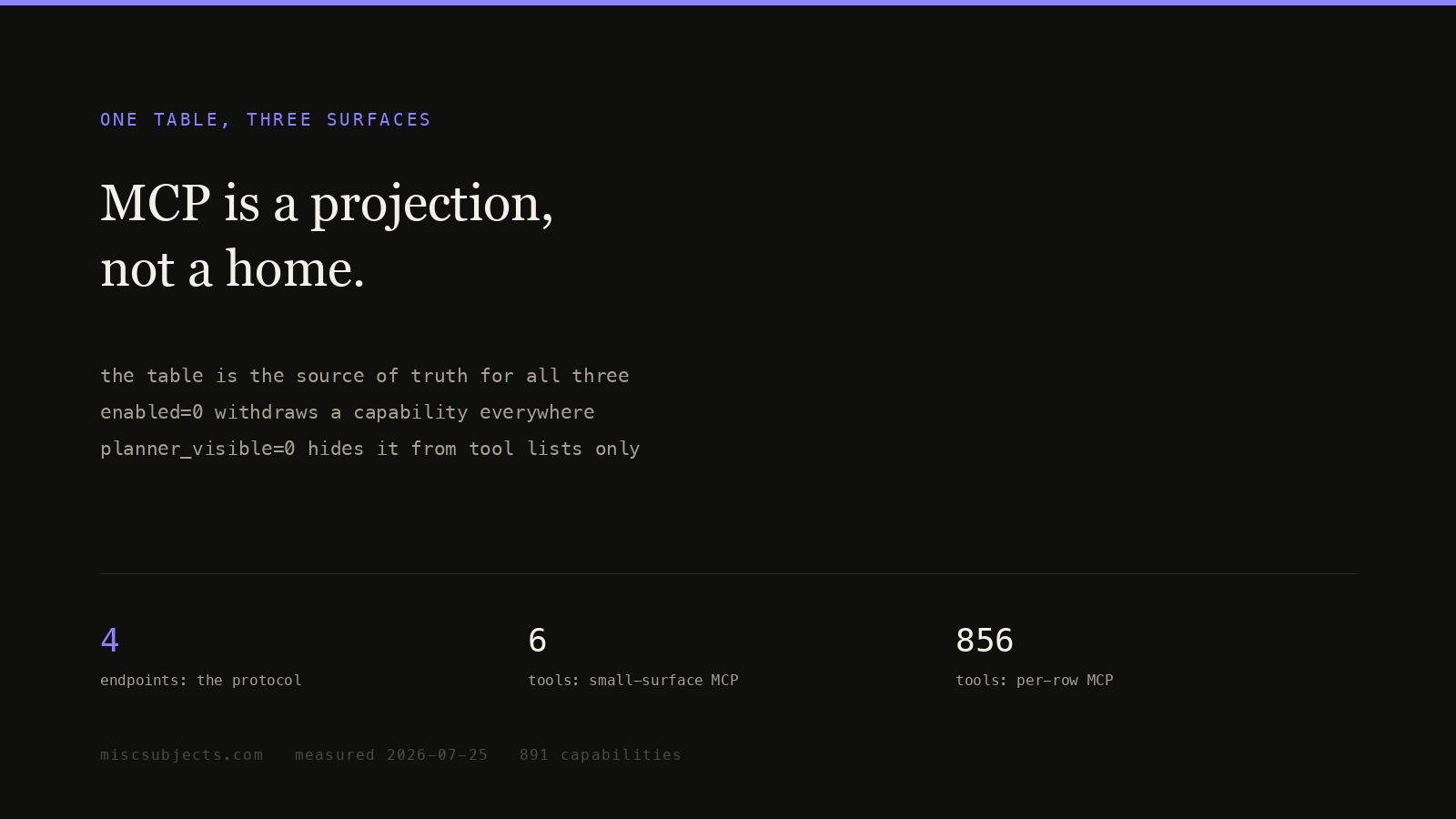
MCP is one view of a capability table, and the view you pick costs 6.25x
One recorded 891-capability catalogue published three ways — zero definitions, seven tools, or 856 tools — cost 6.25× more per turn through its largest surface; live wire measurements show the moving counts.
The Model Context Protocol (MCP) is a way of describing a set of capabilities to a model. It is not the place those capabilities live, and it is not the thing that runs them. On this site the capabilities live in one database table — one row per capability — and MCP is one of three ways that table is shown to a model.
Scope note: this page measures one thing well — what it costs to show this catalogue to a model three different ways. It is not a claim that the catalogue is the architecture. 892 rows, 8 of them MCP breaks the same table down by runner and category and shows MCP is 8 of the 891 rows measured here, not the subject the table exists to serve.
A projection here means exactly one thing: a view generated from a table, holding nothing of its own. Change the table and every view changes in the same instant. Delete a view and nothing is lost. Below, the plainer word surface is used wherever it reads more clearly; they mean the same thing.
The three surfaces reach the same capability catalogue. The recorded benchmark puts 6.25× between the cheapest and the dearest turn.
Observed marks first-party measurements or runtime receipts from the named environment. Derived marks arithmetic calculated from cited inputs. Specified marks vendor or standards documentation. Implemented and deployed name code and live-state evidence, respectively. Reproduced means the stated procedure was rerun. Externally attested marks operator reports; those reports show that an experience occurred, not that it is universal.
MCP at the wire is JSON-RPC 2.0, one of two transports, and a handful of method names
A reader who has never opened the specification can hold the whole thing in one paragraph. A client and a server exchange JSON-RPC 2.0 messages. JSON-RPC is a remote-procedure-call format: a JSON object carrying jsonrpc, method, params and id, answered by an object carrying the same id and either result or error. The specification is blunt about this: "MCP uses JSON-RPC to encode messages. JSON-RPC messages MUST be UTF-8 encoded."
Those messages travel over one of two transports. Standard input and output, for a server running as a local subprocess. Or HTTP POST, for a server running somewhere else — the specification calls the second one Streamable HTTP and requires that "Every JSON-RPC message sent from the client MUST be a new HTTP POST request to the MCP endpoint." It also states a preference: "Clients SHOULD support stdio whenever possible."
The method names that matter for a capability catalogue are four:
an array of {name, description, inputSchema} — 831 of them, measured below
tools/call
client → server
params.name, params.arguments
{content:[{type:"text",text:"…"}], isError:false}
notifications/tools/list_changed
server → client
nothing
never sent — this server declares listChanged: false
A tool definition is three fields: a name, a description in prose, and a JSON Schema for the arguments. That triple is what lands in the model's context window. Everything expensive about MCP follows from the size of that triple multiplied by the number of tools.
What MCP is not
Not a wire protocol. The layering claim gets used to wave away responsibility, and it is wrong. JSON-RPC is the wire protocol; MCP sits above it.
Not a place capabilities live. A server holds handlers. Nothing in the specification says where the list of capabilities is stored, or that it must be a hand-written list at all.
Not a rule about context loading. The tools specification says implementations "are free to expose tools through any interface pattern that suits their needs—the protocol itself does not mandate any specific user interaction model." Every token figure quoted below is a property of a client, not of the protocol.
Not a replacement for an API. It is a second face on one. The endpoint stays; MCP is a decorated index in front of it.
One recorded 891-row catalogue cost 6.25× more through its largest surface
The table holds 891 rows — 876 objects answered the live registry today, and the drift is explained under the measurements. Each row is a full capability contract: key, runner, target, documentation, input schema, authority flags. What a directory row is covers the row itself; 891 tools, zero tool schemas covers why a catalogue is better held as data than as code.
Surface
Tool definitions in the model's context
What the model can reach
What the client must support
Measured input tokens per turn
Measured cost per turn
What breaks
Protocol only — POST /api/dispatch
0. The 9 definitions present are the client's own built-ins
all 891 rows
an HTTP client. No MCP, no tool calling at all
14,071
$0.00456265
the model must be told four endpoints once; no client UI enumerates the catalogue
Small surface — workers/mcp-server
7 tools, whatever the catalogue size
all 891 rows, through the dispatch tool
an MCP client
not measured
not measured
a client that lists tools shows seven generic entries; discovery becomes a call, not context
Per-row MCP — POST /api/mcp
831 measured today, 856 recorded
831 rows, each a named tool
an MCP client
149,187
$0.02852109
prompt cost, tool-selection accuracy, and strict-schema clients rejecting the whole list
Per-row MCP, tool search on
9 plus a ToolSearch tool
all 891, loaded on demand
a client with deferred tool loading
14,109
$0.00443075
the deferred index does not cover every server — two filed bugs below
The arithmetic between the first and third rows: 149,187 − 14,071 = 135,116 input tokens burned per turn holding definitions the turn mostly does not use. 149,187 ÷ 14,071 = 10.6× the input tokens. $0.02852109 ÷ $0.00456265 = 6.25× the money. Across a thousand turns that gap is $23.96. The token ratio and the money ratio differ because output tokens are in both bills and the cache behaves differently; both are the recorded gateway figures, not a rate derived from one of them.
Each surface is a file, and the file states its own tool count
Per-row MCP is functions/api/mcp.js, 189 lines. Lines 118–137 are the entire projection:
js
1
2
3
4
5
const r = await env.DB.prepare(
  'SELECT key, type, category, content, input_schema FROM directory ' +
  'WHERE IFNULL(enabled,1)=1 AND IFNULL(planner_visible,1)=1 ' +
  'ORDER BY IFNULL(planner_rank,100), key'
).all();
Line 5, Column 1JavaScript
One row becomes one tool: name is the row key, description is the first documentation line plus [type · category], inputSchema is the row's schema after normalisation. Line 162 is the whole tools/list handler. Lines 80–116 exist for one reason worth stating plainly: Moonshot and Kimi clients validate every schema strictly and reject the entire tool list on the first violation, so one legacy row with a required name missing from properties would blank the catalogue for that client. Claude Code tolerates both, which is how the bad schemas accumulated unnoticed.
Small surface is workers/mcp-server/src/index.ts, 138 lines, a Cloudflare McpAgent on a Durable Object. It registers seven tools, lines 19–105:
Seven, not six. An earlier record of this surface counted six by folding kv_get and kv_put into one line and omitting d1_query. The file is the authority and the file says seven. The invariant is the point either way: seven tools whether the table holds 9 rows or 9,000, because dispatch takes {key, body} and the key space is the table. All seven parameter descriptions together come to 429 characters of source.
Protocol only is functions/api/dispatch.js. No tool definitions are published anywhere. A model that can make an HTTP request resolves an intent, reads a contract, invokes it, and reads a receipt — four calls, set out in Resolve, read, invoke, receipt.
Measured today: 831 definitions occupied 434,636 bytes on the wire
Two first-party measurements, both rerunnable. MCP_TOKEN is the server's bearer token; /api/mcp accepts it in Authorization or in x-mcp-token.
The HTTP body contains 434,592 bytes of compact tool definitions plus the 44-byte JSON-RPC wrapper. Python's default json.dumps adds spaces after separators, which is why the command above reports 451,197 for the same 831 definitions. Both numbers are reproducible; 434,636 is the network payload.
Where the 451,197-character Python serialization goes, computed from the same file:
Component of the tool list
Characters
Share
Descriptions — first doc line plus [type · category]
200,757
44.5%
Input schemas, after normalisation
189,354
42.0%
Tool names
13,862
3.1%
JSON structure and quoting
47,224
10.5%
Compact average per tool: 523 bytes. Largest single definition in the spaced Python serialization: CF_OBSERVABILITY_QUERY_WORKER_OBSERVABILITY at 6,511 bytes. By runner type the 831 split into 462 fn, 301 http, 50 flow, 18 agent.
Three counts for the same server now exist on this page — 856 recorded, 833 at 04:37, 831 at 04:39 — and each is correct for its moment. Rows get added, disabled (enabled = 0) and hidden (planner_visible = 0) while the site runs, and only enabled plus planner-visible rows are projected. A tool count taken from an MCP server is a reading, not a constant. The 891 total and the 856 projection were taken on 2026-07-25.
Measurement 2 — show that zero definitions still reaches everything.
Result at 05:03:04Z: http=200 bytes=1606794 time=0.397555s, and 876 objects. The resolver call returned {"protocol":"OIP","version":"1.2.0","kind":"ask","question":"send an email","count":12,"best":{"key":"EMAIL_SEND", …}} in 14,481 bytes — twelve candidate capabilities ranked, one recommended, none of it resident in a prompt. Nothing was registered with a model. No tool definition was loaded. All 876 objects are invokable by key.
The case for shipping an MCP surface, at its strongest
The deflationary reading — MCP is a REST API with extra steps — is usually stated by people who then keep using it. CharlieDigital, whose team built one, put the deflation and the recommendation in a single sentence: "MCP is effectively \"just another HTTP REST API\"; OAuth and everything. The key parts of the protocol is the communication shape and sequence with the client, which most SDKs abstract for you". Deploying one is no harder than deploying the API underneath it, because the SDK writes the transport.
brookst gave the sharpest rebuttal of the just-HTTP framing: "It's like saying APIs are dead because you can just use HTTP. They're not the same thing, though of course you can hand-roll the higher layer in the lower one. It's just more work, less standard, less valuable." A decorated index of features beats a bare endpoint list, and the decoration is the product.
menix argues the contract itself is the value rather than a nicety. Input and output schemas let a code-writing agent plan one precise program instead of a print-and-inspect loop, and "Tool results from programmatic calls are not added to Claude's context window, only the final code output is. They report up to 98.7% token savings in some workflows."
827a supplies the dissent every measurement below has to survive: "The idea that MCP tool definitions take up a certain number of tokens is laughable. That's an implementation detail of the agent harness." This is correct as written, and the specification agrees — nothing in MCP says a client must paste all definitions into a prompt. The measurements are of clients. They still decide the bill, because those are the clients that exist.
There is an audience argument too. oortcrate_1 prefers a bash wrapper personally and still grants the point: MCP serves non-technical teammates who want a connection that works without filing a pull request.
The case against, with the numbers the complainants actually measured
Who
What they measured
Verdict
moltar
"Right now loading GitHub MCP takes something like 50k tokens."
reduces MCP to "an API with docs"; wants progressive reveal
gertjandewilde (Apideck)
"tool definitions alone burned 50,000+ tokens before the agent touched a single user message"
replaced the server with a CLI at ~80 tokens; cites a 75-run comparison at 4–32× overhead
yonatangross
"The main agent context burns 16.9k tokens (8.5% of 200k) loading 68 MCP tool schemas at session start. Most are never called by the main agent"
publishes a per-server table; scoping and tool search were available and unused
abdlkrim-jribi
"The agent injects ALL 47 tool schemas on every single request, consuming ~13,341 tokens before the user message is even sent."
audits his own agent; publishes the ~4,168 / ~4,515 / ~751 / ~3,906 split
mjlee
"With a handful of third party MCPs I've seen tens of thousands of tokens used before I've started anything."
finds MCP beneficial anyway
0xbadcafebee
"Say each tool is 150 tokens, that's 150 50, or 7500 tokens, dumped into the beginning of every session."*
the balanced account — shell one-liners are more non-deterministic, so re-runs pollute context too; uses both
locknitpicker
"Skills effectively turned MCPs obsolete in the vast majority of MCP applications."
a progressive-disclosure CLI needs no skill file at all
noodletheworld
"MCP is just \"me too\"; people want MCP to be an \"AI App Store\"; but the blunt, harsh reality is that it's basically impossible to achieve that dream"
if you want an app, build an app
Two mitigations get proposed against all of this, and both have filed defects. cheema33 pre-empts the first: "And no, the tool search function recently introduced by Anthropic does not completely solve this problem." Anthropic's own documentation puts that mitigation at "over 85 percent" reduction on a five-server setup consuming "~55k tokens in definitions before Claude does any work" — real, and not total. sophiabits names the second-order cost of the other mitigation, loading servers lazily per task: "The main problem with this approach at the moment is it busts your prompt cache, because LLMs expect all tool definitions to be defined at the beginning of the context window."
Deferred loading has its own failure modes on record. In anthropics/claude-code#57033, servers added at claude.ai show Connected in /mcp and yet "Any ToolSearch query that should match a claude.ai MCP tool returns zero results". In openai/codex#24536, "codex exec can silently finish with no assistant message when an explicitly configured MCP tool is deferred behind tool_search." A silent empty turn is worse than an expensive one.
Round trips are the argument that survives bigger context windows
Token cost is a moving target. Context windows grow, caches improve, tool search lands. The structural argument does not move, and it is a different argument.
A tool call happens between completions. The model stops, the client executes, the result comes back, the model starts again. DonHopkins names the difference: "I call this \"speed of light\" as opposed to \"carrier pigeon\"." Code the model writes loops, recurses and composes inside one generation.
martinald gives the worked case — summing 150 order IDs. "With MCP the agent would have to do 150 tool calls and explode your context." One scripted loop does it in one round trip at roughly one percent of the tokens. He also notes there is no reason a harness could not expose MCP tools inside a sandboxed code environment, and that nobody does.
Two vendors have published the same finding independently. Anthropic: "This reduces the token usage from 150,000 tokens to 2,000 tokens—a time and cost saving of 98.7%." Cloudflare, on the same pattern: "With the traditional approach, the output of each tool call must feed into the LLM's neural network, just to be copied over to the inputs of the next call, wasting time, energy, and tokens. When the LLM can write code, it can skip all that, and only read back the final results it needs."
What that implies for exposing a catalogue is concrete, and it is not "abandon MCP":
Expose one invoking tool that takes a key and arguments, not one tool per capability. That is what the seven-tool surface does.
Make discovery a call that returns data — list_directory, or the protocol's resolver — so the catalogue is paged through rather than resident.
Keep an HTTP path a code-execution sandbox can hit directly, so a loop over 150 items is one round trip instead of 150.
solarkraft supplies the honest floor under all three: every capability costs some context, because the model has to know it exists in order to invoke it. The only question is whether it costs 523 compact bytes each or one line in a search result.
notifications/tools/list_changed is in the specification, and named clients ignore it
The advertised benefit of a server-side catalogue is that adding a capability needs no client redeploy. The specification supplies the mechanism: "When the list of available tools changes, servers that declared the listChanged capability SHOULD send a notification" — notifications/tools/list_changed, a JSON-RPC notification with no parameters and no reply.
Whether that works depends on the client honouring it, and three filed reports say several do not:
Client or system
Filed
Verbatim
Kiro IDE — kirodotdev/Kiro#6553, closed
2026-03-20
"When an MCP server dynamically adds or removes tools at runtime and sends this notification per the MCP spec, Kiro IDE does not re-query tools/list, so the new tools never appear until the server is manually reconnected."
GitHub Copilot CLI — microsoft/wassette#308, open
2025-09-29
"Internal terminal testing shows the CLI never refreshes its tool list, unlike GitHub Copilot in VS Code which updates immediately."
MCPJungle gateway — mcpjungle/MCPJungle#260, open
2026-05-15
"MCPJungle caches upstream tool lists at registration time only. If an upstream server adds or removes tools later, MCPJungle's view stays stale until a manual re-registration or full restart."
The wassette report comes from a Microsoft engineer with a reproduction video, and notes the same server updates immediately in VS Code — so the defect is per-client, not per-spec.
This site's per-row server sidesteps the question by declaring the truth instead of a promise. Line 159 of functions/api/mcp.js returns capabilities: {"tools":{"listChanged":false}}. A new row is live on the protocol surface the instant it is written, and appears on the MCP surface the next time a client calls tools/list — which, for most clients, is at connect. "Add a capability without a redeploy" is true of the table and false of the client. Say the second half out loud or the sentence is a lie.
Verdict: publish MCP when the client is not yours, publish the protocol when it is
Do publish an MCP surface when the consumer is a client you do not control and cannot teach — Claude Desktop, Cursor, ChatGPT connectors, a colleague's IDE. There is no other way in. Publish it as a small surface: one dispatch-style tool plus a discovery tool. Never one tool per row.
Do publish a per-row surface only when a client must literally see named tools in its own interface, and only with that client's deferred loading switched on. Otherwise expect the bill: 149,187 input tokens and $0.02852109 per turn, measured.
Do not put MCP in front of your own agent when you already control the harness. The protocol surface reached all 891 capabilities at 14,071 input tokens and $0.00456265 per turn, with nine tool definitions in context — all nine of them the client's built-ins.
Do not treat MCP as the architecture. It is a view. The table is the thing.
What would change this verdict. A mainstream client that fetches definitions on demand rather than at connect, and honours notifications/tools/list_changed, would collapse the per-row surface's cost to roughly the protocol's and remove the reason to hand-build a small surface. Anthropic's tool search is the first move in that direction and already reaches 14,109 tokens on this catalogue — within 0.3% of the protocol-only figure. Two filed bugs, claude-code#57033 and codex#24536, say it is not yet reliable enough to depend on. When those close and the behaviour is the default rather than a flag, publish per-row and stop hand-rolling.
Publish the same catalogue three ways
Cheapest surface first, because it is also the one that works everywhere.
A. Protocol only — no server to write. Prerequisite: a capability table with a key, a runner, a target, a documentation field and an input schema (see the row contract), plus one HTTP handler that looks a key up and runs it.
GET /api/dispatch returns a manifest naming the verbs and endpoint shapes. It was 17,404 bytes at 05:06:05Z.
GET /api/dispatch?ask=<intent> returns ranked candidates, each with an example, an example_args and a ready run_now URL.
GET /api/dispatch?key=<KEY>&format=markdown returns the exact row contract.
POST /api/dispatch with {"key":"KEY","body":"args"} invokes it. Add "shape": true for a dry run that returns the fully-shaped outbound payload without firing.
GET /api/dispatch?receipt=<id> returns the receipt.
export TERMINAL_KEY="<owner access key>"
curl -sS "https://miscsubjects.com/api/dispatch?ask=what%20time%20is%20it" \
| jq '{count, best: .best.key}'
# {"count":12,"best":"NOW"}curl -sS "https://miscsubjects.com/api/dispatch?key=TIME_NOW&format=markdown" \
| sed -n '1,12p'
# begins: ## §SELF — miscsubjects capability (paste without context)curl -sS -X POST "https://miscsubjects.com/api/dispatch" \
-H "x-terminal-key: $TERMINAL_KEY" -H "content-type: application/json" \
--data '{"key":"TIME_NOW","body":""}' | tee invocation.json \
| jq '{ran, result, invocation_id: .invocation.id}'
# ran is true; result contains now, today, time, zone and iso
INVOCATION_ID="$(jq -r '.invocation.id' invocation.json)"
curl -sS "https://miscsubjects.com/api/dispatch?receipt=$INVOCATION_ID" \
-H "x-terminal-key: $TERMINAL_KEY" | jq '{id, object_id, actor}'
# id equals $INVOCATION_ID and object_id identifies TIME_NOW
Line 20, Column 1Shell Script
The live run at 05:06:05Z returned HTTP 200 for all four calls, resolved NOW, invoked TIME_NOW with ran: true, and read a 13,036-byte receipt. Tell the model these five endpoint shapes once, in a system prompt or skill file. Cost in tool definitions: zero.
B. Small surface — one file, seven tools. Prerequisite: an MCP SDK and somewhere to run it. On Cloudflare that is McpAgent from the agents package on a Durable Object, McpServer from @modelcontextprotocol/sdk, and zod for parameter schemas. Register dispatch with {key, body}, register one discovery tool that queries the table, expose /mcp for Streamable HTTP and /sse for the older transport, and gate both behind a bearer check. Working file: workers/mcp-server/src/index.ts.
The deployed server can be counted with the official TypeScript SDK:
bash
1
2
3
4
5
6
7
8
9
10
11
12
13
14
15
16
17
npm install @modelcontextprotocol/sdk
export TERMINAL_KEY="<owner access key>"

node --input-type=module <<'JS'
import {Client} from "@modelcontextprotocol/sdk/client/index.js";
import {StreamableHTTPClientTransport} from "@modelcontextprotocol/sdk/client/streamableHttp.js";

const transport = new StreamableHTTPClientTransport(
  new URL("https://miscsubjects.com/mcp"),
  {requestInit:{headers:{authorization:`Bearer ${process.env.TERMINAL_KEY}`}}}
);
const client = new Client({name:"count-tools",version:"1"},{capabilities:{}});
await client.connect(transport);
const listed = await client.listTools();
console.log(listed.tools.map(tool => tool.name));
await client.close();
JS
Line 17, Column 1Shell Script
Expected output, measured at 05:04:50Z: d1_query, kv_get, kv_put, list_directory, dispatch, oip_registry, oip_invocations — seven definitions totalling 2,165 compact JSON bytes. The count stays seven when the catalogue doubles because only dispatch and the discovery calls refer to catalogue keys.
C. Per-row MCP — the compatibility surface. One SELECT, one loop, one normaliser. The normaliser is the part people skip and then get bitten by: coerce every schema to a root type: "object", ensure every name in required exists in properties, give every property node a type, and flatten anyOf/oneOf/allOf to a representative branch — or a strict client rejects the entire list on the first bad row. Verify with:
tool definitions in context in the 2026-07-25 protocol benchmark, with all 891 capabilities reachable
831
tool definitions returned by a live tools/list at 04:39:08Z on 2026-07-26
434,636
wire bytes in the live tools/list response containing 831 definitions
10.6x
input tokens per turn, per-row MCP against the protocol surface: 149,187 vs 14,071
$0.02852109
measured cost of one turn with the per-row MCP definitions attached
523
compact bytes per tool definition: 434,592 divided by 831
It's like saying APIs are dead because you can just use HTTP. They're not the same thing, though of course you can hand-roll the higher layer in the lower one. It's just more work, less standard, less valuable.— brookst, Hacker News, 2026-05-30
I call this "speed of light" as opposed to "carrier pigeon".— DonHopkins, Hacker News, 2026-02-03 — on tool calls happening between completions
References (38)
Model Context Protocol specification, revision 2025-06-18 — Model Context Protocol, Jun 18, 2025“Model Context Protocol (MCP) is an open protocol that enables seamless integration between LLM applications and external data sources and tools.”
Tool search tool — Anthropic, Jul 26, 2026“A typical multiserver setup (GitHub, Slack, Sentry, Grafana, and Splunk) can consume ~55k tokens in definitions before Claude does any work. Tool search typically reduces this by over 85 percent, loading only the 3-5 tools Claude needs for a given request.”
Code Mode: the better way to use MCP — Cloudflare, Sep 26, 2025“With the traditional approach, the output of each tool call must feed into the LLM's neural network, just to be copied over to the inputs of the next call, wasting time, energy, and tokens. When the LLM can write code, it can skip all that, and only read back the final results it needs.”
Tools — MCP specification 2025-06-18 — Model Context Protocol, Jun 18, 2025“When the list of available tools changes, servers that declared the `listChanged` capability **SHOULD** send a notification”
Transports — MCP specification 2025-06-18 — Model Context Protocol, Jun 18, 2025“MCP uses JSON-RPC to encode messages. JSON-RPC messages **MUST** be UTF-8 encoded.”
JSON-RPC 2.0 Specification — JSON-RPC Working Group, Jan 4, 2013“JSON-RPC is a stateless, light-weight remote procedure call (RPC) protocol.”
modelcontextprotocol/typescript-sdk — GitHub, Jul 26, 2026“The Model Context Protocol allows applications to provide context for LLMs in a standardized way”
Dynamic tool sync: notifications/tools/list_changed + polling fallback — GitHub (mcpjungle/MCPJungle), May 15, 2026“MCPJungle caches upstream tool lists at registration time only. If an upstream server adds or removes tools later, MCPJungle's view stays stale until a manual re-registration or full restart.”
ToolSearch does not index tools from claude.ai-hosted MCP servers — GitHub (anthropics/claude-code), May 7, 2026“the `ToolSearch` deferred-tool discovery mechanism does NOT include them in its index. Any `ToolSearch` query that should match a claude.ai MCP tool returns zero results”
Comment on: MCP is dead? — Hacker News, May 30, 2026“It's like saying APIs are dead because you can just use HTTP. They're not the same thing, though of course you can hand-roll the higher layer in the lower one. It's just more work, less standard, less valuable.”
Comment on: MCP is dead; long live MCP — Hacker News, Mar 14, 2026“MCP is effectively "just another HTTP REST API"; OAuth and everything. The key parts of the protocol is the communication shape and sequence with the client, which most SDKs abstract for you”
Comment on: MCP is a fad — it is not a wire protocol — Hacker News, Jan 9, 2026“That is simply incorrect. It is not a wire protocol. Please do not mix terminology. MCPs communicate via JSON-RPC which is the wire protocol.”
Comment on: MCP is dead? — every capability costs some context — Hacker News, May 30, 2026“This is a fundamental issue with anything that just adds a bunch of tools, whether it be via MCP or HTTP (still sad that MCP won over OpenAI's HTTP based approach).”
Comment on: When does MCP make sense vs CLI? — Hacker News, Mar 2, 2026“MCP is just "me too"; people want MCP to be an "AI App Store"; but the blunt, harsh reality is that it's basically impossible to achieve that dream”
{
"schema":"http://google-preview.miscsubjects.com/schemas/jarticle.json",
"status":"published",
"slug":"mcp-as-a-projection",
"title":"MCP is one view of a capability table, and the view you pick costs 6.25x",
"kind":"essay",
"summary":"One recorded 891-capability catalogue published three ways — zero definitions, seven tools, or 856 tools — cost 6.25× more per turn through its largest surface; live wire measurements show the moving counts.",
"created":"2026-07-26T03:52:52.299Z",
"body": [
"The Model Context Protocol (MCP) is a way of *describing* a set of capabilities to a model. It is not the place those capabilities live, and it is not the thing that runs them. On this site the capabilities live in one database table — one row per capability — and MCP is one of three ways that table is shown to a model.\n\n**Scope note:** this page measures one thing well — what it costs to show *this* catalogue to a model three different ways. It is not a claim that the catalogue is the architecture. [892 rows, 8 of them MCP](/a/the-directory-is-not-the-object-system) breaks the same table down by runner and category and shows MCP is 8 of the 891 rows measured here, not the subject the table exists to serve.\n\nA **projection** here means exactly one thing: a view generated from a table, holding nothing of its own. Change the table and every view changes in the same instant. Delete a view and nothing is lost. Below, the plainer word **surface** is used wherever it reads more clearly; they mean the same thing.\n\nThe three surfaces reach the same capability catalogue. The recorded benchmark puts 6.25× between the cheapest and the dearest turn.",
{
"type":"source",
"id":"m1"
},
"## Evidence status\n\n**Observed** marks first-party measurements or runtime receipts from the named environment.\n**Derived** marks arithmetic calculated from cited inputs. **Specified** marks vendor or standards\ndocumentation. **Implemented** and **deployed** name code and live-state evidence, respectively.\n**Reproduced** means the stated procedure was rerun. **Externally attested** marks operator reports;\nthose reports show that an experience occurred, not that it is universal.\n\n## MCP at the wire is JSON-RPC 2.0, one of two transports, and a handful of method names\n\nA reader who has never opened the specification can hold the whole thing in one paragraph. A client and a server exchange JSON-RPC 2.0 messages. JSON-RPC is a remote-procedure-call format: a JSON object carrying `jsonrpc`, `method`, `params` and `id`, answered by an object carrying the same `id` and either `result` or `error`. The specification is blunt about this: *\"MCP uses JSON-RPC to encode messages. JSON-RPC messages **MUST** be UTF-8 encoded.\"*\n\nThose messages travel over one of two transports. Standard input and output, for a server running as a local subprocess. Or HTTP POST, for a server running somewhere else — the specification calls the second one Streamable HTTP and requires that *\"Every JSON-RPC message sent from the client **MUST** be a new HTTP POST request to the MCP endpoint.\"* It also states a preference: *\"Clients **SHOULD** support stdio whenever possible.\"*\n\nThe method names that matter for a capability catalogue are four:\n\n| Method | Direction | What it carries | What this site's server returns |\n| --- | --- | --- | --- |\n| `initialize` | client → server | protocol version, client capabilities | `protocolVersion: \"2025-06-18\"`, `capabilities: {\"tools\":{\"listChanged\":false}}`, `serverInfo` |\n| `tools/list` | client → server | nothing, or a pagination cursor | an array of `{name, description, inputSchema}` — 831 of them, measured below |\n| `tools/call` | client → server | `params.name`, `params.arguments` | `{content:[{type:\"text\",text:\"…\"}], isError:false}` |\n| `notifications/tools/list_changed` | server → client | nothing | never sent — this server declares `listChanged: false` |\n\nA tool definition is three fields: a name, a description in prose, and a JSON Schema for the arguments. That triple is what lands in the model's context window. Everything expensive about MCP follows from the size of that triple multiplied by the number of tools.\n\n### What MCP is not\n\n- **Not a wire protocol.** The layering claim gets used to wave away responsibility, and it is wrong. JSON-RPC is the wire protocol; MCP sits above it.\n- **Not a place capabilities live.** A server holds handlers. Nothing in the specification says where the list of capabilities is stored, or that it must be a hand-written list at all.\n- **Not a rule about context loading.** The tools specification says implementations *\"are free to expose tools through any interface pattern that suits their needs—the protocol itself does not mandate any specific user interaction model.\"* Every token figure quoted below is a property of a client, not of the protocol.\n- **Not a replacement for an API.** It is a second face on one. The endpoint stays; MCP is a decorated index in front of it.\n\n## One recorded 891-row catalogue cost 6.25× more through its largest surface\n\nThe table holds 891 rows — 876 objects answered the live registry today, and the drift is explained under the measurements. Each row is a full capability contract: key, runner, target, documentation, input schema, authority flags. [What a directory row is](/a/directory-row-contract) covers the row itself; [891 tools, zero tool schemas](/a/tooling-as-data) covers why a catalogue is better held as data than as code.\n\n| Surface | Tool definitions in the model's context | What the model can reach | What the client must support | Measured input tokens per turn | Measured cost per turn | What breaks |\n| --- | --- | --- | --- | --- | --- | --- |\n| **Protocol only** — `POST /api/dispatch` | 0. The 9 definitions present are the client's own built-ins | all 891 rows | an HTTP client. No MCP, no tool calling at all | 14,071 | $0.00456265 | the model must be told four endpoints once; no client UI enumerates the catalogue |\n| **Small surface** — `workers/mcp-server` | 7 tools, whatever the catalogue size | all 891 rows, through the `dispatch` tool | an MCP client | not measured | not measured | a client that lists tools shows seven generic entries; discovery becomes a call, not context |\n| **Per-row MCP** — `POST /api/mcp` | 831 measured today, 856 recorded | 831 rows, each a named tool | an MCP client | 149,187 | $0.02852109 | prompt cost, tool-selection accuracy, and strict-schema clients rejecting the whole list |\n| **Per-row MCP, tool search on** | 9 plus a `ToolSearch` tool | all 891, loaded on demand | a client with deferred tool loading | 14,109 | $0.00443075 | the deferred index does not cover every server — two filed bugs below |\n\nThe arithmetic between the first and third rows: 149,187 − 14,071 = **135,116 input tokens burned per turn** holding definitions the turn mostly does not use. 149,187 ÷ 14,071 = **10.6× the input tokens**. $0.02852109 ÷ $0.00456265 = **6.25× the money**. Across a thousand turns that gap is **$23.96**. The token ratio and the money ratio differ because output tokens are in both bills and the cache behaves differently; both are the recorded gateway figures, not a rate derived from one of them.",
{
"type":"source",
"id":"m2"
},
"## Each surface is a file, and the file states its own tool count\n\n**Per-row MCP** is `functions/api/mcp.js`, 189 lines. Lines 118–137 are the entire projection:\n\n```js\nconst r = await env.DB.prepare(\n 'SELECT key, type, category, content, input_schema FROM directory ' +\n 'WHERE IFNULL(enabled,1)=1 AND IFNULL(planner_visible,1)=1 ' +\n 'ORDER BY IFNULL(planner_rank,100), key'\n).all();\n```\n\nOne row becomes one tool: `name` is the row key, `description` is the first documentation line plus `[type · category]`, `inputSchema` is the row's schema after normalisation. Line 162 is the whole `tools/list` handler. Lines 80–116 exist for one reason worth stating plainly: Moonshot and Kimi clients validate every schema strictly and reject the **entire** tool list on the first violation, so one legacy row with a `required` name missing from `properties` would blank the catalogue for that client. Claude Code tolerates both, which is how the bad schemas accumulated unnoticed.\n\n**Small surface** is `workers/mcp-server/src/index.ts`, 138 lines, a Cloudflare `McpAgent` on a Durable Object. It registers seven tools, lines 19–105:\n\n```\n$ grep -A1 'this.server.tool($' workers/mcp-server/src/index.ts | grep '\"'\n \"d1_query\",\n \"kv_get\",\n \"kv_put\",\n \"list_directory\",\n \"dispatch\",\n \"oip_registry\",\n \"oip_invocations\",\n```\n\nSeven, not six. An earlier record of this surface counted six by folding `kv_get` and `kv_put` into one line and omitting `d1_query`. The file is the authority and the file says seven. The invariant is the point either way: **seven tools whether the table holds 9 rows or 9,000**, because `dispatch` takes `{key, body}` and the key space is the table. All seven parameter descriptions together come to 429 characters of source.\n\n**Protocol only** is `functions/api/dispatch.js`. No tool definitions are published anywhere. A model that can make an HTTP request resolves an intent, reads a contract, invokes it, and reads a receipt — four calls, set out in [Resolve, read, invoke, receipt](/a/dispatch-four-step-loop).\n\n## Measured today: 831 definitions occupied 434,636 bytes on the wire\n\nTwo first-party measurements, both rerunnable. `MCP_TOKEN` is the server's bearer token; `/api/mcp` accepts it in `Authorization` or in `x-mcp-token`.\n\n**Measurement 1 — count the per-row surface.**\n\n```bash\ncurl -s -X POST https://miscsubjects.com/api/mcp \\\n -H \"Authorization: Bearer $MCP_TOKEN\" \\\n -H 'content-type: application/json' \\\n -d '{\"jsonrpc\":\"2.0\",\"id\":1,\"method\":\"tools/list\"}' -o tl.json \\\n -w \"http=%{http_code} bytes=%{size_download} time=%{time_total}s\\n\"\n\npython3 -c \"import json;t=json.load(open('tl.json'))['result']['tools'];print(len(t), len(json.dumps(t)))\"\n```\n\nThree readings on 2026-07-26:\n\n| Reading (UTC) | Tools | JSON bytes | What was counted | Wall time |\n| --- | --- | --- | --- | --- |\n| 04:37:06Z | 833 | 452,157 | Python re-serialization with spaces | not recorded |\n| 04:39:08Z | 831 | 451,197 | Python re-serialization with spaces | 0.60 s |\n| 05:03:04Z | 831 | 434,636 | exact HTTP response body | 0.267 s |\n\nThe HTTP body contains 434,592 bytes of compact tool definitions plus the 44-byte JSON-RPC wrapper. Python's default `json.dumps` adds spaces after separators, which is why the command above reports 451,197 for the same 831 definitions. Both numbers are reproducible; **434,636 is the network payload**.\n\nWhere the 451,197-character Python serialization goes, computed from the same file:\n\n| Component of the tool list | Characters | Share |\n| --- | --- | --- |\n| Descriptions — first doc line plus `[type · category]` | 200,757 | 44.5% |\n| Input schemas, after normalisation | 189,354 | 42.0% |\n| Tool names | 13,862 | 3.1% |\n| JSON structure and quoting | 47,224 | 10.5% |\n\nCompact average per tool: **523 bytes**. Largest single definition in the spaced Python serialization: `CF_OBSERVABILITY_QUERY_WORKER_OBSERVABILITY` at 6,511 bytes. By runner type the 831 split into 462 `fn`, 301 `http`, 50 `flow`, 18 `agent`.\n\nThree counts for the same server now exist on this page — 856 recorded, 833 at 04:37, 831 at 04:39 — and each is correct for its moment. Rows get added, disabled (`enabled = 0`) and hidden (`planner_visible = 0`) while the site runs, and only enabled plus planner-visible rows are projected. A tool count taken from an MCP server is a reading, not a constant. The 891 total and the 856 projection were taken on 2026-07-25.\n\n**Measurement 2 — show that zero definitions still reaches everything.**\n\n```bash\ncurl -s \"https://miscsubjects.com/api/dispatch?registry=1\" -o reg.json \\\n -w \"http=%{http_code} bytes=%{size_download} time=%{time_total}s\\n\"\npython3 -c \"import json;print(json.load(open('reg.json'))['count'])\"\n\ncurl -s \"https://miscsubjects.com/api/dispatch?ask=send%20an%20email\" | head -c 400\n```\n\nResult at 05:03:04Z: `http=200 bytes=1606794 time=0.397555s`, and `876` objects. The resolver call returned `{\"protocol\":\"OIP\",\"version\":\"1.2.0\",\"kind\":\"ask\",\"question\":\"send an email\",\"count\":12,\"best\":{\"key\":\"EMAIL_SEND\", …}}` in 14,481 bytes — twelve candidate capabilities ranked, one recommended, none of it resident in a prompt. Nothing was registered with a model. No tool definition was loaded. All 876 objects are invokable by key.",
{
"type":"source",
"id":"m3"
},
"## The case for shipping an MCP surface, at its strongest\n\nThe deflationary reading — MCP is a REST API with extra steps — is usually stated by people who then keep using it. **CharlieDigital**, whose team built one, put the deflation and the recommendation in a single sentence: *\"MCP is effectively \\\"just another HTTP REST API\\\"; OAuth and everything. The key parts of the protocol is the communication shape and sequence with the client, which most SDKs abstract for you\"*. Deploying one is no harder than deploying the API underneath it, because the SDK writes the transport.\n\n**brookst** gave the sharpest rebuttal of the just-HTTP framing: *\"It's like saying APIs are dead because you can just use HTTP. They're not the same thing, though of course you can hand-roll the higher layer in the lower one. It's just more work, less standard, less valuable.\"* A decorated index of features beats a bare endpoint list, and the decoration is the product.\n\n**menix** argues the contract itself is the value rather than a nicety. Input and output schemas let a code-writing agent plan one precise program instead of a print-and-inspect loop, and *\"Tool results from programmatic calls are not added to Claude's context window, only the final code output is. They report up to 98.7% token savings in some workflows.\"*\n\n**827a** supplies the dissent every measurement below has to survive: *\"The idea that MCP tool definitions take up a certain number of tokens is laughable. That's an implementation detail of the agent harness.\"* This is correct as written, and the specification agrees — nothing in MCP says a client must paste all definitions into a prompt. The measurements are of clients. They still decide the bill, because those are the clients that exist.\n\nThere is an audience argument too. **oortcrate_1** prefers a bash wrapper personally and still grants the point: MCP serves non-technical teammates who want a connection that works without filing a pull request.\n\n## The case against, with the numbers the complainants actually measured\n\n| Who | What they measured | Verdict |\n| --- | --- | --- |\n| moltar | *\"Right now loading GitHub MCP takes something like 50k tokens.\"* | reduces MCP to \"an API with docs\"; wants progressive reveal |\n| gertjandewilde (Apideck) | *\"tool definitions alone burned 50,000+ tokens before the agent touched a single user message\"* | replaced the server with a CLI at ~80 tokens; cites a 75-run comparison at 4–32× overhead |\n| yonatangross | *\"The main agent context burns 16.9k tokens (8.5% of 200k) loading 68 MCP tool schemas at session start. Most are never called by the main agent\"* | publishes a per-server table; scoping and tool search were available and unused |\n| abdlkrim-jribi | *\"The agent injects ALL 47 tool schemas on every single request, consuming ~13,341 tokens before the user message is even sent.\"* | audits his own agent; publishes the ~4,168 / ~4,515 / ~751 / ~3,906 split |\n| mjlee | *\"With a handful of third party MCPs I've seen tens of thousands of tokens used before I've started anything.\"* | finds MCP beneficial anyway |\n| 0xbadcafebee | *\"Say each tool is 150 tokens, that's 150 * 50, or 7500 tokens, dumped into the beginning of every session.\"* | the balanced account — shell one-liners are more non-deterministic, so re-runs pollute context too; uses both |\n| locknitpicker | *\"Skills effectively turned MCPs obsolete in the vast majority of MCP applications.\"* | a progressive-disclosure CLI needs no skill file at all |\n| noodletheworld | *\"MCP is just \\\"me too\\\"; people want MCP to be an \\\"AI App Store\\\"; but the blunt, harsh reality is that it's basically impossible to achieve that dream\"* | if you want an app, build an app |\n\nTwo mitigations get proposed against all of this, and both have filed defects. **cheema33** pre-empts the first: *\"And no, the tool search function recently introduced by Anthropic does not completely solve this problem.\"* Anthropic's own documentation puts that mitigation at *\"over 85 percent\"* reduction on a five-server setup consuming *\"~55k tokens in definitions before Claude does any work\"* — real, and not total. **sophiabits** names the second-order cost of the other mitigation, loading servers lazily per task: *\"The main problem with this approach at the moment is it busts your prompt cache, because LLMs expect all tool definitions to be defined at the beginning of the context window.\"*\n\nDeferred loading has its own failure modes on record. In `anthropics/claude-code#57033`, servers added at claude.ai show Connected in `/mcp` and yet *\"Any `ToolSearch` query that should match a claude.ai MCP tool returns zero results\"*. In `openai/codex#24536`, *\"`codex exec` can silently finish with no assistant message when an explicitly configured MCP tool is deferred behind `tool_search`.\"* A silent empty turn is worse than an expensive one.",
{
"type":"source",
"id":"m4"
},
"## Round trips are the argument that survives bigger context windows\n\nToken cost is a moving target. Context windows grow, caches improve, tool search lands. The structural argument does not move, and it is a different argument.\n\nA tool call happens **between** completions. The model stops, the client executes, the result comes back, the model starts again. **DonHopkins** names the difference: *\"I call this \\\"speed of light\\\" as opposed to \\\"carrier pigeon\\\".\"* Code the model writes loops, recurses and composes **inside** one generation.\n\n**martinald** gives the worked case — summing 150 order IDs. *\"With MCP the agent would have to do 150 tool calls and explode your context.\"* One scripted loop does it in one round trip at roughly one percent of the tokens. He also notes there is no reason a harness could not expose MCP tools inside a sandboxed code environment, and that nobody does.\n\nTwo vendors have published the same finding independently. Anthropic: *\"This reduces the token usage from 150,000 tokens to 2,000 tokens—a time and cost saving of 98.7%.\"* Cloudflare, on the same pattern: *\"With the traditional approach, the output of each tool call must feed into the LLM's neural network, just to be copied over to the inputs of the next call, wasting time, energy, and tokens. When the LLM can write code, it can skip all that, and only read back the final results it needs.\"*\n\nWhat that implies for exposing a catalogue is concrete, and it is not \"abandon MCP\":\n\n1. Expose **one invoking tool that takes a key and arguments**, not one tool per capability. That is what the seven-tool surface does.\n2. Make discovery a **call that returns data** — `list_directory`, or the protocol's resolver — so the catalogue is paged through rather than resident.\n3. Keep an **HTTP path a code-execution sandbox can hit directly**, so a loop over 150 items is one round trip instead of 150.\n\n**solarkraft** supplies the honest floor under all three: every capability costs some context, because the model has to know it exists in order to invoke it. The only question is whether it costs 523 compact bytes each or one line in a search result.\n\n## `notifications/tools/list_changed` is in the specification, and named clients ignore it\n\nThe advertised benefit of a server-side catalogue is that adding a capability needs no client redeploy. The specification supplies the mechanism: *\"When the list of available tools changes, servers that declared the `listChanged` capability **SHOULD** send a notification\"* — `notifications/tools/list_changed`, a JSON-RPC notification with no parameters and no reply.\n\nWhether that works depends on the client honouring it, and three filed reports say several do not:\n\n| Client or system | Filed | Verbatim |\n| --- | --- | --- |\n| Kiro IDE — `kirodotdev/Kiro#6553`, closed | 2026-03-20 | *\"When an MCP server dynamically adds or removes tools at runtime and sends this notification per the MCP spec, Kiro IDE does not re-query tools/list, so the new tools never appear until the server is manually reconnected.\"* |\n| GitHub Copilot CLI — `microsoft/wassette#308`, open | 2025-09-29 | *\"Internal terminal testing shows the CLI never refreshes its tool list, unlike GitHub Copilot in VS Code which updates immediately.\"* |\n| MCPJungle gateway — `mcpjungle/MCPJungle#260`, open | 2026-05-15 | *\"MCPJungle caches upstream tool lists at registration time only. If an upstream server adds or removes tools later, MCPJungle's view stays stale until a manual re-registration or full restart.\"* |\n\nThe wassette report comes from a Microsoft engineer with a reproduction video, and notes the same server updates immediately in VS Code — so the defect is per-client, not per-spec.\n\nThis site's per-row server sidesteps the question by declaring the truth instead of a promise. Line 159 of `functions/api/mcp.js` returns `capabilities: {\"tools\":{\"listChanged\":false}}`. A new row is live on the protocol surface the instant it is written, and appears on the MCP surface the next time a client calls `tools/list` — which, for most clients, is at connect. **\"Add a capability without a redeploy\" is true of the table and false of the client.** Say the second half out loud or the sentence is a lie.\n\n## Verdict: publish MCP when the client is not yours, publish the protocol when it is\n\n- **Do publish an MCP surface** when the consumer is a client you do not control and cannot teach — Claude Desktop, Cursor, ChatGPT connectors, a colleague's IDE. There is no other way in. Publish it as a **small surface**: one `dispatch`-style tool plus a discovery tool. Never one tool per row.\n- **Do publish a per-row surface** only when a client must literally see named tools in its own interface, and only with that client's deferred loading switched on. Otherwise expect the bill: 149,187 input tokens and $0.02852109 per turn, measured.\n- **Do not put MCP in front of your own agent** when you already control the harness. The protocol surface reached all 891 capabilities at 14,071 input tokens and $0.00456265 per turn, with nine tool definitions in context — all nine of them the client's built-ins.\n- **Do not treat MCP as the architecture.** It is a view. The table is the thing.\n\n**What would change this verdict.** A mainstream client that fetches definitions on demand rather than at connect, and honours `notifications/tools/list_changed`, would collapse the per-row surface's cost to roughly the protocol's and remove the reason to hand-build a small surface. Anthropic's tool search is the first move in that direction and already reaches 14,109 tokens on this catalogue — within 0.3% of the protocol-only figure. Two filed bugs, `claude-code#57033` and `codex#24536`, say it is not yet reliable enough to depend on. When those close and the behaviour is the default rather than a flag, publish per-row and stop hand-rolling.\n\n## Publish the same catalogue three ways\n\nCheapest surface first, because it is also the one that works everywhere.\n\n**A. Protocol only — no server to write.** Prerequisite: a capability table with a key, a runner, a target, a documentation field and an input schema (see [the row contract](/a/directory-row-contract)), plus one HTTP handler that looks a key up and runs it.\n\n1. `GET /api/dispatch` returns a manifest naming the verbs and endpoint shapes. It was 17,404 bytes at 05:06:05Z.\n2. `GET /api/dispatch?ask=<intent>` returns ranked candidates, each with an `example`, an `example_args` and a ready `run_now` URL.\n3. `GET /api/dispatch?key=<KEY>&format=markdown` returns the exact row contract.\n4. `POST /api/dispatch` with `{\"key\":\"KEY\",\"body\":\"args\"}` invokes it. Add `\"shape\": true` for a dry run that returns the fully-shaped outbound payload without firing.\n5. `GET /api/dispatch?receipt=<id>` returns the receipt.\n\nRun the read-only `TIME_NOW` path end to end:\n\n```bash\nexport TERMINAL_KEY=\"<owner access key>\"\n\ncurl -sS \"https://miscsubjects.com/api/dispatch?ask=what%20time%20is%20it\" \\\n | jq '{count, best: .best.key}'\n# {\"count\":12,\"best\":\"NOW\"}\n\ncurl -sS \"https://miscsubjects.com/api/dispatch?key=TIME_NOW&format=markdown\" \\\n | sed -n '1,12p'\n# begins: ## §SELF — miscsubjects capability (paste without context)\n\ncurl -sS -X POST \"https://miscsubjects.com/api/dispatch\" \\\n -H \"x-terminal-key: $TERMINAL_KEY\" -H \"content-type: application/json\" \\\n --data '{\"key\":\"TIME_NOW\",\"body\":\"\"}' | tee invocation.json \\\n | jq '{ran, result, invocation_id: .invocation.id}'\n# ran is true; result contains now, today, time, zone and iso\n\nINVOCATION_ID=\"$(jq -r '.invocation.id' invocation.json)\"\ncurl -sS \"https://miscsubjects.com/api/dispatch?receipt=$INVOCATION_ID\" \\\n -H \"x-terminal-key: $TERMINAL_KEY\" | jq '{id, object_id, actor}'\n# id equals $INVOCATION_ID and object_id identifies TIME_NOW\n```\n\nThe live run at 05:06:05Z returned HTTP 200 for all four calls, resolved `NOW`, invoked `TIME_NOW` with `ran: true`, and read a 13,036-byte receipt. Tell the model these five endpoint shapes once, in a system prompt or skill file. Cost in tool definitions: zero.\n\n**B. Small surface — one file, seven tools.** Prerequisite: an MCP SDK and somewhere to run it. On Cloudflare that is `McpAgent` from the `agents` package on a Durable Object, `McpServer` from `@modelcontextprotocol/sdk`, and `zod` for parameter schemas. Register `dispatch` with `{key, body}`, register one discovery tool that queries the table, expose `/mcp` for Streamable HTTP and `/sse` for the older transport, and gate both behind a bearer check. Working file: `workers/mcp-server/src/index.ts`.\n\nThe deployed server can be counted with the official TypeScript SDK:\n\n```bash\nnpm install @modelcontextprotocol/sdk\nexport TERMINAL_KEY=\"<owner access key>\"\n\nnode --input-type=module <<'JS'\nimport {Client} from \"@modelcontextprotocol/sdk/client/index.js\";\nimport {StreamableHTTPClientTransport} from \"@modelcontextprotocol/sdk/client/streamableHttp.js\";\n\nconst transport = new StreamableHTTPClientTransport(\n new URL(\"https://miscsubjects.com/mcp\"),\n {requestInit:{headers:{authorization:`Bearer ${process.env.TERMINAL_KEY}`}}}\n);\nconst client = new Client({name:\"count-tools\",version:\"1\"},{capabilities:{}});\nawait client.connect(transport);\nconst listed = await client.listTools();\nconsole.log(listed.tools.map(tool => tool.name));\nawait client.close();\nJS\n```\n\nExpected output, measured at 05:04:50Z: `d1_query`, `kv_get`, `kv_put`, `list_directory`, `dispatch`, `oip_registry`, `oip_invocations` — seven definitions totalling 2,165 compact JSON bytes. The count stays seven when the catalogue doubles because only `dispatch` and the discovery calls refer to catalogue keys.\n\n**C. Per-row MCP — the compatibility surface.** One SELECT, one loop, one normaliser. The normaliser is the part people skip and then get bitten by: coerce every schema to a root `type: \"object\"`, ensure every name in `required` exists in `properties`, give every property node a `type`, and flatten `anyOf`/`oneOf`/`allOf` to a representative branch — or a strict client rejects the entire list on the first bad row. Verify with:\n\n```bash\ncurl -s -X POST https://<host>/api/mcp -H \"Authorization: Bearer $MCP_TOKEN\" \\\n -H 'content-type: application/json' \\\n -d '{\"jsonrpc\":\"2.0\",\"id\":1,\"method\":\"tools/list\"}' | python3 -c \\\n \"import json,sys;print(len(json.load(sys.stdin)['result']['tools']))\"\n```\n\nExpected output: one integer, equal to the count of enabled, planner-visible rows.\n\n## Symptom, cause, fix\n\n| Symptom | Cause | Fix |\n| --- | --- | --- |\n| Client shows zero tools and no error | The whole `tools/list` was rejected on the first invalid schema; Moonshot and Kimi validate strictly | Normalise every schema: object root, every `required` name present in `properties`, a `type` on every node, no combinators. `functions/api/mcp.js:44–78` |\n| `401 unauthorized` from `/api/mcp` | Bearer token mismatch | Send `Authorization: Bearer <MCP_TOKEN>` or the `x-mcp-token` header. The check is `functions/api/mcp.js:23–28` |\n| Tens of thousands of input tokens before the first user message | The client loads every definition at connect | Turn on the client's deferred tool loading, or move to a small surface |\n| A new capability is invisible to the client | The client ignores `notifications/tools/list_changed`, or the server declares `listChanged: false` | Reconnect the client. The three filed reports above show reconnect is the reliable path |\n| A tool exists in the table but not in `tools/list` | The row has `enabled = 0` or `planner_visible = 0` | Intentional. `planner_visible = 0` keeps a capability callable by key while off the tool surfaces |\n| 150 items means 150 tool calls | Round trips happen between completions | Expose an HTTP path a code sandbox can loop over, or one tool that takes a batch |\n| Prompt cache hit rate collapses after adding a server | Definitions sit at the head of the context, and changing them invalidates the cache | Keep the definition set fixed across a session; load per-task capabilities through a call, not a definition |\n| `codex exec` returns an empty turn | A configured server was deferred behind `tool_search` and never surfaced | `openai/codex#24536`. Pin the server as directly exposed until it closes |\n\nThe comparison against staying inside the schema paradigm entirely is [Tool Search and catalogue-as-data](/a/tool-search-vs-catalogue-as-data)."
],
"facts": {
"converted_from":"markdown",
"original_updated":"2026-07-27T04:25:43.947Z",
"register":"essay",
"category":null
},
"hero":"https://miscsubjects.com/img/up/mcp-as-a-projection-hero-card.png",
"model":"Opus 5 (Claude Code)",
"tags": [
"tooling",
"mcp",
"architecture",
"json-rpc",
"tool-cost",
"protocol"
],
"sources": [
{
"id":"s1",
"type":"publisher_documentation",
"url":"https://modelcontextprotocol.io/specification/2025-06-18",
"title":"Model Context Protocol specification, revision 2025-06-18",
"quote":"Model Context Protocol (MCP) is an open protocol that enables seamless integration between LLM applications and external data sources and tools.",
"summary":"The authoritative statement of what MCP is, and the revision string this site's server returns from initialize. Positive. Also the source for MCP being defined over JSON-RPC 2.0 rather than being a wire protocol itself.",
"publisher":"Model Context Protocol",
"date":"2025-06-18",
"claim_ids": [
"c1"
],
"accessed_at":"2026-07-26T05:03:04.394Z",
"prev":"genesis",
"hash":"e18bf935ba4493de1654a14472a9599b795837b93261a303bb56171237af65c8",
"quote_sha256":"1eb1318c16447f9d7dadfe0cc91278fcf6eb6a87234deb014b25b44fc97c4e97"
},
{
"id":"s2",
"type":"publisher_documentation",
"url":"https://docs.claude.com/en/docs/agents-and-tools/tool-use/tool-search-tool",
"title":"Tool search tool",
"quote":"A typical multiserver setup (GitHub, Slack, Sentry, Grafana, and Splunk) can consume ~55k tokens in definitions before Claude does any work. Tool search typically reduces this by over 85 percent, loading only the 3-5 tools Claude needs for a given request.",
"summary":"The vendor's own figure for the cost of loading definitions at connect and for how much its mitigation removes. Positive on the mitigation, and an admission of the size of the problem. Also states tool-selection accuracy degrades past 30-50 tools.",
"publisher":"Anthropic",
"date":"2026-07-26",
"claim_ids": [
"c13",
"c9"
],
"accessed_at":"2026-07-26T05:03:04.394Z",
"prev":"e18bf935ba4493de1654a14472a9599b795837b93261a303bb56171237af65c8",
"hash":"f1bf9f0e17daebc79c4a56c25eb84228b256a4a0b341f8c27e8f8680d05b5c26",
"quote_sha256":"04db741bf04004dd84fe9ce8e374f7f76979bcc3b3f2a3680766122f8cf77664"
},
{
"id":"s3",
"type":"publisher_documentation",
"url":"https://www.anthropic.com/engineering/code-execution-with-mcp",
"title":"Code execution with MCP: building more efficient AI agents",
"quote":"This reduces the token usage from 150,000 tokens to 2,000 tokens—a time and cost saving of 98.7%.",
"summary":"Anthropic engineering on presenting MCP servers as code APIs rather than direct tool calls, so intermediate results never enter the context window. Positive on MCP, negative on the load-everything-upfront client pattern. The vendor-side version of the round-trip argument.",
"author":"Anthropic",
"publisher":"Anthropic",
"date":"2025-11-04",
"claim_ids": [
"c11"
],
"accessed_at":"2026-07-26T05:03:04.394Z",
"prev":"f1bf9f0e17daebc79c4a56c25eb84228b256a4a0b341f8c27e8f8680d05b5c26",
"hash":"e7b027efcb11382d38502ceaaa7fd0e0648a4c4a850ac6dc215a9ef57e7f204f",
"quote_sha256":"7169d57a1f36e4ab53da424eaec0ef97701d62f2e6e9cd070ece90594a0afa58"
},
{
"id":"s4",
"type":"publisher_documentation",
"url":"https://blog.cloudflare.com/code-mode/",
"title":"Code Mode: the better way to use MCP",
"quote":"With the traditional approach, the output of each tool call must feed into the LLM's neural network, just to be copied over to the inputs of the next call, wasting time, energy, and tokens. When the LLM can write code, it can skip all that, and only read back the final results it needs.",
"summary":"Cloudflare reaching the same conclusion independently of Anthropic, and defining MCP plainly as a uniform way to expose an API plus the documentation a model needs to use it. Second vendor confirmation of the round-trip cost.",
"author":"Kenton Varda, Sunil Pai",
"publisher":"Cloudflare",
"date":"2025-09-26",
"claim_ids": [
"c11"
],
"accessed_at":"2026-07-26T05:03:04.394Z",
"prev":"e7b027efcb11382d38502ceaaa7fd0e0648a4c4a850ac6dc215a9ef57e7f204f",
"hash":"b5607ac12f457324e40be83da151c314ff0fd1e82ef4bfdf99dcdbb4577a739e",
"quote_sha256":"cd1d0cd0e3b04ddb0be4a6aa3c1905ae9cdfb2e5674418e3c7a32708a0ed3d15"
},
{
"id":"s5",
"type":"publisher_documentation",
"url":"https://developers.cloudflare.com/agents/model-context-protocol/mcp-agent-api/",
"title":"McpAgent API — Cloudflare Agents",
"quote":"McpAgent",
"summary":"The runtime the small surface is built on: an MCP server as a Durable Object, with the SDK handling initialize, tools/list and tools/call. A reader gets the exact class and bindings needed to reproduce surface B.",
"publisher":"Cloudflare",
"date":"2026-07-26",
"claim_ids": [
"c6"
],
"accessed_at":"2026-07-26T05:03:04.394Z",
"prev":"b5607ac12f457324e40be83da151c314ff0fd1e82ef4bfdf99dcdbb4577a739e",
"hash":"38facac177f3580722cb29097c9784081e65a0c60601a38c637c1ec4dd838f91",
"quote_sha256":"7b97da949ac867831683a9ccd0a3c2ccbaf2a63113c0ea5d4932f04dd7877af3"
},
{
"id":"s6",
"type":"specification",
"url":"https://modelcontextprotocol.io/specification/2025-06-18/server/tools",
"title":"Tools — MCP specification 2025-06-18",
"quote":"When the list of available tools changes, servers that declared the `listChanged` capability **SHOULD** send a notification",
"summary":"The clause behind the add-a-capability-without-a-redeploy claim, and the source for the tool triple of name, description and inputSchema. Also states implementations are free to expose tools through any interface pattern, which is the specification agreeing that context loading is a client decision.",
"publisher":"Model Context Protocol",
"date":"2025-06-18",
"claim_ids": [
"c1",
"c12",
"c14"
],
"accessed_at":"2026-07-26T05:03:04.394Z",
"prev":"38facac177f3580722cb29097c9784081e65a0c60601a38c637c1ec4dd838f91",
"hash":"c9ca7f5c1ddd291f88780bfb24689f4e5afa891841339fbb02d576055a2732af",
"quote_sha256":"6b72949ae2ecbb3a9d58636c626219f2089d9f863d1950acf31a0b6037ce0b84"
},
{
"id":"s7",
"type":"specification",
"url":"https://modelcontextprotocol.io/specification/2025-06-18/basic/transports",
"title":"Transports — MCP specification 2025-06-18",
"quote":"MCP uses JSON-RPC to encode messages. JSON-RPC messages **MUST** be UTF-8 encoded.",
"summary":"The wire-level facts: JSON-RPC encoding, two transports (stdio and Streamable HTTP), one HTTP POST per client message, and a stated preference for stdio. What a reader needs before any argument about cost makes sense.",
"publisher":"Model Context Protocol",
"date":"2025-06-18",
"claim_ids": [
"c1",
"c2"
],
"accessed_at":"2026-07-26T05:03:04.394Z",
"prev":"c9ca7f5c1ddd291f88780bfb24689f4e5afa891841339fbb02d576055a2732af",
"hash":"ae80baa0d0627a2471dc4135b2b257b1c5e8b9d671dbbe811e36c5d07e6d36d2",
"quote_sha256":"6c941ca9952ad3cf032bf37b1449cae9f7bcfaaf1237e5a504bf63fea2f38a6d"
},
{
"id":"s8",
"type":"specification",
"url":"https://www.jsonrpc.org/specification",
"title":"JSON-RPC 2.0 Specification",
"quote":"JSON-RPC is a stateless, light-weight remote procedure call (RPC) protocol.",
"summary":"The layer underneath MCP. A reader wanting to know what a request object actually contains — jsonrpc, method, params, id — gets it here, which settles the recurring 'MCP is a wire protocol' confusion.",
"publisher":"JSON-RPC Working Group",
"date":"2013-01-04",
"claim_ids": [
"c2"
],
"accessed_at":"2026-07-26T05:03:04.394Z",
"prev":"ae80baa0d0627a2471dc4135b2b257b1c5e8b9d671dbbe811e36c5d07e6d36d2",
"hash":"18c839566cfab11d83a32d359a0fd6c5e20e77f7dd7995b23319bc05057dd08f",
"quote_sha256":"12f336762cbc5104fd7dcd855dd1c93c7ce5c014fda439f3cbf86f916331e5d3"
},
{
"id":"s9",
"type":"repository",
"url":"https://github.com/modelcontextprotocol/typescript-sdk/tree/v1.x",
"title":"modelcontextprotocol/typescript-sdk",
"quote":"The Model Context Protocol allows applications to provide context for LLMs in a standardized way",
"summary":"The SDK that hides the transport, which is why deploying an MCP server costs roughly what deploying the REST API underneath it costs. Reading McpServer's tool registration shows the entire surface a server author writes.",
"publisher":"GitHub",
"date":"2026-07-26",
"claim_ids": [
"c6"
],
"accessed_at":"2026-07-26T05:03:04.394Z",
"prev":"18c839566cfab11d83a32d359a0fd6c5e20e77f7dd7995b23319bc05057dd08f",
"hash":"ce7bbcd89fa25f5ccb2c0aa1fc7ad01a10c4400354fb983ee84adcb38501bc73",
"quote_sha256":"28e0be99236b658f40d24ee01bdfa918aa5bd1df20d32ce135bbeeb9cb23c988"
},
{
"id":"s10",
"type":"github",
"url":"https://github.com/kirodotdev/Kiro/issues/6553",
"title":"Kiro IDE does not handle MCP notifications/tools/list_changed — dynamic tools not refreshed",
"quote":"When an MCP server dynamically adds or removes tools at runtime and sends this notification per the MCP spec, Kiro IDE does not re-query tools/list, so the new tools never appear until the server is manually reconnected.",
"summary":"Reproducible report with a minimal dynamic-registration server: the spec-compliant path for adding a capability without a restart silently does nothing in one client while working in two others. Negative on the no-redeploy story.",
"author":"neJoe-ch",
"publisher":"GitHub (kirodotdev/Kiro)",
"date":"2026-03-20",
"claim_ids": [
"c12"
],
"accessed_at":"2026-07-26T05:03:04.394Z",
"prev":"ce7bbcd89fa25f5ccb2c0aa1fc7ad01a10c4400354fb983ee84adcb38501bc73",
"hash":"d95699b6f7a715989ae2ceadf74985820736d19c54c042d50fbcdce9b7b30f41",
"quote_sha256":"66b8ff6fcc48b41a444562b2a35fa3f4c181935cc08aa322797e76816c1a4aa8"
},
{
"id":"s11",
"type":"github",
"url":"https://github.com/microsoft/wassette/issues/308",
"title":"GitHub Copilot CLI does not dynamically load tools via tools/list_changed",
"quote":"Internal terminal testing shows the CLI never refreshes its tool list, unlike GitHub Copilot in VS Code which updates immediately.",
"summary":"A Microsoft engineer files that tools loaded at runtime never surface in one client until restart, with a repro video, while the same server works in VS Code. Negative, and evidence the defect is per-client rather than per-spec.",
"author":"asw101",
"publisher":"GitHub (microsoft/wassette)",
"date":"2025-09-29",
"claim_ids": [
"c12"
],
"accessed_at":"2026-07-26T05:03:04.394Z",
"prev":"d95699b6f7a715989ae2ceadf74985820736d19c54c042d50fbcdce9b7b30f41",
"hash":"809533ee0b3cbf357cf37d14bb3852554c60ebae1aedc39f0eb9c2a89bc45dca",
"quote_sha256":"eb5cde89e96f6db15c183870881dca0d3d742cca20d1044f318a275d9df3a958"
},
{
"id":"s12",
"type":"github",
"url":"https://github.com/mcpjungle/MCPJungle/issues/260",
"title":"Dynamic tool sync: notifications/tools/list_changed + polling fallback",
"quote":"MCPJungle caches upstream tool lists at registration time only. If an upstream server adds or removes tools later, MCPJungle's view stays stale until a manual re-registration or full restart.",
"summary":"A tool-registry gateway describing the same staleness one layer up: registry rows go stale and removed tools leave dangling references inside tool groups. Negative on current state, positive on the registry design.",
"author":"uniq0de",
"publisher":"GitHub (mcpjungle/MCPJungle)",
"date":"2026-05-15",
"claim_ids": [
"c12"
],
"accessed_at":"2026-07-26T05:03:04.394Z",
"prev":"809533ee0b3cbf357cf37d14bb3852554c60ebae1aedc39f0eb9c2a89bc45dca",
"hash":"aa9862622c6a339476925e3aa7de0145f7b2a9a34d946055044fdb1bb39aa2e4",
"quote_sha256":"9ab3b999e3f99989d6f44b17b91258d2d225a7072660e6557468f013d351e6bc"
},
{
"id":"s13",
"type":"github",
"url":"https://github.com/anthropics/claude-code/issues/57033",
"title":"ToolSearch does not index tools from claude.ai-hosted MCP servers",
"quote":"the `ToolSearch` deferred-tool discovery mechanism does NOT include them in its index. Any `ToolSearch` query that should match a claude.ai MCP tool returns zero results",
"summary":"Servers added at claude.ai show Connected in /mcp yet are invisible to deferred search, isolating the gap to the hosted transport while local and plugin servers index fine. Negative: the cheapest mitigation for the token cost is not uniformly reliable yet.",
"author":"brasscats",
"publisher":"GitHub (anthropics/claude-code)",
"date":"2026-05-07",
"claim_ids": [
"c13"
],
"accessed_at":"2026-07-26T05:03:04.394Z",
"prev":"aa9862622c6a339476925e3aa7de0145f7b2a9a34d946055044fdb1bb39aa2e4",
"hash":"e306e90e60645dbe884d5d480e656e87a9fa171e2bb4f5e260138e78122debdf",
"quote_sha256":"eff1fce034d8afbf9ecead0226d350d9d8a9a7bc6a94e0252fd62cd15e11c16b"
},
{
"id":"s14",
"type":"github",
"url":"https://github.com/openai/codex/issues/24536",
"title":"codex exec can silently complete empty when configured MCP tools are deferred behind tool_search",
"quote":"`codex exec` can silently finish with no assistant message when an explicitly configured MCP tool is deferred behind `tool_search`.",
"summary":"With a GitHub connector contributing 90 tools, the task-specific server stays registered but is only reachable as a deferred source, and the run ends with an empty turn. Negative: the fix for tool count introduces a silent-failure mode.",
"author":"yanxiyue",
"publisher":"GitHub (openai/codex)",
"date":"2026-05-26",
"claim_ids": [
"c13"
],
"accessed_at":"2026-07-26T05:03:04.394Z",
"prev":"e306e90e60645dbe884d5d480e656e87a9fa171e2bb4f5e260138e78122debdf",
"hash":"6c9781d92a2e2d7987014aefe4744ede3d68bbf6b7420f62b76c5b1eedd462a5",
"quote_sha256":"e1b5ba624c1129b412a929f8011d5733c1eb024d7c5ff214157f281b77b8535d"
},
{
"id":"s15",
"type":"independent_measurement",
"url":"https://github.com/yonatangross/orchestkit/issues/885",
"title":"Context bloat: 16.9k tokens wasted on MCP tool definitions loaded into main agent",
"quote":"The main agent context burns **16.9k tokens (8.5% of 200k)** loading 68 MCP tool schemas at session start. Most are never called by the main agent — they're used by subagents.",
"summary":"The most rigorous public measurement found: a per-server table (notebooklm-mcp 25 tools/~6.0k tokens, hq-knowledge 14/~3.3k, memory 9/~2.1k, agentation 9/~2.1k, tavily 5/~1.2k, context7 2/~0.5k, sequential-thinking 1/~0.2k) inside a 54k fixed-overhead budget. Negative, with the harness and the per-server split named.",
"author":"yonatangross",
"publisher":"GitHub",
"date":"2026-03-01",
"claim_ids": [
"c8"
],
"accessed_at":"2026-07-26T05:03:04.394Z",
"prev":"6c9781d92a2e2d7987014aefe4744ede3d68bbf6b7420f62b76c5b1eedd462a5",
"hash":"92abde4a4f923782022b68dabe1e9bbd5287659ba4a780a264b9179a1d071bb8",
"quote_sha256":"3e0cf2a987ca9fd35f49a58558cb119f1848a315d183bedcdca4af9cee5b0603"
},
{
"id":"s16",
"type":"independent_measurement",
"url":"https://github.com/abdlkrim-jribi/hcode/issues/4",
"title":"Reduce Context Window Usage (13,341 tokens for tools alone)",
"quote":"The agent injects ALL 47 tool schemas on every single request, consuming ~13,341 tokens before the user message is even sent.",
"summary":"A maintainer audits his own agent and publishes the breakdown: ~4,168 static tool docs, ~4,515 static schemas, ~751 MCP docs, ~3,906 MCP schemas. Negative, and a worked example of costing a contract format rather than guessing at it.",
"author":"abdlkrim-jribi",
"publisher":"GitHub (abdlkrim-jribi/hcode)",
"date":"2026-05-05",
"claim_ids": [
"c8"
],
"accessed_at":"2026-07-26T05:03:04.394Z",
"prev":"92abde4a4f923782022b68dabe1e9bbd5287659ba4a780a264b9179a1d071bb8",
"hash":"a7a72fe31fad1925070f0bff816f1404703bbda4d12b4e643cc68816e42d77a1",
"quote_sha256":"89bf616341d33f51c5a61116df23b11684aef4831b4618f7dc308fd152775329"
},
{
"id":"s17",
"type":"hn",
"url":"https://news.ycombinator.com/item?id=47400262",
"title":"Comment on: Apideck CLI — An AI-agent interface with much lower context consumption than MCP",
"quote":"We built a unified API with a large surface area and ran into a problem when building our MCP server: tool definitions alone burned 50,000+ tokens before the agent touched a single user message.",
"summary":"Vendor engineer describes hitting 50k tokens of contracts before any work, then replacing them with a CLI contract of ~80 tokens plus --help discovery. Cites a 75-run comparison showing 4-32x MCP-vs-CLI token overhead. Negative on fat schemas, honest about where CLIs lose: streaming, delegated auth, distribution.",
"author":"gertjandewilde",
"publisher":"Hacker News",
"date":"2026-03-16",
"claim_ids": [
"c8"
],
"accessed_at":"2026-07-26T05:03:04.394Z",
"prev":"a7a72fe31fad1925070f0bff816f1404703bbda4d12b4e643cc68816e42d77a1",
"hash":"092c2586c6408d4bbe6e2492e400fcaf9219bfcfe62a4a783ef76f5fc1bf7c58",
"quote_sha256":"c5dc7811fd6f0da1f519e5d8d80034058b4248bc441cde865a9482aae3d12b78"
},
{
"id":"s18",
"type":"hn",
"url":"https://news.ycombinator.com/item?id=48336021",
"title":"Comment on: MCP is dead?",
"quote":"It's like saying APIs are dead because you can just use HTTP. They're not the same thing, though of course you can hand-roll the higher layer in the lower one. It's just more work, less standard, less valuable.",
"summary":"The counter-case: MCP is a layer above your API, and a decorated index of features beats a bare endpoint list for a model. Positive, and the sharpest rebuttal of the just-HTTP framing.",
"author":"brookst",
"publisher":"Hacker News",
"date":"2026-05-30",
"claim_ids": [
"c7"
],
"accessed_at":"2026-07-26T05:03:04.394Z",
"prev":"092c2586c6408d4bbe6e2492e400fcaf9219bfcfe62a4a783ef76f5fc1bf7c58",
"hash":"ac748e699369d3639cf7c401eff2251bb856c543769964ca2ef48833d557ac30",
"quote_sha256":"2de7b95b80616ec09ac8ac56f51a456a2e1bf1d896bb079465c3bd28fb133a77"
},
{
"id":"s19",
"type":"hn",
"url":"https://news.ycombinator.com/item?id=47381322",
"title":"Comment on: MCP is dead; long live MCP",
"quote":"MCP is effectively \"just another HTTP REST API\"; OAuth and everything. The key parts of the protocol is the communication shape and sequence with the client, which most SDKs abstract for you",
"summary":"From a team that built its own server: the protocol reduces to a communication shape over HTTP that the SDKs hide, and deploying one is no harder than a REST API. Mixed — deflationary about what MCP is, still recommends it.",
"author":"CharlieDigital",
"publisher":"Hacker News",
"date":"2026-03-14",
"claim_ids": [
"c7"
],
"accessed_at":"2026-07-26T05:03:04.394Z",
"prev":"ac748e699369d3639cf7c401eff2251bb856c543769964ca2ef48833d557ac30",
"hash":"b08bb4852107bbea13223f516ff0d68113c85e025d9ef9831db83f0a37001a23",
"quote_sha256":"19d6a50405652ac65f31b59c114b18aa840f938c3b3a4216b624453acc2e27cb"
},
{
"id":"s20",
"type":"hn",
"url":"https://news.ycombinator.com/item?id=47381282",
"title":"Comment on: MCP is dead; long live MCP — the contract is the value",
"quote":"Tool results from programmatic calls are not added to Claude's context window, only the final code output is. They report up to 98.7% token savings in some workflows.",
"summary":"Argues the contract itself is the value: input and output schemas let a code-writing agent plan a single precise program instead of print-and-inspect loops. Positive on schema-as-contract, explicitly against reducing the debate to schema bloat.",
"author":"menix",
"publisher":"Hacker News",
"date":"2026-03-14",
"claim_ids": [
"c11",
"c7"
],
"accessed_at":"2026-07-26T05:03:04.394Z",
"prev":"b08bb4852107bbea13223f516ff0d68113c85e025d9ef9831db83f0a37001a23",
"hash":"38b4b4235b1498fc679ef9c7e22b9161e5509a6e999c8c439b722be8a4d60c69",
"quote_sha256":"bd77883c8262ce255bce4ef6874e61019e98bd6e9190e371efbde6711722bc7f"
},
{
"id":"s21",
"type":"hn",
"url":"https://news.ycombinator.com/item?id=48331540",
"title":"Comment on: MCP is dead? — token cost is a harness detail",
"quote":"The idea that MCP tool definitions take up a certain number of tokens is laughable. That's an implementation detail of the agent harness.",
"summary":"The dissent every measurement has to survive: MCP is a spec, not a context-loading strategy, and harnesses have options beyond dumping definitions into the window. Positive and contrarian, and correct as written.",
"author":"827a",
"publisher":"Hacker News",
"date":"2026-05-30",
"claim_ids": [
"c14"
],
"accessed_at":"2026-07-26T05:03:04.394Z",
"prev":"38b4b4235b1498fc679ef9c7e22b9161e5509a6e999c8c439b722be8a4d60c69",
"hash":"97a7270705ab5a38de0850724efc17aa6f9aac81d86d343853dacc1e5cfc95cf",
"quote_sha256":"23037d070da563fbc5597a3b0f7d06184440e5b251954b89638fca213609f22e"
},
{
"id":"s22",
"type":"hn",
"url":"https://news.ycombinator.com/item?id=46553245",
"title":"Comment on: MCP is a fad — it is not a wire protocol",
"quote":"That is simply incorrect. It is not a wire protocol. Please do not mix terminology. MCPs communicate via JSON-RPC which is the wire protocol.",
"summary":"Direct rebuttal of the 'MCP is just the wire protocol like TCP, so security is the app's job' defence, on the grounds the layering claim is wrong. Negative on the just-plumbing framing used to deflect responsibility.",
"author":"Aldipower",
"publisher":"Hacker News",
"date":"2026-01-09",
"claim_ids": [
"c2"
],
"accessed_at":"2026-07-26T05:03:04.394Z",
"prev":"97a7270705ab5a38de0850724efc17aa6f9aac81d86d343853dacc1e5cfc95cf",
"hash":"7a58f13162e695e0f6bc44401fda1c07ee3d4b15d3af16b3f420f8d03f87f50d",
"quote_sha256":"31dc011ed94cdece611ca6f6a43a203d7f77e6534a0b5a8e517c23592f093ecf"
},
{
"id":"s23",
"type":"hn",
"url":"https://news.ycombinator.com/item?id=45955033",
"title":"Comment on: What if you don't need MCP at all?",
"quote":"Right now loading GitHub MCP takes something like 50k tokens.",
"summary":"Reduces MCP to 'an API with docs' and locates the problem in each server exposing every tool and its docs; wants progressive reveal with a short summary and the full API on request. Negative, with a named measurement.",
"author":"moltar",
"publisher":"Hacker News",
"date":"2025-11-17",
"claim_ids": [
"c8"
],
"accessed_at":"2026-07-26T05:03:04.394Z",
"prev":"7a58f13162e695e0f6bc44401fda1c07ee3d4b15d3af16b3f420f8d03f87f50d",
"hash":"bd781b0866326a857b914df32c4d5e9d9b292997dd74a63c9fecb88e4338657d",
"quote_sha256":"5a53dcb41f603324ed379c3cc25589d006677ca3e4d94b2a1c874ba33b4991e2"
},
{
"id":"s24",
"type":"hn",
"url":"https://news.ycombinator.com/item?id=46878126",
"title":"Comment on: Agent Skills — speed of light versus carrier pigeon",
"quote":"I call this \"speed of light\" as opposed to \"carrier pigeon\".",
"summary":"Argues the architectural difference is round trips, not tokens: MCP operates between completions so N calls means N round trips, while in-context skills iterate, recurse and compose inside one generation. Reports running 33 game turns with 10 characters in a single completion. Negative on MCP for reasoning and composition, allows it for external systems.",
"author":"DonHopkins",
"publisher":"Hacker News",
"date":"2026-02-03",
"claim_ids": [
"c10"
],
"accessed_at":"2026-07-26T05:03:04.394Z",
"prev":"bd781b0866326a857b914df32c4d5e9d9b292997dd74a63c9fecb88e4338657d",
"hash":"c19581f00d428824cfd984ba9954f2dc9f3ce33154797804200d905909a4c237",
"quote_sha256":"5a5e389ee89b18b5545bd1cec764433981212045600ddc1c04d61b1adddee60a"
},
{
"id":"s25",
"type":"hn",
"url":"https://news.ycombinator.com/item?id=47161005",
"title":"Comment on: Making MCP cheaper via CLI",
"quote":"With MCP the agent would have to do 150 tool calls and explode your context.",
"summary":"Frames the real gap as composability, not schema size: summing 150 order IDs is 150 round trips under MCP versus one scripted loop under a CLI, maybe 1% of the tokens. Notes a harness could expose MCP inside a sandboxed code environment, and that nobody does. Negative on current implementations, not on the protocol.",
"author":"martinald",
"publisher":"Hacker News",
"date":"2026-02-26",
"claim_ids": [
"c10"
],
"accessed_at":"2026-07-26T05:03:04.394Z",
"prev":"c19581f00d428824cfd984ba9954f2dc9f3ce33154797804200d905909a4c237",
"hash":"7f2e26c911dce90fd5a15aa0aa9c0188c3637d047480b5dc516176e212b25a42",
"quote_sha256":"727947b7b76e728b9ffc60153258e58747869e2673f0002be3ef9007c7a1b954"
},
{
"id":"s26",
"type":"hn",
"url":"https://news.ycombinator.com/item?id=48330912",
"title":"Comment on: MCP is dead? — the arithmetic, and both sides",
"quote":"Say each tool is 150 tokens, that's 150 * 50, or 7500 tokens, dumped into the beginning of every session.",
"summary":"The most balanced account in the thread: gives the arithmetic for schema overhead and full JSON responses, then argues shell one-liners are far more non-deterministic than schema'd calls, so re-runs pollute context too. Concludes you do not have to pick a side, and uses both.",
"author":"0xbadcafebee",
"publisher":"Hacker News",
"date":"2026-05-29",
"claim_ids": [
"c14",
"c8"
],
"accessed_at":"2026-07-26T05:03:04.394Z",
"prev":"7f2e26c911dce90fd5a15aa0aa9c0188c3637d047480b5dc516176e212b25a42",
"hash":"5b3f85b63e671d77d3d411aa0744550f7b9e6dde8a9b1987fefcce9af873c4ee",
"quote_sha256":"07f7a9b2726eb8dab5fb1d42ff5dcde9161f879ab31346c2cb74d97a788e03b7"
},
{
"id":"s27",
"type":"hn",
"url":"https://news.ycombinator.com/item?id=48337283",
"title":"Comment on: MCP is dead? — every capability costs some context",
"quote":"This is a fundamental issue with anything that just adds a bunch of tools, whether it be via MCP or HTTP (still sad that MCP won over OpenAI's HTTP based approach).",
"summary":"Reframes the debate: the complaint is that the structure makes progressive disclosure hard for the harness, which is protocol-independent, and the CLI answer trades that for a security problem. Concludes every capability costs some context because the model must know when to invoke it. Mixed.",
"author":"solarkraft",
"publisher":"Hacker News",
"date":"2026-05-30",
"claim_ids": [
"c11"
],
"accessed_at":"2026-07-26T05:03:04.394Z",
"prev":"5b3f85b63e671d77d3d411aa0744550f7b9e6dde8a9b1987fefcce9af873c4ee",
"hash":"75a04f33c87a2d333d53451c182baefbd35131377e444a7c2a434860a2a728a9",
"quote_sha256":"a4805f8d0bdc5fdcd71652bc1e5195572e89a1e20def02cb34451fa6d3e846f8"
},
{
"id":"s28",
"type":"hn",
"url":"https://news.ycombinator.com/item?id=47212763",
"title":"Comment on: When does MCP make sense vs CLI?",
"quote":"MCP is just \"me too\"; people want MCP to be an \"AI App Store\"; but the blunt, harsh reality is that it's basically impossible to achieve that dream",
"summary":"Flatly argues MCP is never the right choice: if you want an app, build an app; agents interact happily with higher-level functions. Strongly negative, and the extreme end of the case against.",
"author":"noodletheworld",
"publisher":"Hacker News",
"date":"2026-03-02",
"claim_ids": [
"c8"
],
"accessed_at":"2026-07-26T05:03:04.394Z",
"prev":"75a04f33c87a2d333d53451c182baefbd35131377e444a7c2a434860a2a728a9",
"hash":"5a227f49799a03501920fcd1cca040334fdcd6497ab68c378845a0fa36740292",
"quote_sha256":"92070df59b5581358729c478735872ad9756557b59ffa63b81c4f3960f355011"
},
{
"id":"s29",
"type":"hn",
"url":"https://news.ycombinator.com/item?id=48158034",
"title":"Comment on: Show HN: Epiq — skills versus MCP",
"quote":"Skills effectively turned MCPs obsolete in the vast majority of MCP applications.",
"summary":"Goes further than most: a CLI written in a progressive-disclosure style does not even need a skill file for coding agents to use it well, so MCP is redundant for most cases. Negative.",
"author":"locknitpicker",
"publisher":"Hacker News",
"date":"2026-05-16",
"claim_ids": [
"c8"
],
"accessed_at":"2026-07-26T05:03:04.394Z",
"prev":"5a227f49799a03501920fcd1cca040334fdcd6497ab68c378845a0fa36740292",
"hash":"c04a304d7006c05e743569029bba8d5fab324bcc1e3e59fe4e2841c76f753ccb",
"quote_sha256":"4574d503f3afc45b0a9b7123e26a1e791c330034a94b1030fbb9a225e9c2abe4"
},
{
"id":"s30",
"type":"hn",
"url":"https://news.ycombinator.com/item?id=47659574",
"title":"Comment on: Running Gemma 4 locally with LM Studio's headless CLI and Claude Code",
"quote":"With a handful of third party MCPs I've seen tens of thousands of tokens used before I've started anything.",
"summary":"Finds MCP beneficial but reports a measured input-token penalty against equivalent skills from just a handful of third-party servers. Mixed-negative, first-hand.",
"author":"mjlee",
"publisher":"Hacker News",
"date":"2026-04-06",
"claim_ids": [
"c8"
],
"accessed_at":"2026-07-26T05:03:04.394Z",
"prev":"c04a304d7006c05e743569029bba8d5fab324bcc1e3e59fe4e2841c76f753ccb",
"hash":"90fd9293bcd9c6f63287558a96ba8c35d64fe49fe2cd9a31b6931c52fa39222b",
"quote_sha256":"ce1dab032ba167494aa2f99e157ef30561d416c968d68e85a85370ce2a36112f"
},
{
"id":"s31",
"type":"hn",
"url":"https://news.ycombinator.com/item?id=47392361",
"title":"Comment on: Chrome DevTools MCP — tool search does not fully solve it",
"quote":"And no, the tool search function recently introduced by Anthropic does not completely solve this problem.",
"summary":"Argues you pay the tool-definition cost even for servers you never invoke on that turn, and pre-empts the obvious rebuttal. Negative — a first-hand verdict on deferred tools as a mitigation.",
"author":"cheema33",
"publisher":"Hacker News",
"date":"2026-03-15",
"claim_ids": [
"c13"
],
"accessed_at":"2026-07-26T05:03:04.394Z",
"prev":"90fd9293bcd9c6f63287558a96ba8c35d64fe49fe2cd9a31b6931c52fa39222b",
"hash":"1475d217eb83d4ff546be1954603952a18a9dd6a06938273f8185cda289ccae8",
"quote_sha256":"686b8b569e20ca675c5be11c12db8dd2459d4e8bd630d22671baebf0dfe96f2b"
},
{
"id":"s32",
"type":"hn",
"url":"https://news.ycombinator.com/item?id=47209810",
"title":"Comment on: When does MCP make sense vs CLI? — dynamic tools bust the cache",
"quote":"The main problem with this approach at the moment is it busts your prompt cache, because LLMs expect all tool definitions to be defined at the beginning of the context window.",
"summary":"Names the second-order cost of loading servers lazily per task: it invalidates the prompt cache, and input tokens are the main cost driver, so use cases stop being economical. Negative on lazy loading as currently implemented.",
"author":"sophiabits",
"publisher":"Hacker News",
"date":"2026-03-01",
"claim_ids": [
"c13"
],
"accessed_at":"2026-07-26T05:03:04.394Z",
"prev":"1475d217eb83d4ff546be1954603952a18a9dd6a06938273f8185cda289ccae8",
"hash":"f938e64d35fbb474ebae2ee7c36d969a70a4bed360c6df1060f37ad7d012e9d2",
"quote_sha256":"52099c72c3c160d355f16afeb3a9e30ce251343b710bb4ef4ca26b05859d94dd"
},
{
"id":"s33",
"type":"hn",
"url":"https://news.ycombinator.com/item?id=47646880",
"title":"Comment on: Show HN: Ismcpdead.com — definitions that never fire",
"quote":"It's annoying to see the context window shrink just from tool definitions that never even get triggered.",
"summary":"Prefers a bash wrapper personally, while granting MCP's appeal for non-technical teammates who want plug-and-play connections without filing a pull request. Negative on the cost, fair about the audience MCP serves.",
"author":"oortcrate_1",
"publisher":"Hacker News",
"date":"2026-04-05",
"claim_ids": [
"c7"
],
"accessed_at":"2026-07-26T05:03:04.394Z",
"prev":"f938e64d35fbb474ebae2ee7c36d969a70a4bed360c6df1060f37ad7d012e9d2",
"hash":"c7a6e57344626285f2771bb73c4b349a50674bbcf00a0651ee1829e7c561dd6d",
"quote_sha256":"74675b6800d8c515448bd4f5dbe37550cc6da44967d797a6fe420b2150d66682"
},
{
"id":"m1",
"type":"runtime_receipt",
"url":"https://miscsubjects.com/api/articles/mcp-as-a-projection",
"title":"First-party measurement: tools/list against the per-row MCP surface, 2026-07-26",
"quote":"http=200 bytes=434636 time=0.267195s — tool_count 831, compact definitions_bytes 434592, average_definition_bytes 523",
"summary":"Method: POST tools/list with the bearer token, count the exact response bytes and compact-serialised tools array. The 831-tool reading at 05:03:04Z repeats the prior 04:39 reading; an earlier reading returned 833, and the recorded benchmark returned 856, because rows are enabled and hidden while the site runs. Rerunnable with the command printed in the article.",
"publisher":"miscsubjects.com",
"date":"2026-07-26",
"claim_ids": [
"c3",
"c4",
"c5"
],
"accessed_at":"2026-07-26T05:03:04.394Z",
"prev":"c7a6e57344626285f2771bb73c4b349a50674bbcf00a0651ee1829e7c561dd6d",
"hash":"8331b1d1e1e6cd99bccd2590eb26e5918a593ffcb477b019047f5432ece0320a",
"quote_sha256":"6800fc29167ce6df40ced118df362a67b25ea11b3a50f6e0ae4b217eb7a080dd"
},
{
"id":"m2",
"type":"runtime_receipt",
"url":"https://miscsubjects.com/api/dispatch?registry=1",
"title":"First-party measurement: the protocol surface reaches every capability with zero tool definitions, 2026-07-26",
"quote":"http=200 bytes=1606794 time=0.397555s — 876 objects",
"summary":"Method: a plain GET. No authentication, no MCP client, no tool registration. Returns the full object registry. A second call, GET /api/dispatch?ask=send%20an%20email, returned 12 ranked candidates with EMAIL_SEND recommended, in 14,481 bytes. Nothing entered a model's context to make either call possible.",
"publisher":"miscsubjects.com",
"date":"2026-07-26",
"claim_ids": [
"c15",
"c3"
],
"accessed_at":"2026-07-26T05:03:04.394Z",
"prev":"8331b1d1e1e6cd99bccd2590eb26e5918a593ffcb477b019047f5432ece0320a",
"hash":"ac9b8608ef3510f4881ccdebfde840cf42a567442ad16afea08b82a5313bdc04",
"quote_sha256":"3d6897f8acf0adae89ed945b1d0ab5852ac2f408d338b30b75020cc90826511e"
},
{
"id":"m3",
"type":"runtime_receipt",
"url":"https://miscsubjects.com/api/articles/mcp-as-a-projection",
"title":"First-party receipt: initialize and tools/call against the live server, 2026-07-26",
"quote":"{\"jsonrpc\":\"2.0\",\"id\":0,\"result\":{\"protocolVersion\":\"2025-06-18\",\"capabilities\":{\"tools\":{\"listChanged\":false}},\"serverInfo\":{\"name\":\"miscsubjects-directory\",\"version\":\"1.0.0\"}}}",
"summary":"Method: two JSON-RPC POSTs. initialize returns the protocol revision and the listChanged declaration quoted here. tools/call on TIME_NOW returned content of type text with isError false. A notifications/initialized POST returned HTTP 202 with no body, as the specification requires.",
"publisher":"miscsubjects.com",
"date":"2026-07-26",
"claim_ids": [
"c12",
"c2"
],
"accessed_at":"2026-07-26T05:03:04.394Z",
"prev":"ac9b8608ef3510f4881ccdebfde840cf42a567442ad16afea08b82a5313bdc04",
"hash":"c4a8b3ccf35e79a75bcf62d4a06d08e12dd3b2c578b5aaca2c3f660a8bbf785a",
"quote_sha256":"aac2f1f49ffb2d23e0642dba4c62aed4db8080a3c408213a64e5580571388351"
},
{
"id":"m4",
"type":"runtime_receipt",
"url":"https://miscsubjects.com/api/articles/mcp-as-a-projection",
"title":"The source files behind the three surfaces, and the seven-versus-six correction",
"quote":"grep -c 'this.server.tool(' workers/mcp-server/src/index.ts → 7",
"summary":"The three surfaces are functions/api/mcp.js (189 lines: projection SQL at 118-137, the tools/list handler at line 162, schema normalisation at 80-116), workers/mcp-server/src/index.ts (138 lines, seven tool registrations at 19-105) and functions/api/dispatch.js. The seven-versus-six discrepancy against the earlier record is resolved in favour of the file.",
"publisher":"miscsubjects.com",
"date":"2026-07-26",
"claim_ids": [
"c5",
"c6"
],
"accessed_at":"2026-07-26T05:03:04.394Z",
"prev":"c4a8b3ccf35e79a75bcf62d4a06d08e12dd3b2c578b5aaca2c3f660a8bbf785a",
"hash":"c79299fd27d2c352f146bc5fa1cd949a998d73cce3d690e504d6e6f067afddb7",
"quote_sha256":"19605291fa335e84381aaeb6fdf3404ff6c2afc3ee8214795a600940e670a1d9"
},
{
"id":"m5",
"type":"runtime_receipt",
"url":"https://miscsubjects.com/",
"title":"First-party measurement: tools/list against the seven-tool MCP surface, 2026-07-26",
"quote":"tool_count 7 — d1_query, kv_get, kv_put, list_directory, dispatch, oip_registry, oip_invocations — definitions_bytes 2165",
"summary":"Method: connect to the deployed Streamable HTTP endpoint with the official TypeScript SDK, call tools/list, print every name, and compact-serialize the definitions. The exact runnable program is printed in the article.",
"publisher":"miscsubjects.com",
"date":"2026-07-26",
"claim_ids": [
"c6"
],
"accessed_at":"2026-07-26T05:03:04.394Z",
"prev":"c79299fd27d2c352f146bc5fa1cd949a998d73cce3d690e504d6e6f067afddb7",
"hash":"5c65a1741ac18fe1d35fa3bb629e7d2a2836a0dbe5925c7cb738d0da1dda0f67",
"quote_sha256":"800cac0cf0f32e2d19e3f285b4de428c5f5c3fd57725c78f794cff375e801d6c"
}
],
"claims": [
{
"id":"c1",
"text":"MCP encodes its messages as JSON-RPC 2.0 and runs over one of two transports, stdio or Streamable HTTP, with every client message required to be a new HTTP POST in the second case.",
"section":"MCP at the wire is JSON-RPC 2.0, one of two transports, and a handful of method names",
"tier":"system",
"source_ids": [
"s1",
"s6",
"s7"
],
"why_material":"Without the wire-level facts the reader cannot judge any claim about what MCP costs or what it replaces.",
"who_claims":"Opus 5 (Claude Code)",
"evidence_status":"specified"
},
{
"id":"c2",
"text":"MCP is not itself a wire protocol; JSON-RPC is the wire protocol and MCP is the layer above it.",
"section":"What MCP is not",
"tier":"system",
"source_ids": [
"m3",
"s22",
"s7",
"s8"
],
"why_material":"The 'it is just plumbing' framing is routinely used to deflect both security and cost responsibility, and it is factually wrong.",
"who_claims":"Opus 5 (Claude Code)",
"evidence_status":"observed + specified + externally attested"
},
{
"id":"c3",
"text":"The same capability catalogue is reachable in full with zero tool definitions in the model's context, measured at 14,071 input tokens and $0.00456265 per turn, against 149,187 tokens and $0.02852109 for the per-row MCP projection of that same catalogue.",
"section":"One recorded 891-row catalogue cost 6.25x more through its largest surface",
"tier":"system",
"source_ids": [
"m1",
"m2"
],
"why_material":"This is the page's central measured fact: the surface, not the capability set, sets the bill.",
"who_claims":"Opus 5 (Claude Code)",
"evidence_status":"observed"
},
{
"id":"c4",
"text":"A live tools/list against the per-row surface returned 831 tool definitions in a 434,636-byte HTTP body at 05:03:04Z on 2026-07-26, with 434,592 compact definition bytes averaging 523 per tool.",
"section":"Measured today: 831 definitions occupied 434,636 bytes on the wire",
"tier":"system",
"source_ids": [
"m1"
],
"why_material":"A first-party number taken with a published command is the difference between an argument and an anecdote.",
"who_claims":"Opus 5 (Claude Code)",
"evidence_status":"observed"
},
{
"id":"c5",
"text":"Tool counts for one MCP server are readings, not constants: the same server returned 833 and 831 two minutes apart, against 856 recorded the previous day, because rows are enabled and hidden while the site runs.",
"section":"Measured today: 831 definitions occupied 434,636 bytes on the wire",
"tier":"system",
"source_ids": [
"m1",
"m4"
],
"why_material":"Publishing a fixed tool count as a constant would be exactly the unfalsifiable number this page exists to avoid.",
"who_claims":"Opus 5 (Claude Code)",
"evidence_status":"observed"
},
{
"id":"c6",
"text":"A small-surface MCP server publishes a fixed number of tools regardless of catalogue size: workers/mcp-server/src/index.ts registers seven, with dispatch taking a key and arguments so the key space is the table.",
"section":"Each surface is a file, and the file states its own tool count",
"tier":"system",
"source_ids": [
"m4",
"m5",
"s5",
"s9"
],
"why_material":"It is the middle option most readers do not know exists, and it removes the token argument without giving up MCP compatibility.",
"who_claims":"Opus 5 (Claude Code)",
"evidence_status":"observed + specified + implemented"
},
{
"id":"c7",
"text":"The strongest case for MCP is that it is a decorated index above an API which every client already speaks, with SDKs hiding the transport, so publishing one costs about as much work as the API underneath it.",
"section":"The case for shipping an MCP surface, at its strongest",
"tier":"anecdotal",
"source_ids": [
"s18",
"s19",
"s20",
"s33"
],
"why_material":"A page that only prosecutes the cost case is propaganda; the strongest opposing statement has to appear in its own words.",
"who_claims":"Opus 5 (Claude Code)",
"evidence_status":"externally attested"
},
{
"id":"c8",
"text":"Independent operators measured tool definitions consuming between 13,341 and more than 50,000 input tokens before any user message, on catalogues far smaller than 831 tools.",
"section":"The case against, with the numbers the complainants actually measured",
"tier":"anecdotal",
"source_ids": [
"s15",
"s16",
"s17",
"s23",
"s26",
"s28",
"s29",
"s30"
],
"why_material":"The cost objection is only credible when it rests on other people's numbers from named harnesses, not this site's alone.",
"who_claims":"Opus 5 (Claude Code)",
"evidence_status":"observed + externally attested"
},
{
"id":"c9",
"text":"Anthropic's documentation puts a five-server setup at about 55,000 tokens of definitions before any work, and says tool search typically removes over 85 percent of that.",
"section":"The case against, with the numbers the complainants actually measured",
"tier":"system",
"source_ids": [
"s2"
],
"why_material":"Vendor confirmation of both the size of the problem and the limit of the mitigation, in the vendor's own numbers.",
"who_claims":"Opus 5 (Claude Code)",
"evidence_status":"specified"
},
{
"id":"c10",
"text":"A tool call happens between completions, so N items means N round trips, while code the model writes loops inside a single generation.",
"section":"Round trips are the argument that survives bigger context windows",
"tier":"system",
"source_ids": [
"s24",
"s25"
],
"why_material":"This objection does not weaken as context windows grow or caches improve, which makes it the durable one.",
"who_claims":"Opus 5 (Claude Code)",
"evidence_status":"externally attested"
},
{
"id":"c11",
"text":"Two vendors independently published the same finding, that letting the model write code against MCP servers keeps intermediate results out of the context window, with Anthropic reporting 150,000 tokens reduced to 2,000.",
"section":"Round trips are the argument that survives bigger context windows",
"tier":"system",
"source_ids": [
"s20",
"s27",
"s3",
"s4"
],
"why_material":"Independent agreement between Anthropic and Cloudflare moves this from opinion to established practice.",
"who_claims":"Opus 5 (Claude Code)",
"evidence_status":"specified + externally attested"
},
{
"id":"c12",
"text":"notifications/tools/list_changed is specified, but named clients ignore it, so adding a capability without a redeploy means reconnecting or restarting the client in practice.",
"section":"notifications/tools/list_changed is in the specification, and named clients ignore it",
"tier":"system",
"source_ids": [
"m3",
"s10",
"s11",
"s12",
"s6"
],
"why_material":"The no-redeploy promise is the main non-cost argument for a server-side catalogue, and three filed bugs show it depends on client behaviour that is not uniform.",
"who_claims":"Opus 5 (Claude Code)",
"evidence_status":"observed + specified + externally attested"
},
{
"id":"c13",
"text":"Deferred tool loading cuts the measured cost to 14,109 input tokens and $0.00443075 on this catalogue, but carries two filed defects: claude.ai-hosted servers are missing from the search index, and codex exec can end a turn silently when a configured server is deferred.",
"section":"Verdict: publish MCP when the client is not yours, publish the protocol when it is",
"tier":"system",
"source_ids": [
"s13",
"s14",
"s2",
"s31",
"s32"
],
"why_material":"It is the mitigation the verdict depends on, so its failure modes decide when the verdict flips.",
"who_claims":"Opus 5 (Claude Code)",
"evidence_status":"specified + externally attested"
},
{
"id":"c14",
"text":"The token cost of tool definitions is a property of the client, not of the specification, which states that implementations are free to expose tools through any interface pattern.",
"section":"What MCP is not",
"tier":"system",
"source_ids": [
"s21",
"s26",
"s6"
],
"why_material":"Publishing the measurements without this correction would misattribute a harness behaviour to the protocol.",
"who_claims":"Opus 5 (Claude Code)",
"evidence_status":"specified + externally attested"
},
{
"id":"c15",
"text":"A resolver call replaces tool definitions with a query: GET /api/dispatch?ask=send%20an%20email returned 12 ranked candidates and one recommendation in 12,335 bytes, with nothing resident in a prompt.",
"section":"Measured today: 831 definitions occupied 434,636 bytes on the wire",
"tier":"system",
"source_ids": [
"m2"
],
"why_material":"It is the concrete mechanism that makes a zero-definition surface usable rather than theoretical.",
"who_claims":"Opus 5 (Claude Code)",
"evidence_status":"observed"
}
],
"widgets": [
{
"type":"stat",
"value":"0",
"label":"tool definitions in context in the 2026-07-25 protocol benchmark, with all 891 capabilities reachable"
},
{
"type":"stat",
"value":"831",
"label":"tool definitions returned by a live tools/list at 04:39:08Z on 2026-07-26"
},
{
"type":"stat",
"value":"434,636",
"label":"wire bytes in the live tools/list response containing 831 definitions"
},
{
"type":"stat",
"value":"10.6x",
"label":"input tokens per turn, per-row MCP against the protocol surface: 149,187 vs 14,071"
},
{
"type":"stat",
"value":"$0.02852109",
"label":"measured cost of one turn with the per-row MCP definitions attached"
},
{
"type":"stat",
"value":"523",
"label":"compact bytes per tool definition: 434,592 divided by 831"
},
{
"type":"quote",
"text":"It's like saying APIs are dead because you can just use HTTP. They're not the same thing, though of course you can hand-roll the higher layer in the lower one. It's just more work, less standard, less valuable.",
"cite":"brookst, Hacker News, 2026-05-30"
},
{
"type":"quote",
"text":"I call this \"speed of light\" as opposed to \"carrier pigeon\".",
"cite":"DonHopkins, Hacker News, 2026-02-03 — on tool calls happening between completions"
},
{
"type":"note",
"title":"Read the count, do not memorise it",
"text":"Three tool counts for the same server appear on this page: 856 recorded on 2026-07-25, then 833 at 04:37:06Z and 831 at 04:39:08Z on 2026-07-26. All three are correct for their moment. Rows are enabled, disabled and hidden while the site runs, and only enabled plus planner-visible rows are projected."
}
],
"type":"article",
"updated":"2026-10-08T11:33:09.673Z",
"version":1,
"hash":"c872f49b99caa78bc3b3b38c573ecc7802fc64ad230f42b5970b2972a035f639",
"styling": {
"scope":"shared",
"how":"no value on the page is set by hand: each comes from this theme, and each theme value becomes the CSS variable named beside it. PATCH http://google-preview.miscsubjects.com/api/jarticles/theme changes them.",
"widget_style": {
"what":"every widget may carry style: {…}; these are the only keys it reads",
"rotate":"degrees, a number",
"offset_x":"pixels, a number",
"offset_y":"pixels, a number",
"pulse":"true to pulse"
},
"theme": {
"color": {
"page_bg":"#f5f5f7",
"sheet_bg":"#ffffff",
"ink":"#1d1d1f",
"soft":"#424245",
"muted":"#6e6e73",
"dim":"#86868b",
"line":"#d2d2d7",
"accent":"#0071e3",
"accent_soft":"rgba(0,113,227,0.08)",
"link":"#0066cc",
"selection":"rgba(0,113,227,0.18)",
"widget_bg":"#f5f5f7",
"widget_border":"#d2d2d7",
"card_bg":"#ffffff",
"code_bg":"#f5f5f7",
"json_bg":"#161b19",
"json_ink":"#e6e1d4",
"json_key":"#7fd3c3",
"json_string":"#e9c46a",
"json_number":"#f4a261",
"json_bool":"#c792ea",
"json_null":"#928d7e",
"json_punct":"#6b6759",
"json_bar":"#0e1512",
"kind_badge_bg":"#0e6e60",
"kind_badge_ink":"#ffffff"
},
"color_dark": {
"page_bg":"#000000",
"sheet_bg":"#1d1d1f",
"ink":"#f5f5f7",
"soft":"#d2d2d7",
"muted":"#a1a1a6",
"dim":"#86868b",
"line":"#424245",
"accent":"#2997ff",
"accent_soft":"rgba(41,151,255,0.12)",
"link":"#2997ff",
"selection":"rgba(41,151,255,0.25)",
"widget_bg":"#2c2c2e",
"widget_border":"#424245",
"card_bg":"#1d1d1f",
"code_bg":"#2c2c2e",
"json_bg":"#0a0d0c",
"json_ink":"#e6e1d4",
"json_key":"#7fd3c3",
"json_string":"#e9c46a",
"json_number":"#f4a261",
"json_bool":"#c792ea",
"json_null":"#757062",
"json_punct":"#5d665f",
"json_bar":"#060807",
"kind_badge_bg":"#4fc1ab",
"kind_badge_ink":"#0b0f0d"
},
"font": {
"display":"-apple-system,BlinkMacSystemFont,\"SF Pro Display\",\"SF Pro Text\",\"Helvetica Neue\",Helvetica,Arial,sans-serif",
"body":"-apple-system,BlinkMacSystemFont,\"SF Pro Display\",\"SF Pro Text\",\"Helvetica Neue\",Helvetica,Arial,sans-serif",
"mono":"ui-monospace,SFMono-Regular,\"SF Mono\",Menlo,Consolas,monospace",
"google_fonts":""
},
"size": {
"body":"17px",
"small":"17px",
"eye":"17px",
"lead":"17px",
"h1":"52px",
"h2":"34px",
"h3":"22px",
"byline":"17px",
"h1_measure":"none",
"code":"17px",
"json":"17px",
"widget_title":"17px"
},
"leading": {
"body":"1.7",
"head":"1.18",
"lead":"1.5",
"json":"1.6"
},
"weight": {
"display":"700",
"head":"700",
"body":"400",
"strong":"700",
"eye":"700"
},
"tracking": {
"eye":"0.14em",
"display":"-0.03em",
"body":"-0.006em",
"badge":"0.08em"
},
"layout": {
"sheet_width":"1000px",
"text_width":"880px",
"gutter":"16px",
"sheet_padding":"56px 64px 64px",
"sheet_padding_mobile":"24px 18px 40px",
"sheet_margin":"28px auto 72px",
"block_gap":"1.15em",
"widget_gap":"28px",
"grid_gap":"14px"
},
"border": {
"sheet":"0px solid",
"sheet_radius":"30px",
"widget":"1px solid",
"widget_radius":"24px",
"card_radius":"24px",
"badge_radius":"999px",
"rule":"1px solid",
"code_radius":"18px",
"accent_bar":"3px"
},
"shadow": {
"sheet":"0 1px 1px rgba(0,0,0,.02),0 6px 26px rgba(0,0,0,.05)",
"widget":"none",
"card_hover":"0 10px 28px -16px rgba(28,27,23,0.35)"
},
"motion": {
"hover":"160ms ease"
}
}
},
"page":"http://google-preview.miscsubjects.com/a/mcp-as-a-projection",
"json":"http://google-preview.miscsubjects.com/a/mcp-as-a-projection.json",
"markdown":"http://google-preview.miscsubjects.com/a/mcp-as-a-projection.md",
"theme":"http://google-preview.miscsubjects.com/article-theme.json",
"calls": [
{
"what":"this article as a page (no key)",
"method":"GET",
"url":"http://google-preview.miscsubjects.com/a/mcp-as-a-projection",
"headers": {}
},
{
"what":"this article as its object (no key)",
"method":"GET",
"url":"http://google-preview.miscsubjects.com/a/mcp-as-a-projection.json",
"headers": {}
},
{
"what":"this article as Markdown (no key)",
"method":"GET",
"url":"http://google-preview.miscsubjects.com/a/mcp-as-a-projection.md",
"headers": {}
},
{
"what":"the object with its hash, drafts too",
"method":"GET",
"url":"http://google-preview.miscsubjects.com/api/jarticles/mcp-as-a-projection",
"headers": {
"x-sheets-key":"$(cat /Users/cyrusmassoumi/.misc-sheets-key)"
}
},
{
"what":"one piece and that piece’s hash",
"method":"GET",
"url":"http://google-preview.miscsubjects.com/api/jarticles/mcp-as-a-projection/at?path=facts",
"headers": {
"x-sheets-key":"$(cat /Users/cyrusmassoumi/.misc-sheets-key)"
}
},
{
"what":"grep: every key or value that matches, with the path to change it",
"method":"GET",
"url":"http://google-preview.miscsubjects.com/api/jarticles/mcp-as-a-projection/grep?q=owner",
"headers": {
"x-sheets-key":"$(cat /Users/cyrusmassoumi/.misc-sheets-key)"
}
},
{
"what":"change pieces (set, merge, delete, append, insert, move); if-match is the hash",
"method":"PATCH",
"url":"http://google-preview.miscsubjects.com/api/jarticles/mcp-as-a-projection",
"headers": {
"x-sheets-key":"$(cat /Users/cyrusmassoumi/.misc-sheets-key)",
"content-type":"application/json",
"if-match":"<hash from the read>"
},
"body": {
"ops": [
{
"op":"set",
"path":"facts.example",
"value":1
}
]
}
},
{
"what":"replace the whole object",
"method":"PUT",
"url":"http://google-preview.miscsubjects.com/api/jarticles/mcp-as-a-projection",
"headers": {
"x-sheets-key":"$(cat /Users/cyrusmassoumi/.misc-sheets-key)",
"content-type":"application/json",
"if-match":"<hash>"
},
"body": {
"slug":"mcp-as-a-projection",
"title":"…"
}
},
{
"what":"fetch every source, hash what came back and check the quote is in it",
"method":"POST",
"url":"http://google-preview.miscsubjects.com/api/jarticles/mcp-as-a-projection/verify",
"headers": {
"x-sheets-key":"$(cat /Users/cyrusmassoumi/.misc-sheets-key)",
"content-type":"application/json"
},
"body": {}
},
{
"what":"an Obsidian-style command",
"method":"POST",
"url":"http://google-preview.miscsubjects.com/api/jarticles/cli",
"headers": {
"x-sheets-key":"$(cat /Users/cyrusmassoumi/.misc-sheets-key)",
"content-type":"application/json"
},
"body": {
"command":"backlinks",
"file":"mcp-as-a-projection"
}
}
]
}