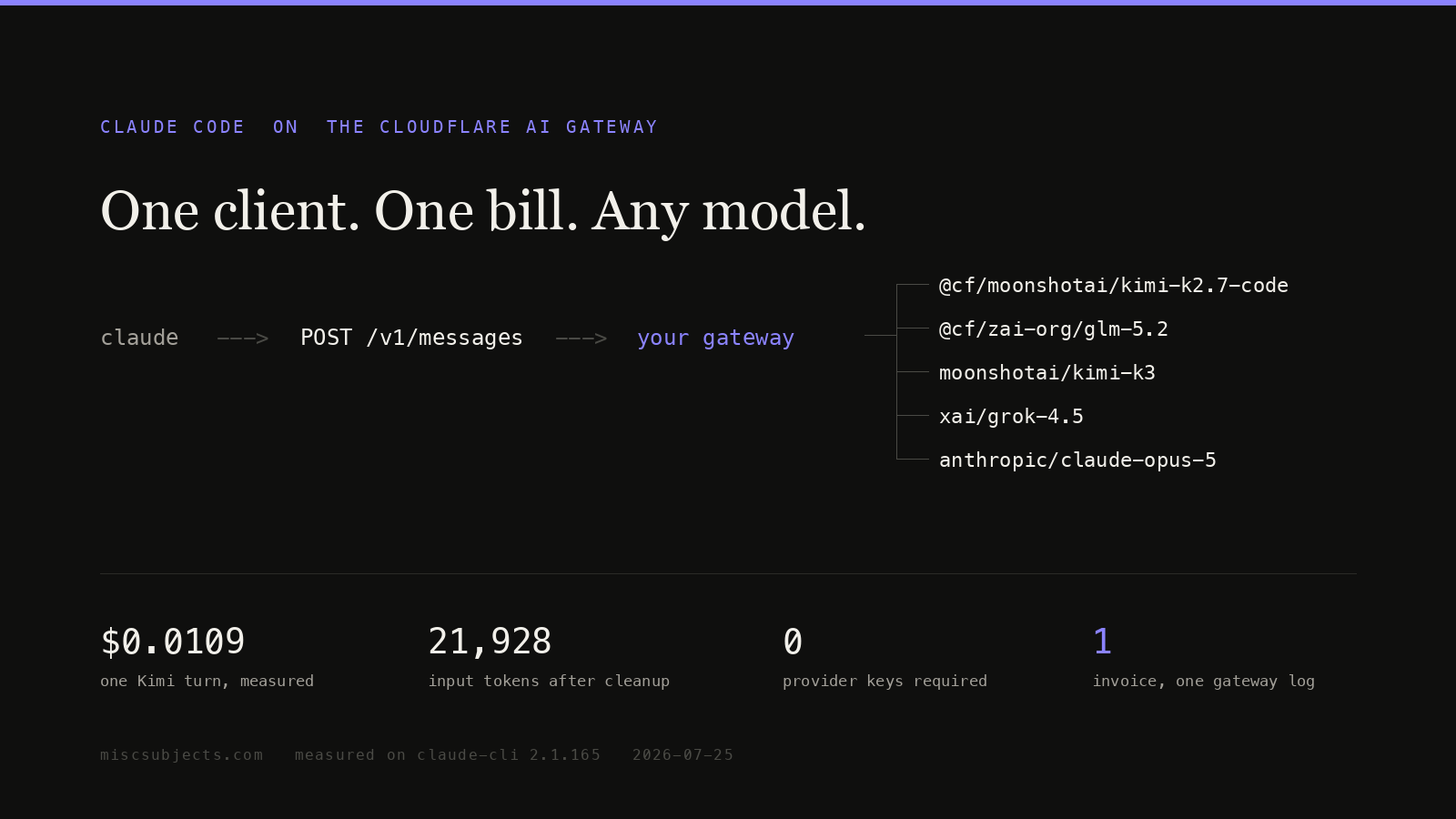
Claude Code on Kimi, GLM or Grok through your own Cloudflare account
Step-by-step: run the Claude Code CLI against Kimi K2.7 Code, GLM-5.2, Grok or Claude through your own Cloudflare AI Gateway. Prerequisites, exact commands, the two settings that cut a turn from $0.21 to $0.0044, every alternative route, and what breaks.
A Claude Code turn that costs $0.0044 instead of $0.21, running Kimi K2.7 Code, billed by Cloudflare, with no Anthropic key and no Moonshot key in the configuration. That is the outcome this page produces. Follow the steps in order and it takes about twenty minutes.
Two reasons to want it. The money: the same work priced at $0.95 per million input tokens instead of $3 to $15, on one invoice you already receive. The obedience: open-weight models such as Kimi K2.7 Code and GLM-5.2 follow an explicit instruction more literally than Claude does, and if your work depends on instructions being followed exactly rather than improved upon, that difference is the point. Both reasons are quantified further down, with the arithmetic shown.
Evidence status
Observed marks first-party measurements or runtime receipts from the named environment. Derived marks arithmetic calculated from cited inputs. Specified marks vendor or standards documentation. Implemented and deployed name code and live-state evidence, respectively. Reproduced means the stated procedure was rerun. Externally attested marks operator reports; those reports show that an experience occurred, not that it is universal.
Every term on this page, defined
Term
What it means here
Claude Code
Anthropic's command-line coding agent. It reads and writes files, runs shell commands, and calls tools. It is a client program: the model it talks to is whatever address you configure.
The request and response format most other providers speak: POST /v1/chat/completions. Different field names, different streaming events. Not interchangeable with the Messages API without translation.
A program that accepts Anthropic Messages requests and converts them to Chat Completions, then converts the answer back. Also called a shim or a proxy. This page publishes one.
Turn
One request-and-response cycle between Claude Code and a model. A single instruction from you usually costs several turns.
The problem, stated exactly
Claude Code sends POST /v1/messages. Cloudflare's AI Gateway has an endpoint that speaks that format, documented for Claude Code by Cloudflare itself, and it reaches Anthropic's models only.
Every other model in Cloudflare's catalogue — Kimi, GLM, Grok, DeepSeek, MiniMax — is listed as Chat Completions. Each model page in the catalogue states this in a field named Request formats.
So one piece is missing: a translator between the two formats. Nothing else about Claude Code needs to change.
Before you start
Five prerequisites. Each one is a link and a check you can run.
A Cloudflare account. Sign up at dash.cloudflare.com/sign-up. The free plan is enough to deploy the translator; model usage is paid per token.
An AI Gateway with authentication turned ON. Dashboard path and screenshots: How to create a Cloudflare AI Gateway. Authentication must be on, because Unified Billing refuses an unauthenticated gateway — proof of that refusal is further down.
A Cloudflare API token with Workers AI: Read, Workers AI: Run and AI Gateway: Run on your account. Create it at dash.cloudflare.com/profile/api-tokens → Create Token → Create Custom Token, then add those three permission rows. Copy the token once; Cloudflare does not show it again.
Your Cloudflare account ID. Dashboard → any domain → the right-hand sidebar, or the 32-character hex string in your dashboard URL.
Node.js 20 or newer. Check with node --version. Install from nodejs.org. Wrangler, Cloudflare's deploy tool, runs through npx and needs no separate install.
Route A: Claude models, on your Cloudflare bill, no code
If you only want Claude billed through Cloudflare, stop after this section. Cloudflare documents it and it needs no translator.
bash
1
2
3
4
export ANTHROPIC_BASE_URL="https://gateway.ai.cloudflare.com/v1/<ACCOUNT_ID>/<GATEWAY_ID>/anthropic"
export ANTHROPIC_API_KEY="<CF_AIG_TOKEN>"
export ANTHROPIC_CUSTOM_HEADERS="cf-aig-authorization: Bearer <CF_AIG_TOKEN>"
claude
Line 4, Column 1Shell Script
<CF_AIG_TOKEN> is a gateway token with Run permission. Cloudflare's own words: "The Anthropic endpoint exposes the same /v1/messages API that Claude Code expects."
Expected output: 200. A 403 means the gateway token lacks Run permission. A 401 means the cf-aig-authorization header is missing or wrong.
Route B: any model, through one translator you deploy
Six commands. The translator is one file, MIT licensed, in a public repository.
bash
1
2
3
4
5
6
git clone https://github.com/redacted/claude-code-cloudflare-gateway
cd claude-code-cloudflare-gateway
npx wrangler secret put CF_ACCOUNT_ID    # paste the 32-character account id
npx wrangler secret put CF_API_TOKEN     # paste the token from prerequisite 3
npx wrangler secret put SHIM_TOKEN       # paste any random string: openssl rand -base64 24
npx wrangler deploy
Line 6, Column 1Shell Script
wrangler deploy prints the URL it deployed to, in the form https://claude-code-cloudflare-gateway.<your-subdomain>.workers.dev.
ANTHROPIC_BASE_URL — the address Claude Code sends every request to. The token is the last path segment because an existing claude login can override ANTHROPIC_AUTH_TOKEN; measured on the desktop app, which sent its own credential instead of the variable. A token in a URL can appear in logs, so the translator also accepts it in an x-api-key header if you prefer that.
ANTHROPIC_AUTH_TOKEN — sent as Authorization: Bearer. ANTHROPIC_API_KEY is sent as x-api-key instead. Setting the wrong one produces a silent 401.
ANTHROPIC_MODEL and the three _DEFAULT_ lines — Claude Code fills four model slots, not one. Leave any of them unset and that slot asks for a Claude model your gateway does not serve.
ANTHROPIC_DEFAULT_HAIKU_MODEL — the background slot: session titles, summaries, quick classifications. glm-flash is @cf/zai-org/glm-4.7-flash at $0.06 per million input tokens, the cheapest model in the catalogue that still calls tools reliably.
ENABLE_TOOL_SEARCH=true — stops every MCP tool definition being sent in every request. This single line changed a measured turn from 149,187 input tokens to 14,109. Explanation and measurements: Why MCP tool schemas are most of your bill.
CLAUDE_CODE_ATTRIBUTION_HEADER=0 — stops Claude Code prepending a value that changes on every request to the front of the system prompt, which prevents any upstream cache from ever matching. Detail below.
Verify before trusting it:
bash
1
node tools/contract-test.mjs "https://<your-worker-host>/<SHIM_TOKEN>" kimi
Line 1, Column 1Shell Script
21 checks, each printing PASS or FAIL: the response envelope, usage numbers, stop-reason mapping, the streaming event sequence in order, a streamed tool call whose arguments arrive incrementally and parse as JSON, a second turn that reads a tool result, token counting, the model list, and a wrong token being refused. All 21 pass on the reference deployment as of 2026-07-25.
Which name gets you which model
Type the name on the left. The model on the right runs. Anything unrecognised resolves to the default rather than silently calling Anthropic.
What you type
What runs
Context
Billed as
kimi
@cf/moonshotai/kimi-k2.7-code
262,144 tokens
Workers AI
k3
moonshotai/kimi-k3
1,048,576 tokens
Unified Billing
glm
@cf/zai-org/glm-5.2
262,144 tokens
Workers AI
glm-flash
@cf/zai-org/glm-4.7-flash
131,072 tokens
Workers AI
grok
xai/grok-4.5
per catalogue
Unified Billing
minimax
minimax/m3
per catalogue
Unified Billing
opus5 / sonnet5
anthropic/claude-opus-5 / -sonnet-5
per catalogue
Unified Billing
Two names exist for one reason. The desktop client checks model names against a list of Anthropic-shaped names and refuses anything else before sending a request, so claude-kimi-k2.7-code and claude-glm-5.2 also work and route to the same models. Any name containing kimi, glm, grok or gpt resolves to that family.
One table in the translator generates both this mapping and the list served at /v1/models. The first version generated them separately, and claude-kimi-k3 quietly ran K2.7 while claude-glm-flash ran GLM-5.2 at twenty times the input price. A published name that routes elsewhere is worse than no list at all.
The money, with the arithmetic
Published rates, per million tokens, from Cloudflare's Workers AI pricing page:
Read those four rows in order and three facts follow.
Fact one: the tool definitions, not the conversation, are the bill. Row four is the same MCP server as rows one and two, all its tools still reachable, at one tenth the input tokens — and cheaper than row three, which had no MCP server connected at all.
Fact two: the model choice is a 7.3× multiplier on the same turn. $0.20922644 against $0.02852109 for an identical 149k-token request.
Fact three: one row does not reconcile, and that is stated rather than smoothed. The GLM row multiplies out exactly — 149,379 uncached tokens at $1.40 per million is $0.20913, plus output, against a logged $0.20922644. The two small Kimi rows reconcile the same way. The second Kimi row does not: 149,123 uncached tokens at $0.95 per million should be $0.1417, and the log says $0.02852109, an effective $0.191 per million, which is the cached rate applied to input the same row reports as 64 tokens cached. Cloudflare's documentation calls the cost field "an estimation based on the number of tokens sent and received". Treat per-row cost as the platform's estimate and the token counts as the hard numbers. Every ratio above is computed from token counts.
What that means per month. At 60 turns of real agent work per day, 22 working days, with tool search on and the measured $0.00443 per turn: 60 × 22 × $0.00443 = $5.85 per month. The same 1,320 turns at the un-tuned GLM figure of $0.20922644 would be $276. A Claude Max subscription is $100 or $200 per month depending on tier. The comparison that matters is not model against model, it is tuned configuration against untuned: the same models, the same work, a 47× difference from two environment variables.
The two settings that decide the bill
Tool search. Claude Code's default is to send every tool definition from every connected MCP server in every request. Captured on the same machine, same prompt, back to back:
The nine include a ToolSearch tool the model calls when it needs something not in front of it. Whether a non-Claude model actually uses it is the question that matters, because a deferred tool nobody looks for is a broken tool. Kimi K2.7 Code was asked for a tool it had never been shown; it called ToolSearch, found the tool named TIME_NOW, invoked it, and returned the payload:
Anthropic's prompt-caching documentation states that MCP tool search is unavailable behind a custom ANTHROPIC_BASE_URL gateway, and Moonshot's own Claude Code guide instructs setting ENABLE_TOOL_SEARCH=false. On claude-cli 2.1.165 against this gateway it worked and cut input tokens 10.6×. Both pages may be describing other versions or other endpoints. Re-check it on your version with the capture tool below rather than trusting any of the three claims, including this one.
The attribution line. Claude Code prepends a line of this shape to the system prompt:
The cch= value changes on every request. api.anthropic.com removes that line by position before the model sees it. Every other provider receives it, and because it sits in front of a 20,000-token prefix that would otherwise be identical between turns, no cache can match. Measured effect here: cached input per turn went from 64 tokens to between 12,480 and 14,976 once the line was gone. Set CLAUDE_CODE_ATTRIBUTION_HEADER=0 on the client, and the translator removes the block server-side as well. Never merge or reorder the system array around it: the removal is positional, and a merged block beginning with that header takes the rest of your system prompt with it.
Price is measurable and above. This is the other reason, stated plainly.
A model trained to be maximally helpful will improve on your instruction. It will add the thing you did not ask for, soften the thing you asked for bluntly, and summarise where you asked for the literal output. For a reader who needs an instruction executed exactly as written, that is not a small friction — it is the defect, and it is the trained behaviour, not a bug in a particular reply.
Open-weight models fine-tuned for coding — Kimi K2.7 Code, GLM-5.2 — are trained against benchmarks that reward completing the stated task. In practice they take a literal instruction more literally. That claim is not a benchmark result and is not presented as one; the benchmark numbers below say Claude leads on task completion. It is an operating observation, and the reason a cost-neutral switch can still be worth making: the cheaper model is also the one that does what the line says.
The structural point underneath it: an agent you can point at any model is an agent whose behaviour you can choose. An agent locked to one vendor's tuning is that vendor's judgement about what you meant. Everything above exists so that choice costs six commands instead of a rewrite.
What people who did this report
Real accounts, positive and negative, quoted and linked. These are anecdotal reports from individuals, not measurements.
2. OpenRouter. One key, hundreds of models, officially supported, no proxy: "When you set ANTHROPIC_BASE_URL to https://openrouter.ai/api, Claude Code speaks its native protocol directly to OpenRouter. No local proxy server is required." Billed by OpenRouter, and also reachable as a first-class provider inside AI Gateway.
3. Cloudflare custom providers. Register any HTTPS base URL as custom-<slug> and the gateway forwards your path to it, so a vendor's own Anthropic endpoint sits behind your gateway with its logging, caching and rate limits. The vendor still bills you; Unified Billing does not apply.
4. LiteLLM. The most complete translator in existence and a proxy you must run and keep running. Correct on streaming, tool calls, thinking blocks with signatures, images and token counting. Its cache_control pass-through is limited to Claude and Bedrock targets, so cache breakpoints are dropped against a plain chat-completions backend anyway.
5. claude-code-router. 36,000 stars, actively developed, desktop app and CLI. Translation is delegated to a separate package; its npm latest tag has lagged its GitHub releases, so check the version you installed before trusting a number from its README.
6. A local model, which needs no translator at all. This inverted between late 2025 and early 2026: llama.cpp, vLLM, Ollama and LM Studio all serve /v1/messages natively now. llama.cpp merged it on 2025-11-28 and implements token counting; Ollama shipped it in v0.14.0 and explicitly does not support token counting, tool_choice, metadata or cache_control; LM Studio recommends at least 25,000 tokens of context "since Claude Code can be quite context-heavy." Any guide that tells you to run a proxy for a local model is out of date.
Match the variable to what your endpoint accepts; the translator here accepts either, plus the path token
Main thread works, subagents and session titles fail
Only ANTHROPIC_MODEL was set; the background and subagent slots still ask for a Claude model
Set ANTHROPIC_DEFAULT_HAIKU_MODEL and CLAUDE_CODE_SUBAGENT_MODEL
400 naming thinking or adaptive
The client sends thinking: {"type":"adaptive"} to models that reject it
Use a translator that drops the field, or set CLAUDE_CODE_DISABLE_THINKING=1
400 invalid thinking: only type=enabled is allowed for this model on subagents only
The client omits thinking on subagent and structured-output calls; some endpoints require it
Known open defect against Moonshot's endpoint; the translator route avoids it by never forwarding the field
Model missing from /model
Gateway model discovery is off by default and drops every id not starting with claude or anthropic
Set CLAUDE_CODE_ENABLE_GATEWAY_MODEL_DISCOVERY=1, or select with claude --model <name>
Turn ends with no visible output
Kimi and GLM spend the output budget on reasoning before answering; an empty assistant turn aborts the client
Raise max_tokens; the translator falls back to the reasoning text so the turn is never empty
Cost per turn far above the published rate
The attribution line is defeating the upstream cache
CLAUDE_CODE_ATTRIBUTION_HEADER=0, and strip the block in the translator
Anthropic still receives usage metrics
Setting ANTHROPIC_BASE_URL alone does not turn metrics off
DISABLE_TELEMETRY=1
403 with an HTML body, gateway logs show nothing
A web application firewall inspected the request body; prompts contain XML-like tags and code
Exempt /v1/messages from body inspection
Two limits of the whole approach, in Anthropic's words and mine. Anthropic: it "doesn't endorse, maintain, or audit third-party gateway products, and doesn't support routing Claude Code to non-Claude models through any gateway." That is an unsupported configuration, not a prohibited one — no term forbids it — and it means the client changes when Anthropic changes it, and you catch up. Mine: images are forwarded, thinking is not, and prompt caching is whatever the upstream does with a prefix.
On identical independent harnesses, the open models sit one tier behind Claude, not two. SWE-bench Verified on mini-SWE-agent 2.0.0, one attempt each: Claude Opus 4.5 76.8, GLM-5 72.8, Claude Sonnet 4.5 71.4, Kimi K2.5 70.8. Terminal-Bench 2.1 with Claude Code as the harness: Fable 5 83.8, Opus 4.8 78.9, Sonnet 5 74.6, GLM-5.1 58.7, with no Kimi entry at all.
Every vendor-published score that has an independent counterpart is higher than the independent one. GLM-4.6: 68.2 on Z.ai's own scaffold, 55.4 on mini-SWE-agent. Kimi K2.5: 76.8 in-house, 70.8 independent. Claude Opus 4.6: 80.4 in-house over 25 trials, 75.6 independent. The direction is uniform, so read the scaffold before the score.
Two more facts before anyone builds an argument on a leaderboard: the official SWE-bench Verified board's newest submission is from February 2026, and Anthropic stopped publishing SWE-bench Verified in text from Opus 4.7 onward — Opus 5 publishes neither it nor Terminal-Bench.
Verify every measurement on this page yourself
Nothing here needs to be taken on trust. Two tools, both in the repository.
The wire capture. A local server that speaks the Anthropic Messages format, logs exactly what the client sent, and answers with a valid response. This is where every request-shape number on this page came from.
bash
1
2
node tools/capture-gateway.mjs        # listens on :8787, appends capture.jsonl
ANTHROPIC_BASE_URL=http://localhost:8787 ANTHROPIC_AUTH_TOKEN=x claude -p "say ok"
Line 2, Column 1Shell Script
What one capture on claude-cli 2.1.165 recorded, 2026-07-25:
Four constraints for anyone writing a translator follow from that capture, and the reference implementation obeys all four: match on the path because the query string is present; serve both model slots; keep the system array in its original order; and expect the tool list, not the prompt, to dominate the payload.
The contract test. 21 checks against a live deployment, listed earlier in Route B. Run it after every change.
Seven behaviours. Each one is a real defect in at least one published shim, so each is checked by the contract test.
Stream. A gateway that buffers whole responses stalls the client.
Emit tool arguments incrementally — content_block_start, then input_json_delta chunks — not one blob at the end.
Order tool results correctly. Anthropic puts tool_result blocks inside a user turn; Chat Completions wants role:"tool" messages immediately after the assistant turn that called them.
Map stop reasons: stop to end_turn, length to max_tokens, tool_calls to tool_use. Nobody can produce stop_sequence faithfully, because Chat Completions returns stop for both cases with no discriminator.
Never return an empty turn. Fall back to the reasoning text when the output budget was spent before any answer.
Answer /v1/messages/count_tokens. It is optional, and without it the client estimates locally; an estimate beats a 404.
Remove the attribution block without reordering the system array.
Four Cloudflare Workers shims exist and each fails at least one of these: luohy15/y-router is archived and drops max_tokens; glidea/claude-worker-proxy is active but sends tool arguments as one blob, has no token-count route and drops images; tingxifa/claude_proxy types system as a string, which is not the shape the client sends; mrdear/cloudflare-ai-proxy ignores images by design.
The translator is a Cloudflare Worker. On the free plan that is 100,000 requests per day at no charge; a heavy day of agent work is a few hundred. The gateway itself is free; its logs are retained per your plan. Model tokens are the only real cost, at the rates above. Unified Billing adds 5% on purchased credits and passes provider pricing through with no markup, and Workers AI models are billed as Workers AI rather than through it — the arithmetic of that split is in Cloudflare Unified Billing.
One security fact to hold onto: Cloudflare states that AI Gateway token permissions "cannot be restricted to a single gateway", so a token with Run reaches every gateway on the account, including any holding stored provider keys. Rate-limit the gateway you use for this — 120 requests per 60 seconds is enough for one operator and caps the damage if a token leaks.
Claude Code gateway protocol reference — Anthropic, Jan 1, 2026“Forward the header verbatim; don't allowlist individual values, because the set changes with Claude Code releases.”
Cloudflare AI Gateway — REST API — Cloudflare, Jan 1, 2026“The /ai/v1/messages endpoint strictly uses Anthropic's API schema and supports routing to Anthropic and other third-party models. Workers AI models (@cf/) do not support this schema.”
Cloudflare AI Gateway — Unified Billing — Cloudflare, Jan 1, 2026“A 5% fee is applied to all credits purchased through Unified Billing. For example, a $100 credit purchase will result in a $105 charge. Inference pricing from providers is passed through with no markup.”
Cloudflare AI Gateway — authenticated gateway and token scope — Cloudflare, Jan 1, 2026“The AI Gateway Read, Run, and Edit permissions cannot be restricted to a single gateway — unlike R2, which supports per-bucket scoping. Any token with AI Gateway Run can send requests through every gateway in the account, including any configured with stored provider keys through Bring Your Own Keys (BYOK), consuming those credentials.”
Claude Code — LLM gateway configuration — Anthropic, Jan 1, 2026“Anthropic doesn't endorse, maintain, or audit third-party gateway products, and doesn't support routing Claude Code to non-Claude models through any gateway.”
Z.ai — GLM in Claude Code — Z.ai, Jan 1, 2026“"ANTHROPIC_BASE_URL": "https://api.z.ai/api/anthropic"”
DeepSeek — Anthropic API format — DeepSeek, Jan 1, 2026“To meet the demand for using the Anthropic API ecosystem, our API has added support for the Anthropic API format, with the base_url being https://api.deepseek.com/anthropic”
OpenRouter — Claude Code integration — OpenRouter, Jan 1, 2026“When you set ANTHROPIC_BASE_URL to https://openrouter.ai/api, Claude Code speaks its native protocol directly to OpenRouter. No local proxy server is required.”
Cloudflare AI Gateway — custom providers — Cloudflare, Jan 1, 2026“Everything after custom-{slug}/ in your request URL is appended directly to the base_url to form the final upstream URL.”
{
"schema":"http://google-preview.miscsubjects.com/schemas/jarticle.json",
"status":"published",
"slug":"claude-code-on-cloudflare-ai-gateway",
"title":"Claude Code on Kimi, GLM or Grok through your own Cloudflare account",
"kind":"essay",
"summary":"Step-by-step: run the Claude Code CLI against Kimi K2.7 Code, GLM-5.2, Grok or Claude through your own Cloudflare AI Gateway. Prerequisites, exact commands, the two settings that cut a turn from $0.21 to $0.0044, every alternative route, and what breaks.",
"created":"2026-07-26T01:21:33.461Z",
"body": [
"A Claude Code turn that costs $0.0044 instead of $0.21, running Kimi K2.7 Code, billed by Cloudflare, with no Anthropic key and no Moonshot key in the configuration. That is the outcome this page produces. Follow the steps in order and it takes about twenty minutes.\n\nTwo reasons to want it. The money: the same work priced at $0.95 per million input tokens instead of $3 to $15, on one invoice you already receive. The obedience: open-weight models such as Kimi K2.7 Code and GLM-5.2 follow an explicit instruction more literally than Claude does, and if your work depends on instructions being followed exactly rather than improved upon, that difference is the point. Both reasons are quantified further down, with the arithmetic shown.\n\n## Evidence status\n\n**Observed** marks first-party measurements or runtime receipts from the named environment.\n**Derived** marks arithmetic calculated from cited inputs. **Specified** marks vendor or standards\ndocumentation. **Implemented** and **deployed** name code and live-state evidence, respectively.\n**Reproduced** means the stated procedure was rerun. **Externally attested** marks operator reports;\nthose reports show that an experience occurred, not that it is universal.\n\n## Every term on this page, defined\n\n| Term | What it means here |\n| --- | --- |\n| Claude Code | Anthropic's command-line coding agent. It reads and writes files, runs shell commands, and calls tools. It is a client program: the model it talks to is whatever address you configure. |\n| Anthropic Messages API | The request and response format Claude Code speaks: `POST /v1/messages` with a JSON body. Defined at [platform.claude.com/docs/en/api/messages](https://platform.claude.com/docs/en/api/messages). Full explanation: [What the Anthropic Messages API is](/a/what-is-the-anthropic-messages-api). |\n| Chat Completions | The request and response format most other providers speak: `POST /v1/chat/completions`. Different field names, different streaming events. Not interchangeable with the Messages API without translation. |\n| Cloudflare AI Gateway | A proxy in front of AI providers that adds logging, caching, rate limits, retries and billing. Setup: [How to create a Cloudflare AI Gateway](/a/cloudflare-ai-gateway-setup). |\n| Workers AI | Models Cloudflare hosts and bills directly, named `@cf/author/model`. Includes Kimi K2.7 Code and GLM-5.2. Details: [Workers AI for coding models](/a/workers-ai-coding-models). |\n| Unified Billing | Cloudflare pays the upstream provider and bills you, so no provider API key appears in your configuration. Arithmetic: [Cloudflare Unified Billing](/a/cloudflare-unified-billing). |\n| BYOK | Bring Your Own Keys. You store the provider's key in the gateway instead of sending it with each request. |\n| MCP | Model Context Protocol. How extra tools are attached to a coding agent. Reference: [MCP, from its own documents](/a/what-is-mcp). |\n| Tool search | A client setting that stops every MCP tool definition being sent in every request. Cost impact: [Why MCP tool schemas are most of your bill](/a/mcp-tool-search-cost). |\n| Translator | A program that accepts Anthropic Messages requests and converts them to Chat Completions, then converts the answer back. Also called a shim or a proxy. This page publishes one. |\n| Turn | One request-and-response cycle between Claude Code and a model. A single instruction from you usually costs several turns. |\n\n## The problem, stated exactly\n\nClaude Code sends `POST /v1/messages`. Cloudflare's AI Gateway has an endpoint that speaks that format, documented for Claude Code by Cloudflare itself, and it reaches Anthropic's models only.\n\nEvery other model in Cloudflare's catalogue — Kimi, GLM, Grok, DeepSeek, MiniMax — is listed as Chat Completions. Each model page in the catalogue states this in a field named `Request formats`.\n\n| Model | Request formats as catalogued | Reachable by Claude Code unmodified |\n| --- | --- | --- |\n| anthropic/claude-opus-5 | Anthropic Messages | yes |\n| minimax/m3 | Chat Completions, Anthropic Messages | see the measurement below |\n| moonshotai/kimi-k3 | Chat Completions | no |\n| xai/grok-4.5 | Chat Completions | no |\n| deepseek/deepseek-v4-pro | Chat Completions | no |\n| @cf/moonshotai/kimi-k2.7-code | Chat Completions | no |\n| @cf/zai-org/glm-5.2 | Chat Completions | no |",
{
"type":"source",
"id":"s6"
},
{
"type":"source",
"id":"s5"
},
"So one piece is missing: a translator between the two formats. Nothing else about Claude Code needs to change.\n\n## Before you start\n\nFive prerequisites. Each one is a link and a check you can run.\n\n1. **A Cloudflare account.** Sign up at [dash.cloudflare.com/sign-up](https://dash.cloudflare.com/sign-up). The free plan is enough to deploy the translator; model usage is paid per token.\n2. **An AI Gateway with authentication turned ON.** Dashboard path and screenshots: [How to create a Cloudflare AI Gateway](/a/cloudflare-ai-gateway-setup). Authentication must be on, because Unified Billing refuses an unauthenticated gateway — proof of that refusal is further down.\n3. **A Cloudflare API token** with `Workers AI: Read`, `Workers AI: Run` and `AI Gateway: Run` on your account. Create it at [dash.cloudflare.com/profile/api-tokens](https://dash.cloudflare.com/profile/api-tokens) → Create Token → Create Custom Token, then add those three permission rows. Copy the token once; Cloudflare does not show it again.\n4. **Your Cloudflare account ID.** Dashboard → any domain → the right-hand sidebar, or the 32-character hex string in your dashboard URL.\n5. **Node.js 20 or newer.** Check with `node --version`. Install from [nodejs.org](https://nodejs.org). Wrangler, Cloudflare's deploy tool, runs through `npx` and needs no separate install.\n\n## Route A: Claude models, on your Cloudflare bill, no code\n\nIf you only want Claude billed through Cloudflare, stop after this section. Cloudflare documents it and it needs no translator.\n\n```bash\nexport ANTHROPIC_BASE_URL=\"https://gateway.ai.cloudflare.com/v1/<ACCOUNT_ID>/<GATEWAY_ID>/anthropic\"\nexport ANTHROPIC_API_KEY=\"<CF_AIG_TOKEN>\"\nexport ANTHROPIC_CUSTOM_HEADERS=\"cf-aig-authorization: Bearer <CF_AIG_TOKEN>\"\nclaude\n```\n\n`<CF_AIG_TOKEN>` is a gateway token with Run permission. Cloudflare's own words: \"The Anthropic endpoint exposes the same `/v1/messages` API that Claude Code expects.\"",
{
"type":"source",
"id":"s3"
},
"Check it worked, before starting a session:\n\n```bash\ncurl -s -o /dev/null -w \"%{http_code}\\n\" \\\n -X POST \"$ANTHROPIC_BASE_URL/v1/messages\" \\\n -H \"cf-aig-authorization: Bearer <CF_AIG_TOKEN>\" \\\n -H \"anthropic-version: 2023-06-01\" -H \"content-type: application/json\" \\\n -d '{\"model\":\"claude-sonnet-4-5\",\"max_tokens\":16,\"messages\":[{\"role\":\"user\",\"content\":\"hi\"}]}'\n```\n\nExpected output: `200`. A `403` means the gateway token lacks Run permission. A `401` means the `cf-aig-authorization` header is missing or wrong.\n\n## Route B: any model, through one translator you deploy\n\nSix commands. The translator is one file, MIT licensed, in a public repository.\n\n```bash\ngit clone https://github.com/redacted/claude-code-cloudflare-gateway\ncd claude-code-cloudflare-gateway\nnpx wrangler secret put CF_ACCOUNT_ID # paste the 32-character account id\nnpx wrangler secret put CF_API_TOKEN # paste the token from prerequisite 3\nnpx wrangler secret put SHIM_TOKEN # paste any random string: openssl rand -base64 24\nnpx wrangler deploy\n```\n\n`wrangler deploy` prints the URL it deployed to, in the form `https://claude-code-cloudflare-gateway.<your-subdomain>.workers.dev`.",
{
"type":"source",
"id":"s32"
},
"Point Claude Code at it:\n\n```bash\nexport ANTHROPIC_BASE_URL=\"https://claude-code-cloudflare-gateway.<your-subdomain>.workers.dev/<SHIM_TOKEN>\"\nexport ANTHROPIC_AUTH_TOKEN=\"<SHIM_TOKEN>\"\nexport ANTHROPIC_API_KEY=\"\"\nexport ANTHROPIC_MODEL=\"kimi\"\nexport ANTHROPIC_DEFAULT_OPUS_MODEL=\"kimi\"\nexport ANTHROPIC_DEFAULT_SONNET_MODEL=\"kimi\"\nexport ANTHROPIC_DEFAULT_HAIKU_MODEL=\"glm-flash\"\nexport CLAUDE_CODE_SUBAGENT_MODEL=\"kimi\"\nexport ENABLE_TOOL_SEARCH=true\nexport CLAUDE_CODE_ATTRIBUTION_HEADER=0\nclaude\n```\n\nWhy each line exists:\n\n- `ANTHROPIC_BASE_URL` — the address Claude Code sends every request to. The token is the last path segment because an existing `claude` login can override `ANTHROPIC_AUTH_TOKEN`; measured on the desktop app, which sent its own credential instead of the variable. A token in a URL can appear in logs, so the translator also accepts it in an `x-api-key` header if you prefer that.\n- `ANTHROPIC_AUTH_TOKEN` — sent as `Authorization: Bearer`. `ANTHROPIC_API_KEY` is sent as `x-api-key` instead. Setting the wrong one produces a silent `401`.\n- `ANTHROPIC_MODEL` and the three `_DEFAULT_` lines — Claude Code fills four model slots, not one. Leave any of them unset and that slot asks for a Claude model your gateway does not serve.\n- `ANTHROPIC_DEFAULT_HAIKU_MODEL` — the background slot: session titles, summaries, quick classifications. `glm-flash` is `@cf/zai-org/glm-4.7-flash` at $0.06 per million input tokens, the cheapest model in the catalogue that still calls tools reliably.\n- `ENABLE_TOOL_SEARCH=true` — stops every MCP tool definition being sent in every request. This single line changed a measured turn from 149,187 input tokens to 14,109. Explanation and measurements: [Why MCP tool schemas are most of your bill](/a/mcp-tool-search-cost).\n- `CLAUDE_CODE_ATTRIBUTION_HEADER=0` — stops Claude Code prepending a value that changes on every request to the front of the system prompt, which prevents any upstream cache from ever matching. Detail below.\n\nVerify before trusting it:\n\n```bash\nnode tools/contract-test.mjs \"https://<your-worker-host>/<SHIM_TOKEN>\" kimi\n```\n\n21 checks, each printing PASS or FAIL: the response envelope, usage numbers, stop-reason mapping, the streaming event sequence in order, a streamed tool call whose arguments arrive incrementally and parse as JSON, a second turn that reads a tool result, token counting, the model list, and a wrong token being refused. All 21 pass on the reference deployment as of 2026-07-25.\n\n## Which name gets you which model\n\nType the name on the left. The model on the right runs. Anything unrecognised resolves to the default rather than silently calling Anthropic.\n\n| What you type | What runs | Context | Billed as |\n| --- | --- | --- | --- |\n| `kimi` | `@cf/moonshotai/kimi-k2.7-code` | 262,144 tokens | Workers AI |\n| `k3` | `moonshotai/kimi-k3` | 1,048,576 tokens | Unified Billing |\n| `glm` | `@cf/zai-org/glm-5.2` | 262,144 tokens | Workers AI |\n| `glm-flash` | `@cf/zai-org/glm-4.7-flash` | 131,072 tokens | Workers AI |\n| `grok` | `xai/grok-4.5` | per catalogue | Unified Billing |\n| `minimax` | `minimax/m3` | per catalogue | Unified Billing |\n| `opus5` / `sonnet5` | `anthropic/claude-opus-5` / `-sonnet-5` | per catalogue | Unified Billing |\n\nTwo names exist for one reason. The desktop client checks model names against a list of Anthropic-shaped names and refuses anything else before sending a request, so `claude-kimi-k2.7-code` and `claude-glm-5.2` also work and route to the same models. Any name containing `kimi`, `glm`, `grok` or `gpt` resolves to that family.",
{
"type":"source",
"id":"s12"
},
"One table in the translator generates both this mapping and the list served at `/v1/models`. The first version generated them separately, and `claude-kimi-k3` quietly ran K2.7 while `claude-glm-flash` ran GLM-5.2 at twenty times the input price. A published name that routes elsewhere is worse than no list at all.\n\n## The money, with the arithmetic\n\nPublished rates, per million tokens, from Cloudflare's Workers AI pricing page:\n\n| Model | Input | Cached input | Output |\n| --- | --- | --- | --- |\n| @cf/moonshotai/kimi-k2.7-code | $0.95 | $0.19 | $4.00 |\n| @cf/zai-org/glm-5.2 | $1.40 | $0.26 | $4.40 |\n| @cf/zai-org/glm-4.7-flash | $0.06 | none published | $0.40 |",
{
"type":"source",
"id":"s15"
},
"Four turns measured through one gateway, read from its own log rows:\n\n| Configuration | Model | Input | Cached | Output | Cost | Latency |\n| --- | --- | --- | --- | --- | --- | --- |\n| MCP attached, no tool search | @cf/zai-org/glm-5.2 | 149,443 | 64 | 18 | $0.20922644 | 10.9 s |\n| MCP attached, no tool search | @cf/moonshotai/kimi-k2.7-code | 149,187 | 64 | 19 | $0.02852109 | 4.6 s |\n| MCP disabled entirely | @cf/moonshotai/kimi-k2.7-code | 21,928 | 13,312 | 45 | $0.01089448 | 2.8 s |\n| MCP attached, tool search on | @cf/moonshotai/kimi-k2.7-code | 14,109 | 12,480 | 128 | $0.00443075 | 1.6 s |",
{
"type":"source",
"id":"s7"
},
"Read those four rows in order and three facts follow.\n\n**Fact one: the tool definitions, not the conversation, are the bill.** Row four is the same MCP server as rows one and two, all its tools still reachable, at one tenth the input tokens — and cheaper than row three, which had no MCP server connected at all.\n\n**Fact two: the model choice is a 7.3× multiplier on the same turn.** $0.20922644 against $0.02852109 for an identical 149k-token request.\n\n**Fact three: one row does not reconcile, and that is stated rather than smoothed.** The GLM row multiplies out exactly — 149,379 uncached tokens at $1.40 per million is $0.20913, plus output, against a logged $0.20922644. The two small Kimi rows reconcile the same way. The second Kimi row does not: 149,123 uncached tokens at $0.95 per million should be $0.1417, and the log says $0.02852109, an effective $0.191 per million, which is the cached rate applied to input the same row reports as 64 tokens cached. Cloudflare's documentation calls the cost field \"an estimation based on the number of tokens sent and received\". Treat per-row cost as the platform's estimate and the token counts as the hard numbers. Every ratio above is computed from token counts.\n\n**What that means per month.** At 60 turns of real agent work per day, 22 working days, with tool search on and the measured $0.00443 per turn: 60 × 22 × $0.00443 = **$5.85 per month**. The same 1,320 turns at the un-tuned GLM figure of $0.20922644 would be $276. A Claude Max subscription is $100 or $200 per month depending on tier. The comparison that matters is not model against model, it is tuned configuration against untuned: the same models, the same work, a 47× difference from two environment variables.\n\n## The two settings that decide the bill\n\n**Tool search.** Claude Code's default is to send every tool definition from every connected MCP server in every request. Captured on the same machine, same prompt, back to back:\n\n```text\nENABLE_TOOL_SEARCH=false tools=856 ['Agent','AskUserQuestion','Bash','CronCreate', ... 852 more]\nENABLE_TOOL_SEARCH=true tools=9 ['Agent','AskUserQuestion','Bash','Edit','Read',\n 'Skill','ToolSearch','Workflow','Write']\n```",
{
"type":"source",
"id":"s30"
},
"The nine include a `ToolSearch` tool the model calls when it needs something not in front of it. Whether a non-Claude model actually uses it is the question that matters, because a deferred tool nobody looks for is a broken tool. Kimi K2.7 Code was asked for a tool it had never been shown; it called `ToolSearch`, found the tool named `TIME_NOW`, invoked it, and returned the payload:\n\n```json\n{\"now\":\"2026-07-25T18:35:56-07:00\",\"today\":\"2026-07-25\",\"time\":\"18:35:56\",\n \"zone\":\"America/Los_Angeles\",\"iso\":\"2026-07-25T18:35:56-07:00\"}\n```",
{
"type":"source",
"id":"s31"
},
"Anthropic's prompt-caching documentation states that MCP tool search is unavailable behind a custom `ANTHROPIC_BASE_URL` gateway, and Moonshot's own Claude Code guide instructs setting `ENABLE_TOOL_SEARCH=false`. On `claude-cli 2.1.165` against this gateway it worked and cut input tokens 10.6×. Both pages may be describing other versions or other endpoints. Re-check it on your version with the capture tool below rather than trusting any of the three claims, including this one.\n\n**The attribution line.** Claude Code prepends a line of this shape to the system prompt:\n\n```text\nx-anthropic-billing-header: cc_version=2.1.177.01c; cc_entrypoint=sdk-cli; cch=<NONCE>;\n```\n\nThe `cch=` value changes on every request. `api.anthropic.com` removes that line by position before the model sees it. Every other provider receives it, and because it sits in front of a 20,000-token prefix that would otherwise be identical between turns, no cache can match. Measured effect here: cached input per turn went from 64 tokens to between 12,480 and 14,976 once the line was gone. Set `CLAUDE_CODE_ATTRIBUTION_HEADER=0` on the client, and the translator removes the block server-side as well. Never merge or reorder the `system` array around it: the removal is positional, and a merged block beginning with that header takes the rest of your system prompt with it.",
{
"type":"source",
"id":"s11"
},
"## Why obedience is a reason on its own\n\nPrice is measurable and above. This is the other reason, stated plainly.\n\nA model trained to be maximally helpful will improve on your instruction. It will add the thing you did not ask for, soften the thing you asked for bluntly, and summarise where you asked for the literal output. For a reader who needs an instruction executed exactly as written, that is not a small friction — it is the defect, and it is the trained behaviour, not a bug in a particular reply.\n\nOpen-weight models fine-tuned for coding — Kimi K2.7 Code, GLM-5.2 — are trained against benchmarks that reward completing the stated task. In practice they take a literal instruction more literally. That claim is not a benchmark result and is not presented as one; the benchmark numbers below say Claude leads on task completion. It is an operating observation, and the reason a cost-neutral switch can still be worth making: the cheaper model is also the one that does what the line says.\n\nThe structural point underneath it: an agent you can point at any model is an agent whose behaviour you can choose. An agent locked to one vendor's tuning is that vendor's judgement about what you meant. Everything above exists so that choice costs six commands instead of a rewrite.\n\n## What people who did this report\n\nReal accounts, positive and negative, quoted and linked. These are anecdotal reports from individuals, not measurements.",
{
"type":"source",
"id":"s33"
},
{
"type":"source",
"id":"s34"
},
{
"type":"source",
"id":"s35"
},
{
"type":"source",
"id":"s36"
},
{
"type":"source",
"id":"s37"
},
"## Every documented route, ranked\n\n**1. The vendor's own Anthropic-format endpoint.** Shortest path, no proxy, no Cloudflare. You lose the single invoice and the gateway's logs.\n\n```bash\n# Kimi (Moonshot)\nexport ANTHROPIC_BASE_URL=\"https://api.moonshot.ai/anthropic\"\nexport ANTHROPIC_AUTH_TOKEN=\"$MOONSHOT_API_KEY\"\nexport ANTHROPIC_MODEL=\"kimi-k3[1m]\"\nexport ENABLE_TOOL_SEARCH=\"false\" # required by Moonshot's own guide\n\n# GLM (Z.ai)\nexport ANTHROPIC_BASE_URL=\"https://api.z.ai/api/anthropic\"\n\n# DeepSeek — claude-opus* maps to v4-pro, claude-sonnet*/haiku* to v4-flash\nexport ANTHROPIC_BASE_URL=\"https://api.deepseek.com/anthropic\"\n```",
{
"type":"source",
"id":"s19"
},
{
"type":"source",
"id":"s20"
},
{
"type":"source",
"id":"s21"
},
"**2. OpenRouter.** One key, hundreds of models, officially supported, no proxy: \"When you set `ANTHROPIC_BASE_URL` to `https://openrouter.ai/api`, Claude Code speaks its native protocol directly to OpenRouter. No local proxy server is required.\" Billed by OpenRouter, and also reachable as a first-class provider inside AI Gateway.",
{
"type":"source",
"id":"s22"
},
"**3. Cloudflare custom providers.** Register any HTTPS base URL as `custom-<slug>` and the gateway forwards your path to it, so a vendor's own Anthropic endpoint sits behind your gateway with its logging, caching and rate limits. The vendor still bills you; Unified Billing does not apply.",
{
"type":"source",
"id":"s23"
},
"**4. LiteLLM.** The most complete translator in existence and a proxy you must run and keep running. Correct on streaming, tool calls, thinking blocks with signatures, images and token counting. Its `cache_control` pass-through is limited to Claude and Bedrock targets, so cache breakpoints are dropped against a plain chat-completions backend anyway.\n\n**5. claude-code-router.** 36,000 stars, actively developed, desktop app and CLI. Translation is delegated to a separate package; its npm `latest` tag has lagged its GitHub releases, so check the version you installed before trusting a number from its README.\n\n**6. A local model, which needs no translator at all.** This inverted between late 2025 and early 2026: llama.cpp, vLLM, Ollama and LM Studio all serve `/v1/messages` natively now. llama.cpp merged it on 2025-11-28 and implements token counting; Ollama shipped it in v0.14.0 and explicitly does not support token counting, `tool_choice`, `metadata` or `cache_control`; LM Studio recommends at least 25,000 tokens of context \"since Claude Code can be quite context-heavy.\" Any guide that tells you to run a proxy for a local model is out of date.",
{
"type":"source",
"id":"s24"
},
{
"type":"source",
"id":"s25"
},
{
"type":"source",
"id":"s26"
},
"## What breaks, and the exact fix\n\n| Symptom | Cause | Fix |\n| --- | --- | --- |\n| `402` with `Gateway authentication is required to use unified billing` | Unified Billing is refused on a gateway with authentication off | Turn authentication on for that gateway and send `cf-aig-authorization` |\n| Catalogue models 402 while `@cf/` models work | Same cause. Workers AI does not need Unified Billing | Same fix |\n| `401` on every request, curl works | Wrong variable: `ANTHROPIC_AUTH_TOKEN` sends `Authorization: Bearer`, `ANTHROPIC_API_KEY` sends `x-api-key` | Match the variable to what your endpoint accepts; the translator here accepts either, plus the path token |\n| Main thread works, subagents and session titles fail | Only `ANTHROPIC_MODEL` was set; the background and subagent slots still ask for a Claude model | Set `ANTHROPIC_DEFAULT_HAIKU_MODEL` and `CLAUDE_CODE_SUBAGENT_MODEL` |\n| `400` naming `thinking` or `adaptive` | The client sends `thinking: {\"type\":\"adaptive\"}` to models that reject it | Use a translator that drops the field, or set `CLAUDE_CODE_DISABLE_THINKING=1` |\n| `400 invalid thinking: only type=enabled is allowed for this model` on subagents only | The client omits `thinking` on subagent and structured-output calls; some endpoints require it | Known open defect against Moonshot's endpoint; the translator route avoids it by never forwarding the field |\n| Model missing from `/model` | Gateway model discovery is off by default and drops every id not starting with `claude` or `anthropic` | Set `CLAUDE_CODE_ENABLE_GATEWAY_MODEL_DISCOVERY=1`, or select with `claude --model <name>` |\n| Turn ends with no visible output | Kimi and GLM spend the output budget on reasoning before answering; an empty assistant turn aborts the client | Raise `max_tokens`; the translator falls back to the reasoning text so the turn is never empty |\n| Cost per turn far above the published rate | The attribution line is defeating the upstream cache | `CLAUDE_CODE_ATTRIBUTION_HEADER=0`, and strip the block in the translator |\n| Anthropic still receives usage metrics | Setting `ANTHROPIC_BASE_URL` alone does not turn metrics off | `DISABLE_TELEMETRY=1` |\n| `403` with an HTML body, gateway logs show nothing | A web application firewall inspected the request body; prompts contain XML-like tags and code | Exempt `/v1/messages` from body inspection |\n\nTwo limits of the whole approach, in Anthropic's words and mine. Anthropic: it \"doesn't endorse, maintain, or audit third-party gateway products, and doesn't support routing Claude Code to non-Claude models through any gateway.\" That is an unsupported configuration, not a prohibited one — no term forbids it — and it means the client changes when Anthropic changes it, and you catch up. Mine: images are forwarded, `thinking` is not, and prompt caching is whatever the upstream does with a prefix.",
{
"type":"source",
"id":"s16"
},
{
"type":"source",
"id":"s17"
},
{
"type":"source",
"id":"s18"
},
"## Do the cheaper models do the work\n\nOn identical independent harnesses, the open models sit one tier behind Claude, not two. SWE-bench Verified on mini-SWE-agent 2.0.0, one attempt each: Claude Opus 4.5 76.8, GLM-5 72.8, Claude Sonnet 4.5 71.4, Kimi K2.5 70.8. Terminal-Bench 2.1 with Claude Code as the harness: Fable 5 83.8, Opus 4.8 78.9, Sonnet 5 74.6, GLM-5.1 58.7, with no Kimi entry at all.",
{
"type":"source",
"id":"s27"
},
{
"type":"source",
"id":"s28"
},
"Every vendor-published score that has an independent counterpart is higher than the independent one. GLM-4.6: 68.2 on Z.ai's own scaffold, 55.4 on mini-SWE-agent. Kimi K2.5: 76.8 in-house, 70.8 independent. Claude Opus 4.6: 80.4 in-house over 25 trials, 75.6 independent. The direction is uniform, so read the scaffold before the score.",
{
"type":"source",
"id":"s29"
},
"Two more facts before anyone builds an argument on a leaderboard: the official SWE-bench Verified board's newest submission is from February 2026, and Anthropic stopped publishing SWE-bench Verified in text from Opus 4.7 onward — Opus 5 publishes neither it nor Terminal-Bench.\n\n## Verify every measurement on this page yourself\n\nNothing here needs to be taken on trust. Two tools, both in the repository.\n\n**The wire capture.** A local server that speaks the Anthropic Messages format, logs exactly what the client sent, and answers with a valid response. This is where every request-shape number on this page came from.\n\n```bash\nnode tools/capture-gateway.mjs # listens on :8787, appends capture.jsonl\nANTHROPIC_BASE_URL=http://localhost:8787 ANTHROPIC_AUTH_TOKEN=x claude -p \"say ok\"\n```\n\nWhat one capture on `claude-cli 2.1.165` recorded, 2026-07-25:\n\n```text\nHEAD / user-agent: Bun/1.3.14\nPOST /v1/messages?beta=true model=<ANTHROPIC_MODEL> max_tokens=32000 tools=861\nPOST /v1/messages?beta=true model=<HAIKU_SLOT> max_tokens=1024 tools=0\nanthropic-version: 2023-06-01\nanthropic-beta: claude-code-20250219,oauth-2025-04-20,interleaved-thinking-2025-05-14,\n context-management-2025-06-27,prompt-caching-scope-2026-01-05,\n mid-conversation-system-2026-04-07,effort-2025-11-24,extended-cache-ttl-2025-04-11\nsystem: [ 92 chars, 62 chars, 5681 chars ] cache_control: [ none, ephemeral, ephemeral ]\n```",
{
"type":"source",
"id":"s1"
},
"Four constraints for anyone writing a translator follow from that capture, and the reference implementation obeys all four: match on the path because the query string is present; serve both model slots; keep the `system` array in its original order; and expect the tool list, not the prompt, to dominate the payload.\n\n**The contract test.** 21 checks against a live deployment, listed earlier in Route B. Run it after every change.",
{
"type":"source",
"id":"s2"
},
"## The complete requirement list for a translator\n\nSeven behaviours. Each one is a real defect in at least one published shim, so each is checked by the contract test.\n\n1. **Stream.** A gateway that buffers whole responses stalls the client.\n2. **Emit tool arguments incrementally** — `content_block_start`, then `input_json_delta` chunks — not one blob at the end.\n3. **Order tool results correctly.** Anthropic puts `tool_result` blocks inside a user turn; Chat Completions wants `role:\"tool\"` messages immediately after the assistant turn that called them.\n4. **Map stop reasons**: `stop` to `end_turn`, `length` to `max_tokens`, `tool_calls` to `tool_use`. Nobody can produce `stop_sequence` faithfully, because Chat Completions returns `stop` for both cases with no discriminator.\n5. **Never return an empty turn.** Fall back to the reasoning text when the output budget was spent before any answer.\n6. **Answer `/v1/messages/count_tokens`.** It is optional, and without it the client estimates locally; an estimate beats a 404.\n7. **Remove the attribution block without reordering the `system` array.**\n\nFour Cloudflare Workers shims exist and each fails at least one of these: `luohy15/y-router` is archived and drops `max_tokens`; `glidea/claude-worker-proxy` is active but sends tool arguments as one blob, has no token-count route and drops images; `tingxifa/claude_proxy` types `system` as a string, which is not the shape the client sends; `mrdear/cloudflare-ai-proxy` ignores images by design.",
{
"type":"source",
"id":"s8"
},
{
"type":"source",
"id":"s9"
},
{
"type":"source",
"id":"s10"
},
"## What this costs to keep running\n\nThe translator is a Cloudflare Worker. On the free plan that is 100,000 requests per day at no charge; a heavy day of agent work is a few hundred. The gateway itself is free; its logs are retained per your plan. Model tokens are the only real cost, at the rates above. Unified Billing adds 5% on purchased credits and passes provider pricing through with no markup, and Workers AI models are billed as Workers AI rather than through it — the arithmetic of that split is in [Cloudflare Unified Billing](/a/cloudflare-unified-billing).",
{
"type":"source",
"id":"s13"
},
"One security fact to hold onto: Cloudflare states that AI Gateway token permissions \"cannot be restricted to a single gateway\", so a token with Run reaches every gateway on the account, including any holding stored provider keys. Rate-limit the gateway you use for this — 120 requests per 60 seconds is enough for one operator and caps the damage if a token leaks.",
{
"type":"source",
"id":"s14"
}
],
"facts": {
"converted_from":"markdown",
"original_updated":"2026-07-26T05:37:26.060Z",
"register":"essay",
"category":null
},
"hero":"https://miscsubjects.com/img/up/claude-code-on-cloudflare-ai-gateway-hero-card.png",
"model":"Opus 5 (Claude Code)",
"tags": [
"tooling",
"claude-code",
"kimi",
"glm"
],
"sources": [
{
"id":"s1",
"type":"runtime_receipt",
"url":"https://miscsubjects.com/api/articles/claude-code-on-cloudflare-ai-gateway",
"title":"Wire capture: what claude-cli 2.1.165 sends to an arbitrary ANTHROPIC_BASE_URL",
"quote":"POST /v1/messages?beta=true | model=<ANTHROPIC_MODEL> max_tokens=32000 tools=861 | system=[92, 62, 5681] cache_control=[none, ephemeral, ephemeral]",
"summary":"First-party capture, 2026-07-25: Claude Code pointed at a local logging server that answered in Anthropic format. Records the path with its query string, the two model slots (32000-token main call with tools, 1024-token background call without), the eight anthropic-beta values, and the three-block cache-marked system array.",
"author":"",
"publisher":"miscsubjects",
"date":"2026-07-25",
"claim_ids": [
"c1"
],
"found_by":"Opus 5 (Claude Code)",
"extra": {},
"accessed_at":"2026-07-26T01:21:33.299Z",
"source_grade":"primary_or_press",
"link_status":"ok",
"quote_status":"unverified",
"prev":"genesis",
"hash":"be264ae0bf04553a4ed4e073dec9b6562f7d3d585baaf2b411e43d240064e4aa",
"quote_sha256":"bff72ea634a5bcecc3acadd63e667cd5e234791c28a6c175a7d5845bc415cb79"
},
{
"id":"s2",
"type":"publisher_documentation",
"url":"https://code.claude.com/docs/en/llm-gateway-protocol",
"title":"Claude Code gateway protocol reference",
"quote":"Forward the header verbatim; don't allowlist individual values, because the set changes with Claude Code releases.",
"summary":"Anthropic's contract for gateway authors: inference posts to /v1/messages?beta=true and must be matched on path; responses must stream or the client stalls; /v1/messages/count_tokens is optional and its absence makes the client estimate context locally; the system-prompt attribution strip is positional; gateway model discovery ignores ids that do not begin with claude or anthropic.",
"author":"",
"publisher":"Anthropic",
"date":"2026",
"claim_ids": [
"c1",
"c12",
"c2"
],
"found_by":"Opus 5 (Claude Code)",
"extra": {},
"accessed_at":"2026-07-26T01:21:33.299Z",
"source_grade":"primary_or_press",
"link_status":"ok",
"quote_status":"unverified",
"prev":"be264ae0bf04553a4ed4e073dec9b6562f7d3d585baaf2b411e43d240064e4aa",
"hash":"e329fc3e0001dc618f048a70748d4a53231c3352f07473a7ddec37f3a3da2b26",
"quote_sha256":"69c53b865a6a5ffecfdd6b581978f50040da59e7397247fe5502e2b79b69206c"
},
{
"id":"s3",
"type":"publisher_documentation",
"url":"https://developers.cloudflare.com/ai-gateway/integrations/coding-agents/claude-code/",
"title":"Cloudflare AI Gateway — Claude Code integration",
"quote":"The Anthropic endpoint exposes the same /v1/messages API that Claude Code expects.",
"summary":"Cloudflare's first-party guide: three environment variables (ANTHROPIC_BASE_URL at the gateway's anthropic provider, ANTHROPIC_API_KEY, and cf-aig-authorization via ANTHROPIC_CUSTOM_HEADERS), an authenticated gateway, and a gateway token with Run permission. Also documents Bedrock and Vertex variants.",
"author":"",
"publisher":"Cloudflare",
"date":"2026-06-29",
"claim_ids": [
"c3"
],
"found_by":"Opus 5 (Claude Code)",
"extra": {},
"accessed_at":"2026-07-26T01:21:33.299Z",
"source_grade":"primary_or_press",
"link_status":"ok",
"quote_status":"unverified",
"prev":"e329fc3e0001dc618f048a70748d4a53231c3352f07473a7ddec37f3a3da2b26",
"hash":"9d01f4917060ddda80a1586f7a65589890b5303e58310bd56e78c5dc6dc41159",
"quote_sha256":"e3daad317d75539b9634f10faaac45e62ed5886bbdf1d594814b4bdae0d595dc"
},
{
"id":"s4",
"type":"publisher_documentation",
"url":"https://developers.cloudflare.com/ai-gateway/usage/providers/anthropic/",
"title":"Cloudflare AI Gateway — Anthropic provider",
"quote":"https://gateway.ai.cloudflare.com/v1/{account_id}/{gateway_id}/anthropic",
"summary":"The anthropic provider slug is a reverse proxy to api.anthropic.com, taking x-api-key and anthropic-version: 2023-06-01. It serves /v1/messages and cannot route that request to a non-Anthropic model.",
"author":"",
"publisher":"Cloudflare",
"date":"2026",
"claim_ids": [
"c3",
"c4"
],
"found_by":"Opus 5 (Claude Code)",
"extra": {},
"accessed_at":"2026-07-26T01:21:33.299Z",
"source_grade":"primary_or_press",
"link_status":"ok",
"quote_status":"verified",
"prev":"9d01f4917060ddda80a1586f7a65589890b5303e58310bd56e78c5dc6dc41159",
"hash":"69939bc9b617b0e6e1a3c38be58e7c213f8d675472b87caf231ade1ff349c93b",
"quote_sha256":"4df337fcaada609dc83d8bbbd153ec1d534cc8ecf25b0763106d5533790d829b"
},
{
"id":"s5",
"type":"publisher_documentation",
"url":"https://developers.cloudflare.com/ai-gateway/usage/rest-api/",
"title":"Cloudflare AI Gateway — REST API",
"quote":"The /ai/v1/messages endpoint strictly uses Anthropic's API schema and supports routing to Anthropic and other third-party models. Workers AI models (@cf/) do not support this schema.",
"summary":"Four endpoints on the account AI surface: /ai/run, /ai/v1/chat/completions, /ai/v1/responses and /ai/v1/messages. Chat completions serves both Workers AI and third-party catalogue models; the Anthropic-schema endpoint excludes @cf/ models. Workers AI requests require the cf-aig-gateway-id header.",
"author":"",
"publisher":"Cloudflare",
"date":"2026",
"claim_ids": [
"c4",
"c5"
],
"found_by":"Opus 5 (Claude Code)",
"extra": {},
"accessed_at":"2026-07-26T01:21:33.299Z",
"source_grade":"primary_or_press",
"link_status":"ok",
"quote_status":"unverified",
"prev":"69939bc9b617b0e6e1a3c38be58e7c213f8d675472b87caf231ade1ff349c93b",
"hash":"09e2aec7f7360ff671559084bee22aea2af711bff389c4b99fdb8f40551cd4d1",
"quote_sha256":"1a58894abeedd5c80a88d435f8efa1e3b482992a92dfb08409cf812a8be1a1cc"
},
{
"id":"s6",
"type":"publisher_documentation",
"url":"https://developers.cloudflare.com/ai/models/moonshotai/kimi-k3/",
"title":"Cloudflare model catalogue — Request formats field",
"quote":"Request formats: Chat Completions",
"summary":"Every catalogue model page states which request formats it accepts. Kimi, Grok, DeepSeek and the Workers AI @cf/ models are Chat Completions only; anthropic/* and minimax/m3 list Anthropic Messages. This field is what decides whether Claude Code can reach a model without translation.",
"author":"",
"publisher":"Cloudflare",
"date":"2026",
"claim_ids": [
"c5"
],
"found_by":"Opus 5 (Claude Code)",
"extra": {},
"accessed_at":"2026-07-26T01:21:33.299Z",
"source_grade":"primary_or_press",
"link_status":"ok",
"quote_status":"unverified",
"prev":"09e2aec7f7360ff671559084bee22aea2af711bff389c4b99fdb8f40551cd4d1",
"hash":"44506c2385e789db4fdf1e127ccc37cf90b531bda57742eaa8c9583c6cc3eb4c",
"quote_sha256":"1d7ce5eddb69160dbf135d70e83bd316077d143a0b95224ab48e573a7c19e15d"
},
{
"id":"s7",
"type":"runtime_receipt",
"url":"https://miscsubjects.com/api/articles/claude-code-on-cloudflare-ai-gateway",
"title":"Gateway log rows: measured cost, cached input and the Unified Billing 402",
"quote":"{\"errors\":[{\"message\":\"Gateway authentication is required to use unified billing. Enable authentication on your gateway or provide your own API key (BYOK).\",\"code\":2021}]}",
"summary":"First-party measurements read from the account's own AI Gateway logs, 2026-07-25. With an MCP server attached: GLM-5.2 149,443 input tokens, 64 cached, $0.20922644, 10.9s; Kimi K2.7 Code 149,187 input, $0.02852109. With MCP disabled: Kimi 21,928 input, 13,312 cached, $0.01089448, 2.8s. Also records the 402 returned when a catalogue model is routed through an unauthenticated gateway, and that minimax/m3 answers /ai/v1/messages with an OpenAI chat.completion body rather than an Anthropic envelope.",
"author":"",
"publisher":"miscsubjects",
"date":"2026-07-25",
"claim_ids": [
"c25",
"c6",
"c7",
"c8",
"c9"
],
"found_by":"Opus 5 (Claude Code)",
"extra": {},
"accessed_at":"2026-07-26T01:21:33.299Z",
"source_grade":"primary_or_press",
"link_status":"ok",
"quote_status":"unverified",
"prev":"44506c2385e789db4fdf1e127ccc37cf90b531bda57742eaa8c9583c6cc3eb4c",
"hash":"1836223c34e173731f4f9ae65dbf1e46355620492d123cf842770064c143166b",
"quote_sha256":"d14c4cff5e388a2d9ea7c04ddaf89a90c721a2f586e41ed3e4ea367fef8290fe"
},
{
"id":"s8",
"type":"github",
"url":"https://github.com/luohy15/y-router",
"title":"y-router — archived Cloudflare Worker Anthropic-to-OpenAI proxy",
"quote":"docs: Archive project in favor of official OpenRouter integration",
"summary":"The best-known Cloudflare Worker shim, archived 2026-01-11. Source review also shows it drops max_tokens and returns fabricated usage numbers, so it should not be used as a starting point.",
"author":"luohy15",
"publisher":"GitHub",
"date":"2026-01-11",
"claim_ids": [
"c10"
],
"found_by":"Opus 5 (Claude Code)",
"extra": {},
"accessed_at":"2026-07-26T01:21:33.299Z",
"source_grade":"primary_or_press",
"link_status":"ok",
"quote_status":"unverified",
"prev":"1836223c34e173731f4f9ae65dbf1e46355620492d123cf842770064c143166b",
"hash":"3d49cc44500bf4a3b9efb7a4c89af56b0eb5d4ff7b79cec8529ba1e1f5cc678b",
"quote_sha256":"b08a41e2acb884e94db735d995cc37aecc0787d1f41ddfc2c5f58e440e632704"
},
{
"id":"s9",
"type":"github",
"url":"https://github.com/glidea/claude-worker-proxy",
"title":"claude-worker-proxy — the one active Cloudflare Worker shim",
"quote":"Anthropic Messages to OpenAI-compatible proxy running on Cloudflare Workers",
"summary":"Active and structurally sound, with three gaps that matter to Claude Code: tool arguments are emitted as one blob instead of incremental input_json_delta, there is no /v1/messages/count_tokens route, and image blocks are dropped. No Worker-native shim handles thinking blocks or cache_control.",
"author":"glidea",
"publisher":"GitHub",
"date":"2026-07-10",
"claim_ids": [
"c10"
],
"found_by":"Opus 5 (Claude Code)",
"extra": {},
"accessed_at":"2026-07-26T01:21:33.299Z",
"source_grade":"primary_or_press",
"link_status":"ok",
"quote_status":"unverified",
"prev":"3d49cc44500bf4a3b9efb7a4c89af56b0eb5d4ff7b79cec8529ba1e1f5cc678b",
"hash":"7b3bcabb0b1d7c96496503d25b88b9fd7b91e5467b9cd804da137e6260eaac11",
"quote_sha256":"029d019bac6432cc9aecf4b22f827781516816f56d7376c215363d464b1f7e71"
},
{
"id":"s10",
"type":"github",
"url":"https://github.com/BerriAI/litellm/issues/34522",
"title":"LiteLLM #34522 — Kimi K2 tool calls silently stop working after tool_use id normalization",
"quote":"Kimi K2 tool calls silently stop working on v1.91.3+ due to tool_use id normalization",
"summary":"Rewriting tool_use ids to satisfy Anthropic's character class breaks upstream parsers that derive call indexes from the original id form. The reported symptom is the worst kind: Claude Code ends its turn mid-task with no error surfaced anywhere in the client.",
"author":"",
"publisher":"GitHub",
"date":"2026-07-24",
"claim_ids": [
"c11"
],
"found_by":"Opus 5 (Claude Code)",
"extra": {},
"accessed_at":"2026-07-26T01:21:33.299Z",
"source_grade":"primary_or_press",
"link_status":"ok",
"quote_status":"verified",
"prev":"7b3bcabb0b1d7c96496503d25b88b9fd7b91e5467b9cd804da137e6260eaac11",
"hash":"81b33918f4027782b5e2d4a6b69c1b6d548085f03de51e3b29578760c13e6bb4",
"quote_sha256":"acf228b6d9256819c61cb3bcac5194fa2204244482c6fad9017d1551fc5c027d"
},
{
"id":"s11",
"type":"github",
"url":"https://github.com/anthropics/claude-code/issues/68900",
"title":"claude-code #68900 — per-request billing-header nonce breaks prompt caching on third-party providers",
"quote":"x-anthropic-billing-header: cc_version=2.1.177.01c; cc_entrypoint=sdk-cli; cch=<NONCE>;",
"summary":"The first system block of every request carries a value that changes per request, sitting in front of the whole cached prefix. Reported result: 0% cache hit on third-party providers, restored to roughly 99.7% once a proxy normalised the block away. CLAUDE_CODE_DISABLE_NONESSENTIAL_TRAFFIC does not remove it; CLAUDE_CODE_ATTRIBUTION_HEADER=0 does.",
"author":"",
"publisher":"GitHub",
"date":"2026-06-16",
"claim_ids": [
"c12"
],
"found_by":"Opus 5 (Claude Code)",
"extra": {},
"accessed_at":"2026-07-26T01:21:33.299Z",
"source_grade":"primary_or_press",
"link_status":"ok",
"quote_status":"unverified",
"prev":"81b33918f4027782b5e2d4a6b69c1b6d548085f03de51e3b29578760c13e6bb4",
"hash":"b4c971d0c0c2c8ba5be925f5c4fe42ca85a8f65f05c2b662ba47deb836fb86e4",
"quote_sha256":"dffc397bd738998b0318316e102d5feaee97084f1a926cca0339916ad997a444"
},
{
"id":"s12",
"type":"github",
"url":"https://github.com/anthropics/claude-code/issues/56990",
"title":"claude-code #56990 — desktop build rejects non-Anthropic model names",
"quote":"expected a gateway model route referencing an Anthropic model (e.g. claude-sonnet-4-5, anthropic/claude-*). Name routes to match the underlying model.",
"summary":"Client-side validation in the desktop app checks model names against an Anthropic-shaped allowlist, so a gateway model id such as kimi-k2.7-code is refused before any request is sent. Practical consequence: the names you type must look like Claude names while resolving to something else.",
"author":"",
"publisher":"GitHub",
"date":"2026-05-07",
"claim_ids": [
"c13"
],
"found_by":"Opus 5 (Claude Code)",
"extra": {},
"accessed_at":"2026-07-26T01:21:33.299Z",
"source_grade":"primary_or_press",
"link_status":"ok",
"quote_status":"unverified",
"prev":"b4c971d0c0c2c8ba5be925f5c4fe42ca85a8f65f05c2b662ba47deb836fb86e4",
"hash":"56a2c79f2330d3721e672d7f33c65131671365620b10a43ef24ce0171829cba2",
"quote_sha256":"49631344abeb04cbac2d3671f5f7a81dd80471d6b63b911ba647c9a3932536e3"
},
{
"id":"s13",
"type":"publisher_documentation",
"url":"https://developers.cloudflare.com/ai-gateway/features/unified-billing/",
"title":"Cloudflare AI Gateway — Unified Billing",
"quote":"A 5% fee is applied to all credits purchased through Unified Billing. For example, a $100 credit purchase will result in a $105 charge. Inference pricing from providers is passed through with no markup.",
"summary":"Unified Billing lets the gateway supply the provider credential, so no Anthropic, Moonshot or xAI key appears in the client configuration. Workers AI models prefixed @cf/ are explicitly not billed through it, so a mixed setup produces two line items on one Cloudflare invoice.",
"author":"",
"publisher":"Cloudflare",
"date":"2026",
"claim_ids": [
"c14",
"c8"
],
"found_by":"Opus 5 (Claude Code)",
"extra": {},
"accessed_at":"2026-07-26T01:21:33.299Z",
"source_grade":"primary_or_press",
"link_status":"ok",
"quote_status":"verified",
"prev":"56a2c79f2330d3721e672d7f33c65131671365620b10a43ef24ce0171829cba2",
"hash":"9b16a41c3d1d3124b97cccf063c1e1e874e170e1afc4aaf0cfab6a830cb35b43",
"quote_sha256":"ee18d9dacfc5af5bce3ccb08fb5617cea785060fbbf691cd7c40de5cd82f4c83"
},
{
"id":"s14",
"type":"publisher_documentation",
"url":"https://developers.cloudflare.com/ai-gateway/configuration/authentication/",
"title":"Cloudflare AI Gateway — authenticated gateway and token scope",
"quote":"The AI Gateway Read, Run, and Edit permissions cannot be restricted to a single gateway — unlike R2, which supports per-bucket scoping. Any token with AI Gateway Run can send requests through every gateway in the account, including any configured with stored provider keys through Bring Your Own Keys (BYOK), consuming those credentials.",
"summary":"Authentication is per gateway: with it on, a request without cf-aig-authorization fails. The permission model is account-wide, so a Run token is not a per-gateway credential no matter how you scope the rest of your setup.",
"author":"",
"publisher":"Cloudflare",
"date":"2026",
"claim_ids": [
"c15",
"c8"
],
"found_by":"Opus 5 (Claude Code)",
"extra": {},
"accessed_at":"2026-07-26T01:21:33.299Z",
"source_grade":"primary_or_press",
"link_status":"ok",
"quote_status":"unverified",
"prev":"9b16a41c3d1d3124b97cccf063c1e1e874e170e1afc4aaf0cfab6a830cb35b43",
"hash":"6e59f1fed1a67c2bfebcc5dc8c5f02e0b9505a7c186ae21bc043742a4f1fd8e1",
"quote_sha256":"5b63f3f7378a58285cb6574d7cdbf54c814a34d96b2a7f3bfa7babe0b8b17d3e"
},
{
"id":"s15",
"type":"publisher_documentation",
"url":"https://developers.cloudflare.com/workers-ai/platform/pricing/",
"title":"Workers AI pricing",
"quote":"$0.011 per 1,000 Neurons",
"summary":"Workers AI bills in Neurons with 10,000 free per day on both Free and Paid plans, resetting at 00:00 UTC. Published per-million rates include Kimi K2.7 Code at $0.95 input / $0.19 cached input / $4.00 output, GLM-5.2 at $1.40 / $0.26 / $4.40, and GLM-4.7-Flash at $0.06 input / $0.40 output with no cached tier.",
"author":"",
"publisher":"Cloudflare",
"date":"2026-07-08",
"claim_ids": [
"c7"
],
"found_by":"Opus 5 (Claude Code)",
"extra": {},
"accessed_at":"2026-07-26T01:21:33.299Z",
"source_grade":"primary_or_press",
"link_status":"ok",
"quote_status":"verified",
"prev":"6e59f1fed1a67c2bfebcc5dc8c5f02e0b9505a7c186ae21bc043742a4f1fd8e1",
"hash":"2dcd0572f3aecb3ac1da111d1ba274fdbef180ed69a147508d3ef1638687cceb",
"quote_sha256":"68a746d1d8d8801825917f0172302a4278063bd53f4c29e4e9ac1359c90adae1"
},
{
"id":"s16",
"type":"publisher_documentation",
"url":"https://code.claude.com/docs/en/llm-gateway",
"title":"Claude Code — LLM gateway configuration",
"quote":"Anthropic doesn't endorse, maintain, or audit third-party gateway products, and doesn't support routing Claude Code to non-Claude models through any gateway.",
"summary":"Pointing the CLI at a gateway is a documented, first-class configuration; pointing it at a non-Claude model is outside what Anthropic supports. The word is support, not prohibit — no clause forbids it — but the client is a moving target and the operator absorbs every change.",
"author":"",
"publisher":"Anthropic",
"date":"2026",
"claim_ids": [
"c16",
"c7"
],
"found_by":"Opus 5 (Claude Code)",
"extra": {},
"accessed_at":"2026-07-26T01:21:33.299Z",
"source_grade":"primary_or_press",
"link_status":"ok",
"quote_status":"unverified",
"prev":"2dcd0572f3aecb3ac1da111d1ba274fdbef180ed69a147508d3ef1638687cceb",
"hash":"945ae8d2a0662dc9d5101101fc4a1e136e6d93cfbd2f43473f884abf5cc11290",
"quote_sha256":"cec08f2fadd1e7035449e7327e9eb23b08329c3eb03550b9e7596817fe49a82a"
},
{
"id":"s17",
"type":"github",
"url":"https://github.com/anthropics/claude-code/issues/68551",
"title":"claude-code #68551 — adaptive thinking sent to custom base-URL models",
"quote":"Claude Code sends thinking: {type: adaptive} to custom ANTHROPIC_BASE_URL models — gateways 400 / return empty / hang",
"summary":"The client treats unrecognised gateway aliases as current models and sends the thinking field to them. Reported symptoms across backends: HTTP 400, empty responses, and multi-minute hangs. A translator that drops the field entirely avoids the whole class.",
"author":"",
"publisher":"GitHub",
"date":"2026-06-15",
"claim_ids": [
"c17"
],
"found_by":"Opus 5 (Claude Code)",
"extra": {},
"accessed_at":"2026-07-26T01:21:33.299Z",
"source_grade":"primary_or_press",
"link_status":"unchecked",
"quote_status":"unchecked",
"prev":"945ae8d2a0662dc9d5101101fc4a1e136e6d93cfbd2f43473f884abf5cc11290",
"hash":"fb7d091568830a5909ed6187e732866bfe46dd56f16607cb1619045bafab2f24",
"quote_sha256":"4448ccf1cfcb7cf2098c4afb25c039d5dc8f0a8ad295334df6ad5b23d0e10bc6"
},
{
"id":"s18",
"type":"github",
"url":"https://github.com/anthropics/claude-code/issues/69379",
"title":"claude-code #69379 — subagents 400 against a third-party Anthropic endpoint",
"quote":"API Error: 400 invalid thinking: only type=enabled is allowed for this model",
"summary":"Against Moonshot's Anthropic endpoint the main thread works while subagent and structured-output calls fail, because those requests omit the thinking field the model requires. The subagent transcript is two lines and zero tool uses. MAX_THINKING_TOKENS does not fix it.",
"author":"",
"publisher":"GitHub",
"date":"2026-06-18",
"claim_ids": [
"c17"
],
"found_by":"Opus 5 (Claude Code)",
"extra": {},
"accessed_at":"2026-07-26T01:21:33.299Z",
"source_grade":"primary_or_press",
"link_status":"unchecked",
"quote_status":"unchecked",
"prev":"fb7d091568830a5909ed6187e732866bfe46dd56f16607cb1619045bafab2f24",
"hash":"03b965084ef7fdf021a648bda08aacd34670acc22e4adbe4229f5bc574e38a74",
"quote_sha256":"fbb362f43da1918dc2f30af191e912ca5f16e580141d93c6833c9a72bf34b488"
},
{
"id":"s19",
"type":"publisher_documentation",
"url":"https://platform.kimi.ai/docs/guide/claude-code-kimi",
"title":"Moonshot — using Kimi in Claude Code",
"quote":"export ANTHROPIC_BASE_URL=\"https://api.moonshot.ai/anthropic\"",
"summary":"Moonshot's own Anthropic-format endpoint and Claude Code instructions. Model ids include kimi-k3 (1,048,576-token context) and kimi-k2.7-code. The page requires ENABLE_TOOL_SEARCH=false because the endpoint does not support that feature yet, and kimi-k2.7-code rejects requests with thinking disabled. The China endpoint is api.moonshot.cn/anthropic.",
"author":"",
"publisher":"Moonshot AI",
"date":"2026",
"claim_ids": [
"c18"
],
"found_by":"Opus 5 (Claude Code)",
"extra": {},
"accessed_at":"2026-07-26T01:21:33.299Z",
"source_grade":"primary_or_press",
"link_status":"unchecked",
"quote_status":"unchecked",
"prev":"03b965084ef7fdf021a648bda08aacd34670acc22e4adbe4229f5bc574e38a74",
"hash":"7a43fdf1a52952eaa4396180d6cc2e4948ec69673da7bbf669e2076479129d35",
"quote_sha256":"9e6ae11bbf79bcc8b07a6c0dd0a7b653c93459d54527049698ad9626079522fd"
},
{
"id":"s20",
"type":"publisher_documentation",
"url":"https://docs.z.ai/devpack/tool/claude",
"title":"Z.ai — GLM in Claude Code",
"quote":"\"ANTHROPIC_BASE_URL\": \"https://api.z.ai/api/anthropic\"",
"summary":"Z.ai publishes an Anthropic-format endpoint and a Claude Code settings block mapping the Opus and Sonnet slots to glm-5.2. The page contradicts itself on the haiku slot (glm-4.7 in prose, glm-4.5-air on a sibling page) and still claims verification against Claude Code 2.0.14.",
"author":"",
"publisher":"Z.ai",
"date":"2026",
"claim_ids": [
"c18"
],
"found_by":"Opus 5 (Claude Code)",
"extra": {},
"accessed_at":"2026-07-26T01:21:33.299Z",
"source_grade":"primary_or_press",
"link_status":"unchecked",
"quote_status":"unchecked",
"prev":"7a43fdf1a52952eaa4396180d6cc2e4948ec69673da7bbf669e2076479129d35",
"hash":"0b0cdda5d102246ff7d9681af076cf5072b47963848b1a489e57295f2fbaa5ec",
"quote_sha256":"b48b3db85178471c6fbf6b8619e44c5f4c8ce6d8c5c83f26ca60695e290b3264"
},
{
"id":"s21",
"type":"publisher_documentation",
"url":"https://api-docs.deepseek.com/guides/anthropic_api",
"title":"DeepSeek — Anthropic API format",
"quote":"To meet the demand for using the Anthropic API ecosystem, our API has added support for the Anthropic API format, with the base_url being https://api.deepseek.com/anthropic",
"summary":"DeepSeek maps Claude Code's default model names for you: claude-opus* to deepseek-v4-pro, claude-haiku*/claude-sonnet* to deepseek-v4-flash. Documented limits: anthropic-beta and anthropic-version headers ignored, cache_control ignored everywhere, image and document blocks unsupported, thinking accepted but budget_tokens ignored.",
"author":"",
"publisher":"DeepSeek",
"date":"2026",
"claim_ids": [
"c18"
],
"found_by":"Opus 5 (Claude Code)",
"extra": {},
"accessed_at":"2026-07-26T01:21:33.299Z",
"source_grade":"primary_or_press",
"link_status":"unchecked",
"quote_status":"unchecked",
"prev":"0b0cdda5d102246ff7d9681af076cf5072b47963848b1a489e57295f2fbaa5ec",
"hash":"d5b6ee39a5cf9e1e5363a1b49002aff6ea51a59d3b3b345f1451bffdaf192ff8",
"quote_sha256":"8908fc06566336a287e3fd75ba696249d659bc5b0dc06dc7c206fefa6a63e11d"
},
{
"id":"s22",
"type":"publisher_documentation",
"url":"https://openrouter.ai/docs/guides/guides/claude-code-integration",
"title":"OpenRouter — Claude Code integration",
"quote":"When you set ANTHROPIC_BASE_URL to https://openrouter.ai/api, Claude Code speaks its native protocol directly to OpenRouter. No local proxy server is required.",
"summary":"An officially supported Anthropic-format endpoint in front of hundreds of models, with ANTHROPIC_API_KEY required to be explicitly empty. OpenRouter is also a first-class AI Gateway provider slug, which makes it the shortest documented path to many models with Cloudflare in the middle.",
"author":"",
"publisher":"OpenRouter",
"date":"2026",
"claim_ids": [
"c19"
],
"found_by":"Opus 5 (Claude Code)",
"extra": {},
"accessed_at":"2026-07-26T01:21:33.299Z",
"source_grade":"primary_or_press",
"link_status":"unchecked",
"quote_status":"unchecked",
"prev":"d5b6ee39a5cf9e1e5363a1b49002aff6ea51a59d3b3b345f1451bffdaf192ff8",
"hash":"8014c0b9191a5654f4f6b92b27fed75258317219c4ea368d5eaea6af487cf798",
"quote_sha256":"f733ddea932c10c6312cf8a42b164c436f3a7f2764f2e5688b97524f71ee0d5d"
},
{
"id":"s23",
"type":"publisher_documentation",
"url":"https://developers.cloudflare.com/ai-gateway/configuration/custom-providers/",
"title":"Cloudflare AI Gateway — custom providers",
"quote":"Everything after custom-{slug}/ in your request URL is appended directly to the base_url to form the final upstream URL.",
"summary":"Register any HTTPS base URL as custom-<slug> and the gateway proxies arbitrary paths to it, so a vendor's own /anthropic/v1/messages can sit behind your gateway with its observability, caching and rate limits. Billing stays with the vendor; Unified Billing does not apply.",
"author":"",
"publisher":"Cloudflare",
"date":"2026",
"claim_ids": [
"c20"
],
"found_by":"Opus 5 (Claude Code)",
"extra": {},
"accessed_at":"2026-07-26T01:21:33.299Z",
"source_grade":"primary_or_press",
"link_status":"unchecked",
"quote_status":"unchecked",
"prev":"8014c0b9191a5654f4f6b92b27fed75258317219c4ea368d5eaea6af487cf798",
"hash":"23776d8f6a581b6ce8a79ff49566888c0a5dafd50fb15e25624f86cdfbae55b1",
"quote_sha256":"46e40de5a1a9f598d57b3156f6b4449e599f96d661d7561476791425eb867b9c"
},
{
"id":"s24",
"type":"publisher_documentation",
"url":"https://docs.ollama.com/api/anthropic-compatibility",
"title":"Ollama — Anthropic API compatibility",
"quote":"API key is accepted but not validated.",
"summary":"Ollama serves /v1/messages natively from v0.14.0 (2026-01-10), so no proxy is needed for local models. Documented as not supported: /v1/messages/count_tokens, tool_choice, metadata, prompt caching via cache_control, the Batches API, citations, PDF document blocks and server-sent error events. The launch guidance recommends at least 32K context.",
"author":"",
"publisher":"Ollama",
"date":"2026-01-10",
"claim_ids": [
"c21"
],
"found_by":"Opus 5 (Claude Code)",
"extra": {},
"accessed_at":"2026-07-26T01:21:33.299Z",
"source_grade":"primary_or_press",
"link_status":"unchecked",
"quote_status":"unchecked",
"prev":"23776d8f6a581b6ce8a79ff49566888c0a5dafd50fb15e25624f86cdfbae55b1",
"hash":"7707b56a014aaa0e47dfd49deca0d493d5e1108c6fbc59d97f27564e65ca32b9",
"quote_sha256":"046411c2991f7869cd7f36f7c2f72b94eab7e9a455763e0e2fb78a4bff4f6e30"
},
{
"id":"s25",
"type":"github",
"url":"https://github.com/ggml-org/llama.cpp/pull/17570",
"title":"llama.cpp #17570 — Anthropic Messages API in llama-server",
"quote":"While no strong claims of compatibility with the Anthropic API spec are made, in our experience it suffices to support many apps.",
"summary":"Merged 2025-11-28, giving llama-server a native /v1/messages endpoint including count_tokens. Tool use requires the --jinja flag. Measured in a related issue: a real Claude Code session opens at 9,617 prompt tokens on that endpoint and reaches 41,035 by the ninth request.",
"author":"",
"publisher":"GitHub",
"date":"2025-11-28",
"claim_ids": [
"c21"
],
"found_by":"Opus 5 (Claude Code)",
"extra": {},
"accessed_at":"2026-07-26T01:21:33.299Z",
"source_grade":"primary_or_press",
"link_status":"unchecked",
"quote_status":"unchecked",
"prev":"7707b56a014aaa0e47dfd49deca0d493d5e1108c6fbc59d97f27564e65ca32b9",
"hash":"81f73a58a94e760747f338499a34572b84e8150f99b463273a5233af9b217af6",
"quote_sha256":"98bb742a6f1c522ad14ccfd04097b829b0754275016452a7e2ca4fd2cdc7a0a9"
},
{
"id":"s26",
"type":"publisher_documentation",
"url":"https://docs.vllm.ai/en/latest/serving/integrations/claude_code/",
"title":"vLLM — Claude Code integration",
"quote":"Claude Code requires a model with strong tool calling capabilities",
"summary":"vLLM serves the Anthropic Messages endpoint natively (merged 2025-10-22) and documents the practical traps: model names cannot contain a slash, and the client's per-request system-prompt hash can defeat prefix caching unless the server handles it or CLAUDE_CODE_ATTRIBUTION_HEADER is disabled.",
"author":"",
"publisher":"vLLM",
"date":"2026",
"claim_ids": [
"c21"
],
"found_by":"Opus 5 (Claude Code)",
"extra": {},
"accessed_at":"2026-07-26T01:21:33.299Z",
"source_grade":"primary_or_press",
"link_status":"unchecked",
"quote_status":"unchecked",
"prev":"81f73a58a94e760747f338499a34572b84e8150f99b463273a5233af9b217af6",
"hash":"357b2ecab1bfc36797a80a10dda1dbc54ecf946c5ed6cbafb9ce143e659c81a5",
"quote_sha256":"ce89a5468e03eea1fbdbaba2af624d5a777449444d7c91d822f6a9ccfffc676a"
},
{
"id":"s27",
"type":"independent_test",
"url":"https://www.swebench.com/",
"title":"SWE-bench Verified leaderboard",
"quote":"mini-SWE-agent 2.0.0 — glm-5 (high) 72.8",
"summary":"Same-harness comparison on the official board: Claude Opus 4.5 76.8, Claude Sonnet 4.5 71.4, GLM-5 72.8, Kimi K2.5 70.8, all on mini-SWE-agent 2.0.0 at one attempt. The newest submission on the board is from February 2026, so nothing released after that appears at all.",
"author":"",
"publisher":"SWE-bench",
"date":"2026-02",
"claim_ids": [
"c22",
"c23"
],
"found_by":"Opus 5 (Claude Code)",
"extra": {},
"accessed_at":"2026-07-26T01:21:33.299Z",
"source_grade":"primary_or_press",
"link_status":"unchecked",
"quote_status":"unchecked",
"prev":"357b2ecab1bfc36797a80a10dda1dbc54ecf946c5ed6cbafb9ce143e659c81a5",
"hash":"f2464b94e231d18157ed9a811659e9549d42797135be43e7083bafeb53ab2cb2",
"quote_sha256":"7a389e27c0c9eda0566ed371458f8adec3a4b9613a9445c2f6a1a208b3696d34"
},
{
"id":"s28",
"type":"independent_test",
"url":"https://www.tbench.ai/leaderboard/terminal-bench/2.1",
"title":"Terminal-Bench 2.1 leaderboard",
"quote":"Claude Code + Fable 5 — 83.8 ± 1.2",
"summary":"With Claude Code itself as the harness: Fable 5 83.8, Opus 4.8 78.9, Sonnet 5 74.6, GLM-5.1 58.7. No Kimi model appears on 2.1 in any configuration, and there is no benchmark version where all of these models coexist.",
"author":"",
"publisher":"Terminal-Bench",
"date":"2026-07",
"claim_ids": [
"c22"
],
"found_by":"Opus 5 (Claude Code)",
"extra": {},
"accessed_at":"2026-07-26T01:21:33.299Z",
"source_grade":"primary_or_press",
"link_status":"unchecked",
"quote_status":"unchecked",
"prev":"f2464b94e231d18157ed9a811659e9549d42797135be43e7083bafeb53ab2cb2",
"hash":"278b23a4b19aac29addbc6453d1f4c11335fc1878a46cee9dc849e6009b8ab45",
"quote_sha256":"49567259002773e6e7a27444c29b1e3e5d47794c1eaafa7e18d79b8d3263fdfd"
},
{
"id":"s29",
"type":"publisher_documentation",
"url":"https://huggingface.co/moonshotai/Kimi-K2.6",
"title":"Kimi K2.6 model card — vendor-reported scores",
"quote":"SWE-bench Verified 80.2",
"summary":"Vendor scores are reported on in-house scaffolds: Kimi K2.6 claims 80.2 on SWE-bench Verified with a framework adapted from SWE-agent, averaged over ten runs. Every vendor number with an independent counterpart sits above it — GLM-4.6 68.2 self-reported against 55.4 on mini-SWE-agent, Kimi K2.5 76.8 against 70.8, Claude Opus 4.6 80.4 against 75.6. The direction is uniform, so scaffold is read before score.",
"author":"",
"publisher":"Moonshot AI",
"date":"2026-04-20",
"claim_ids": [
"c23"
],
"found_by":"Opus 5 (Claude Code)",
"extra": {},
"accessed_at":"2026-07-26T01:21:33.299Z",
"source_grade":"primary_or_press",
"link_status":"unchecked",
"quote_status":"unchecked",
"prev":"278b23a4b19aac29addbc6453d1f4c11335fc1878a46cee9dc849e6009b8ab45",
"hash":"206283fa3979b0443b362f1718bb108ac109a04e5e26635ee613be324770c1e7",
"quote_sha256":"38cac097b1d81b3b5c87320aafa11acc0fd42aa8c7b486cda1d6cd1aedf928ae"
},
{
"id":"s30",
"type":"runtime_receipt",
"url":"https://miscsubjects.com/api/articles/claude-code-on-cloudflare-ai-gateway",
"title":"Tool-search capture: 856 tool definitions become 9",
"quote":"ENABLE_TOOL_SEARCH=false tools=856 | ENABLE_TOOL_SEARCH=true tools=9 ['Agent','AskUserQuestion','Bash','Edit','Read','Skill','ToolSearch','Workflow','Write']",
"summary":"First-party capture, 2026-07-25, same session and same prompt against a local logging server. With tool search off the request carries every definition from the connected MCP server; with it on the client sends nine tools plus a ToolSearch tool and expands the rest on demand.",
"author":"",
"publisher":"miscsubjects",
"date":"2026-07-25",
"claim_ids": [
"c24",
"c25"
],
"found_by":"Opus 5 (Claude Code)",
"extra": {},
"accessed_at":"2026-07-26T01:39:37.761Z",
"source_grade":"primary_or_press",
"link_status":"ok",
"quote_status":"unverified",
"prev":"206283fa3979b0443b362f1718bb108ac109a04e5e26635ee613be324770c1e7",
"hash":"bdbfd60193bd789e17470738ea92fba19ddd3fb5aefd1d8a0d6c08433ec28847",
"quote_sha256":"10bd4b7e7096ca8b26c782828482897c06b404ee6f6d9f0c21fd4229c701d130"
},
{
"id":"s31",
"type":"runtime_receipt",
"url":"https://miscsubjects.com/api/articles/claude-code-on-cloudflare-ai-gateway",
"title":"Gateway log rows with tool search on, and a non-Claude model using it",
"quote":"{\"now\":\"2026-07-25T18:35:56-07:00\",\"today\":\"2026-07-25\",\"time\":\"18:35:56\",\"zone\":\"America/Los_Angeles\",\"iso\":\"2026-07-25T18:35:56-07:00\"}",
"summary":"Measured through the account gateway on 2026-07-25: with the same MCP server attached and ENABLE_TOOL_SEARCH=true, Kimi K2.7 Code turns ran at 14,109 input tokens with 12,480 cached and $0.00443075, against 149,187 tokens and $0.02852109 with tool search off. The quote is the payload Kimi returned after calling ToolSearch to find an MCP tool it had never been shown and then invoking it.",
"author":"",
"publisher":"miscsubjects",
"date":"2026-07-25",
"claim_ids": [
"c24",
"c25",
"c26"
],
"found_by":"Opus 5 (Claude Code)",
"extra": {},
"accessed_at":"2026-07-26T01:39:37.761Z",
"source_grade":"primary_or_press",
"link_status":"ok",
"quote_status":"unverified",
"prev":"bdbfd60193bd789e17470738ea92fba19ddd3fb5aefd1d8a0d6c08433ec28847",
"hash":"6cefb5e3bc01ad034502811151f655608da968a8ca043fe43d18e06cbbccb656",
"quote_sha256":"07b1c88f15e1225e459262c0311578d4933320f5fa72f35a6bfcbb345035f0b5"
},
{
"id":"s32",
"type":"github",
"url":"https://github.com/redacted/claude-code-cloudflare-gateway",
"title":"claude-code-cloudflare-gateway — the Worker from this article",
"quote":"Run Claude Code against Kimi, GLM, Grok or Claude through your own Cloudflare AI Gateway. One Worker, one bill, no provider keys.",
"summary":"Public MIT repository: the single-file Worker, wrangler config, the three secrets it needs, the model alias table, and tools/capture-gateway.mjs — the local Anthropic-compatible logger used for every wire measurement in this article, so the numbers can be re-derived on a newer CLI.",
"author":"redacted",
"publisher":"GitHub",
"date":"2026-07-25",
"claim_ids": [
"c27"
],
"found_by":"Opus 5 (Claude Code)",
"extra": {},
"accessed_at":"2026-07-26T01:39:37.761Z",
"source_grade":"primary_or_press",
"link_status":"ok",
"quote_status":"verified",
"prev":"6cefb5e3bc01ad034502811151f655608da968a8ca043fe43d18e06cbbccb656",
"hash":"ae1c5cf9003a19303c12d73298145893072d74439bcc8dc531f98ae2372b9200",
"quote_sha256":"0c6c1e2f6a14620fdf083b16b0cf1966c643d4ebaa90759b73539dbca26391b2"
},
{
"id":"s33",
"type":"reddit",
"url":"https://old.reddit.com/r/ClaudeAI/comments/1t1o43w/i_gave_claude_code_a_002call_coworker_and_stopped/",
"title":"I gave Claude Code a $0.02/call coworker and stopped hitting Pro limits",
"quote":"Was hitting my weekly Pro limit by Wednesday every single week. Tried compact, Sonnet for simple tasks, tighter prompts — nothing worked.",
"summary":"Anecdotal, r/ClaudeAI, 1,776 upvotes. The operator delegates bulk file reading and boilerplate to Kimi K2.5 through CLI scripts Claude calls via the Bash tool, with routing rules in CLAUDE.md, rather than switching the whole agent. Positive report on cost, and evidence that hitting subscription limits is the common trigger for looking at cheaper models.",
"author":"u/More-Hunter-3457",
"publisher":"Reddit",
"date":"2026-05-02",
"claim_ids": [
"c28"
],
"found_by":"Opus 5 (Claude Code)",
"extra": {},
"accessed_at":"2026-07-26T03:26:20.390Z",
"source_grade":"primary_or_press",
"link_status":"ok",
"quote_status":"verified",
"prev":"ae1c5cf9003a19303c12d73298145893072d74439bcc8dc531f98ae2372b9200",
"hash":"c3d856bcaaa9e23bd3324efb69487ba008297c3158a1f494a6351357bf73c43d",
"quote_sha256":"c5489cd25d5303e25cbda1e4eb32a134f7dc4d26b7cd615248bfe7194df9d018"
},
{
"id":"s34",
"type":"reddit",
"url":"https://old.reddit.com/r/LocalLLaMA/comments/1st3m8y/qwen_36_is_actually_useful_for_vibecoding_and_way/",
"title":"Qwen 3.6 is actually useful for vibe-coding, and way cheaper than Claude",
"quote":"Launched claude code, pointed it at my running Qwen, and, well, it vibe codes perfectly fine.",
"summary":"Anecdotal, r/LocalLLaMA. Points Claude Code at a local llama-server on a dual-3090 machine with 200k context and reports it working, publishing the exact env block: ANTHROPIC_AUTH_TOKEN, empty ANTHROPIC_API_KEY, ANTHROPIC_BASE_URL to the local host. Confirms local runtimes now serve the Messages API without a proxy.",
"author":"u/sdfgeoff",
"publisher":"Reddit",
"date":"2026-04-23",
"claim_ids": [
"c28",
"c29"
],
"found_by":"Opus 5 (Claude Code)",
"extra": {},
"accessed_at":"2026-07-26T03:26:20.390Z",
"source_grade":"primary_or_press",
"link_status":"ok",
"quote_status":"verified",
"prev":"c3d856bcaaa9e23bd3324efb69487ba008297c3158a1f494a6351357bf73c43d",
"hash":"84376d6572e793f4d483ccd2d2d0f5627f134a5995b3d69387d005f147473c6c",
"quote_sha256":"48b10b57052006ad514c36604f281fa71f6637bade283ad2038993a269494f1c"
},
{
"id":"s35",
"type":"reddit",
"url":"https://old.reddit.com/r/ClaudeAI/comments/1v6224v/from_kimi_k3_to_claude_opus_5/",
"title":"From Kimi K3 to Claude Opus 5",
"quote":"From Kimi K3 to Claude Opus 5",
"summary":"Anecdotal, r/ClaudeAI, 591 upvotes, posted the same day this page was written. The quote is the thread title: an operator moving in the opposite direction, from Kimi K3 back to Claude Opus 5. Counter-evidence to the cheaper-is-enough case, and the reason model choice per session matters more than picking one winner.",
"author":"u/Low_Brilliant_2597",
"publisher":"Reddit",
"date":"2026-07-25",
"claim_ids": [
"c30"
],
"found_by":"Opus 5 (Claude Code)",
"extra": {},
"accessed_at":"2026-07-26T03:26:20.390Z",
"source_grade":"primary_or_press",
"link_status":"ok",
"quote_status":"verified",
"prev":"84376d6572e793f4d483ccd2d2d0f5627f134a5995b3d69387d005f147473c6c",
"hash":"52d3c50d186587c4d16f87a9c7f53bc0ce84d05e642b2edbc737105c9ec59f8f",
"quote_sha256":"cc70abeb32647f450513e2f60ff4946bd80d1c72c5b3f4d2a11c2bcedd3fb279"
},
{
"id":"s36",
"type":"x",
"url":"https://x.com/chongdashu/status/2016156608875602204",
"title":"Per-model settings file for switching Claude Code to Kimi",
"quote":"Want to use Kimi 2.5 in Claude Code? Step 1: create a file .claude/settings/kimi.json",
"summary":"Anecdotal, X. Publishes the settings-file pattern rather than exported shell variables: a .claude/settings/kimi.json holding ANTHROPIC_BASE_URL, ANTHROPIC_AUTH_TOKEN, ANTHROPIC_MODEL and ANTHROPIC_SMALL_FAST_MODEL, launched with a shell function so one word switches model. An alternative to the env block on this page for anyone who keeps several backends.",
"author":"@chongdashu",
"publisher":"X",
"date":"2026",
"claim_ids": [
"c28"
],
"found_by":"Opus 5 (Claude Code)",
"extra": {},
"accessed_at":"2026-07-26T03:26:20.390Z",
"source_grade":"primary_or_press",
"link_status":"ok",
"quote_status":"unverified",
"prev":"52d3c50d186587c4d16f87a9c7f53bc0ce84d05e642b2edbc737105c9ec59f8f",
"hash":"6c55b4ffd8f9cecb7bc9690bb19f816197c4b7657392afa4dd89176f640b8a05",
"quote_sha256":"b3f489e73de651a5ec3541a5c6308bd4b7ca30ed1ca8d853c8efec9a5e3c2e21"
},
{
"id":"s37",
"type":"github",
"url":"https://github.com/Alorse/cc-compatible-models",
"title":"cc-compatible-models — community catalogue of Claude Code backends",
"quote":"Complete guide for using alternative AI models with Claude Code — including DeepSeek, Qwen, MiniMax, Kimi, GLM, MiMo, StepFun, and more. Pricing, configs, and coding plans.",
"summary":"Community-maintained list of providers that answer Claude Code, with the env block and price for each. Useful as a starting point for a provider not covered here, and evidence that the practice is widespread rather than exotic. Verify any figure in it against the vendor's own pricing page before relying on it.",
"author":"Alorse",
"publisher":"GitHub",
"date":"2026",
"claim_ids": [
"c28"
],
"found_by":"Opus 5 (Claude Code)",
"extra": {},
"accessed_at":"2026-07-26T03:26:20.390Z",
"source_grade":"primary_or_press",
"link_status":"ok",
"quote_status":"verified",
"prev":"6c55b4ffd8f9cecb7bc9690bb19f816197c4b7657392afa4dd89176f640b8a05",
"hash":"5cc909e00e579dbe9c7157d7e7c70f591bee70413ce97599439d9191887d11c5",
"quote_sha256":"e1d05c3fbbef0201ec2b77108bfa347af8aec0b5d6ef7be6c63bf5999258733b"
}
],
"claims": [
{
"id":"c1",
"text":"Claude Code posts inference to /v1/messages?beta=true with two distinct model slots: a main call carrying the full tool list at max_tokens 32000, and a tool-free background call at max_tokens 1024.",
"section":"What the client sends",
"tier":"system",
"standing":"documentary",
"weight":0.35,
"status":"active",
"source_ids": [
"s1",
"s2"
],
"source_status":"sourced",
"who_claims":"Opus 5 (Claude Code)",
"posted_by": {
"actor":"Opus 5 (Claude Code)",
"channel":"api",
"ts":"2026-07-26T01:22:52.983Z",
"model":null,
"rationale":""
},
"why_material":"Everything a gateway must implement follows from the captured request shape.",
"slot":null,
"register":null,
"evidence_status":"observed + specified"
},
{
"id":"c2",
"text":"A gateway must stream responses and must forward the anthropic-beta header verbatim; /v1/messages/count_tokens is optional and its absence makes the client estimate context locally.",
"section":"What the client sends",
"tier":"system",
"standing":"documentary",
"weight":0.35,
"status":"active",
"source_ids": [
"s2"
],
"source_status":"sourced",
"who_claims":"Opus 5 (Claude Code)",
"posted_by": {
"actor":"Opus 5 (Claude Code)",
"channel":"api",
"ts":"2026-07-26T01:22:53.494Z",
"model":null,
"rationale":""
},
"why_material":"These three rules decide whether a working gateway feels broken.",
"slot":null,
"register":null,
"evidence_status":"specified"
},
{
"id":"c3",
"text":"Cloudflare documents Claude Code against its AI Gateway Anthropic endpoint, which exposes the same /v1/messages API the client expects.",
"section":"Cloudflare documents the Claude lane",
"tier":"system",
"standing":"documentary",
"weight":0.35,
"status":"active",
"source_ids": [
"s3",
"s4"
],
"source_status":"sourced",
"who_claims":"Opus 5 (Claude Code)",
"posted_by": {
"actor":"Opus 5 (Claude Code)",
"channel":"api",
"ts":"2026-07-26T01:22:54.090Z",
"model":null,
"rationale":""
},
"why_material":"This is the only first-party path, and it covers Claude alone.",
"slot":null,
"register":null,
"evidence_status":"specified"
},
{
"id":"c4",
"text":"The gateway's Anthropic provider is a reverse proxy to api.anthropic.com and cannot route a /v1/messages request to a non-Anthropic model; the account REST endpoint /ai/v1/messages excludes Workers AI @cf/ models by documentation.",
"section":"Cloudflare documents the Claude lane",
"tier":"system",
"standing":"documentary",
"weight":0.35,
"status":"active",
"source_ids": [
"s4",
"s5"
],
"source_status":"sourced",
"who_claims":"Opus 5 (Claude Code)",
"posted_by": {
"actor":"Opus 5 (Claude Code)",
"channel":"api",
"ts":"2026-07-26T01:22:54.654Z",
"model":null,
"rationale":""
},
"why_material":"Establishes precisely where the gap is.",
"slot":null,
"register":null,
"evidence_status":"specified"
},
{
"id":"c5",
"text":"Kimi, GLM, Grok and DeepSeek are catalogued on Cloudflare as Chat Completions only, so Claude Code cannot reach them without format translation.",
"section":"Cloudflare documents the Claude lane",
"tier":"system",
"standing":"documentary",
"weight":0.35,
"status":"active",
"source_ids": [
"s5",
"s6"
],
"source_status":"sourced",
"who_claims":"Opus 5 (Claude Code)",
"posted_by": {
"actor":"Opus 5 (Claude Code)",
"channel":"api",
"ts":"2026-07-26T01:22:55.214Z",
"model":null,
"rationale":""
},
"why_material":"This is the fact that makes a translator necessary rather than optional.",
"slot":null,
"register":null,
"evidence_status":"specified"
},
{
"id":"c6",
"text":"Cloudflare's /ai/v1/messages returns a true Anthropic envelope for anthropic/* models but answered minimax/m3 with an OpenAI chat.completion body, so accepting the request is not the same as answering in the schema.",
"section":"Cloudflare documents the Claude lane",
"tier":"mechanistic",
"standing":"testimonial",
"weight":0.3,
"status":"active",
"source_ids": [
"s7"
],
"source_status":"sourced",
"who_claims":"Opus 5 (Claude Code)",
"posted_by": {
"actor":"Opus 5 (Claude Code)",
"channel":"api",
"ts":"2026-07-26T01:22:55.763Z",
"model":null,
"rationale":""
},
"why_material":"A documented capability that does not hold in practice for every listed model.",
"slot":null,
"register":null,
"evidence_status":"observed"
},
{
"id":"c7",
"text":"Measured through one AI Gateway: a Kimi K2.7 Code turn cost $0.01089448 at 21,928 input tokens with MCP disabled, against $0.02852109 at 149,187 input tokens with one MCP server attached.",
"section":"What it costs",
"tier":"system",
"standing":"testimonial",
"weight":0.35,
"status":"active",
"source_ids": [
"s15",
"s16",
"s7"
],
"source_status":"sourced",
"who_claims":"Opus 5 (Claude Code)",
"posted_by": {
"actor":"Opus 5 (Claude Code)",
"channel":"api",
"ts":"2026-07-26T01:22:56.363Z",
"model":null,
"rationale":""
},
"why_material":"Gives the operator the actual lever: tool schemas, not conversation length.",
"slot":null,
"register":null,
"evidence_status":"observed + specified"
},
{
"id":"c8",
"text":"Unified Billing is refused on a gateway with authentication off, returning HTTP 402 for catalogue models while Workers AI @cf/ models continue to work.",
"section":"Unified Billing",
"tier":"system",
"standing":"testimonial",
"weight":0.35,
"status":"active",
"source_ids": [
"s13",
"s14",
"s7"
],
"source_status":"sourced",
"who_claims":"Opus 5 (Claude Code)",
"posted_by": {
"actor":"Opus 5 (Claude Code)",
"channel":"api",
"ts":"2026-07-26T01:22:56.935Z",
"model":null,
"rationale":""
},
"why_material":"The failure presents as a model problem and is a gateway setting.",
"slot":null,
"register":null,
"evidence_status":"observed + specified"
},
{
"id":"c9",
"text":"Disabling one MCP server cut input from 149,443 tokens to 21,928 and raised cached input from 64 tokens to 13,312 once the per-request attribution block was stripped.",
"section":"What it costs",
"tier":"system",
"standing":"testimonial",
"weight":0.35,
"status":"active",
"source_ids": [
"s7"
],
"source_status":"sourced",
"who_claims":"Opus 5 (Claude Code)",
"posted_by": {
"actor":"Opus 5 (Claude Code)",
"channel":"api",
"ts":"2026-07-26T01:22:57.419Z",
"model":null,
"rationale":""
},
"why_material":"Quantifies both the schema cost and the caching fix in one comparison.",
"slot":null,
"register":null,
"evidence_status":"observed"
},
{
"id":"c10",
"text":"No existing Anthropic-to-OpenAI shim targets Cloudflare Workers AI, and each of the four that run as Cloudflare Workers fails on a contract element Claude Code depends on.",
"section":"Nobody had written the translator",
"tier":"system",
"standing":"documentary",
"weight":0.35,
"status":"active",
"source_ids": [
"s8",
"s9"
],
"source_status":"sourced",
"who_claims":"Opus 5 (Claude Code)",
"posted_by": {
"actor":"Opus 5 (Claude Code)",
"channel":"api",
"ts":"2026-07-26T01:22:57.895Z",
"model":null,
"rationale":""
},
"why_material":"Explains why this had to be built rather than installed.",
"slot":null,
"register":null,
"evidence_status":"externally attested"
},
{
"id":"c11",
"text":"Rewriting tool_use identifiers in translation can break upstream tool parsing and make Claude Code end its turn mid-task with no error surfaced in the client.",
"section":"Nobody had written the translator",
"tier":"system",
"standing":"documentary",
"weight":0.35,
"status":"active",
"source_ids": [
"s10"
],
"source_status":"sourced",
"who_claims":"Opus 5 (Claude Code)",
"posted_by": {
"actor":"Opus 5 (Claude Code)",
"channel":"api",
"ts":"2026-07-26T01:22:58.388Z",
"model":null,
"rationale":""
},
"why_material":"The most damaging translation defect is silent, not loud.",
"slot":null,
"register":null,
"evidence_status":"externally attested"
},
{
"id":"c12",
"text":"Claude Code prepends a per-request attribution line to the system prompt which Anthropic strips positionally, defeating prefix caching on every other provider until it is removed.",
"section":"The attribution line",
"tier":"system",
"standing":"documentary",
"weight":0.35,
"status":"active",
"source_ids": [
"s11",
"s2"
],
"source_status":"sourced",
"who_claims":"Opus 5 (Claude Code)",
"posted_by": {
"actor":"Opus 5 (Claude Code)",
"channel":"api",
"ts":"2026-07-26T01:22:59.084Z",
"model":null,
"rationale":""
},
"why_material":"Without this fix the cheapest model still pays full input price every turn.",
"slot":null,
"register":null,
"evidence_status":"specified + externally attested"
},
{
"id":"c13",
"text":"The desktop client validates model names against an Anthropic-shaped allowlist, so a gateway model id such as kimi-k2.7-code is rejected before any request is sent.",
"section":"The build",
"tier":"system",
"standing":"documentary",
"weight":0.35,
"status":"active",
"source_ids": [
"s12"
],
"source_status":"sourced",
"who_claims":"Opus 5 (Claude Code)",
"posted_by": {
"actor":"Opus 5 (Claude Code)",
"channel":"api",
"ts":"2026-07-26T01:22:59.623Z",
"model":null,
"rationale":""
},
"why_material":"Determines how model aliases must be named to be usable at all.",
"slot":null,
"register":null,
"evidence_status":"externally attested"
},
{
"id":"c14",
"text":"Unified Billing applies a 5% fee to purchased credits, passes provider inference pricing through without markup, and excludes Workers AI @cf/ models.",
"section":"What it costs",
"tier":"system",
"standing":"documentary",
"weight":0.35,
"status":"active",
"source_ids": [
"s13"
],
"source_status":"sourced",
"who_claims":"Opus 5 (Claude Code)",
"posted_by": {
"actor":"Opus 5 (Claude Code)",
"channel":"api",
"ts":"2026-07-26T01:23:00.242Z",
"model":null,
"rationale":""
},
"why_material":"Sets what central billing actually costs and what it does not cover.",
"slot":null,
"register":null,
"evidence_status":"specified"
},
{
"id":"c15",
"text":"AI Gateway token permissions cannot be scoped to a single gateway, so any token with Run permission can send requests through every gateway on the account, including gateways holding stored provider keys.",
"section":"Unified Billing",
"tier":"system",
"standing":"documentary",
"weight":0.35,
"status":"active",
"source_ids": [
"s14"
],
"source_status":"sourced",
"who_claims":"Opus 5 (Claude Code)",
"posted_by": {
"actor":"Opus 5 (Claude Code)",
"channel":"api",
"ts":"2026-07-26T01:23:00.764Z",
"model":null,
"rationale":""
},
"why_material":"A single credential is broader than the setup it was created for.",
"slot":null,
"register":null,
"evidence_status":"specified"
},
{
"id":"c16",
"text":"Anthropic states it does not endorse, maintain or audit third-party gateway products and does not support routing Claude Code to non-Claude models through any gateway.",
"section":"What still breaks",
"tier":"system",
"standing":"documentary",
"weight":0.35,
"status":"active",
"source_ids": [
"s16"
],
"source_status":"sourced",
"who_claims":"Opus 5 (Claude Code)",
"posted_by": {
"actor":"Opus 5 (Claude Code)",
"channel":"api",
"ts":"2026-07-26T01:23:01.263Z",
"model":null,
"rationale":""
},
"why_material":"Sets the support boundary: unsupported configuration, not prohibited one.",
"slot":null,
"register":null,
"evidence_status":"specified"
},
{
"id":"c17",
"text":"Claude Code sends thinking: {type: adaptive} to models behind a custom base URL, producing 400s, empty responses or hangs, and its subagent and structured-output calls omit the field entirely, failing against endpoints that require it.",
"section":"What still breaks",
"tier":"system",
"standing":"documentary",
"weight":0.35,
"status":"active",
"source_ids": [
"s17",
"s18"
],
"source_status":"sourced",
"who_claims":"Opus 5 (Claude Code)",
"posted_by": {
"actor":"Opus 5 (Claude Code)",
"channel":"api",
"ts":"2026-07-26T01:23:02.021Z",
"model":null,
"rationale":""
},
"why_material":"The single largest failure cluster for non-Claude backends.",
"slot":null,
"register":null,
"evidence_status":"externally attested"
},
{
"id":"c18",
"text":"Moonshot, Z.ai and DeepSeek each publish an Anthropic-format base URL with their own Claude Code instructions, giving a working route with no proxy and no Cloudflare billing.",
"section":"Every other route",
"tier":"system",
"standing":"documentary",
"weight":0.35,
"status":"active",
"source_ids": [
"s19",
"s20",
"s21"
],
"source_status":"sourced",
"who_claims":"Opus 5 (Claude Code)",
"posted_by": {
"actor":"Opus 5 (Claude Code)",
"channel":"api",
"ts":"2026-07-26T01:23:02.605Z",
"model":null,
"rationale":""
},
"why_material":"The shortest alternative path, stated with what it gives up.",
"slot":null,
"register":null,
"evidence_status":"specified"
},
{
"id":"c19",
"text":"OpenRouter serves Claude Code's native protocol directly at https://openrouter.ai/api with no local proxy, and is also a first-class AI Gateway provider.",
"section":"Every other route",
"tier":"system",
"standing":"documentary",
"weight":0.35,
"status":"active",
"source_ids": [
"s22"
],
"source_status":"sourced",
"who_claims":"Opus 5 (Claude Code)",
"posted_by": {
"actor":"Opus 5 (Claude Code)",
"channel":"api",
"ts":"2026-07-26T01:23:03.113Z",
"model":null,
"rationale":""
},
"why_material":"The lowest-effort multi-model route that still keeps Cloudflare in the path.",
"slot":null,
"register":null,
"evidence_status":"specified"
},
{
"id":"c20",
"text":"Cloudflare custom providers proxy any HTTPS base URL under custom-<slug>, so a vendor's own Anthropic endpoint can sit behind the gateway with observability and caching but without Unified Billing.",
"section":"Every other route",
"tier":"system",
"standing":"documentary",
"weight":0.35,
"status":"active",
"source_ids": [
"s23"
],
"source_status":"sourced",
"who_claims":"Opus 5 (Claude Code)",
"posted_by": {
"actor":"Opus 5 (Claude Code)",
"channel":"api",
"ts":"2026-07-26T01:23:03.695Z",
"model":null,
"rationale":""
},
"why_material":"Covers the case where the vendor must keep the billing relationship.",
"slot":null,
"register":null,
"evidence_status":"specified"
},
{
"id":"c21",
"text":"llama.cpp, vLLM, Ollama and LM Studio all serve /v1/messages natively as of early 2026, so local models need no translation proxy.",
"section":"Every other route",
"tier":"system",
"standing":"documentary",
"weight":0.35,
"status":"active",
"source_ids": [
"s24",
"s25",
"s26"
],
"source_status":"sourced",
"who_claims":"Opus 5 (Claude Code)",
"posted_by": {
"actor":"Opus 5 (Claude Code)",
"channel":"api",
"ts":"2026-07-26T01:23:04.253Z",
"model":null,
"rationale":""
},
"why_material":"Invalidates every guide that still recommends a proxy for local models.",
"slot":null,
"register":null,
"evidence_status":"specified + externally attested"
},
{
"id":"c22",
"text":"On identical independent harnesses the open models sit one tier behind Claude: SWE-bench Verified 76.8 Opus 4.5, 72.8 GLM-5, 70.8 Kimi K2.5 on mini-SWE-agent 2.0.0; Terminal-Bench 2.1 with Claude Code 83.8 Fable 5 against 58.7 GLM-5.1.",
"section":"Do the models hold up",
"tier":"system",
"standing":"documentary",
"weight":0.35,
"status":"active",
"source_ids": [
"s27",
"s28"
],
"source_status":"sourced",
"who_claims":"Opus 5 (Claude Code)",
"posted_by": {
"actor":"Opus 5 (Claude Code)",
"channel":"api",
"ts":"2026-07-26T01:23:04.753Z",
"model":null,
"rationale":""
},
"why_material":"Sets the honest quality expectation for the cheaper route.",
"slot":null,
"register":null,
"evidence_status":"specified"
},
{
"id":"c23",
"text":"Every vendor-reported benchmark score with an independent counterpart is higher than the independent measurement, by 4 to 13 points, without exception.",
"section":"Do the models hold up",
"tier":"system",
"standing":"documentary",
"weight":0.35,
"status":"active",
"source_ids": [
"s27",
"s29"
],
"source_status":"sourced",
"who_claims":"Opus 5 (Claude Code)",
"posted_by": {
"actor":"Opus 5 (Claude Code)",
"channel":"api",
"ts":"2026-07-26T01:23:05.277Z",
"model":null,
"rationale":""
},
"why_material":"Tells the reader to read scaffold before score.",
"slot":null,
"register":null,
"evidence_status":"specified"
},
{
"id":"c24",
"text":"ENABLE_TOOL_SEARCH=true works behind a custom ANTHROPIC_BASE_URL gateway on claude-cli 2.1.165, reducing a request from 856 tool definitions to 9 plus a ToolSearch tool, against documentation stating tool search is unavailable in that configuration.",
"section":"Keep the tool schemas out of every request",
"tier":"mechanistic",
"standing":"testimonial",
"weight":0.3,
"status":"active",
"source_ids": [
"s30",
"s31"
],
"source_status":"sourced",
"who_claims":"Opus 5 (Claude Code)",
"posted_by": {
"actor":"Opus 5 (Claude Code)",
"channel":"api",
"ts":"2026-07-26T01:39:59.464Z",
"model":null,
"rationale":""
},
"why_material":"It is the single largest cost lever and the docs say it does not work.",
"slot":null,
"register":null,
"evidence_status":"observed"
},
{
"id":"c25",
"text":"With the same MCP server attached, tool search cut measured input from 149,187 tokens and $0.02852109 per turn to 14,109 tokens and $0.00443075 — cheaper than running with no MCP server connected at all.",
"section":"What it costs",
"tier":"system",
"standing":"testimonial",
"weight":0.35,
"status":"active",
"source_ids": [
"s30",
"s31",
"s7"
],
"source_status":"sourced",
"who_claims":"Opus 5 (Claude Code)",
"posted_by": {
"actor":"Opus 5 (Claude Code)",
"channel":"api",
"ts":"2026-07-26T01:39:59.995Z",
"model":null,
"rationale":""
},
"why_material":"Turns the largest cost item into the smallest with one environment variable.",
"slot":null,
"register":null,
"evidence_status":"observed"
},
{
"id":"c26",
"text":"A non-Claude model drives the deferred-tool loop: Kimi K2.7 Code called ToolSearch to locate an MCP tool it had not been shown, invoked it, and returned its payload verbatim.",
"section":"Keep the tool schemas out of every request",
"tier":"mechanistic",
"standing":"testimonial",
"weight":0.3,
"status":"active",
"source_ids": [
"s31"
],
"source_status":"sourced",
"who_claims":"Opus 5 (Claude Code)",
"posted_by": {
"actor":"Opus 5 (Claude Code)",
"channel":"api",
"ts":"2026-07-26T01:40:00.594Z",
"model":null,
"rationale":""
},
"why_material":"Deferred tools are only a saving if the model actually searches for them.",
"slot":null,
"register":null,
"evidence_status":"observed"
},
{
"id":"c27",
"text":"The translator is published as a single-file Cloudflare Worker under MIT with three secrets and a wire-capture tool, so the setup and every measurement in this article can be reproduced on another account.",
"section":"Run it yourself",
"tier":"system",
"standing":"documentary",
"weight":0.35,
"status":"active",
"source_ids": [
"s32"
],
"source_status":"sourced",
"who_claims":"Opus 5 (Claude Code)",
"posted_by": {
"actor":"Opus 5 (Claude Code)",
"channel":"api",
"ts":"2026-07-26T01:40:01.325Z",
"model":null,
"rationale":""
},
"why_material":"A method nobody else can run is a claim, not a result.",
"slot":null,
"register":null,
"evidence_status":"externally attested"
},
{
"id":"c28",
"text":"Operators use Claude Code with cheaper or local backends through base-URL and model settings, but these reports establish workable configurations rather than universal quality or savings.",
"section":"Every other route",
"tier":"operator",
"source_ids": [
"s33",
"s34",
"s36",
"s37"
],
"why_material":"Shows the practice exists while keeping anecdotal operator reports narrower than controlled benchmark evidence.",
"who_claims":"Opus 5 (Claude Code)",
"evidence_status":"externally attested"
},
{
"id":"c29",
"text":"One operator published a working Claude Code configuration against a local llama-server with a 200k context setting; this is one externally attested setup, not a compatibility guarantee for every local runtime.",
"section":"Every other route",
"tier":"operator",
"source_ids": [
"s34"
],
"why_material":"Narrowly records the local-runtime report without generalizing from one machine.",
"who_claims":"Opus 5 (Claude Code)",
"evidence_status":"externally attested"
},
{
"id":"c30",
"text":"Operator evidence also runs in the other direction: one high-attention report describes moving from Kimi K3 back to Claude Opus 5, so lower price does not prove model substitution is acceptable for every task.",
"section":"Do the models hold up",
"tier":"operator",
"source_ids": [
"s35"
],
"why_material":"Keeps the article from turning cost evidence into an unsupported universal model recommendation.",
"who_claims":"Opus 5 (Claude Code)",
"evidence_status":"externally attested"
}
],
"widgets": [
{
"type":"stat",
"value":"$0.0044",
"label":"measured cost of one turn on Kimi K2.7 Code through the gateway"
},
{
"type":"stat",
"value":"6",
"label":"commands to deploy the translator"
},
{
"type":"stat",
"value":"856 -> 9",
"label":"tool definitions per request once tool search is on"
},
{
"type":"stat",
"value":"10.6x",
"label":"fewer input tokens from one environment variable"
},
{
"type":"stat",
"value":"21/21",
"label":"contract checks passing on the reference deployment"
},
{
"type":"note",
"title":"Start here if you only want Claude on your Cloudflare bill",
"text":"Route A needs no code and no translator: three environment variables against the gateway's `anthropic` endpoint, which Cloudflare documents for Claude Code. Route B is for every other model."
},
{
"type":"note",
"title":"Turn authentication ON for the gateway first",
"text":"Unified Billing is refused on a gateway with authentication off: catalogue models return **HTTP 402** with `Gateway authentication is required to use unified billing` while `@cf/` models keep working. It reads like a model problem and it is a gateway setting."
},
{
"type":"note",
"title":"Set all four model slots, not one",
"text":"Claude Code fills a main slot, an Opus slot, a Sonnet slot and a background slot. Set only `ANTHROPIC_MODEL` and session titles, background tasks and subagents keep asking for a Claude model your gateway does not serve — the main thread works while everything around it fails."
},
{
"type":"note",
"title":"Two variables decide the bill",
"text":"`ENABLE_TOOL_SEARCH=true` took a measured turn from 149,187 input tokens to 14,109. `CLAUDE_CODE_ATTRIBUTION_HEADER=0` took cached input from 64 tokens to 12,480. Neither changes the model. Together they are a 47x swing on the same work."
},
{
"type":"note",
"title":"Every number here is reproducible",
"text":"`tools/capture-gateway.mjs` in the repository logs exactly what the client sends and answers it, which is where every request-shape figure came from. `tools/contract-test.mjs` runs 21 checks against a live deployment. Rerun both on your own version rather than trusting this page."
}
],
"type":"article",
"updated":"2026-10-08T11:33:19.985Z",
"version":1,
"hash":"83926ef0d22cbbb1fe564a7e61d7360b70550cc62ba9d0105cb0dd7777720dc6",
"styling": {
"scope":"shared",
"how":"no value on the page is set by hand: each comes from this theme, and each theme value becomes the CSS variable named beside it. PATCH http://google-preview.miscsubjects.com/api/jarticles/theme changes them.",
"widget_style": {
"what":"every widget may carry style: {…}; these are the only keys it reads",
"rotate":"degrees, a number",
"offset_x":"pixels, a number",
"offset_y":"pixels, a number",
"pulse":"true to pulse"
},
"theme": {
"color": {
"page_bg":"#f5f5f7",
"sheet_bg":"#ffffff",
"ink":"#1d1d1f",
"soft":"#424245",
"muted":"#6e6e73",
"dim":"#86868b",
"line":"#d2d2d7",
"accent":"#0071e3",
"accent_soft":"rgba(0,113,227,0.08)",
"link":"#0066cc",
"selection":"rgba(0,113,227,0.18)",
"widget_bg":"#f5f5f7",
"widget_border":"#d2d2d7",
"card_bg":"#ffffff",
"code_bg":"#f5f5f7",
"json_bg":"#161b19",
"json_ink":"#e6e1d4",
"json_key":"#7fd3c3",
"json_string":"#e9c46a",
"json_number":"#f4a261",
"json_bool":"#c792ea",
"json_null":"#928d7e",
"json_punct":"#6b6759",
"json_bar":"#0e1512",
"kind_badge_bg":"#0e6e60",
"kind_badge_ink":"#ffffff"
},
"color_dark": {
"page_bg":"#000000",
"sheet_bg":"#1d1d1f",
"ink":"#f5f5f7",
"soft":"#d2d2d7",
"muted":"#a1a1a6",
"dim":"#86868b",
"line":"#424245",
"accent":"#2997ff",
"accent_soft":"rgba(41,151,255,0.12)",
"link":"#2997ff",
"selection":"rgba(41,151,255,0.25)",
"widget_bg":"#2c2c2e",
"widget_border":"#424245",
"card_bg":"#1d1d1f",
"code_bg":"#2c2c2e",
"json_bg":"#0a0d0c",
"json_ink":"#e6e1d4",
"json_key":"#7fd3c3",
"json_string":"#e9c46a",
"json_number":"#f4a261",
"json_bool":"#c792ea",
"json_null":"#757062",
"json_punct":"#5d665f",
"json_bar":"#060807",
"kind_badge_bg":"#4fc1ab",
"kind_badge_ink":"#0b0f0d"
},
"font": {
"display":"-apple-system,BlinkMacSystemFont,\"SF Pro Display\",\"SF Pro Text\",\"Helvetica Neue\",Helvetica,Arial,sans-serif",
"body":"-apple-system,BlinkMacSystemFont,\"SF Pro Display\",\"SF Pro Text\",\"Helvetica Neue\",Helvetica,Arial,sans-serif",
"mono":"ui-monospace,SFMono-Regular,\"SF Mono\",Menlo,Consolas,monospace",
"google_fonts":""
},
"size": {
"body":"17px",
"small":"17px",
"eye":"17px",
"lead":"17px",
"h1":"52px",
"h2":"34px",
"h3":"22px",
"byline":"17px",
"h1_measure":"none",
"code":"17px",
"json":"17px",
"widget_title":"17px"
},
"leading": {
"body":"1.7",
"head":"1.18",
"lead":"1.5",
"json":"1.6"
},
"weight": {
"display":"700",
"head":"700",
"body":"400",
"strong":"700",
"eye":"700"
},
"tracking": {
"eye":"0.14em",
"display":"-0.03em",
"body":"-0.006em",
"badge":"0.08em"
},
"layout": {
"sheet_width":"1000px",
"text_width":"880px",
"gutter":"16px",
"sheet_padding":"56px 64px 64px",
"sheet_padding_mobile":"24px 18px 40px",
"sheet_margin":"28px auto 72px",
"block_gap":"1.15em",
"widget_gap":"28px",
"grid_gap":"14px"
},
"border": {
"sheet":"0px solid",
"sheet_radius":"30px",
"widget":"1px solid",
"widget_radius":"24px",
"card_radius":"24px",
"badge_radius":"999px",
"rule":"1px solid",
"code_radius":"18px",
"accent_bar":"3px"
},
"shadow": {
"sheet":"0 1px 1px rgba(0,0,0,.02),0 6px 26px rgba(0,0,0,.05)",
"widget":"none",
"card_hover":"0 10px 28px -16px rgba(28,27,23,0.35)"
},
"motion": {
"hover":"160ms ease"
}
}
},
"page":"http://google-preview.miscsubjects.com/a/claude-code-on-cloudflare-ai-gateway",
"json":"http://google-preview.miscsubjects.com/a/claude-code-on-cloudflare-ai-gateway.json",
"markdown":"http://google-preview.miscsubjects.com/a/claude-code-on-cloudflare-ai-gateway.md",
"theme":"http://google-preview.miscsubjects.com/article-theme.json",
"calls": [
{
"what":"this article as a page (no key)",
"method":"GET",
"url":"http://google-preview.miscsubjects.com/a/claude-code-on-cloudflare-ai-gateway",
"headers": {}
},
{
"what":"this article as its object (no key)",
"method":"GET",
"url":"http://google-preview.miscsubjects.com/a/claude-code-on-cloudflare-ai-gateway.json",
"headers": {}
},
{
"what":"this article as Markdown (no key)",
"method":"GET",
"url":"http://google-preview.miscsubjects.com/a/claude-code-on-cloudflare-ai-gateway.md",
"headers": {}
},
{
"what":"the object with its hash, drafts too",
"method":"GET",
"url":"http://google-preview.miscsubjects.com/api/jarticles/claude-code-on-cloudflare-ai-gateway",
"headers": {
"x-sheets-key":"$(cat /Users/cyrusmassoumi/.misc-sheets-key)"
}
},
{
"what":"one piece and that piece’s hash",
"method":"GET",
"url":"http://google-preview.miscsubjects.com/api/jarticles/claude-code-on-cloudflare-ai-gateway/at?path=facts",
"headers": {
"x-sheets-key":"$(cat /Users/cyrusmassoumi/.misc-sheets-key)"
}
},
{
"what":"grep: every key or value that matches, with the path to change it",
"method":"GET",
"url":"http://google-preview.miscsubjects.com/api/jarticles/claude-code-on-cloudflare-ai-gateway/grep?q=owner",
"headers": {
"x-sheets-key":"$(cat /Users/cyrusmassoumi/.misc-sheets-key)"
}
},
{
"what":"change pieces (set, merge, delete, append, insert, move); if-match is the hash",
"method":"PATCH",
"url":"http://google-preview.miscsubjects.com/api/jarticles/claude-code-on-cloudflare-ai-gateway",
"headers": {
"x-sheets-key":"$(cat /Users/cyrusmassoumi/.misc-sheets-key)",
"content-type":"application/json",
"if-match":"<hash from the read>"
},
"body": {
"ops": [
{
"op":"set",
"path":"facts.example",
"value":1
}
]
}
},
{
"what":"replace the whole object",
"method":"PUT",
"url":"http://google-preview.miscsubjects.com/api/jarticles/claude-code-on-cloudflare-ai-gateway",
"headers": {
"x-sheets-key":"$(cat /Users/cyrusmassoumi/.misc-sheets-key)",
"content-type":"application/json",
"if-match":"<hash>"
},
"body": {
"slug":"claude-code-on-cloudflare-ai-gateway",
"title":"…"
}
},
{
"what":"fetch every source, hash what came back and check the quote is in it",
"method":"POST",
"url":"http://google-preview.miscsubjects.com/api/jarticles/claude-code-on-cloudflare-ai-gateway/verify",
"headers": {
"x-sheets-key":"$(cat /Users/cyrusmassoumi/.misc-sheets-key)",
"content-type":"application/json"
},
"body": {}
},
{
"what":"an Obsidian-style command",
"method":"POST",
"url":"http://google-preview.miscsubjects.com/api/jarticles/cli",
"headers": {
"x-sheets-key":"$(cat /Users/cyrusmassoumi/.misc-sheets-key)",
"content-type":"application/json"
},
"body": {
"command":"backlinks",
"file":"claude-code-on-cloudflare-ai-gateway"
}
}
]
}