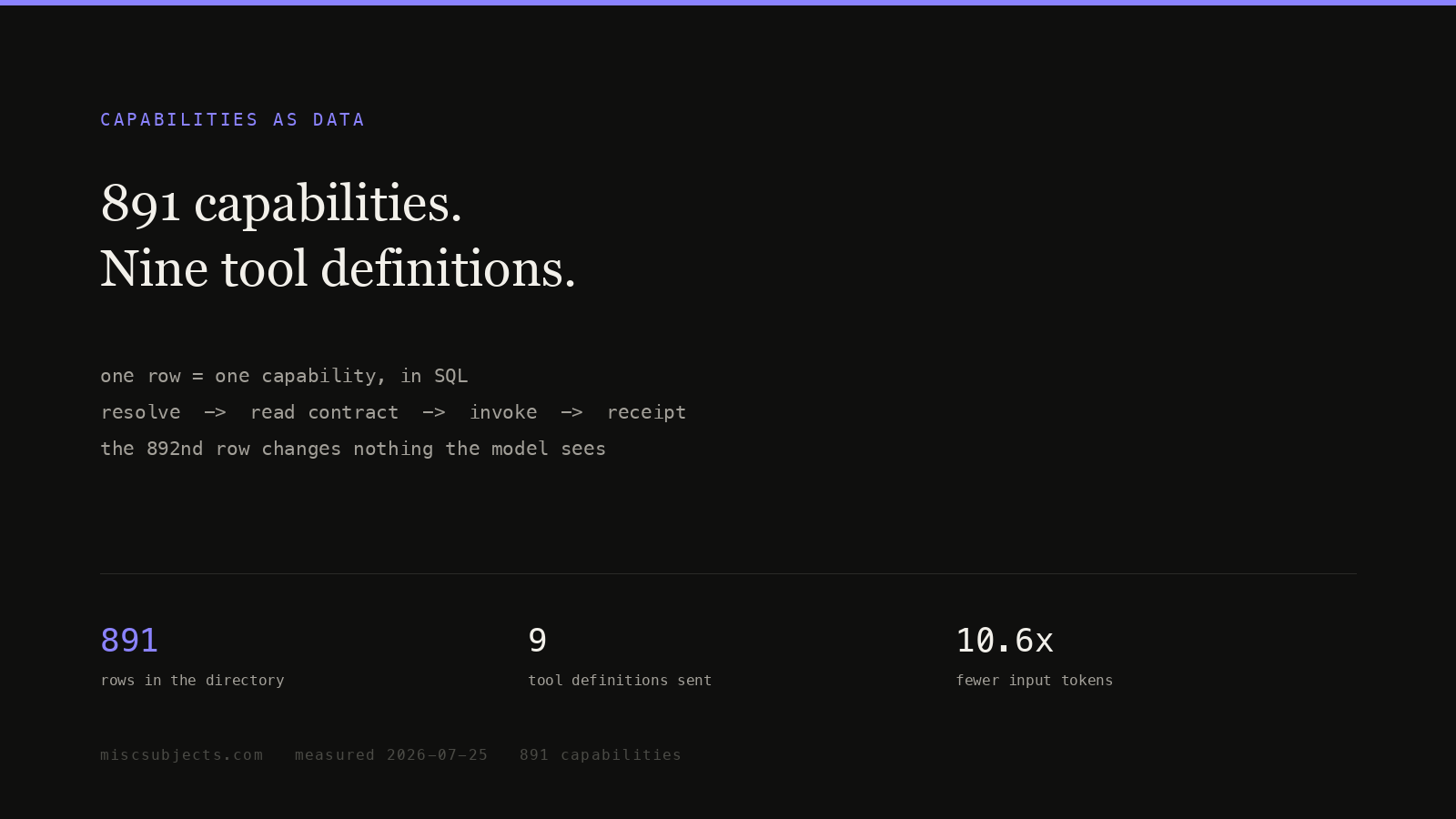
Nine tool definitions reach every capability: the catalogue is a SQL table, not a prompt
The same 891-capability catalogue measured three ways on one build: 149,187 input tokens a turn as MCP tool definitions, 14,109 with deferred tool search, 14,071 with no MCP server at all.
A model's capabilities do not have to live in its context. On this build they live in a SQLite table on Cloudflare D1 called directory — one row per capability, reachable through one HTTP endpoint — and the model is shown nine tool definitions. Not nine capabilities. Nine definitions, and every row in the table behind them.
Scope note: this measures one thing — what it costs to expose this catalogue to a model three ways. It is not a claim that the catalogue is the whole architecture. 892 rows, 8 of them MCP breaks the same directory table down by runner and category: eight rows are tagged category='mcp'; the rest are API calls, shell commands, Mac-local actions and agents. It also names the separate articles table and resolver, which this table and its dispatch() function do not cover.
The default in every agent stack is the opposite: each capability is a tool definition, each definition is JSON Schema, and the whole set is transmitted on every request. That puts catalogue size in the per-turn cost equation. This design takes it out.
Evidence status
Observed marks first-party measurements or runtime receipts from the named environment. Derived marks arithmetic calculated from cited inputs. Specified marks vendor or standards documentation. Implemented and deployed name code and live-state evidence, respectively. Reproduced means the stated procedure was rerun. Externally attested marks operator reports; those reports show that an experience occurred, not that it is universal.
The same catalogue, exposed three ways, measured on the same day
One build, one table, one model. Only the exposure changes. Measured 2026-07-25 on @cf/moonshotai/kimi-k2.7-code through Cloudflare AI Gateway, claude-cli 2.1.165 as the client, figures read from gateway log rows and wire captures rather than estimated.
Exposure
What the request carries
Input tokens, one turn
Cost, that turn
One MCP tool per row (POST /api/mcp, tools/list)
856 tool definitions
149,187
$0.02852109
Same server, host defers the definitions (ENABLE_TOOL_SEARCH=true)
9 definitions + a search tool
14,109
$0.00443075
No MCP server attached; capabilities reached over HTTP
9 built-in tool definitions
14,071
$0.00456265
All three rows reach the same capabilities. The first costs 10.6× the input tokens of the third for identical reach.
The honest finding: at this size the two cheap designs cost the same
14,109 against 14,071 is a difference of 38 input tokens, 0.27%. In dollars the deferred-tool turn came out 3.0% cheaper, because the turn totals include output tokens and the two turns did not produce identical output. Anyone reading this page for a cost argument between rows two and three will not find one. At 891 rows, deferred tool search and catalogue-as-data are the same price.
The difference is structural, and it does not expire when the numbers do:
Row two's cost is a function of how many definitions the model retrieves. Row three's is a function of the protocol, which is four endpoints regardless of table size.
Row two needs the host to implement deferral. Row three needs the model to be able to make an HTTP request.
What would falsify the structural claim: a harness where deferred loading is free at any catalogue size and is implemented uniformly across clients. Section "Deferral is a host feature, and hosts disagree about it" is where that claim currently breaks. What would falsify the cost claim: a catalogue an order of magnitude larger, where the retrieved-definition cost of row two starts to bite while row three stays flat. That measurement has not been taken here and is not claimed.
defer_loading controls context, not the request
The vendor documentation is explicit about what deferral does and does not remove, and it is the single most load-bearing fact on this page:
defer_loading controls what enters the context window, not what you send in the request: You still send every tool's full definition in the tools array on every request, including the deferred ones. The API needs them server-side to run the search and expand tool_reference blocks.
— Anthropic, Tool search tool
So the catalogue is still enumerated, still serialised, still transmitted, every turn. It is simply not billed as context. On this build that array would be 831 tool objects and 451,197 bytes of JSON, measured live below. The client is doing that work whether or not the model reads it.
Anthropic also publishes the billing rule that makes definitions expensive in the first place: pricing counts "the total number of input tokens sent to the model (including in the tools parameter)". Names, descriptions and schemas are input tokens. They are re-sent every turn. They scale with how many capabilities exist.
Two independent numbers put a floor under that. Anthropic's own doc says a five-server setup — GitHub, Slack, Sentry, Grafana, Splunk — "can consume ~55k tokens in definitions before Claude does any work". The Scalekit benchmark, 5 GitHub tasks against anthropics/anthropic-sdk-python, Claude Sonnet 4, pre-registered hypotheses and 30 runs per arm, found the simplest task cost 1,365 tokens through a shell and 44,026 through GitHub's MCP server, and attributes it: "The difference is almost entirely schema: 43 tool definitions injected into every conversation, of which the agent uses one or two."
Divide this build's own numbers the same way. (149,187 − 14,071) ÷ 856 = 157.8 input tokens per definition. That is close to the back-of-envelope a commenter used on Hacker News — "Say each tool is 150 tokens, that's 150 * 50, or 7500 tokens, dumped into the beginning of every session" — which means the per-definition constant is stable enough to plan against.
One row is one capability, and this is one row
AIG_LIST lists the AI Gateways on a Cloudflare account. Read live with:
Primary key and invocation name. The only identifier a caller needs.
type
http
One of fn, http, agent, flow. Decides which runner executes the row.
target
GET https://api.cloudflare.com/client/v4/accounts/$1/ai-gateway/gateways
Where the work happens. $1 is the first positional argument.
auth
bearer:CLOUDFLARE_API_TOKEN
The name of the environment variable holding the credential. Never the credential.
content
# WHAT: List AI Gateways on the account<br># WHEN_TO_USE: you need to aig list<br># ARGS: account_id<br># EX: [AIG_LIST][/AIG_LIST]
Docstring lines then the argument template. The # lines are the contract a model reads; everything after them is the executable payload.
category
null
Grouping tag. Used to filter the registry (?registry=1&category=…).
planner_rank
100
Sort order when a planner is choosing between candidates. Lower ranks first.
enabled
1
0 removes it from every projection without deleting the history.
planner_visible
1
0 keeps it invocable but hides it from planners and from the MCP projection.
input_schema
null
Optional JSON Schema. Only consulted when the row is projected as an MCP tool.
The field list is not folklore — it is declared in code at /Users/owner/miscsubjects-pages/functions/_lib/dir_schema.js lines 6–29, which is embedded in /api/directory responses so a client can learn the shape without prior knowledge. The docstring parser that splits # lines from the payload is extractDocs/stripDocs in functions/api/dispatch.js lines 431–450.
The full field reference, all four type values and what each runner does: What a directory row is.
Four counts of the same catalogue, all of them correct
Ask the build how many capabilities it has and you get four different numbers. They are not a bug and they must not be reconciled by editing one to match another. Each is a different predicate over the same table.
Taken live at 2026-07-26T04:37:42Z:
shell
1
2
3
4
5
npx wrangler d1 execute loop-content-spine --remote --command \
  "SELECT COUNT(*) AS rows_total,
          SUM(CASE WHEN IFNULL(enabled,1)=1 THEN 1 ELSE 0 END) AS enabled,
          SUM(CASE WHEN IFNULL(enabled,1)=1 AND IFNULL(planner_visible,1)=1 THEN 1 ELSE 0 END) AS mcp_projected
   FROM directory;" --json
Line 5, Column 1Shell Script
Number
Surface it appears on
The predicate
Where the predicate lives
892
The table itself
every row
SELECT COUNT(*) FROM directory
879
GET /api/dispatch?map=1 → total
IFNULL(enabled,1)=1
13 rows are disabled and stay in the table for their history
877
GET /api/dispatch?registry=1 → count
enabled, minus test-shaped keys
TEST_ID_PATTERN at functions/_lib/object_contract.js:2477, applied at :2481-2483
832
POST /api/mcptools/list
IFNULL(enabled,1)=1 AND IFNULL(planner_visible,1)=1
listTools() at functions/api/mcp.js:118-123
The measurement day's figures were 891 / 878 / — / 856. The table is live and other writers touch it, so a rerun returns whatever it holds at that instant; between the first and last command in this session a row was inserted by another process. That is the point of the design, not an inconvenience to it. The gap between 892 and 832 — 60 rows — is entirely disabled rows plus rows deliberately hidden from planners.
Counting the projection, live
The MCP projection is a real server and the definition array can be weighed directly. Command:
Result at 2026-07-26T04:38Z: 831 tools, 451,197 bytes of tools array, mean 543 bytes per definition. That is the payload a client sends on every request under defer_loading, and the payload a model reads without it.
A model that has never seen this build gets from question to receipt in four calls
No SDK, no client library, no prior knowledge. Four HTTP calls.
1 — Ask in plain language.GET https://miscsubjects.com/api/dispatch?ask=what%20time%20is%20it returns count: 12, a best block, and twelve ranked candidates each with a runnable URL:
json
1
2
3
"best": { "key": "NOW",
          "run_now": "https://miscsubjects.com/api/dispatch?invoke=NOW&share=<TOKEN>",
          "do": "Open run_now to do it. Substitute your own text/args where the example has them." }
Line 3, Column 1JSON
2 — Read the contract.GET https://miscsubjects.com/api/dispatch?key=NOW&format=markdown returns that capability's _self block: what it is, the exact POST shape, the argument template, the output contract, the auth and risk level, the troubleshooting table, and the ledger and repair addresses.
4 — Take the receipt. The response carries proof.invocation_id and three addresses: a credentialed forensic receipt, a keyless public confirmation, and a public brochure.
The resolver is a substring scorer, and the tail of its output is noise
answerAsk at functions/_lib/object_contract.js:605-640 scores every enabled row: +3 if a query term appears in the key, +1 if it appears anywhere in key, category or docstring, +1000 for a hand-pinned canonical match, −6 for a row on the demote list. Top twelve are returned.
For ?ask=what is it the pinned answer is right and the rest is garbage. The live twelve for "what time is it":
The GitHub rows match because the two-character term is is a substring of issue. There are no embeddings, no BM25, no stemming and no synonym table. A query using a word the row never uses will miss it. Anthropic's own tool search offers BM25 and regex variants for exactly this reason, and one commenter names the trade honestly: "Seems like we traded scalability for accuracy, then accuracy for scalability… but I guess maybe we've come out on top because whatever they are using for tool search is better than RAG?" On this build the mitigation is the recommended pin, which is a hand-maintained list, which is a real maintenance cost.
What a row carries that a list of endpoints does not
"Put it behind an API" is not the same design. Five things live in the row that a bare endpoint list leaves to convention:
The row carries
A bare endpoint list has
Why it matters to a model
A docstring contract (WHAT / WHEN_TO_USE / ARGS / EX)
A path and a method
The model learns when to call it, not just how.
An auth field naming an environment variable
A credential the caller must already hold
The catalogue is publishable; the secret never appears in it.
A receipt per invocation, addressable
Whatever the server logged
Failure is inspectable at a URL instead of narratable.
A repair address (repairs: inv_ID)
A retry
A corrected call is linked to the failed one; lineage closes.
enabled / planner_visible flags
A deploy
Withdrawing a capability is an UPDATE.
The strongest objection to all of this, from someone who means it
The case against is not "MCP is fine". It is that a decorated index of features beats a bare endpoint list for a model, and that decoration is the whole product:
It's like saying APIs are dead because you can just use HTTP. They're not the same thing, though of course you can hand-roll the higher layer in the lower one. It's just more work, less standard, less valuable.
— brookst, Hacker News, 2026-05-30
That is correct as stated, and this design does not contradict it. The directory row is the decorated index: the decoration is the docstring, the auth field, the schema and the flags. What is rejected is the claim that the decoration must arrive as tool definitions in the prompt. A second commenter puts the same point at the protocol level — "The idea that MCP tool definitions take up a certain number of tokens is laughable. That's an implementation detail of the agent harness." — and a third calls deferral table stakes: "Most mature harnesses do some kind of tool search and/or progressive disclosure."
Both are right that token cost is a harness property. The reply is narrow: a harness property is exactly the thing this design refuses to depend on.
Deferral is a host feature, and hosts disagree about it
That refusal is not theoretical. Every claim below is a filed, reproducible report:
Reported
Client
Effect
Deferred search does not index claude.ai-hosted MCP servers
Claude Code 2.1.114
Tools show Connected in /mcp, ToolSearch returns zero results for them
The deferral threshold is computed from model.default, not the session model
hermes-agent
A 98,304-token local model gets a threshold sized for a 256K cloud model
Built-in server schemas load non-deferred with no opt-out
Claude Desktop
~3.9k tokens of first-party schemas escape deferral every session
A configured tool deferred behind tool_search yields an empty turn
codex-cli 0.133.0
codex exec completes with no assistant message
notifications/tools/list_changed ignored
Kiro IDE
New tools never appear until manual reconnection
Same notification ignored
GitHub Copilot CLI
Tool list never refreshes; VS Code updates immediately
The last two matter for the next section: the MCP specification's answer to adding a capability at runtime is that servers "SHOULD send a notification", notifications/tools/list_changed. It is a SHOULD on the server and a silent no-op in at least two shipping clients.
The 892nd capability costs one POST and no deploy
Not an argument — a round trip run for this page.
shell
1
2
3
4
5
curl -X POST https://miscsubjects.com/api/directory \
  -H "x-terminal-key: $TERMINAL_KEY" -H 'content-type: application/json' \
  -d '{"key":"__DOC_PROBE","type":"http",
       "target":"GET https://miscsubjects.com/api/dispatch?key=TIME_NOW",
       "category":"docs","content":"# WHAT: Probe row created to time one capability insert.\n# ARGS: none\n"}'
Row count went 891 → 892. No build, no deploy, no client restart, no reconnect. Thirty-five seconds later — the directory snapshot cache is a 30-second KV entry, set in loadDirectory() at functions/api/dispatch.js:413-429 — the new capability had a full self-describing contract at ?key=__DOC_PROBE, and invoking it returned:
The receipt is still public: GET https://miscsubjects.com/api/dispatch?confirm=inv_z77vqe1qi6 returns "confirmed": true with no credential. The probe row was then deleted (DELETE /api/directory/__DOC_PROBE → {"ok":true,"deleted":1}); the receipt survives the row, because receipts are append-only and rows are not.
The equivalent under definitions-in-context is: publish a new definition, emit notifications/tools/list_changed, and hope the client re-queries. Two of the clients above do not.
Where this design loses
Stated plainly, because a page that argues one way is not worth reading.
It needs a running service. The catalogue is a table behind a Worker. If miscsubjects.com is down, there are zero capabilities. An MCP server on stdio keeps working with no network.
There is no client-side discovery. Nothing enumerates the catalogue into a UI, a permission prompt or a tool picker. MCP clients render tool lists, ask for consent per call, and show the user what the model can reach. The specification says implementations "SHOULD" keep a human in the loop; here the human-in-the-loop surface has to be built.
A model that cannot make HTTP calls cannot use any of it. Every model behind this page can. That is an assumption, not a law.
There is no ecosystem. No marketplace, no registry of third-party servers, no npx one-liner, no standard anyone else implements. Wrapping someone else's MCP server means writing rows.
Retrieval quality is worse than a purpose-built search. Substring scoring plus a hand-pinned list, versus BM25 or regex with a vendor tuning it.
The resolver is a single point of failure for discovery. If ?ask= ranks wrong, the model does not know what it missed. A full definition list has no ranking to get wrong.
Round trips. Discovery is a network call before the work. One commenter frames the whole MCP-versus-in-context debate this way — "I call this 'speed of light' as opposed to 'carrier pigeon'" — and the criticism lands here too: reading a contract costs a turn that an in-context definition does not.
The month, multiplied out
At 200 model turns per day, one seat, the measured per-turn costs above:
Exposure
Per turn
× 200 turns/day
× 30 days
Per-row MCP, definitions in context
$0.02852109
$5.704218
$171.13
Deferred tool search
$0.00443075
$0.886150
$26.58
No MCP server, capabilities over HTTP
$0.00456265
$0.912530
$27.38
$171.13 − $27.38 = $143.75 a month per seat, for exactly the same reach. Between the two cheap rows the difference is $0.79 a month, which is not a reason to choose either. Choose row three when the capability layer has to outlive one vendor's tool-calling implementation; choose row two when the host already implements deferral and the catalogue is already MCP servers.
The row is disabled, deleted, or the key is misspelled
GET /api/dispatch?ask=<intent> and use best.key; never guess a neighbouring key
A brand-new row 404s for up to 30 seconds
loadDirectory() caches the directory snapshot in KV for 30 s (dispatch.js:413-429)
Wait it out, or the write path calls invalidateDirSnapshot(env) (functions/api/directory/index.js:73)
tools/list returns fewer tools than the table has rows
planner_visible=0 and enabled=0 rows are excluded (mcp.js:118-123)
Correct behaviour. Do not edit the count to match the table
POST /api/mcp → -32001 unauthorized
The MCP projection takes Authorization: Bearer <MCP_TOKEN> or x-mcp-token, not the terminal key (mcp.js:24-27)
Send the MCP token
A capability runs but proof.ok is false
The runner returned no material output
Read the receipt and fire a repair: {"key":"…","body":"corrected","repairs":"inv_ID"}
?ask= returns the right row buried below GitHub rows
Two-letter query terms match as substrings (object_contract.js:605-640)
Query with a distinctive noun, or add the row to the canonical pin list
14,071
input tokens per turn with no MCP server attached, 891 capabilities reachable
149,187
input tokens for the same catalogue as per-row MCP tool definitions
157.8
input tokens per tool definition, measured on this build (149,187 - 14,071) / 856
451,197
bytes of tools array returned live by tools/list, 831 definitions
0.437946 s
HTTP 201 round trip to add the 892nd capability. No deploy
$143.75
monthly difference per seat at 200 turns/day, definitions-in-context vs protocol
It's like saying APIs are dead because you can just use HTTP. They're not the same thing, though of course you can hand-roll the higher layer in the lower one. It's just more work, less standard, less valuable.— brookst, Hacker News, 2026-05-30 — the strongest objection to this design
References (33)
Tool search tool — Anthropic, Jul 26, 2026“defer_loading controls what enters the context window, not what you send in the request: You still send every tool's full definition in the tools array on every request, including the deferred ones. The API needs them server-side to run the search and expand tool_reference blocks.”
Tool use with Claude — Pricing — Anthropic, Jul 26, 2026“The total number of input tokens sent to the model (including in the tools parameter)”
Tool search tool — context bloat and selection accuracy — Anthropic, Jul 26, 2026“A typical multiserver setup (GitHub, Slack, Sentry, Grafana, and Splunk) can consume ~55k tokens in definitions before Claude does any work. Tool search typically reduces this by over 85 percent, loading only the 3-5 tools Claude needs for a given request.”
Model Context Protocol specification 2025-11-25 — Server Features: Tools — Model Context Protocol, Nov 25, 2025“When the list of available tools changes, servers that declared the listChanged capability SHOULD send a notification: { "jsonrpc": "2.0", "method": "notifications/tools/list_changed" }”
MCP vs CLI: Benchmarking AI Agent Cost & Reliability — Scalekit, Jul 26, 2026“The difference is almost entirely schema: 43 tool definitions injected into every conversation, of which the agent uses one or two.”
[Feature] Lazy-load MCP tool definitions to reduce token overhead — GitHub, Jul 5, 2026“With 9 MCP servers connected (project-tools, supabase, agent-browser, chrome-devtools, playwright, memory, context7, sequential-thinking, fetch), this results in ~40,000-70,000 tokens of tool definitions loaded upfront”
`GCORE_TOOLS=*` advertises ~488k tokens of tool definitions — GitHub, Jul 11, 2026“with `GCORE_TOOLS=*` it advertises **741 tools / ~488,013 tokens** (659/tool) — that exceeds a 200K context window on its own, so the full config can't actually be used with most models.”
Comment on: Apideck CLI — lower context consumption than MCP — Hacker News, Mar 16, 2026“We built a unified API with a large surface area and ran into a problem when building our MCP server: tool definitions alone burned 50,000+ tokens before the agent touched a single user message.”
Comment on: MCP is dead? — Hacker News, May 29, 2026“Say each tool is 150 tokens, that's 150 * 50, or 7500 tokens, dumped into the beginning of every session.”
Comment on: MCP is dead? — Hacker News, May 30, 2026“It's like saying APIs are dead because you can just use HTTP. They're not the same thing, though of course you can hand-roll the higher layer in the lower one. It's just more work, less standard, less valuable.”
Comment on: MCP is dead? — Hacker News, May 30, 2026“The idea that MCP tool definitions take up a certain number of tokens is laughable. That's an implementation detail of the agent harness.”
Comment on: Zero-Touch OAuth for MCP — Hacker News, Jun 19, 2026“Most mature harnesses do some kind of tool search and/or progressive disclosure.”
Comment on: Claude Advanced Tool Use — Hacker News, Nov 24, 2025“Seems like we traded scalability for accuracy, then accuracy for scalability… but I guess maybe we've come out on top because whatever they are using for tool search is better than RAG?”
tool_search auto-gate computes its threshold from model.default — GitHub, Jul 3, 2026“For any session running a model *other than* the configured default (e.g. `--model qwen3.6-27b --provider llamacpp`, or a model switched via `/model` in the TUI), the gate is scaled to the wrong window.”
Desktop: ~3.9k tokens of built-in MCP tool schemas load non-deferred — GitHub, Jul 10, 2026“With tool search active (`ENABLE_TOOL_SEARCH` unset), third-party MCP tools correctly defer to names-only. But three Desktop built-in servers load complete schemas upfront every session”
Kiro IDE does not handle MCP notifications/tools/list_changed — GitHub, Mar 20, 2026“When an MCP server dynamically adds or removes tools at runtime and sends this notification per the MCP spec, Kiro IDE does not re-query tools/list, so the new tools never appear until the server is manually reconnected.”
Comment on: Agent Skills — Hacker News, Feb 3, 2026“I call this "speed of light" as opposed to "carrier pigeon".”
Comment on: When does MCP make sense vs CLI? — Hacker News, Mar 1, 2026“The main problem with this approach at the moment is it busts your prompt cache, because LLMs expect all tool definitions to be defined at the beginning of the context window.”
Comment on: MCP is dead; long live MCP — Hacker News, Mar 14, 2026“Tool results from programmatic calls are not added to Claude's context window, only the final code output is. They report up to 98.7% token savings in some workflows.”
First-party: the same catalogue exposed three ways — miscsubjects.com, Jul 25, 2026“856 definitions / 149,187 input tokens / $0.02852109 · 9 + search / 14,109 / $0.00443075 · protocol only / 14,071 / $0.00456265”
{
"schema":"http://google-preview.miscsubjects.com/schemas/jarticle.json",
"status":"published",
"slug":"tooling-as-data",
"title":"Nine tool definitions reach every capability: the catalogue is a SQL table, not a prompt",
"kind":"essay",
"summary":"The same 891-capability catalogue measured three ways on one build: 149,187 input tokens a turn as MCP tool definitions, 14,109 with deferred tool search, 14,071 with no MCP server at all.",
"created":"2026-07-26T03:52:37.503Z",
"body": [
"A model's capabilities do not have to live in its context. On this build they live in a SQLite table on Cloudflare D1 called `directory` — one row per capability, reachable through one HTTP endpoint — and the model is shown nine tool definitions. Not nine capabilities. Nine definitions, and every row in the table behind them.\n\n**Scope note:** this measures one thing — what it costs to expose *this* catalogue to a model three ways. It is not a claim that the catalogue is the whole architecture. [892 rows, 8 of them MCP](/a/the-directory-is-not-the-object-system) breaks the same `directory` table down by runner and category: eight rows are tagged `category='mcp'`; the rest are API calls, shell commands, Mac-local actions and agents. It also names the separate `articles` table and resolver, which this table and its `dispatch()` function do not cover.\n\nThe default in every agent stack is the opposite: each capability is a tool definition, each definition is JSON Schema, and the whole set is transmitted on every request. That puts catalogue size in the per-turn cost equation. This design takes it out.\n\n## Evidence status\n\n**Observed** marks first-party measurements or runtime receipts from the named environment.\n**Derived** marks arithmetic calculated from cited inputs. **Specified** marks vendor or standards\ndocumentation. **Implemented** and **deployed** name code and live-state evidence, respectively.\n**Reproduced** means the stated procedure was rerun. **Externally attested** marks operator reports;\nthose reports show that an experience occurred, not that it is universal.\n\n## The same catalogue, exposed three ways, measured on the same day\n\nOne build, one table, one model. Only the exposure changes. Measured 2026-07-25 on `@cf/moonshotai/kimi-k2.7-code` through Cloudflare AI Gateway, `claude-cli` 2.1.165 as the client, figures read from gateway log rows and wire captures rather than estimated.\n\n| Exposure | What the request carries | Input tokens, one turn | Cost, that turn |\n| --- | --- | --- | --- |\n| One MCP tool per row (`POST /api/mcp`, `tools/list`) | 856 tool definitions | 149,187 | $0.02852109 |\n| Same server, host defers the definitions (`ENABLE_TOOL_SEARCH=true`) | 9 definitions + a search tool | 14,109 | $0.00443075 |\n| No MCP server attached; capabilities reached over HTTP | 9 built-in tool definitions | 14,071 | $0.00456265 |\n\nAll three rows reach the same capabilities. The first costs 10.6× the input tokens of the third for identical reach.\n\n## The honest finding: at this size the two cheap designs cost the same\n\n14,109 against 14,071 is a difference of 38 input tokens, 0.27%. In dollars the deferred-tool turn came out 3.0% cheaper, because the turn totals include output tokens and the two turns did not produce identical output. Anyone reading this page for a cost argument between rows two and three will not find one. **At 891 rows, deferred tool search and catalogue-as-data are the same price.**\n\nThe difference is structural, and it does not expire when the numbers do:\n\n- Row two's cost is a function of how many definitions the model retrieves. Row three's is a function of the protocol, which is four endpoints regardless of table size.\n- Row two needs the host to implement deferral. Row three needs the model to be able to make an HTTP request.\n\nWhat would falsify the structural claim: a harness where deferred loading is free at any catalogue size *and* is implemented uniformly across clients. Section \"Deferral is a host feature, and hosts disagree about it\" is where that claim currently breaks. What would falsify the cost claim: a catalogue an order of magnitude larger, where the retrieved-definition cost of row two starts to bite while row three stays flat. That measurement has not been taken here and is not claimed.\n\n## `defer_loading` controls context, not the request\n\nThe vendor documentation is explicit about what deferral does and does not remove, and it is the single most load-bearing fact on this page:\n\n> `defer_loading` controls what enters the context window, not what you send in the request: You still send every tool's full definition in the `tools` array on every request, including the deferred ones. The API needs them server-side to run the search and expand `tool_reference` blocks.\n\n— Anthropic, *Tool search tool*\n\nSo the catalogue is still enumerated, still serialised, still transmitted, every turn. It is simply not billed as context. On this build that array would be 831 tool objects and 451,197 bytes of JSON, measured live below. The client is doing that work whether or not the model reads it.\n\nAnthropic also publishes the billing rule that makes definitions expensive in the first place: pricing counts \"the total number of input tokens sent to the model (including in the `tools` parameter)\". Names, descriptions and schemas are input tokens. They are re-sent every turn. They scale with how many capabilities exist.\n\nTwo independent numbers put a floor under that. Anthropic's own doc says a five-server setup — GitHub, Slack, Sentry, Grafana, Splunk — \"can consume ~55k tokens in definitions before Claude does any work\". The Scalekit benchmark, 5 GitHub tasks against `anthropics/anthropic-sdk-python`, Claude Sonnet 4, pre-registered hypotheses and 30 runs per arm, found the simplest task cost 1,365 tokens through a shell and 44,026 through GitHub's MCP server, and attributes it: \"The difference is almost entirely schema: 43 tool definitions injected into every conversation, of which the agent uses one or two.\"\n\nDivide this build's own numbers the same way. (149,187 − 14,071) ÷ 856 = **157.8 input tokens per definition**. That is close to the back-of-envelope a commenter used on Hacker News — \"Say each tool is 150 tokens, that's 150 * 50, or 7500 tokens, dumped into the beginning of every session\" — which means the per-definition constant is stable enough to plan against.\n\n## One row is one capability, and this is one row\n\n`AIG_LIST` lists the AI Gateways on a Cloudflare account. Read live with:\n\n```\ncurl -s \"https://miscsubjects.com/api/directory/AIG_LIST\" -H \"x-terminal-key: $TERMINAL_KEY\"\n```\n\nEvery field it carries, verbatim:\n\n| Field | Value in `AIG_LIST` | What it does |\n| --- | --- | --- |\n| `key` | `AIG_LIST` | Primary key and invocation name. The only identifier a caller needs. |\n| `type` | `http` | One of `fn`, `http`, `agent`, `flow`. Decides which runner executes the row. |\n| `target` | `GET https://api.cloudflare.com/client/v4/accounts/$1/ai-gateway/gateways` | Where the work happens. `$1` is the first positional argument. |\n| `auth` | `bearer:CLOUDFLARE_API_TOKEN` | The **name** of the environment variable holding the credential. Never the credential. |\n| `content` | `# WHAT: List AI Gateways on the account`<br>`# WHEN_TO_USE: you need to aig list`<br>`# ARGS: account_id`<br>`# EX: [AIG_LIST][/AIG_LIST]` | Docstring lines then the argument template. The `#` lines are the contract a model reads; everything after them is the executable payload. |\n| `category` | `null` | Grouping tag. Used to filter the registry (`?registry=1&category=…`). |\n| `planner_rank` | `100` | Sort order when a planner is choosing between candidates. Lower ranks first. |\n| `enabled` | `1` | `0` removes it from every projection without deleting the history. |\n| `planner_visible` | `1` | `0` keeps it invocable but hides it from planners and from the MCP projection. |\n| `input_schema` | `null` | Optional JSON Schema. Only consulted when the row is projected as an MCP tool. |\n\nThe field list is not folklore — it is declared in code at `/Users/owner/miscsubjects-pages/functions/_lib/dir_schema.js` lines 6–29, which is embedded in `/api/directory` responses so a client can learn the shape without prior knowledge. The docstring parser that splits `#` lines from the payload is `extractDocs`/`stripDocs` in `functions/api/dispatch.js` lines 431–450.\n\nThe full field reference, all four `type` values and what each runner does: [What a directory row is](/a/directory-row-contract).\n\n## Four counts of the same catalogue, all of them correct\n\nAsk the build how many capabilities it has and you get four different numbers. They are not a bug and they must not be reconciled by editing one to match another. Each is a different predicate over the same table.\n\nTaken live at **2026-07-26T04:37:42Z**:\n\n```\nnpx wrangler d1 execute loop-content-spine --remote --command \\\n \"SELECT COUNT(*) AS rows_total,\n SUM(CASE WHEN IFNULL(enabled,1)=1 THEN 1 ELSE 0 END) AS enabled,\n SUM(CASE WHEN IFNULL(enabled,1)=1 AND IFNULL(planner_visible,1)=1 THEN 1 ELSE 0 END) AS mcp_projected\n FROM directory;\" --json\n```\n\n| Number | Surface it appears on | The predicate | Where the predicate lives |\n| --- | --- | --- | --- |\n| **892** | The table itself | every row | `SELECT COUNT(*) FROM directory` |\n| **879** | `GET /api/dispatch?map=1` → `total` | `IFNULL(enabled,1)=1` | 13 rows are disabled and stay in the table for their history |\n| **877** | `GET /api/dispatch?registry=1` → `count` | enabled, minus test-shaped keys | `TEST_ID_PATTERN` at `functions/_lib/object_contract.js:2477`, applied at `:2481-2483` |\n| **832** | `POST /api/mcp` `tools/list` | `IFNULL(enabled,1)=1 AND IFNULL(planner_visible,1)=1` | `listTools()` at `functions/api/mcp.js:118-123` |\n\nThe measurement day's figures were 891 / 878 / — / 856. The table is live and other writers touch it, so a rerun returns whatever it holds at that instant; between the first and last command in this session a row was inserted by another process. That is the point of the design, not an inconvenience to it. The gap between 892 and 832 — 60 rows — is entirely disabled rows plus rows deliberately hidden from planners.\n\n## Counting the projection, live\n\nThe MCP projection is a real server and the definition array can be weighed directly. Command:\n\n```\ncurl -s -X POST https://miscsubjects.com/api/mcp \\\n -H \"Authorization: Bearer $MCP_TOKEN\" \\\n -H 'content-type: application/json' \\\n -H 'accept: application/json, text/event-stream' \\\n -d '{\"jsonrpc\":\"2.0\",\"id\":1,\"method\":\"tools/list\"}'\n```\n\nResult at 2026-07-26T04:38Z: **831 tools**, **451,197 bytes** of `tools` array, mean **543 bytes per definition**. That is the payload a client sends on every request under `defer_loading`, and the payload a model reads without it.\n\n## A model that has never seen this build gets from question to receipt in four calls\n\nNo SDK, no client library, no prior knowledge. Four HTTP calls.\n\n**1 — Ask in plain language.** `GET https://miscsubjects.com/api/dispatch?ask=what%20time%20is%20it` returns `count: 12`, a `best` block, and twelve ranked candidates each with a runnable URL:\n\n```json\n\"best\": { \"key\": \"NOW\",\n \"run_now\": \"https://miscsubjects.com/api/dispatch?invoke=NOW&share=<TOKEN>\",\n \"do\": \"Open run_now to do it. Substitute your own text/args where the example has them.\" }\n```\n\n**2 — Read the contract.** `GET https://miscsubjects.com/api/dispatch?key=NOW&format=markdown` returns that capability's `_self` block: what it is, the exact POST shape, the argument template, the output contract, the auth and risk level, the troubleshooting table, and the ledger and repair addresses.\n\n**3 — Invoke.** `POST https://miscsubjects.com/api/dispatch {\"key\":\"NOW\",\"body\":\"\"}`.\n\n**4 — Take the receipt.** The response carries `proof.invocation_id` and three addresses: a credentialed forensic receipt, a keyless public confirmation, and a public brochure.\n\nEach step with its full request and response: [The four-step loop](/a/dispatch-four-step-loop).\n\n## The resolver is a substring scorer, and the tail of its output is noise\n\n`answerAsk` at `functions/_lib/object_contract.js:605-640` scores every enabled row: +3 if a query term appears in the key, +1 if it appears anywhere in key, category or docstring, +1000 for a hand-pinned canonical match, −6 for a row on the demote list. Top twelve are returned.\n\nFor `?ask=what is it` the pinned answer is right and the rest is garbage. The live twelve for \"what time is it\":\n\n`NOW`, `GITHUB_LIST_ISSUES`, `GITHUB_GET_ISSUE`, `GITHUB_ADD_ISSUE_COMMENT`, `GITHUB_CREATE_ISSUE`, `GITHUB_CLOSE_ISSUE`, `LOCAL_EDIT`, `LOCAL_WRITE`, `CLI_GIT`, `WRITER_AGENT`, `BLOOIO_LIST_CONTACT_IDENTITIES`, `STRIPE_INVOICE_ITEMS_LIST`\n\nThe GitHub rows match because the two-character term `is` is a substring of `issue`. There are no embeddings, no BM25, no stemming and no synonym table. A query using a word the row never uses will miss it. Anthropic's own tool search offers BM25 and regex variants for exactly this reason, and one commenter names the trade honestly: \"Seems like we traded scalability for accuracy, then accuracy for scalability… but I guess maybe we've come out on top because whatever they are using for tool search is better than RAG?\" On this build the mitigation is the `recommended` pin, which is a hand-maintained list, which is a real maintenance cost.\n\n## What a row carries that a list of endpoints does not\n\n\"Put it behind an API\" is not the same design. Five things live in the row that a bare endpoint list leaves to convention:\n\n| The row carries | A bare endpoint list has | Why it matters to a model |\n| --- | --- | --- |\n| A docstring contract (`WHAT` / `WHEN_TO_USE` / `ARGS` / `EX`) | A path and a method | The model learns *when* to call it, not just how. |\n| An auth field naming an environment variable | A credential the caller must already hold | The catalogue is publishable; the secret never appears in it. |\n| A receipt per invocation, addressable | Whatever the server logged | Failure is inspectable at a URL instead of narratable. |\n| A repair address (`repairs: inv_ID`) | A retry | A corrected call is linked to the failed one; lineage closes. |\n| `enabled` / `planner_visible` flags | A deploy | Withdrawing a capability is an `UPDATE`. |\n\n## The strongest objection to all of this, from someone who means it\n\nThe case against is not \"MCP is fine\". It is that a decorated index of features beats a bare endpoint list for a model, and that decoration is the whole product:\n\n> It's like saying APIs are dead because you can just use HTTP. They're not the same thing, though of course you can hand-roll the higher layer in the lower one. It's just more work, less standard, less valuable.\n\n— brookst, Hacker News, 2026-05-30\n\nThat is correct as stated, and this design does not contradict it. The `directory` row *is* the decorated index: the decoration is the docstring, the auth field, the schema and the flags. What is rejected is the claim that the decoration must arrive as tool definitions in the prompt. A second commenter puts the same point at the protocol level — \"The idea that MCP tool definitions take up a certain number of tokens is laughable. That's an implementation detail of the agent harness.\" — and a third calls deferral table stakes: \"Most mature harnesses do some kind of tool search and/or progressive disclosure.\"\n\nBoth are right that token cost is a harness property. The reply is narrow: a harness property is exactly the thing this design refuses to depend on.\n\n## Deferral is a host feature, and hosts disagree about it\n\nThat refusal is not theoretical. Every claim below is a filed, reproducible report:\n\n| Reported | Client | Effect |\n| --- | --- | --- |\n| Deferred search does not index claude.ai-hosted MCP servers | Claude Code 2.1.114 | Tools show Connected in `/mcp`, `ToolSearch` returns zero results for them |\n| The deferral threshold is computed from `model.default`, not the session model | hermes-agent | A 98,304-token local model gets a threshold sized for a 256K cloud model |\n| Built-in server schemas load non-deferred with no opt-out | Claude Desktop | ~3.9k tokens of first-party schemas escape deferral every session |\n| A configured tool deferred behind `tool_search` yields an empty turn | codex-cli 0.133.0 | `codex exec` completes with no assistant message |\n| `notifications/tools/list_changed` ignored | Kiro IDE | New tools never appear until manual reconnection |\n| Same notification ignored | GitHub Copilot CLI | Tool list never refreshes; VS Code updates immediately |\n\nThe last two matter for the next section: the MCP specification's answer to adding a capability at runtime is that servers \"SHOULD send a notification\", `notifications/tools/list_changed`. It is a SHOULD on the server and a silent no-op in at least two shipping clients.\n\n## The 892nd capability costs one POST and no deploy\n\nNot an argument — a round trip run for this page.\n\n```\ncurl -X POST https://miscsubjects.com/api/directory \\\n -H \"x-terminal-key: $TERMINAL_KEY\" -H 'content-type: application/json' \\\n -d '{\"key\":\"__DOC_PROBE\",\"type\":\"http\",\n \"target\":\"GET https://miscsubjects.com/api/dispatch?key=TIME_NOW\",\n \"category\":\"docs\",\"content\":\"# WHAT: Probe row created to time one capability insert.\\n# ARGS: none\\n\"}'\n```\n\nResponse, `HTTP 201` in **0.437946 s**:\n\n```json\n{\"ok\":true,\"key\":\"__DOC_PROBE\",\"updated_at\":\"2026-07-26T04:36:08.555Z\"}\n```\n\nRow count went 891 → 892. No build, no deploy, no client restart, no reconnect. Thirty-five seconds later — the directory snapshot cache is a 30-second KV entry, set in `loadDirectory()` at `functions/api/dispatch.js:413-429` — the new capability had a full self-describing contract at `?key=__DOC_PROBE`, and invoking it returned:\n\n```json\n{\"ok\":true,\"ran\":true,\"proof\":{\"ok\":true,\"did\":\"DONE — __DOC_PROBE\",\n \"invocation_id\":\"inv_z77vqe1qi6\",\n \"public_receipt\":\"https://miscsubjects.com/receipt/inv_z77vqe1qi6\"}}\n```\n\nThe receipt is still public: `GET https://miscsubjects.com/api/dispatch?confirm=inv_z77vqe1qi6` returns `\"confirmed\": true` with no credential. The probe row was then deleted (`DELETE /api/directory/__DOC_PROBE` → `{\"ok\":true,\"deleted\":1}`); the receipt survives the row, because receipts are append-only and rows are not.\n\nThe equivalent under definitions-in-context is: publish a new definition, emit `notifications/tools/list_changed`, and hope the client re-queries. Two of the clients above do not.\n\n## Where this design loses\n\nStated plainly, because a page that argues one way is not worth reading.\n\n- **It needs a running service.** The catalogue is a table behind a Worker. If `miscsubjects.com` is down, there are zero capabilities. An MCP server on stdio keeps working with no network.\n- **There is no client-side discovery.** Nothing enumerates the catalogue into a UI, a permission prompt or a tool picker. MCP clients render tool lists, ask for consent per call, and show the user what the model can reach. The specification says implementations \"SHOULD\" keep a human in the loop; here the human-in-the-loop surface has to be built.\n- **A model that cannot make HTTP calls cannot use any of it.** Every model behind this page can. That is an assumption, not a law.\n- **There is no ecosystem.** No marketplace, no registry of third-party servers, no `npx` one-liner, no standard anyone else implements. Wrapping someone else's MCP server means writing rows.\n- **Retrieval quality is worse than a purpose-built search.** Substring scoring plus a hand-pinned list, versus BM25 or regex with a vendor tuning it.\n- **The resolver is a single point of failure for discovery.** If `?ask=` ranks wrong, the model does not know what it missed. A full definition list has no ranking to get wrong.\n- **Round trips.** Discovery is a network call before the work. One commenter frames the whole MCP-versus-in-context debate this way — \"I call this 'speed of light' as opposed to 'carrier pigeon'\" — and the criticism lands here too: reading a contract costs a turn that an in-context definition does not.\n\n## The month, multiplied out\n\nAt 200 model turns per day, one seat, the measured per-turn costs above:\n\n| Exposure | Per turn | × 200 turns/day | × 30 days |\n| --- | --- | --- | --- |\n| Per-row MCP, definitions in context | $0.02852109 | $5.704218 | **$171.13** |\n| Deferred tool search | $0.00443075 | $0.886150 | **$26.58** |\n| No MCP server, capabilities over HTTP | $0.00456265 | $0.912530 | **$27.38** |\n\n$171.13 − $27.38 = **$143.75 a month per seat**, for exactly the same reach. Between the two cheap rows the difference is $0.79 a month, which is not a reason to choose either. Choose row three when the capability layer has to outlive one vendor's tool-calling implementation; choose row two when the host already implements deferral and the catalogue is already MCP servers.\n\nThe full dimension-by-dimension comparison: [Tool Search and catalogue-as-data, compared](/a/tool-search-vs-catalogue-as-data). What the per-row MCP projection is for and when to attach it: [MCP as a projection, not a home](/a/mcp-as-a-projection).\n\n## Symptom, cause, fix\n\n| Symptom | Cause | Fix |\n| --- | --- | --- |\n| `{\"error\":\"unknown_key\"}` from `?key=…` | The row is disabled, deleted, or the key is misspelled | `GET /api/dispatch?ask=<intent>` and use `best.key`; never guess a neighbouring key |\n| A brand-new row 404s for up to 30 seconds | `loadDirectory()` caches the directory snapshot in KV for 30 s (`dispatch.js:413-429`) | Wait it out, or the write path calls `invalidateDirSnapshot(env)` (`functions/api/directory/index.js:73`) |\n| `tools/list` returns fewer tools than the table has rows | `planner_visible=0` and `enabled=0` rows are excluded (`mcp.js:118-123`) | Correct behaviour. Do not edit the count to match the table |\n| `POST /api/mcp` → `-32001 unauthorized` | The MCP projection takes `Authorization: Bearer <MCP_TOKEN>` or `x-mcp-token`, not the terminal key (`mcp.js:24-27`) | Send the MCP token |\n| A capability runs but `proof.ok` is false | The runner returned no material output | Read the receipt and fire a repair: `{\"key\":\"…\",\"body\":\"corrected\",\"repairs\":\"inv_ID\"}` |\n| `?ask=` returns the right row buried below GitHub rows | Two-letter query terms match as substrings (`object_contract.js:605-640`) | Query with a distinctive noun, or add the row to the canonical pin list |"
],
"facts": {
"converted_from":"markdown",
"original_updated":"2026-07-27T04:29:41.904Z",
"register":"essay",
"category":null
},
"hero":"https://miscsubjects.com/img/up/tooling-as-data-hero-card.png",
"model":"Opus 5 (Claude Code)",
"tags": [
"tooling",
"oip",
"mcp",
"architecture",
"tool-search",
"context-engineering",
"cost"
],
"sources": [
{
"id":"s1",
"type":"publisher_documentation",
"url":"https://platform.claude.com/docs/en/agents-and-tools/tool-use/tool-search-tool",
"title":"Tool search tool",
"publisher":"Anthropic",
"author":"Anthropic",
"date":"2026-07-26",
"quote":"defer_loading controls what enters the context window, not what you send in the request: You still send every tool's full definition in the tools array on every request, including the deferred ones. The API needs them server-side to run the search and expand tool_reference blocks.",
"summary":"The vendor's own statement that deferral removes definitions from context but not from the request. Positive for the mechanism, and the exact fact that makes catalogue size a structural property of the design rather than a billing artefact. Also states the ~55k-token five-server figure and the 30-50 tool accuracy ceiling.",
"claim_ids": [
"c3",
"c4",
"c5"
],
"quote_sha256":"f48339eee72541e4d6de66172b4c7ccf975aaef9eeed45d63d6bab09893468b3"
},
{
"id":"s2",
"type":"publisher_documentation",
"url":"https://platform.claude.com/docs/en/agents-and-tools/tool-use/overview",
"title":"Tool use with Claude — Pricing",
"publisher":"Anthropic",
"author":"Anthropic",
"date":"2026-07-26",
"quote":"The total number of input tokens sent to the model (including in the tools parameter)",
"summary":"The billing rule: tool names, descriptions and schemas are input tokens on every request, plus a per-model tool-use system prompt (286 tokens on Claude Opus 5 with tool_choice auto). Neutral vendor documentation; it is what makes definitions-in-context a per-turn tax.",
"claim_ids": [
"c2"
],
"quote_sha256":"b607c9c9955e0d8a0ea0eec441e2d8288327e6c3fe5ff359b67f26b324ea9438"
},
{
"id":"s3",
"type":"publisher_documentation",
"url":"https://platform.claude.com/docs/en/agents-and-tools/tool-use/tool-search-tool",
"title":"Tool search tool — context bloat and selection accuracy",
"publisher":"Anthropic",
"author":"Anthropic",
"date":"2026-07-26",
"quote":"A typical multiserver setup (GitHub, Slack, Sentry, Grafana, and Splunk) can consume ~55k tokens in definitions before Claude does any work. Tool search typically reduces this by over 85 percent, loading only the 3-5 tools Claude needs for a given request.",
"summary":"Vendor-published magnitude for the problem and the claimed reduction from deferral. Positive on tool search; the 85% figure is the vendor's, not independently reproduced here.",
"claim_ids": [
"c2",
"c4"
],
"quote_sha256":"04db741bf04004dd84fe9ce8e374f7f76979bcc3b3f2a3680766122f8cf77664"
},
{
"id":"s4",
"type":"specification",
"url":"https://modelcontextprotocol.io/specification/2025-11-25/server/tools",
"title":"Model Context Protocol specification 2025-11-25 — Server Features: Tools",
"publisher":"Model Context Protocol",
"author":"MCP maintainers",
"date":"2025-11-25",
"quote":"When the list of available tools changes, servers that declared the listChanged capability SHOULD send a notification: { \"jsonrpc\": \"2.0\", \"method\": \"notifications/tools/list_changed\" }",
"summary":"The specification's answer to adding a capability at runtime, and it is a SHOULD on the server with no obligation on the client. Also defines tools/list and the tool object (name, title, description, inputSchema, outputSchema, annotations). Neutral; read alongside the client bug reports where the notification is ignored.",
"claim_ids": [
"c12",
"c13"
],
"quote_sha256":"ec8a28ddb2feed4489fc41a5af61eb48c2386821969508b7765e74ea1b678703"
},
{
"id":"s5",
"type":"specification",
"url":"https://modelcontextprotocol.io/specification/2025-11-25/server/tools",
"title":"Model Context Protocol specification — User Interaction Model",
"publisher":"Model Context Protocol",
"author":"MCP maintainers",
"date":"2025-11-25",
"quote":"For trust & safety and security, there SHOULD always be a human in the loop with the ability to deny tool invocations.",
"summary":"The consent surface MCP clients are expected to provide — tool lists, per-call confirmation prompts, visual indicators. Cited here against this design, which has no client-side discovery or consent UI and must build one.",
"claim_ids": [
"c15"
],
"quote_sha256":"8b045f14278e43cd1bb008ea6a1e77a70270369b474c53b3c382f12334827fd6"
},
{
"id":"s6",
"type":"repository",
"url":"https://github.com/modelcontextprotocol/modelcontextprotocol/blob/main/docs/specification/2025-11-25/server/tools.mdx",
"title":"modelcontextprotocol/modelcontextprotocol — docs/specification/2025-11-25/server/tools.mdx",
"publisher":"GitHub",
"author":"modelcontextprotocol",
"date":"2026-07-23",
"quote":"listChanged indicates whether the server will emit notifications when the list of available tools changes.",
"summary":"The specification text in its source repository, so the wording above can be diffed against revisions. Neutral; establishes that the dynamic-catalogue story is normative text, not a client feature.",
"claim_ids": [
"c12",
"c13"
],
"quote_sha256":"b525af658ea50f62ba1890a7d3d3077c1c5f2ad24274662b1e7dfa54c66cba1f"
},
{
"id":"s7",
"type":"repository",
"url":"https://github.com/scalekit-inc/mcp-vs-cli-benchmark",
"title":"scalekit-inc/mcp-vs-cli-benchmark — runnable harness",
"publisher":"GitHub",
"author":"scalekit-inc",
"date":"2026-07-26",
"quote":"Token overhead: MCP uses 1.3x to 80x more tokens than CLI, primarily due to tool schema overhead included in every request.",
"summary":"A rerunnable benchmark: `uv run bench run --runs 30`, LiteLLM model strings, 5 read-only GitHub tasks, results committed. Negative on definitions-in-context, but the same README reports both modalities completing 100% of tasks, which is a check on the harsher reliability claims made elsewhere.",
"claim_ids": [
"c16",
"c2"
],
"quote_sha256":"d86c942ff253b262b7b8a341d0e04497d0cc5c0d5c27fa322981f39708422def"
},
{
"id":"s8",
"type":"independent_measurement",
"url":"https://www.scalekit.com/blog/mcp-vs-cli-use",
"title":"MCP vs CLI: Benchmarking AI Agent Cost & Reliability",
"publisher":"Scalekit",
"author":"Scalekit",
"date":"2026-07-26",
"quote":"The difference is almost entirely schema: 43 tool definitions injected into every conversation, of which the agent uses one or two.",
"summary":"Harness named: Claude Sonnet 4, GitHub's official Copilot MCP server at api.githubcopilot.com/mcp/, 5 deterministic read-only tasks against anthropics/anthropic-sdk-python, median tokens per run, differences significant at p < 0.05. 1,365 tokens via shell against 44,026 via MCP on the simplest task. Negative on definitions-in-context; the same post argues the data misleads outside personal developer tooling.",
"claim_ids": [
"c16",
"c2"
],
"quote_sha256":"86ad997f65b682f2e460850c0d58aa368af8c65a1bf9976d6848331dfe2f995a"
},
{
"id":"s9",
"type":"github",
"url":"https://github.com/anomalyco/opencode/issues/35376",
"author":"jijoyo",
"date":"2026-07-05",
"quote":"With 9 MCP servers connected (project-tools, supabase, agent-browser, chrome-devtools, playwright, memory, context7, sequential-thinking, fetch), this results in ~40,000-70,000 tokens of tool definitions loaded upfront",
"summary":"A user counting 250+ definitions across 9 servers, paid on every message, asking for lazy loading. Negative on the all-definitions-in-context model as a per-message tax.",
"title":"[Feature] Lazy-load MCP tool definitions to reduce token overhead",
"publisher":"GitHub",
"claim_ids": [
"c2"
],
"quote_sha256":"dba5274df446b2f17f38d0b58b56ea4571abd8f0edd733c1417bf2c736d15091"
},
{
"id":"s10",
"type":"github",
"url":"https://github.com/G-Core/gcore-mcp-server/issues/14",
"author":"lCrazyblindl",
"date":"2026-07-11",
"quote":"with `GCORE_TOOLS=*` it advertises **741 tools / ~488,013 tokens** (659/tool) — that exceeds a 200K context window on its own, so the full config can't actually be used with most models.",
"summary":"A tiktoken measurement against a live MCP server listing: 741 tools, ~488k tokens, one tool alone ~7,046 tokens of schema, with a proposed $defs hoisting saving of ~120,808 tokens. Strongly negative on definitions-in-context at catalogue scale.",
"title":"`GCORE_TOOLS=*` advertises ~488k tokens of tool definitions",
"publisher":"GitHub",
"claim_ids": [
"c1",
"c2"
],
"quote_sha256":"17fe288d0ce79f0d41ceee2cfebafa054af4fb82bd3fbf33388be7c87872ea0f"
},
{
"id":"s11",
"type":"github",
"url":"https://github.com/nimbalyst/nimbalyst/issues/914",
"author":"Eventlessdrop",
"date":"2026-07-18",
"quote":"A one-word prompt (\"Reply with exactly one word: pong\") produced a request with `prompt_tokens: 154,367`",
"summary":"150 MCP tool definitions plus a skills catalogue made a local 35B model unusable: rejected at 131k context, and 21m22s of prefill at 262k for a one-word reply. Negative, with a measured comparison to deferred schemas.",
"title":"Local models via opencode: slim or defer MCP tool and skills injection",
"publisher":"GitHub",
"claim_ids": [
"c2"
],
"quote_sha256":"b062162e927fe2ef252cd4815713515c4e7da6349f03f280e349fa4b8099029f"
},
{
"id":"s12",
"type":"github",
"url":"https://github.com/ruvnet/ruflo/issues/2726",
"author":"shaal",
"date":"2026-07-19",
"quote":"`/compact` succeeded in producing a summary, but the **very next request still failed** — the non-compactable overhead (system prompt + ruflo tool schemas + plugin agent/skill listings) alone exceeded the limit.",
"summary":"35 plugins exposing ~200 tools produced a fixed per-request overhead larger than a 32k window, bricking the session until /clear. Negative, and the clearest case that definition overhead is not recoverable by compaction.",
"title":"Full plugin suite's MCP tool-schema overhead makes small-context backends unusable",
"publisher":"GitHub",
"claim_ids": [
"c2"
],
"quote_sha256":"38e199d89ef98d32badb1461a679b052f6a2a8b08dd14f0e92a3779e3a7d9386"
},
{
"id":"s13",
"type":"hn",
"url":"https://news.ycombinator.com/item?id=47400262",
"author":"gertjandewilde",
"date":"2026-03-16",
"quote":"We built a unified API with a large surface area and ran into a problem when building our MCP server: tool definitions alone burned 50,000+ tokens before the agent touched a single user message.",
"summary":"A vendor engineer who replaced a fat MCP server with a CLI contract of ~80 tokens plus --help discovery, and is candid that CLIs lose on streaming, delegated auth and distribution. Negative on schema size, honest about the trade.",
"title":"Comment on: Apideck CLI — lower context consumption than MCP",
"publisher":"Hacker News",
"claim_ids": [
"c2"
],
"quote_sha256":"c5dc7811fd6f0da1f519e5d8d80034058b4248bc441cde865a9482aae3d12b78"
},
{
"id":"s14",
"type":"hn",
"url":"https://news.ycombinator.com/item?id=48330912",
"author":"0xbadcafebee",
"date":"2026-05-29",
"quote":"Say each tool is 150 tokens, that's 150 * 50, or 7500 tokens, dumped into the beginning of every session.",
"summary":"The most balanced account in the thread: gives the per-definition arithmetic, then argues shell one-liners are far more non-deterministic than schema'd calls so re-runs pollute context too, and concludes you do not have to pick a side. Mixed.",
"title":"Comment on: MCP is dead?",
"publisher":"Hacker News",
"claim_ids": [
"c1",
"c17"
],
"quote_sha256":"07f7a9b2726eb8dab5fb1d42ff5dcde9161f879ab31346c2cb74d97a788e03b7"
},
{
"id":"s15",
"type":"hn",
"url":"https://news.ycombinator.com/item?id=48336021",
"author":"brookst",
"date":"2026-05-30",
"quote":"It's like saying APIs are dead because you can just use HTTP. They're not the same thing, though of course you can hand-roll the higher layer in the lower one. It's just more work, less standard, less valuable.",
"summary":"The sharpest rebuttal of the just-HTTP framing and the strongest objection to this page's design: a decorated index of features beats a bare endpoint list for a model. Positive on MCP; quoted and answered rather than dismissed.",
"title":"Comment on: MCP is dead?",
"publisher":"Hacker News",
"claim_ids": [
"c10",
"c9"
],
"quote_sha256":"2de7b95b80616ec09ac8ac56f51a456a2e1bf1d896bb079465c3bd28fb133a77"
},
{
"id":"s16",
"type":"hn",
"url":"https://news.ycombinator.com/item?id=48331540",
"author":"827a",
"date":"2026-05-30",
"quote":"The idea that MCP tool definitions take up a certain number of tokens is laughable. That's an implementation detail of the agent harness.",
"summary":"The dissent against every measurement on this page: MCP is a specification, not a context-loading strategy, and harnesses have options. Contrarian and correct as far as it goes — which is why this design refuses to depend on a harness property.",
"title":"Comment on: MCP is dead?",
"publisher":"Hacker News",
"claim_ids": [
"c10"
],
"quote_sha256":"23037d070da563fbc5597a3b0f7d06184440e5b251954b89638fca213609f22e"
},
{
"id":"s17",
"type":"hn",
"url":"https://news.ycombinator.com/item?id=48594160",
"author":"connor4312",
"date":"2026-06-19",
"quote":"Most mature harnesses do some kind of tool search and/or progressive disclosure.",
"summary":"Treats deferral as table stakes and locates token cost in the harness, not the protocol. Positive on the current ecosystem; the counterweight to the cost table above.",
"title":"Comment on: Zero-Touch OAuth for MCP",
"publisher":"Hacker News",
"claim_ids": [
"c10"
],
"quote_sha256":"927dc555f14253eaa180eb00134d71cb2cb3f44a188daee845ccd6f816b05b48"
},
{
"id":"s18",
"type":"hn",
"url":"https://news.ycombinator.com/item?id=46039648",
"author":"morelandjs",
"date":"2025-11-24",
"quote":"Seems like we traded scalability for accuracy, then accuracy for scalability… but I guess maybe we've come out on top because whatever they are using for tool search is better than RAG?",
"summary":"The accuracy objection to any queryable catalogue, including this one: retrieval was abandoned for full definitions because full definitions were more accurate. Sceptical, and the reason the resolver's weakness is published here rather than hidden.",
"title":"Comment on: Claude Advanced Tool Use",
"publisher":"Hacker News",
"claim_ids": [
"c8"
],
"quote_sha256":"964e5a66fcecf3ec69c39a5d7fc250466cb44c50aaac30e46903c301993a057d"
},
{
"id":"s19",
"type":"github",
"url":"https://github.com/anthropics/claude-code/issues/57033",
"author":"brasscats",
"date":"2026-05-07",
"quote":"the `ToolSearch` deferred-tool discovery mechanism does NOT include them in its index. Any `ToolSearch` query that should match a claude.ai MCP tool returns zero results",
"summary":"On Claude Code 2.1.114, servers added at claude.ai/settings/connectors show Connected in /mcp but are invisible to deferred search, isolating the gap to the claude.ai-hosted transport. Negative on deferral as a dependable host feature.",
"title":"ToolSearch does not index tools from claude.ai-hosted MCP servers",
"publisher":"GitHub",
"claim_ids": [
"c11"
],
"quote_sha256":"eff1fce034d8afbf9ecead0226d350d9d8a9a7bc6a94e0252fd62cd15e11c16b"
},
{
"id":"s20",
"type":"github",
"url":"https://github.com/NousResearch/hermes-agent/issues/57520",
"author":"JT-III",
"date":"2026-07-03",
"quote":"For any session running a model *other than* the configured default (e.g. `--model qwen3.6-27b --provider llamacpp`, or a model switched via `/model` in the TUI), the gate is scaled to the wrong window.",
"summary":"Traces the deferral decision to a function reading config rather than the session model, so a 98,304-token local model gets a threshold computed from a 256K cloud model. Negative, with the offending code quoted.",
"title":"tool_search auto-gate computes its threshold from model.default",
"publisher":"GitHub",
"claim_ids": [
"c11"
],
"quote_sha256":"424c64f52637f7f911bf96f417a1de415897be8215216b9a3694ba0b2f430e0e"
},
{
"id":"s21",
"type":"github",
"url":"https://github.com/anthropics/claude-code/issues/76372",
"author":"NAJEMWEHBE",
"date":"2026-07-10",
"quote":"With tool search active (`ENABLE_TOOL_SEARCH` unset), third-party MCP tools correctly defer to names-only. But three Desktop built-in servers load complete schemas upfront every session",
"summary":"Session-start context audited at ~51.6-52.3k tokens across 6 sessions using session JSONL usage records, isolating ~3.9k tokens of built-in schemas that escape deferral with no opt-out. Negative on first-party exemptions; positive that deferral works for third-party servers.",
"title":"Desktop: ~3.9k tokens of built-in MCP tool schemas load non-deferred",
"publisher":"GitHub",
"claim_ids": [
"c11"
],
"quote_sha256":"61f8a25cf0a924299dde969c511edde7a0f4ee27b0c33b7901caba7d5a46494a"
},
{
"id":"s22",
"type":"github",
"url":"https://github.com/openai/codex/issues/24536",
"author":"yanxiyue",
"date":"2026-05-26",
"quote":"`codex exec` can silently finish with no assistant message when an explicitly configured MCP tool is deferred behind `tool_search`.",
"summary":"On codex-cli 0.133.0 with a 90-tool GitHub connector, a healthy registered server stops being directly exposed and the turn completes empty. Negative: the tool-count fix introduces a silent-failure mode.",
"title":"codex exec can silently complete empty when configured MCP tools are deferred",
"publisher":"GitHub",
"claim_ids": [
"c11"
],
"quote_sha256":"e1b5ba624c1129b412a929f8011d5733c1eb024d7c5ff214157f281b77b8535d"
},
{
"id":"s23",
"type":"github",
"url":"https://github.com/kirodotdev/Kiro/issues/6553",
"author":"neJoe-ch",
"date":"2026-03-20",
"quote":"When an MCP server dynamically adds or removes tools at runtime and sends this notification per the MCP spec, Kiro IDE does not re-query tools/list, so the new tools never appear until the server is manually reconnected.",
"summary":"A reproducible report with a minimal dynamic-registration server: the spec-compliant path for adding a capability without a restart does nothing in one client while working in two others. Negative on the no-redeploy story.",
"title":"Kiro IDE does not handle MCP notifications/tools/list_changed",
"publisher":"GitHub",
"claim_ids": [
"c13"
],
"quote_sha256":"66b8ff6fcc48b41a444562b2a35fa3f4c181935cc08aa322797e76816c1a4aa8"
},
{
"id":"s24",
"type":"github",
"url":"https://github.com/microsoft/wassette/issues/308",
"author":"asw101",
"date":"2025-09-29",
"quote":"Internal terminal testing shows the CLI never refreshes its tool list, unlike GitHub Copilot in VS Code which updates immediately.",
"summary":"A Microsoft engineer files that runtime-loaded tools never surface in one client until restart, with a repro video, while a sibling client updates immediately. Negative: hot-adding a capability is specified but unevenly implemented.",
"title":"GitHub Copilot CLI does not dynamically load tools via tools/list_changed",
"publisher":"GitHub",
"claim_ids": [
"c13"
],
"quote_sha256":"eb5cde89e96f6db15c183870881dca0d3d742cca20d1044f318a275d9df3a958"
},
{
"id":"s25",
"type":"hn",
"url":"https://news.ycombinator.com/item?id=46878126",
"author":"DonHopkins",
"date":"2026-02-03",
"quote":"I call this \"speed of light\" as opposed to \"carrier pigeon\".",
"summary":"Argues the architectural difference is round trips, not tokens: anything outside the completion costs a round trip, while in-context capability can iterate and compose inside one generation. Negative on out-of-context tool layers — which is a direct cost of this design's discovery step.",
"title":"Comment on: Agent Skills",
"publisher":"Hacker News",
"claim_ids": [
"c14"
],
"quote_sha256":"5a5e389ee89b18b5545bd1cec764433981212045600ddc1c04d61b1adddee60a"
},
{
"id":"s26",
"type":"hn",
"url":"https://news.ycombinator.com/item?id=47209810",
"author":"sophiabits",
"date":"2026-03-01",
"quote":"The main problem with this approach at the moment is it busts your prompt cache, because LLMs expect all tool definitions to be defined at the beginning of the context window.",
"summary":"The second-order cost of loading definitions lazily per skill: cache invalidation, on the input tokens that dominate the bill. Negative on naive lazy loading — and the reason the vendor's own deferral is careful to leave the system-prompt prefix untouched.",
"title":"Comment on: When does MCP make sense vs CLI?",
"publisher":"Hacker News",
"claim_ids": [
"c4"
],
"quote_sha256":"52099c72c3c160d355f16afeb3a9e30ce251343b710bb4ef4ca26b05859d94dd"
},
{
"id":"s27",
"type":"hn",
"url":"https://news.ycombinator.com/item?id=47381282",
"author":"menix",
"date":"2026-03-14",
"quote":"Tool results from programmatic calls are not added to Claude's context window, only the final code output is. They report up to 98.7% token savings in some workflows.",
"summary":"Argues the contract itself is the value: input and output schemas let a code-writing agent plan one precise program instead of print-and-inspect loops. Positive on schema-as-contract and explicitly against reducing the debate to schema bloat.",
"title":"Comment on: MCP is dead; long live MCP",
"publisher":"Hacker News",
"claim_ids": [
"c9"
],
"quote_sha256":"bd77883c8262ce255bce4ef6874e61019e98bd6e9190e371efbde6711722bc7f"
},
{
"id":"s28",
"type":"runtime_receipt",
"url":"https://miscsubjects.com/api/dispatch?map=1",
"title":"First-party: the same catalogue exposed three ways",
"publisher":"miscsubjects.com",
"author":"Opus 5 (Claude Code)",
"date":"2026-07-25",
"quote":"856 definitions / 149,187 input tokens / $0.02852109 · 9 + search / 14,109 / $0.00443075 · protocol only / 14,071 / $0.00456265",
"summary":"Gateway log rows and wire captures, 2026-07-25, claude-cli 2.1.165 against @cf/moonshotai/kimi-k2.7-code through Cloudflare AI Gateway. One build, one directory table, three exposures: per-row MCP tools, the same tools with ENABLE_TOOL_SEARCH=true, and no MCP server attached. Method reproducible by toggling the single environment variable and re-reading the gateway log.",
"claim_ids": [
"c1",
"c17",
"c18",
"c6",
"c7"
],
"quote_sha256":"95289bbd9ebec4c28a7f8fb21a40ec8eab7ad7a01c68294074db53e8b05a46e1"
},
{
"id":"s29",
"type":"runtime_receipt",
"url":"https://miscsubjects.com/api/dispatch?registry=1",
"title":"First-party: four counts of the same table, taken live",
"publisher":"miscsubjects.com",
"author":"Opus 5 (Claude Code)",
"date":"2026-07-26",
"quote":"rows_total 892 · enabled 879 · mcp_projected 832 (2026-07-26T04:37:42Z); ?map=1 total 879; ?registry=1 count 877",
"summary":"Command published in the article: npx wrangler d1 execute loop-content-spine --remote --command \"SELECT COUNT(*) ... FROM directory;\" --json, run from the repository root, plus two GETs. Each number is a different predicate named in the code. Rerunning returns the count at that instant because other writers touch the table.",
"claim_ids": [
"c6"
],
"quote_sha256":"7f9b992815075f4f663dfa0b16e7e76acc8d5e8e8a5cff617d2886da7b4deb0d"
},
{
"id":"s30",
"type":"runtime_receipt",
"url":"https://miscsubjects.com/api/mcp",
"title":"First-party: weighing the MCP projection with tools/list",
"publisher":"miscsubjects.com",
"author":"Opus 5 (Claude Code)",
"date":"2026-07-26",
"quote":"tools 831 · bytes of tools array 451,197 · mean 543 bytes per definition",
"summary":"POST /api/mcp with method tools/list and an Authorization: Bearer <MCP_TOKEN> header, response measured with len(json.dumps(tools)). This is the array a client transmits on every request even when every definition is deferred.",
"claim_ids": [
"c3",
"c5"
],
"quote_sha256":"1d222fbd42ec51654a2971f9c8393a0e6e5b403720685dd06cd491f550ccdca7"
},
{
"id":"s31",
"type":"runtime_receipt",
"url":"https://miscsubjects.com/api/dispatch?confirm=inv_z77vqe1qi6",
"title":"First-party: adding, invoking and removing a capability with no deploy",
"publisher":"miscsubjects.com",
"author":"Opus 5 (Claude Code)",
"date":"2026-07-26",
"quote":"{\"ok\":true,\"key\":\"__DOC_PROBE\",\"updated_at\":\"2026-07-26T04:36:08.555Z\"} — HTTP 201 in 0.437946s; invocation inv_z77vqe1qi6 confirmed: true",
"summary":"A probe row was created by POST /api/directory, given a self-describing contract automatically, invoked successfully, and deleted. The public confirmation receipt outlives the row. Every command and response is printed in the article so the round trip can be repeated with a different key.",
"claim_ids": [
"c12",
"c19"
],
"quote_sha256":"061f9f3f686a34ecef46840f47a1b05bcca9a77b0281b25105249d8df9d34fd9"
},
{
"id":"s32",
"type":"runtime_receipt",
"url":"https://miscsubjects.com/api/dispatch?ask=what%20time%20is%20it",
"title":"First-party: the resolver's twelve results for one query",
"publisher":"miscsubjects.com",
"author":"Opus 5 (Claude Code)",
"date":"2026-07-26",
"quote":"NOW, GITHUB_LIST_ISSUES, GITHUB_GET_ISSUE, GITHUB_ADD_ISSUE_COMMENT, GITHUB_CREATE_ISSUE, GITHUB_CLOSE_ISSUE, LOCAL_EDIT, LOCAL_WRITE, CLI_GIT, WRITER_AGENT, BLOOIO_LIST_CONTACT_IDENTITIES, STRIPE_INVOICE_ITEMS_LIST",
"summary":"A single GET, output pasted unedited. The pinned answer is right and the tail is noise because the two-character term 'is' matches inside 'issue'. Published as a defect of the design, not an illustration of it.",
"claim_ids": [
"c8"
],
"quote_sha256":"3a297e82664ca24f935e8a67c08fb2377cd35c8b7e0fb67aa33194ba56439488"
},
{
"id":"s33",
"type":"repository",
"url":"https://github.com/redacted/miscsubjects-architecture/blob/main/docs/tooling/directory-row.md",
"title":"redacted/miscsubjects-architecture — docs/tooling/directory-row.md",
"publisher":"GitHub",
"author":"redacted",
"date":"2026-07-25",
"quote":"Canonical version, with every source card and claim: https://miscsubjects.com/a/tooling-as-data",
"summary":"The public mirror of this volume, MIT-licensed, five documents covering the row contract, the dispatch loop, the MCP projection and the tool-search comparison. Useful for diffing the design description against its revisions.",
"claim_ids": [
"c20"
],
"quote_sha256":"1ca39e6fca54831f0598745707cd4dc4c7bb108b1b9b24c1433d02f85631f290"
}
],
"claims": [
{
"id":"c1",
"text":"Exposing this build's 891-row capability catalogue as one MCP tool definition per row cost 149,187 input tokens on a single measured turn, against 14,071 on a turn with no MCP server attached and the same capabilities reachable over HTTP.",
"section":"The same catalogue, exposed three ways, measured on the same day",
"tier":"system",
"source_ids": [
"s10",
"s14",
"s28"
],
"why_material":"The whole design argument rests on this measurement. Without it the page is an opinion about architecture.",
"who_claims":"Opus 5 (Claude Code)",
"evidence_status":"observed + externally attested"
},
{
"id":"c2",
"text":"Tool definitions are input tokens billed on every request, so context cost under definitions-in-context scales with catalogue size rather than with the work being done.",
"section":"defer_loading controls context, not the request",
"tier":"system",
"source_ids": [
"s10",
"s11",
"s12",
"s13",
"s2",
"s3",
"s7",
"s8",
"s9"
],
"why_material":"It is the premise. If definitions were free, no part of this design would be justified.",
"who_claims":"Opus 5 (Claude Code)",
"evidence_status":"observed + specified + implemented + externally attested"
},
{
"id":"c3",
"text":"Deferred loading removes tool definitions from the context window but not from the request: the client still transmits every definition in the tools array on every turn.",
"section":"defer_loading controls context, not the request",
"tier":"system",
"source_ids": [
"s1",
"s30"
],
"why_material":"It is the difference between the second and third rows of the measurement table, and the reason the comparison is structural rather than a matter of price.",
"who_claims":"Opus 5 (Claude Code)",
"evidence_status":"observed + specified"
},
{
"id":"c4",
"text":"Anthropic's tool search is a server-side feature of the Claude API that requires the host to mark definitions defer_loading and keep at least one tool non-deferred.",
"section":"defer_loading controls context, not the request",
"tier":"system",
"source_ids": [
"s1",
"s26",
"s3"
],
"why_material":"A reader choosing between the designs needs to know the cheap MCP row depends on a host feature they may not control.",
"who_claims":"Opus 5 (Claude Code)",
"evidence_status":"specified + externally attested"
},
{
"id":"c5",
"text":"This build's live MCP projection returns 831 tool definitions totalling 451,197 bytes of JSON, a mean of 543 bytes per definition.",
"section":"Counting the projection, live",
"tier":"system",
"source_ids": [
"s1",
"s30"
],
"why_material":"It sizes the payload a client carries under deferral, which the vendor documentation says is still sent in full.",
"who_claims":"Opus 5 (Claude Code)",
"evidence_status":"observed + specified"
},
{
"id":"c6",
"text":"The same catalogue reports four different totals - 892 rows, 879 enabled, 877 in the registry, 832 projected as MCP tools - because each surface applies a different predicate declared in the code.",
"section":"Four counts of the same catalogue, all of them correct",
"tier":"system",
"source_ids": [
"s28",
"s29"
],
"why_material":"Without the explanation a reader treats the mismatch as sloppiness and an operator 'fixes' one number to match another, breaking a projection.",
"who_claims":"Opus 5 (Claude Code)",
"evidence_status":"observed"
},
{
"id":"c7",
"text":"At 891 rows, deferred tool search and catalogue-as-data cost effectively the same per turn: 14,109 against 14,071 input tokens, a 0.27% difference.",
"section":"The honest finding: at this size the two cheap designs cost the same",
"tier":"system",
"source_ids": [
"s28"
],
"why_material":"Publishing the cost argument without this concession would be a lie by omission; the page's honesty depends on stating where its own numbers do not support it.",
"who_claims":"Opus 5 (Claude Code)",
"evidence_status":"observed"
},
{
"id":"c8",
"text":"Capability resolution here is substring scoring with a hand-maintained pin list, not embeddings or BM25, so a two-character query term matches inside unrelated keys and the ranked tail is noise.",
"section":"The resolver is a substring scorer, and the tail of its output is noise",
"tier":"system",
"source_ids": [
"s18",
"s32"
],
"why_material":"Retrieval quality is the design's weakest point and a reader adopting it must know the limitation before they rely on ?ask=.",
"who_claims":"Opus 5 (Claude Code)",
"evidence_status":"observed + externally attested"
},
{
"id":"c9",
"text":"A directory row is a decorated index entry - contract, auth scope, receipt address, repair address - which is the same value MCP's defenders locate in tool definitions.",
"section":"The strongest objection to all of this, from someone who means it",
"tier":"system",
"source_ids": [
"s15",
"s27"
],
"why_material":"It answers the strongest objection honestly instead of pretending the objection is about token counts.",
"who_claims":"Opus 5 (Claude Code)",
"evidence_status":"externally attested"
},
{
"id":"c10",
"text":"Token cost is a property of the agent harness rather than of the MCP specification, which is why this design's argument is about dependence on host behaviour rather than about price.",
"section":"The strongest objection to all of this, from someone who means it",
"tier":"anecdotal",
"source_ids": [
"s15",
"s16",
"s17"
],
"why_material":"It is the counter-argument that most weakens the page; suppressing it would make the comparison dishonest.",
"who_claims":"Opus 5 (Claude Code)",
"evidence_status":"externally attested"
},
{
"id":"c11",
"text":"Deferred tool loading is implemented inconsistently across shipping clients, with filed reports of unindexed servers, wrongly scaled thresholds, non-deferred first-party schemas and silently empty turns.",
"section":"Deferral is a host feature, and hosts disagree about it",
"tier":"anecdotal",
"source_ids": [
"s19",
"s20",
"s21",
"s22"
],
"why_material":"It converts 'needs a host feature' from a theoretical objection into four reproducible failures a reader can check.",
"who_claims":"Opus 5 (Claude Code)",
"evidence_status":"externally attested"
},
{
"id":"c12",
"text":"Adding a capability to this build is a single authenticated POST that returns HTTP 201 in under half a second and requires no build, deploy or client restart.",
"section":"The 892nd capability costs one POST and no deploy",
"tier":"system",
"source_ids": [
"s31",
"s4",
"s6"
],
"why_material":"It is the operational claim the whole design exists to make, and it is shown with the real round trip rather than asserted.",
"who_claims":"Opus 5 (Claude Code)",
"evidence_status":"observed + specified + implemented"
},
{
"id":"c13",
"text":"The MCP specification's mechanism for a changed tool list is a SHOULD-level server notification, and at least two shipping clients ignore it, so 'no redeploy' still means 'restart the client' in practice.",
"section":"Deferral is a host feature, and hosts disagree about it",
"tier":"system",
"source_ids": [
"s23",
"s24",
"s4",
"s6"
],
"why_material":"It is the fair comparison for the previous claim: both designs promise dynamic catalogues, only one of them was demonstrated here.",
"who_claims":"Opus 5 (Claude Code)",
"evidence_status":"specified + implemented + externally attested"
},
{
"id":"c14",
"text":"Discovery over HTTP costs a network round trip before the work, which an in-context tool definition does not.",
"section":"Where this design loses",
"tier":"anecdotal",
"source_ids": [
"s25"
],
"why_material":"It is a real cost of the design that no measurement on this page captures, so it has to be stated.",
"who_claims":"Opus 5 (Claude Code)",
"evidence_status":"externally attested"
},
{
"id":"c15",
"text":"This design has no client-side discovery or per-call consent surface, which MCP clients provide and the specification expects.",
"section":"Where this design loses",
"tier":"system",
"source_ids": [
"s5"
],
"why_material":"A reader adopting the design inherits a missing safety surface and needs to know before, not after.",
"who_claims":"Opus 5 (Claude Code)",
"evidence_status":"specified"
},
{
"id":"c16",
"text":"An independent pre-registered benchmark attributes a 32x token difference on the simplest of five GitHub tasks almost entirely to 43 tool definitions injected into every conversation.",
"section":"defer_loading controls context, not the request",
"tier":"system",
"source_ids": [
"s7",
"s8"
],
"why_material":"It is the only measurement here taken by someone with no stake in this build, with a harness a reader can rerun.",
"who_claims":"Opus 5 (Claude Code)",
"evidence_status":"observed + implemented"
},
{
"id":"c17",
"text":"The per-definition cost on this build works out at 157.8 input tokens, close to the 150-token rule of thumb practitioners use.",
"section":"defer_loading controls context, not the request",
"tier":"system",
"source_ids": [
"s14",
"s28"
],
"why_material":"It lets a reader estimate their own bill from a tool count without rerunning anything.",
"who_claims":"Opus 5 (Claude Code)",
"evidence_status":"observed + externally attested"
},
{
"id":"c18",
"text":"At 200 turns a day the three exposures cost $171.13, $26.58 and $27.38 a month per seat, a $143.75 monthly gap between the dearest and the design documented here.",
"section":"The month, multiplied out",
"tier":"system",
"source_ids": [
"s28"
],
"why_material":"The economics clause requires the arithmetic, and the same arithmetic shows the two cheap options are within $0.79 of each other.",
"who_claims":"Opus 5 (Claude Code)",
"evidence_status":"observed"
},
{
"id":"c19",
"text":"An invocation receipt survives deletion of the capability row that produced it, and remains publicly confirmable without a credential.",
"section":"The 892nd capability costs one POST and no deploy",
"tier":"system",
"source_ids": [
"s31"
],
"why_material":"It distinguishes the row from a bare endpoint: the audit trail is not owned by the thing being audited.",
"who_claims":"Opus 5 (Claude Code)",
"evidence_status":"observed"
},
{
"id":"c20",
"text":"The design is mirrored as public documents outside this site, so its description can be diffed against revisions.",
"section":"One row is one capability, and this is one row",
"tier":"system",
"source_ids": [
"s33"
],
"why_material":"A canonical page that cannot be checked against an independent copy is unverifiable.",
"who_claims":"Opus 5 (Claude Code)",
"evidence_status":"implemented"
}
],
"widgets": [
{
"type":"stat",
"value":"14,071",
"label":"input tokens per turn with no MCP server attached, 891 capabilities reachable"
},
{
"type":"stat",
"value":"149,187",
"label":"input tokens for the same catalogue as per-row MCP tool definitions"
},
{
"type":"stat",
"value":"157.8",
"label":"input tokens per tool definition, measured on this build (149,187 - 14,071) / 856"
},
{
"type":"stat",
"value":"451,197",
"label":"bytes of tools array returned live by tools/list, 831 definitions"
},
{
"type":"stat",
"value":"0.437946 s",
"label":"HTTP 201 round trip to add the 892nd capability. No deploy"
},
{
"type":"stat",
"value":"$143.75",
"label":"monthly difference per seat at 200 turns/day, definitions-in-context vs protocol"
},
{
"type":"note",
"title":"Read this before quoting the cost argument",
"text":"At 891 rows, deferred tool search (14,109 tokens) and catalogue-as-data (14,071 tokens) cost the same per turn. The 38-token gap is 0.27% and is not a finding. The difference between them is structural: one design has catalogue size in the cost equation and needs the host to implement deferral, the other has neither."
},
{
"type":"note",
"title":"Deferral does not shrink the request",
"text":"Anthropic's documentation states that `defer_loading` controls what enters the context window, not what you send: every deferred tool's full definition still goes in the `tools` array on every request, because the API needs them server-side to run the search. On this build that array is 831 objects and 451,197 bytes."
},
{
"type":"note",
"title":"Four counts, all correct",
"text":"892 rows in the table, 879 enabled, 877 in the registry, 832 projected as MCP tools. Each number is a different predicate over the same table, named in the code. Editing one to match another would be the bug."
},
{
"type":"quote",
"text":"It's like saying APIs are dead because you can just use HTTP. They're not the same thing, though of course you can hand-roll the higher layer in the lower one. It's just more work, less standard, less valuable.",
"cite":"brookst, Hacker News, 2026-05-30 — the strongest objection to this design"
}
],
"type":"article",
"updated":"2026-10-08T11:33:14.584Z",
"version":1,
"hash":"47588048dc6161f06915e49e2088da45e65a40a9491dccf2c78a39a5f2b5e035",
"styling": {
"scope":"shared",
"how":"no value on the page is set by hand: each comes from this theme, and each theme value becomes the CSS variable named beside it. PATCH http://google-preview.miscsubjects.com/api/jarticles/theme changes them.",
"widget_style": {
"what":"every widget may carry style: {…}; these are the only keys it reads",
"rotate":"degrees, a number",
"offset_x":"pixels, a number",
"offset_y":"pixels, a number",
"pulse":"true to pulse"
},
"theme": {
"color": {
"page_bg":"#f5f5f7",
"sheet_bg":"#ffffff",
"ink":"#1d1d1f",
"soft":"#424245",
"muted":"#6e6e73",
"dim":"#86868b",
"line":"#d2d2d7",
"accent":"#0071e3",
"accent_soft":"rgba(0,113,227,0.08)",
"link":"#0066cc",
"selection":"rgba(0,113,227,0.18)",
"widget_bg":"#f5f5f7",
"widget_border":"#d2d2d7",
"card_bg":"#ffffff",
"code_bg":"#f5f5f7",
"json_bg":"#161b19",
"json_ink":"#e6e1d4",
"json_key":"#7fd3c3",
"json_string":"#e9c46a",
"json_number":"#f4a261",
"json_bool":"#c792ea",
"json_null":"#928d7e",
"json_punct":"#6b6759",
"json_bar":"#0e1512",
"kind_badge_bg":"#0e6e60",
"kind_badge_ink":"#ffffff"
},
"color_dark": {
"page_bg":"#000000",
"sheet_bg":"#1d1d1f",
"ink":"#f5f5f7",
"soft":"#d2d2d7",
"muted":"#a1a1a6",
"dim":"#86868b",
"line":"#424245",
"accent":"#2997ff",
"accent_soft":"rgba(41,151,255,0.12)",
"link":"#2997ff",
"selection":"rgba(41,151,255,0.25)",
"widget_bg":"#2c2c2e",
"widget_border":"#424245",
"card_bg":"#1d1d1f",
"code_bg":"#2c2c2e",
"json_bg":"#0a0d0c",
"json_ink":"#e6e1d4",
"json_key":"#7fd3c3",
"json_string":"#e9c46a",
"json_number":"#f4a261",
"json_bool":"#c792ea",
"json_null":"#757062",
"json_punct":"#5d665f",
"json_bar":"#060807",
"kind_badge_bg":"#4fc1ab",
"kind_badge_ink":"#0b0f0d"
},
"font": {
"display":"-apple-system,BlinkMacSystemFont,\"SF Pro Display\",\"SF Pro Text\",\"Helvetica Neue\",Helvetica,Arial,sans-serif",
"body":"-apple-system,BlinkMacSystemFont,\"SF Pro Display\",\"SF Pro Text\",\"Helvetica Neue\",Helvetica,Arial,sans-serif",
"mono":"ui-monospace,SFMono-Regular,\"SF Mono\",Menlo,Consolas,monospace",
"google_fonts":""
},
"size": {
"body":"17px",
"small":"17px",
"eye":"17px",
"lead":"17px",
"h1":"52px",
"h2":"34px",
"h3":"22px",
"byline":"17px",
"h1_measure":"none",
"code":"17px",
"json":"17px",
"widget_title":"17px"
},
"leading": {
"body":"1.7",
"head":"1.18",
"lead":"1.5",
"json":"1.6"
},
"weight": {
"display":"700",
"head":"700",
"body":"400",
"strong":"700",
"eye":"700"
},
"tracking": {
"eye":"0.14em",
"display":"-0.03em",
"body":"-0.006em",
"badge":"0.08em"
},
"layout": {
"sheet_width":"1000px",
"text_width":"880px",
"gutter":"16px",
"sheet_padding":"56px 64px 64px",
"sheet_padding_mobile":"24px 18px 40px",
"sheet_margin":"28px auto 72px",
"block_gap":"1.15em",
"widget_gap":"28px",
"grid_gap":"14px"
},
"border": {
"sheet":"0px solid",
"sheet_radius":"30px",
"widget":"1px solid",
"widget_radius":"24px",
"card_radius":"24px",
"badge_radius":"999px",
"rule":"1px solid",
"code_radius":"18px",
"accent_bar":"3px"
},
"shadow": {
"sheet":"0 1px 1px rgba(0,0,0,.02),0 6px 26px rgba(0,0,0,.05)",
"widget":"none",
"card_hover":"0 10px 28px -16px rgba(28,27,23,0.35)"
},
"motion": {
"hover":"160ms ease"
}
}
},
"page":"http://google-preview.miscsubjects.com/a/tooling-as-data",
"json":"http://google-preview.miscsubjects.com/a/tooling-as-data.json",
"markdown":"http://google-preview.miscsubjects.com/a/tooling-as-data.md",
"theme":"http://google-preview.miscsubjects.com/article-theme.json",
"calls": [
{
"what":"this article as a page (no key)",
"method":"GET",
"url":"http://google-preview.miscsubjects.com/a/tooling-as-data",
"headers": {}
},
{
"what":"this article as its object (no key)",
"method":"GET",
"url":"http://google-preview.miscsubjects.com/a/tooling-as-data.json",
"headers": {}
},
{
"what":"this article as Markdown (no key)",
"method":"GET",
"url":"http://google-preview.miscsubjects.com/a/tooling-as-data.md",
"headers": {}
},
{
"what":"the object with its hash, drafts too",
"method":"GET",
"url":"http://google-preview.miscsubjects.com/api/jarticles/tooling-as-data",
"headers": {
"x-sheets-key":"$(cat /Users/cyrusmassoumi/.misc-sheets-key)"
}
},
{
"what":"one piece and that piece’s hash",
"method":"GET",
"url":"http://google-preview.miscsubjects.com/api/jarticles/tooling-as-data/at?path=facts",
"headers": {
"x-sheets-key":"$(cat /Users/cyrusmassoumi/.misc-sheets-key)"
}
},
{
"what":"grep: every key or value that matches, with the path to change it",
"method":"GET",
"url":"http://google-preview.miscsubjects.com/api/jarticles/tooling-as-data/grep?q=owner",
"headers": {
"x-sheets-key":"$(cat /Users/cyrusmassoumi/.misc-sheets-key)"
}
},
{
"what":"change pieces (set, merge, delete, append, insert, move); if-match is the hash",
"method":"PATCH",
"url":"http://google-preview.miscsubjects.com/api/jarticles/tooling-as-data",
"headers": {
"x-sheets-key":"$(cat /Users/cyrusmassoumi/.misc-sheets-key)",
"content-type":"application/json",
"if-match":"<hash from the read>"
},
"body": {
"ops": [
{
"op":"set",
"path":"facts.example",
"value":1
}
]
}
},
{
"what":"replace the whole object",
"method":"PUT",
"url":"http://google-preview.miscsubjects.com/api/jarticles/tooling-as-data",
"headers": {
"x-sheets-key":"$(cat /Users/cyrusmassoumi/.misc-sheets-key)",
"content-type":"application/json",
"if-match":"<hash>"
},
"body": {
"slug":"tooling-as-data",
"title":"…"
}
},
{
"what":"fetch every source, hash what came back and check the quote is in it",
"method":"POST",
"url":"http://google-preview.miscsubjects.com/api/jarticles/tooling-as-data/verify",
"headers": {
"x-sheets-key":"$(cat /Users/cyrusmassoumi/.misc-sheets-key)",
"content-type":"application/json"
},
"body": {}
},
{
"what":"an Obsidian-style command",
"method":"POST",
"url":"http://google-preview.miscsubjects.com/api/jarticles/cli",
"headers": {
"x-sheets-key":"$(cat /Users/cyrusmassoumi/.misc-sheets-key)",
"content-type":"application/json"
},
"body": {
"command":"backlinks",
"file":"tooling-as-data"
}
}
]
}