Herniated disc: 70% resorb without surgery and 95% recover at one year
The definitive herniated-disc guide: ~67% resorb on their own (the biggest best), why sciatica is chemical, the recovery timeline, what actually helps vs what's low-value, injections and surgery reality (SPORT), weight and smoking levers, red flags, and the resorption-vs-anti-inflammatory paradox.
Start with the two numbers that should govern every decision you make about this in the next twelve months.
Roughly seven out of ten herniated discs shrink and disappear on their own. A meta-analysis pooled 31 studies covering 2,233 people treated without surgery: the disc material was reabsorbed in 70.39% of them overall. Broken down by how far the disc had pushed out — 87.77% for a fragment that had fully broken free, 66.91% for an extrusion, 37.53% for a protrusion, 13.33% for a bulge. Most of it happened inside the first six months.
Roughly nineteen out of twenty people are recovered at one year, whichever route they take. A randomised trial assigned 283 people with severe sciatica lasting 6 to 12 weeks to either early surgery or continued conservative care with surgery only if needed. Surgery relieved leg pain faster and produced faster perceived recovery. But at one year, the probability of perceived recovery was 95% in both groups.
Hold those two numbers up against every claim anyone makes to you about a treatment for this — including every claim on this page. Seven in ten discs shrink on their own. Nineteen in twenty people are recovered at a year. Anything sold to you has to beat that baseline, or it has to be honest that it is buying you speed and comfort inside a recovery that was going to happen anyway.
Before anything else: the symptoms that mean go now, not next week
These override everything below. Get to an emergency department immediately if you have:
Loss of bladder or bowel control, or new difficulty starting or stopping urination
Numbness in the saddle area — groin, buttocks, inner thighs, the parts that would contact a bicycle seat
Leg weakness that is getting worse day by day, especially in both legs
Sudden loss of sexual sensation
These can mean the nerve bundle at the base of the spine is being crushed. The window for preventing permanent damage is measured in hours, and the risk rises sharply past roughly 48 hours.
That is the whole exception list. If none of those apply, the rest of this page is about the ordinary case, and the ordinary case behaves far better than the diagnosis sounds.
What actually happened inside your back
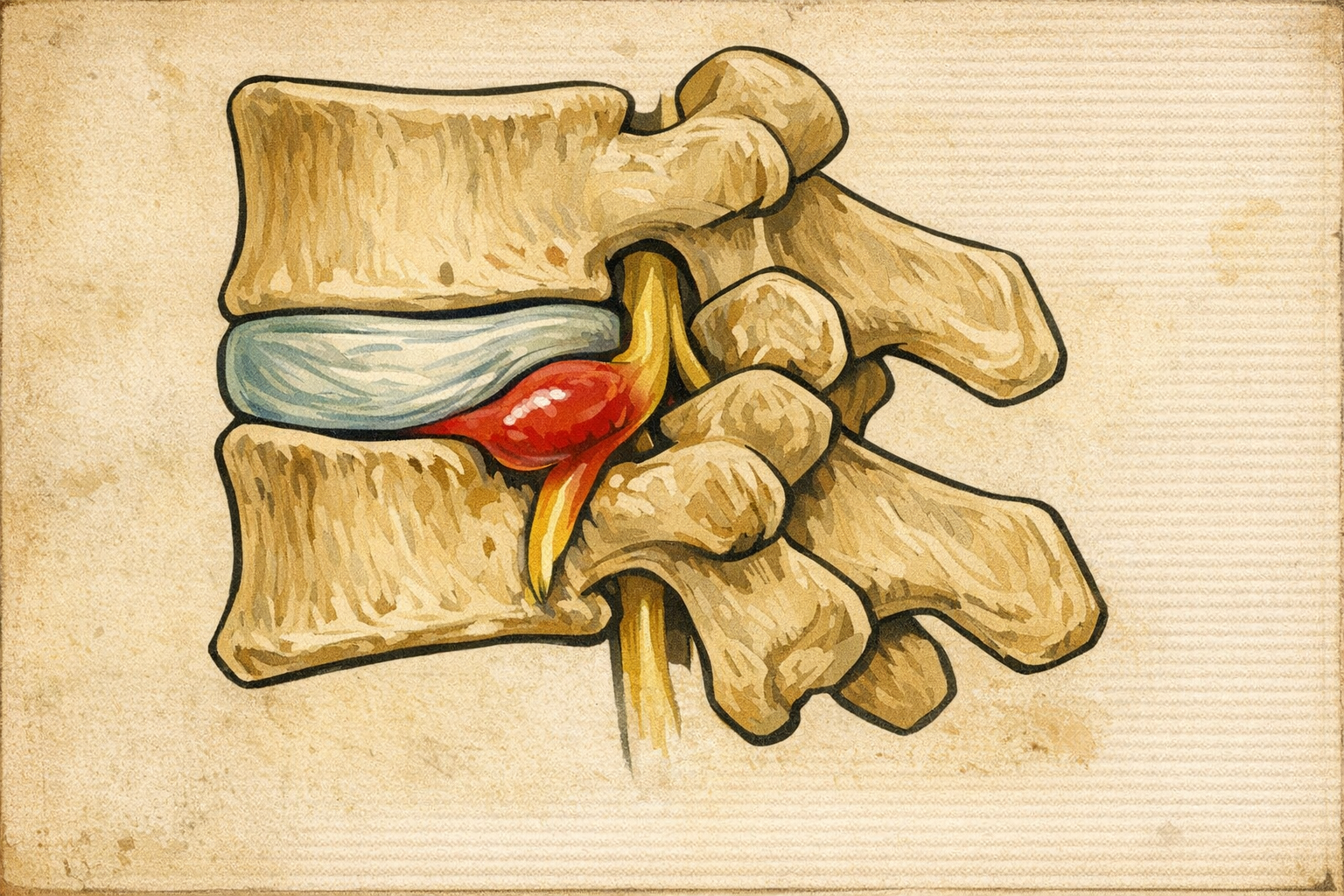
The disc between two bones of your spine is a fibre-wound ring with a pressurised, water-rich core. Under load, the core pushes outward and the ring contains it.
A herniation is the core (nucleus pulposus) pushing out through a crack in the ring (annulus fibrosus), almost always toward the back and to one side, because that is where the ring is thinnest and where a nerve root happens to be sitting.
The key word is displaced. Nothing was destroyed, nothing was severed, nothing was worn away. Living tissue moved from where it belongs to where it does not. That single distinction is why the 70% number exists — your body has a well-documented mechanism for removing tissue that is in the wrong place, and no mechanism at all for regrowing tissue that is gone.
Worth knowing before you read your report again: in people with no back pain at all, 29% of 20-year-olds and 43% of 80-year-olds have a disc protrusion on their scan. A true extrusion is rarer — in one study of 98 pain-free people, 27% had a protrusion and only 1% had an extrusion.
So a protrusion on your report may or may not be the thing hurting you. An extrusion that matches your symptom pattern almost certainly is.
Your pain is four separate problems wearing one name
This is the most useful reframe on the page, because each of the four responds to different things, on different timescales, and only one of them is what the MRI is measuring.
Layer 1 — Physical pressure. Disc material is occupying space a nerve root needs. This is what the scan shows and what surgery removes.
Layer 2 — Chemical irritation. The material leaking out is not inert. It carries inflammatory signals that inflame the nerve directly, with no compression required.
Layer 3 — Nerve fibre damage. A nerve root that has been squeezed and chemically inflamed for weeks has damaged fibres. That is what produces the numbness, the pins and needles, and the weakness — and it recovers on nerve-repair timescales, which are slower than everything else here.
Layer 4 — The surrounding tissue. The torn ring, the segment that now moves differently, the muscles that have been guarding for months, and the movement patterns you have built around the pain.
Now the honest part, up front: no compound, supplement, injection or peptide has been shown to reduce Layer 1. The only two things that reduce physical pressure on the nerve are your own body reabsorbing the fragment over months, and a surgeon removing it. Anyone offering you a substance that shrinks a herniation is claiming something no study in any species supports. Everything else on this page is aimed at Layers 2, 3 and 4 — which, as it happens, is where most of your pain is coming from.
Why a small herniation can hurt more than a large one
Here is the fact that explains why the imaging so often fails to match how you feel. Sciatica is largely chemical.
The core material carries TNF-alpha, which by itself produces nerve pain and nerve damage in controlled animal work — the compression is not required for the pain.
And it is loaded with an inflammatory enzyme called phospholipase A2, measured in herniated human discs at 20 to 100,000 times the activity of any other source described in the literature.
Read that magnitude again. Displaced disc material is, chemically, one of the most inflammatory substances your body can put next to a nerve.
Two consequences fall out of it directly:
Pain size does not track herniation size. A small tear that leaks a lot of chemically active material next to an irritable nerve can hurt more than a large fragment sitting in a roomy space.
Your pain will usually ease long before your scan changes. The chemical irritation settles in weeks. The fragment shrinks over months. People routinely feel fine while the imaging still looks alarming, which is one good reason not to re-scan a recovering back.
The counterintuitive rule: the worse it looks, the better it clears
Intuition says the big extruded fragment is catastrophic and the small contained bulge is minor. The resorption data says the reverse, and the gradient is steep:
A separate systematic review of predictive factors reaches the same conclusion: extruded and sequestered fragments are significantly more likely to regress completely than contained ones.
The mechanism explains the gradient exactly. Read the next section and the table stops being surprising.
The removal mechanism runs on inflammation and blood supply — which is why it works better the further out the fragment is
The inside of a healthy disc is one of the few places in your body the immune system never visits. It has no blood supply and no immune surveillance. When core material breaks out through the ring, it enters a completely different neighbourhood: one with blood vessels, oxygen, and white blood cells that have never encountered this tissue before and treat it as foreign.
What happens next is a cleanup operation. Immune cells called macrophages swarm the fragment and digest it. New blood vessels grow into the edge of the fragment to supply the operation.
That new vessel growth at the fragment's rim is described as the principal driver of resorption, and it runs on VEGF, the body's main vessel-growth signal.
Now the gradient makes sense. The more completely the fragment has broken out of the disc, the more of its surface is exposed to the cleanup crew. A sequestered fragment is fully surrounded and clears 87.8% of the time. A contained bulge is still sealed inside the ring, invisible to the immune system, and clears 13.3% of the time. Exposure is the variable.
This has a direct and uncomfortable implication for treatment, taken up two sections below.
What genuinely speeds recovery, ranked by the evidence behind it
1. Keep moving. Do not go to bed. Staying active beats bed rest for acute low back pain and sciatica — bed rest slows recovery rather than protecting it.
2. Structured exercise, once you can tolerate it. Cochrane pooled 249 randomised trials of exercise for chronic low back pain: a 15.2-point reduction on a 0–100 pain scale against no treatment, usual care or placebo, which clears the review's own pre-set threshold for a clinically important difference. No single style of exercise won. Doing it is what mattered.
3. If you have a directional preference, use it. Some people find one specific direction of movement — usually leaning backwards — pulls the pain out of the leg and back toward the spine. That migration of pain toward the centre is a good sign, and in the subgroup that shows it, the McKenzie approach of repeated end-range movements outperformed other exercise.
4. Walk, once the acute stage passes. In 701 adults randomised after recovering from an episode of back pain, a progressive individualised walking programme pushed the median time to the next activity-limiting episode from 112 days to 208 days, hazard ratio 0.72.
5. Stop smoking. Nicotine narrows the small vessels feeding a disc that already has the slowest nutrient delivery of any tissue in your body, and is directly toxic to disc cells. In 5,333 patients tracked through spinal care, the group who kept smoking showed no clinically important improvement in pain across an entire course of care.
6. Reduce the load, on causal-grade evidence. Mendelian randomisation — the design that uses inherited genetic variation as a natural experiment to separate cause from correlation — found higher BMI causally raises the odds of disc degeneration, back pain and sciatica, at roughly a third higher odds of sciatica per standard-deviation increase in BMI.
Spinal traction. The Cochrane review of 32 trials found little or no impact on pain, function or return to work, including specifically in people with sciatica. Machines, tables, inversion, and hanging all sit here.
Repeat scanning a back that is improving. Your pain resolves on a timescale of weeks; the fragment shrinks over months. A follow-up scan during that window shows you an unchanged herniation while you are actually getting better, and the psychological cost of that image is real.
Any product claiming to dissolve a herniation. See Layer 1 above. Nothing has done this in any species in a controlled study.
Injections buy time, and they may cost you something to do it
Epidural steroid injections produce real short- and medium-term reduction in sciatica pain, with no significant long-term benefit and no change to the underlying natural history.
Understand them for what they are: a bridge across a stretch of pain bad enough to stop you moving, sleeping or working. If the pain is preventing the movement that is the best-evidenced thing you can do, an injection that restores movement is buying something worth having.
Now the tension, stated plainly rather than buried. Your resorption engine is an inflammatory process. Suppressing inflammation is the mechanism of both steroids and anti-inflammatory painkillers. In preclinical work corticosteroids inhibited resorption, and a clinical series that deliberately avoided anti-inflammatory drugs reported resorption in every patient.
That is not a reason to refuse a single injection in a crisis. It is a reason to be specific about the difference between a short course and a policy. Weeks of blanket anti-inflammatory suppression as a standing strategy is working against the process clearing your disc. The full argument, with the stomach, kidney and heart numbers attached to it, is here:
Surgery is faster, not better, at one year — with two things it does not do
The largest randomised evidence is the SPORT trial. Over eight years, both surgical and non-operative patients improved substantially. Surgery delivered faster and greater early relief. It was not a requirement for recovery in most people.
The Dutch trial quoted at the top of this page puts the same finding in one sentence: faster relief with early surgery, identical 95% recovery probability at one year.
Surgery is the right answer for the emergency list at the top, for weakness that is worsening, and for pain that has failed 6 to 12 weeks of genuine conservative care with imaging that matches the symptoms. It is a decision about how long you are willing to hurt, not a decision about whether you will recover.
Twelve people with a herniated disc, counted
Trials give you averages. Here is what people say happened to them, counted, with the outcomes that did not go well given the same room as the ones that did.
Denominator: 12 first-person accounts — 9 from X, 3 from a Reddit thread already filed on this page. Outcome: 8 resolved or near-resolved, 1 improved but not resolved, 2 still in pain at the time of posting, 1 outcome not stated. All non-surgical unless stated.
Resolved — 8 of 12.
Three years pain-free from a fifteen-minute routine done twice a week:
How much weight to put on that count. Eight in twelve resolved sits close to the 70% resorption rate and the 95% one-year recovery figure, which is reassuring but partly coincidence: these accounts are heavily selected. People write recovery threads because "did anyone's disc reabsorb?" is a question people search; people in month two of agony often post nothing at all. Note also what the resolved accounts have in common — every one of them describes movement, exercise or physiotherapy, and not one describes a substance. Note the honest one too: @ViktorBunin explicitly says he is not at 100% three months in, which is a more accurate picture of month three than most recovery posts give you.
Every link, with the strength of the evidence behind it
Link
Evidence
Strength
About 70% of herniations reabsorb without surgery
Meta-analysis, 31 studies, 2,233 patients
Strong
The more the fragment has broken out, the better it clears
Same meta-analysis, gradient 87.8% → 13.3%
Strong
95% recovered at one year regardless of surgery
Randomised trial, 283 patients
Strong
Surgery relieves leg pain faster
Randomised trial + SPORT, 8-year follow-up
Strong
Resorption is driven by immune clearance and new blood vessel growth
Mechanistic human and animal studies
Strong
Sciatica pain is substantially chemical, not only mechanical
Controlled animal model; enzyme measured 20–100,000× in human discs
Strong
Anti-inflammatory suppression can impede resorption
Preclinical inhibition plus one clinical series
Moderate
Staying active beats bed rest
Cochrane review
Strong
Exercise reduces pain by a clinically important margin
249 randomised trials, −15.2 points
Strong
McKenzie helps the directional-preference subgroup
Randomised trial in responders
Moderate
Walking delays the next episode
Randomised trial, 701 people
Moderate
Traction helps
Cochrane, 32 trials
Negative
Bed rest helps
Cochrane
Negative
Epidural steroid gives short-term relief
Meta-analysis
Moderate, temporary
Epidural steroid changes the long-term course
Meta-analysis
No effect
Higher body weight causally raises sciatica odds
Mendelian randomisation
Strong for cause
Smoking accelerates disc degeneration; quitters improve more
Mechanistic plus 5,333-patient cohort
Moderate
Any compound reduces physical pressure on the nerve
No study, any species
Absent
BPC-157 or TB-500 helps a human disc
No trial, any species, on a disc
Absent
ARA-290 improves nerve fibre density and nerve pain
Randomised human trials, small-fibre nerve damage
Moderate, different condition
Where the compounds could plausibly act, and where they cannot
Map them onto the four layers and the picture becomes precise instead of promotional.
Layer 1, physical pressure: nothing. Time or a surgeon. No exceptions.
Layer 2, chemical irritation: this is where the mechanistic case sits. The inflammatory receptor pathway that TNF-alpha runs through is the target of ARA-290, and that compound has actual randomised human trials — for nerve damage rather than for a disc.
Layer 3, nerve fibre damage. A severed rat sciatic nerve regrew faster with BPC-157, which is the closest thing to a relevant animal result that exists. It is a rat, it is a cut nerve rather than a compressed one, and no human has been studied.
Layer 4, surrounding tissue. Animal tendon, ligament and muscle repair is where both BPC-157 and TB-500 have the most consistent data — mechanically stronger healed tissue, faster cell migration into poorly supplied tissue.
There is one more thing worth holding onto. Your resorption engine runs on new blood vessel growth, and new blood vessel growth is precisely what these compounds are studied for driving. That could be read as encouraging. It could equally be read as a caution, since nobody has ever tested whether pushing that pathway helps clearance or does something unwanted next to an inflamed nerve. Neither reading is a result. The full mechanism-by-mechanism version, including where each inference breaks, is here:
Check yourself against the emergency list at the top. If any of it applies, stop reading and go.
Get out of bed and move within your tolerance. Not through sharp pain, but not still either.
Find out whether you have a directional preference. If one direction repeatedly pulls the pain out of your leg and toward your spine, that is a lead worth following with someone who can watch you do it.
Use pain relief to enable movement, in short courses, not as a standing policy.
Do not book a repeat scan because you still hurt at week six. Your pain and your imaging are on different clocks.
Count from the start of the episode, not from the day of the scan. Most of the resorption in that 70% happened inside six months.
Set the surgical decision on a rule, before the bad week arrives: worsening weakness, or 6 to 12 weeks of genuine conservative effort with pain you cannot live inside, and imaging that matches your symptoms.
This page explains mechanism and the state of the evidence. It is not a diagnosis, a treatment plan, or medical advice. Red-flag symptoms — bladder or bowel changes, saddle numbness, worsening weakness — are emergencies. The compounds referenced are investigational and unproven for disc conditions.
70.4%
of herniated discs reabsorb without surgery (31 studies, 2,233 patients)
95%
recovered at one year with or without surgery (randomised, n=283)
87.8% vs 13.3%
resorption rate: a fully broken-free fragment vs a contained bulge
20-100,000x
the inflammatory enzyme activity in herniated disc material vs any other source measured
6 months
where most of the resorption happens, counting from the start of the episode
0
compounds shown to reduce physical pressure on the nerve, in any species
References (40)
Lumbar Disc Herniation (StatPearls)“extrusion of the nucleus pulposus through the annulus fibrosus while maintaining continuity of the disc space, or obliteration of the disc space continuity and sequestration of free fragments.”
VEGF-induced angiogenesis in herniated disc resorption“VEGF induction, under the co-culture conditions tested can result in neo-vascularization of intervertebral disc tissue and may thus play a role in the resorption of HD.”
Incidence of Spontaneous Resorption of Lumbar Disc Herniation: A Meta-analysis (Clin Spine Surg 2024, PMID 37559207)“Thirty-one studies with 2233 patients who received conservative treatment were included for this analysis. We found that the pooled overall incidence of disk resorption was 70.39%, 87.77% for disk sequestration, 66.91% for disk extrusion, 37.53% for disk protrusion, and 13.33% for disk bugle, respectively... The resorption process mainly occurred within 6 months of conservative treatment.”
Surgery versus prolonged conservative treatment for sciatica (NEJM 2007, PMID 17538084)“We randomly assigned 283 patients who had had severe sciatica for 6 to 12 weeks to early surgery or to prolonged conservative treatment with surgery if needed... Relief of leg pain was faster for patients assigned to early surgery (P<0.001)... In both groups, however, the probability of perceived recovery after 1 year of follow-up was 95%.”
Exercise therapy for chronic low back pain (Cochrane 2021, PMID 34580864)“We found moderate-certainty evidence that exercise treatment is more effective for treatment of chronic low back pain compared to no treatment, usual care or placebo comparisons for pain outcomes at earliest follow-up (MD -15.2, 95% CI -18.3 to -12.2), a clinically important difference.”
Eight months to fully heal a herniated disc (anecdotal) — Jul 29, 2026“I had a situation similar to this a few years ago and it ended up being a herniated disc. It took 8 months to fully heal, I couldn't sit or stand up long, the pain was worst when I woke up in the morning, shit was depress Keep your head up bro, it'll pass”
Years of experimenting, and what finally worked was loaded strength training (anecdotal) — Dec 10, 2024“I had excruciating pain from two bad discs in my 30s. I too saw multiple doctors - neurosurgeons, orthopedists, etc. The majoriity said I would never (! emphasized) eliminate the pain without surgery... But I could not find anyone whose mobility, range of motion, was better after surgery than before... that started a very long journey.... yoga, pilates, alexander technique, ELDOA method, freeweigh”
Functional at three months from an L5/S1 herniation, explicitly not at 100% (anecdotal) — Jul 2, 2025“How I healed a major L5/S1 disc herniation in a month. ... It's now been 3 months since the ER visit and while I'm still not at 100%, I can carry my kids, run for short distances, and comfortably go to the gym. I was told it would take a year to heal, but I feel like everything I did in the first month was insanely impactful to accelerating my progress.”
Third herniation at the same thoracic level, surgery not on the table (anecdotal) — Aug 1, 2026“Yeah back injuries are not fun. Third time I've herniated the same T8/T9 disk in my spine. Since its thoracic they pretty much told me surgery isn't much of an option. Just pt, injections, staying active. I'll heal, just takes forever”
Week three of a herniated disc, described from inside it (anecdotal) — Aug 4, 2026“having been in pain constantly for 3 weeks, my brain is mush. I can't sit down without being in pain, every little movement hurts like a bitch. I go back to the hospital on thursday, this herniated disc has me at my wits end and it's really impacting everything”
Newly diagnosed, told one to three months (anecdotal) — Apr 18, 2022“Finished my appointment. We ran through a whole assessment and he concluded I have a herniated disc. The injury is putting pressure on my nerves as well which is causing further pain. Estimated recovery time is 1-3 months. I'll get it done in 1.”
Eleven months of severe sciatica, then near-total resolution on a self-built programme (anecdotal) — May 28, 2024“August 1st last year i herniated a disc in my back and it caused severe pain in my left sciatic nerve going all the way from my hip to my toe. For the last 11 months I experienced the most debilitating and severe pain I've ever felt in my entire life. The spine specialists and PT I personally went to were fucking useless. I created my own plan for PT from research on the internet. I can fucking pr”
the whole object this page is drawn from, as JSON
{
"schema":"http://google-preview.miscsubjects.com/schemas/jarticle.json",
"status":"published",
"slug":"herniated-disc",
"title":"Herniated disc: 70% resorb without surgery and 95% recover at one year",
"kind":"essay",
"summary":"The definitive herniated-disc guide: ~67% resorb on their own (the biggest best), why sciatica is chemical, the recovery timeline, what actually helps vs what's low-value, injections and surgery reality (SPORT), weight and smoking levers, red flags, and the resorption-vs-anti-inflammatory paradox.",
"created":"2026-07-24T16:37:34.475Z",
"body": [
"Start with the two numbers that should govern every decision you make about this in the next twelve months.\n\n**Roughly seven out of ten herniated discs shrink and disappear on their own.** A meta-analysis pooled 31 studies covering 2,233 people treated without surgery: the disc material was reabsorbed in 70.39% of them overall. Broken down by how far the disc had pushed out — 87.77% for a fragment that had fully broken free, 66.91% for an extrusion, 37.53% for a protrusion, 13.33% for a bulge. Most of it happened inside the first six months.",
{
"type":"source",
"id":"s26"
},
"**Roughly nineteen out of twenty people are recovered at one year, whichever route they take.** A randomised trial assigned 283 people with severe sciatica lasting 6 to 12 weeks to either early surgery or continued conservative care with surgery only if needed. Surgery relieved leg pain faster and produced faster perceived recovery. But at one year, the probability of perceived recovery was **95% in both groups**.",
{
"type":"source",
"id":"s27"
},
"Hold those two numbers up against every claim anyone makes to you about a treatment for this — including every claim on this page. Seven in ten discs shrink on their own. Nineteen in twenty people are recovered at a year. Anything sold to you has to beat that baseline, or it has to be honest that it is buying you speed and comfort inside a recovery that was going to happen anyway.\n\n## Before anything else: the symptoms that mean go now, not next week\n\nThese override everything below. Get to an emergency department immediately if you have:\n\n- **Loss of bladder or bowel control**, or new difficulty starting or stopping urination\n- **Numbness in the saddle area** — groin, buttocks, inner thighs, the parts that would contact a bicycle seat\n- **Leg weakness that is getting worse day by day**, especially in both legs\n- **Sudden loss of sexual sensation**\n\nThese can mean the nerve bundle at the base of the spine is being crushed. The window for preventing permanent damage is measured in hours, and the risk rises sharply past roughly 48 hours.",
{
"type":"source",
"id":"s17"
},
"That is the whole exception list. If none of those apply, the rest of this page is about the ordinary case, and the ordinary case behaves far better than the diagnosis sounds.\n\n## What actually happened inside your back\n\nThe disc between two bones of your spine is a fibre-wound ring with a pressurised, water-rich core. Under load, the core pushes outward and the ring contains it.\n\nA herniation is the core (*nucleus pulposus*) pushing out through a crack in the ring (*annulus fibrosus*), almost always toward the back and to one side, because that is where the ring is thinnest and where a nerve root happens to be sitting.",
{
"type":"source",
"id":"s1"
},
"The key word is **displaced**. Nothing was destroyed, nothing was severed, nothing was worn away. Living tissue moved from where it belongs to where it does not. That single distinction is why the 70% number exists — your body has a well-documented mechanism for removing tissue that is in the wrong place, and no mechanism at all for regrowing tissue that is gone.\n\nWorth knowing before you read your report again: in people with **no back pain at all**, 29% of 20-year-olds and 43% of 80-year-olds have a disc protrusion on their scan. A true extrusion is rarer — in one study of 98 pain-free people, 27% had a protrusion and only 1% had an extrusion.",
{
"type":"source",
"id":"s28"
},
{
"type":"source",
"id":"s29"
},
"So a protrusion on your report may or may not be the thing hurting you. An extrusion that matches your symptom pattern almost certainly is.\n\n## Your pain is four separate problems wearing one name\n\nThis is the most useful reframe on the page, because each of the four responds to different things, on different timescales, and only one of them is what the MRI is measuring.\n\n**Layer 1 — Physical pressure.** Disc material is occupying space a nerve root needs. This is what the scan shows and what surgery removes.\n\n**Layer 2 — Chemical irritation.** The material leaking out is not inert. It carries inflammatory signals that inflame the nerve directly, with no compression required.\n\n**Layer 3 — Nerve fibre damage.** A nerve root that has been squeezed and chemically inflamed for weeks has damaged fibres. That is what produces the numbness, the pins and needles, and the weakness — and it recovers on nerve-repair timescales, which are slower than everything else here.\n\n**Layer 4 — The surrounding tissue.** The torn ring, the segment that now moves differently, the muscles that have been guarding for months, and the movement patterns you have built around the pain.\n\nNow the honest part, up front: **no compound, supplement, injection or peptide has been shown to reduce Layer 1.** The only two things that reduce physical pressure on the nerve are your own body reabsorbing the fragment over months, and a surgeon removing it. Anyone offering you a substance that shrinks a herniation is claiming something no study in any species supports. Everything else on this page is aimed at Layers 2, 3 and 4 — which, as it happens, is where most of your pain is coming from.\n\n## Why a small herniation can hurt more than a large one\n\nHere is the fact that explains why the imaging so often fails to match how you feel. Sciatica is largely chemical.\n\nThe core material carries TNF-alpha, which by itself produces nerve pain and nerve damage in controlled animal work — the compression is not required for the pain.",
{
"type":"source",
"id":"s7"
},
"And it is loaded with an inflammatory enzyme called phospholipase A2, measured in herniated human discs at **20 to 100,000 times the activity of any other source described in the literature**.",
{
"type":"source",
"id":"s8"
},
"Read that magnitude again. Displaced disc material is, chemically, one of the most inflammatory substances your body can put next to a nerve.\n\nTwo consequences fall out of it directly:\n\n1. **Pain size does not track herniation size.** A small tear that leaks a lot of chemically active material next to an irritable nerve can hurt more than a large fragment sitting in a roomy space.\n2. **Your pain will usually ease long before your scan changes.** The chemical irritation settles in weeks. The fragment shrinks over months. People routinely feel fine while the imaging still looks alarming, which is one good reason not to re-scan a recovering back.\n\n## The counterintuitive rule: the worse it looks, the better it clears\n\nIntuition says the big extruded fragment is catastrophic and the small contained bulge is minor. The resorption data says the reverse, and the gradient is steep:\n\n| What the report says | Chance it reabsorbs |\n|---|---|\n| Sequestration — a fragment fully broken free | 87.8% |\n| Extrusion — pushed out past the ring | 66.9% |\n| Protrusion — bulging but still contained | 37.5% |\n| Bulge — the whole rim extends outward | 13.3% |",
{
"type":"source",
"id":"s26"
},
"A separate systematic review of predictive factors reaches the same conclusion: extruded and sequestered fragments are significantly more likely to regress completely than contained ones.",
{
"type":"source",
"id":"s3"
},
"The mechanism explains the gradient exactly. Read the next section and the table stops being surprising.\n\n## The removal mechanism runs on inflammation and blood supply — which is why it works better the further out the fragment is\n\nThe inside of a healthy disc is one of the few places in your body the immune system never visits. It has no blood supply and no immune surveillance. When core material breaks out through the ring, it enters a completely different neighbourhood: one with blood vessels, oxygen, and white blood cells that have never encountered this tissue before and treat it as foreign.\n\nWhat happens next is a cleanup operation. Immune cells called macrophages swarm the fragment and digest it. New blood vessels grow into the edge of the fragment to supply the operation.",
{
"type":"source",
"id":"s5"
},
"That new vessel growth at the fragment's rim is described as the principal driver of resorption, and it runs on VEGF, the body's main vessel-growth signal.",
{
"type":"source",
"id":"s6"
},
"Now the gradient makes sense. **The more completely the fragment has broken out of the disc, the more of its surface is exposed to the cleanup crew.** A sequestered fragment is fully surrounded and clears 87.8% of the time. A contained bulge is still sealed inside the ring, invisible to the immune system, and clears 13.3% of the time. Exposure is the variable.\n\nThis has a direct and uncomfortable implication for treatment, taken up two sections below.\n\n## What genuinely speeds recovery, ranked by the evidence behind it\n\n**1. Keep moving. Do not go to bed.** Staying active beats bed rest for acute low back pain and sciatica — bed rest slows recovery rather than protecting it.",
{
"type":"source",
"id":"s18"
},
"**2. Structured exercise, once you can tolerate it.** Cochrane pooled 249 randomised trials of exercise for chronic low back pain: a 15.2-point reduction on a 0–100 pain scale against no treatment, usual care or placebo, which clears the review's own pre-set threshold for a clinically important difference. No single style of exercise won. Doing it is what mattered.",
{
"type":"source",
"id":"s30"
},
"**3. If you have a directional preference, use it.** Some people find one specific direction of movement — usually leaning backwards — pulls the pain out of the leg and back toward the spine. That migration of pain toward the centre is a good sign, and in the subgroup that shows it, the McKenzie approach of repeated end-range movements outperformed other exercise.",
{
"type":"source",
"id":"s19"
},
"**4. Walk, once the acute stage passes.** In 701 adults randomised after recovering from an episode of back pain, a progressive individualised walking programme pushed the median time to the next activity-limiting episode from 112 days to 208 days, hazard ratio 0.72.",
{
"type":"source",
"id":"s31"
},
"**5. Stop smoking.** Nicotine narrows the small vessels feeding a disc that already has the slowest nutrient delivery of any tissue in your body, and is directly toxic to disc cells. In 5,333 patients tracked through spinal care, the group who kept smoking showed no clinically important improvement in pain across an entire course of care.",
{
"type":"source",
"id":"s24"
},
"**6. Reduce the load, on causal-grade evidence.** Mendelian randomisation — the design that uses inherited genetic variation as a natural experiment to separate cause from correlation — found higher BMI causally raises the odds of disc degeneration, back pain and sciatica, at roughly a third higher odds of sciatica per standard-deviation increase in BMI.",
{
"type":"source",
"id":"s23"
},
"## What to skip, and what it costs you to try it anyway\n\n**Bed rest.** Actively worse than staying active. Every day in bed is a day of losing the muscle support that gets you through this.",
{
"type":"source",
"id":"s18"
},
"**Spinal traction.** The Cochrane review of 32 trials found little or no impact on pain, function or return to work, including specifically in people with sciatica. Machines, tables, inversion, and hanging all sit here.",
{
"type":"source",
"id":"s20"
},
"**Repeat scanning a back that is improving.** Your pain resolves on a timescale of weeks; the fragment shrinks over months. A follow-up scan during that window shows you an unchanged herniation while you are actually getting better, and the psychological cost of that image is real.\n\n**Any product claiming to dissolve a herniation.** See Layer 1 above. Nothing has done this in any species in a controlled study.\n\n## Injections buy time, and they may cost you something to do it\n\nEpidural steroid injections produce real short- and medium-term reduction in sciatica pain, with no significant long-term benefit and no change to the underlying natural history.",
{
"type":"source",
"id":"s21"
},
"Understand them for what they are: a bridge across a stretch of pain bad enough to stop you moving, sleeping or working. If the pain is preventing the movement that is the best-evidenced thing you can do, an injection that restores movement is buying something worth having.\n\nNow the tension, stated plainly rather than buried. **Your resorption engine is an inflammatory process.** Suppressing inflammation is the mechanism of both steroids and anti-inflammatory painkillers. In preclinical work corticosteroids inhibited resorption, and a clinical series that deliberately avoided anti-inflammatory drugs reported resorption in every patient.",
{
"type":"source",
"id":"s25"
},
"That is not a reason to refuse a single injection in a crisis. It is a reason to be specific about the difference between a short course and a policy. Weeks of blanket anti-inflammatory suppression as a standing strategy is working against the process clearing your disc. The full argument, with the stomach, kidney and heart numbers attached to it, is here:\n\n![[bpc-157-vs-nsaids]]\n\n## Surgery is faster, not better, at one year — with two things it does not do\n\nThe largest randomised evidence is the SPORT trial. Over eight years, both surgical and non-operative patients improved substantially. Surgery delivered faster and greater early relief. It was not a requirement for recovery in most people.",
{
"type":"source",
"id":"s9"
},
"The Dutch trial quoted at the top of this page puts the same finding in one sentence: faster relief with early surgery, identical 95% recovery probability at one year.",
{
"type":"source",
"id":"s27"
},
"Two things surgery does not do:\n\n- **It does not regenerate the disc.** Removing displaced material leaves you with a disc that has less material in it and a tear in the ring.\n- **It is not permanent-proof.** Reoperation reached about 15% by eight years in SPORT, roughly 85% of those for a re-herniation at the same level.",
{
"type":"source",
"id":"s22"
},
"Surgery is the right answer for the emergency list at the top, for weakness that is worsening, and for pain that has failed 6 to 12 weeks of genuine conservative care with imaging that matches the symptoms. It is a decision about how long you are willing to hurt, not a decision about whether you will recover.\n\n## Twelve people with a herniated disc, counted\n\nTrials give you averages. Here is what people say happened to them, counted, with the outcomes that did not go well given the same room as the ones that did.\n\n**Denominator: 12 first-person accounts** — 9 from X, 3 from a Reddit thread already filed on this page. **Outcome: 8 resolved or near-resolved, 1 improved but not resolved, 2 still in pain at the time of posting, 1 outcome not stated.** All non-surgical unless stated.\n\n**Resolved — 8 of 12.**\n\nThree years pain-free from a fifteen-minute routine done twice a week:",
{
"type":"source",
"id":"s32"
},
"Eleven months of the worst pain of his life, then near-total resolution on a self-built programme:",
{
"type":"source",
"id":"s33"
},
"Eight months to heal, described without any triumphalism:",
{
"type":"source",
"id":"s34"
},
"A cane at 22, five years of daily pain, told surgery was the only option, and now pain-free:",
{
"type":"source",
"id":"s35"
},
"The long version — years of experimenting, and what finally worked was loaded strength training:",
{
"type":"source",
"id":"s36"
},
"And from Reddit, three accounts on the same thread, including one with a measured reduction on repeat imaging:",
{
"type":"source",
"id":"s12"
},
{
"type":"source",
"id":"s13"
},
{
"type":"source",
"id":"s14"
},
"**Improved but not resolved — 1 of 12.** Functional in three months, explicitly not back to 100%, and honest about it:",
{
"type":"source",
"id":"s37"
},
"**Still in pain at the time of posting — 2 of 12.**\n\nThird herniation at the same level, thoracic, told surgery is not really an option:",
{
"type":"source",
"id":"s38"
},
"Three weeks in and at the end of her rope — which is exactly what week three of this feels like:",
{
"type":"source",
"id":"s39"
},
"**Outcome not stated — 1 of 12.** Newly diagnosed, told to expect one to three months.",
{
"type":"source",
"id":"s40"
},
"**How much weight to put on that count.** Eight in twelve resolved sits close to the 70% resorption rate and the 95% one-year recovery figure, which is reassuring but partly coincidence: these accounts are heavily selected. People write recovery threads because \"did anyone's disc reabsorb?\" is a question people search; people in month two of agony often post nothing at all. Note also what the resolved accounts have in common — every one of them describes movement, exercise or physiotherapy, and not one describes a substance. Note the honest one too: @ViktorBunin explicitly says he is not at 100% three months in, which is a more accurate picture of month three than most recovery posts give you.\n\n## Every link, with the strength of the evidence behind it\n\n| Link | Evidence | Strength |\n|---|---|---|\n| About 70% of herniations reabsorb without surgery | Meta-analysis, 31 studies, 2,233 patients | Strong |\n| The more the fragment has broken out, the better it clears | Same meta-analysis, gradient 87.8% → 13.3% | Strong |\n| 95% recovered at one year regardless of surgery | Randomised trial, 283 patients | Strong |\n| Surgery relieves leg pain faster | Randomised trial + SPORT, 8-year follow-up | Strong |\n| Resorption is driven by immune clearance and new blood vessel growth | Mechanistic human and animal studies | Strong |\n| Sciatica pain is substantially chemical, not only mechanical | Controlled animal model; enzyme measured 20–100,000× in human discs | Strong |\n| Anti-inflammatory suppression can impede resorption | Preclinical inhibition plus one clinical series | Moderate |\n| Staying active beats bed rest | Cochrane review | Strong |\n| Exercise reduces pain by a clinically important margin | 249 randomised trials, −15.2 points | Strong |\n| McKenzie helps the directional-preference subgroup | Randomised trial in responders | Moderate |\n| Walking delays the next episode | Randomised trial, 701 people | Moderate |\n| Traction helps | Cochrane, 32 trials | Negative |\n| Bed rest helps | Cochrane | Negative |\n| Epidural steroid gives short-term relief | Meta-analysis | Moderate, temporary |\n| Epidural steroid changes the long-term course | Meta-analysis | No effect |\n| Higher body weight causally raises sciatica odds | Mendelian randomisation | Strong for cause |\n| Smoking accelerates disc degeneration; quitters improve more | Mechanistic plus 5,333-patient cohort | Moderate |\n| Any compound reduces physical pressure on the nerve | No study, any species | Absent |\n| BPC-157 or TB-500 helps a human disc | No trial, any species, on a disc | Absent |\n| ARA-290 improves nerve fibre density and nerve pain | Randomised human trials, small-fibre nerve damage | Moderate, different condition |\n\n## Where the compounds could plausibly act, and where they cannot\n\nMap them onto the four layers and the picture becomes precise instead of promotional.\n\n**Layer 1, physical pressure: nothing.** Time or a surgeon. No exceptions.\n\n**Layer 2, chemical irritation: this is where the mechanistic case sits.** The inflammatory receptor pathway that TNF-alpha runs through is the target of ARA-290, and that compound has actual randomised human trials — for nerve damage rather than for a disc.\n\n![[ara-290]]\n\n**Layer 3, nerve fibre damage.** A severed rat sciatic nerve regrew faster with BPC-157, which is the closest thing to a relevant animal result that exists. It is a rat, it is a cut nerve rather than a compressed one, and no human has been studied.\n\n![[bpc-157]]\n\n**Layer 4, surrounding tissue.** Animal tendon, ligament and muscle repair is where both BPC-157 and TB-500 have the most consistent data — mechanically stronger healed tissue, faster cell migration into poorly supplied tissue.\n\n![[tb-500]]\n\nThere is one more thing worth holding onto. Your resorption engine runs on new blood vessel growth, and new blood vessel growth is precisely what these compounds are studied for driving. That could be read as encouraging. It could equally be read as a caution, since nobody has ever tested whether pushing that pathway helps clearance or does something unwanted next to an inflamed nerve. Neither reading is a result. The full mechanism-by-mechanism version, including where each inference breaks, is here:\n\n![[what-are-peptides-herniated-disc]]\n\nAnd the slower wear process that sets up many herniations in the first place is a separate page with a very different set of numbers:\n\n![[degenerative-disc-disease]]\n\n## What to actually do, this week\n\n1. **Check yourself against the emergency list at the top.** If any of it applies, stop reading and go.\n2. **Get out of bed and move within your tolerance.** Not through sharp pain, but not still either.\n3. **Find out whether you have a directional preference.** If one direction repeatedly pulls the pain out of your leg and toward your spine, that is a lead worth following with someone who can watch you do it.\n4. **Use pain relief to enable movement, in short courses, not as a standing policy.**\n5. **Do not book a repeat scan because you still hurt at week six.** Your pain and your imaging are on different clocks.\n6. **Count from the start of the episode, not from the day of the scan.** Most of the resorption in that 70% happened inside six months.\n7. **Set the surgical decision on a rule, before the bad week arrives:** worsening weakness, or 6 to 12 weeks of genuine conservative effort with pain you cannot live inside, and imaging that matches your symptoms.\n\n*This page explains mechanism and the state of the evidence. It is not a diagnosis, a treatment plan, or medical advice. Red-flag symptoms — bladder or bowel changes, saddle numbness, worsening weakness — are emergencies. The compounds referenced are investigational and unproven for disc conditions.*"
],
"facts": {
"converted_from":"markdown",
"original_updated":"2026-08-04T20:48:43.175Z",
"register":"essay",
"category":null
},
"hero":"https://miscsubjects.com/img/gen/arcads-gpt-image-63777cd7-ae7f-4e50-88d5-18bd92efe08b.png",
"model":"Fable 5 (Claude Code)",
"tags": [
"condition",
"herniated-disc",
"sciatica",
"spine",
"disc"
],
"sources": [
{
"id":"s1",
"type":"pubmed",
"url":"https://www.ncbi.nlm.nih.gov/books/NBK560878/",
"title":"Lumbar Disc Herniation (StatPearls)",
"quote":"extrusion of the nucleus pulposus through the annulus fibrosus while maintaining continuity of the disc space, or obliteration of the disc space continuity and sequestration of free fragments.",
"claim_ids": [
"c1"
],
"accessed_at":"2026-08-04T19:17:09.117Z",
"prev":"genesis",
"hash":"c6d4888d1a9207707169daca3bde4860f0a2949c6c4246802afbfec1e5a8025e",
"plain":"A clinical reference chapter defining the words that appear on a radiology report. The distinction it draws is the one that matters practically: whether the displaced material still connects to the disc, or has broken loose as a free fragment.",
"quote_sha256":"a2f1c8f351ee9255d71f996e49b2a809a370fbed56ce27dbe0f0a82456a3f964"
},
{
"id":"s2",
"type":"pubmed",
"url":"https://pubmed.ncbi.nlm.nih.gov/28072796/",
"title":"Incidence of Spontaneous Resorption of Lumbar Disc Herniation: A Meta-Analysis",
"quote":"The overall incidence of spontaneous resorption after LDH was 66.66% (95% CI 51% - 69%).",
"claim_ids": [
"c2",
"c7"
],
"accessed_at":"2026-08-04T19:17:09.117Z",
"prev":"c6d4888d1a9207707169daca3bde4860f0a2949c6c4246802afbfec1e5a8025e",
"hash":"82823c42c2d56fe3b71aa2a0cc1e7195682d0e8d32e25beb6397dc009efe0938",
"plain":"Pools follow-up imaging studies to ask how often a herniation shrinks with no procedure at all: roughly two in three. Nobody was randomly assigned to wait, so this is the natural course rather than a tested treatment, and it is the base rate every decision starts from.",
"quote_sha256":"72ff46b44c376e1fe4c960a005c7d902dc8a41df790b21aff3be19ddcd4fe42b"
},
{
"id":"s3",
"type":"pubmed",
"url":"https://pubmed.ncbi.nlm.nih.gov/37486886/",
"title":"Systematic review and meta-analysis of predictive factors for spontaneous regression in lumbar disc herniation",
"quote":"Extruded and sequestered discs were also significantly more likely to completely regress than smaller morphologies.",
"claim_ids": [
"c3"
],
"accessed_at":"2026-08-04T19:17:09.117Z",
"prev":"82823c42c2d56fe3b71aa2a0cc1e7195682d0e8d32e25beb6397dc009efe0938",
"hash":"9706cf785bab2fd22c60ac073d01af32703b106fcbde0a4d6866a9ace7e7ca12",
"plain":"Pooled predictors drawn from many studies, and the finding runs against instinct. The big, alarming fragments regress far more reliably than the small contained bulges, which is worth holding onto when a scan report sounds frightening.",
"quote_sha256":"9fa4a6abca626ad75a14d2ab55a8a08874531f6bc150fe96e3676e2a0baf84b8"
},
{
"id":"s4",
"type":"pubmed",
"url":"https://pmc.ncbi.nlm.nih.gov/articles/PMC11165499/",
"title":"Prediction and Mechanisms of Spontaneous Resorption in Lumbar Disc Herniation: Narrative Review",
"quote":"the hyperplasia of new blood vessels has been discovered at the edge of the herniated tissue, which is considered to be the main determining factor for the spontaneous resorption of LDH.",
"claim_ids": [
"c4",
"c5"
],
"accessed_at":"2026-08-04T19:17:09.117Z",
"prev":"9706cf785bab2fd22c60ac073d01af32703b106fcbde0a4d6866a9ace7e7ca12",
"hash":"e606853a62f8be2a7c2758ef733c6f2c52b6289402a3bbee0af346f6e45e7c44",
"plain":"A narrative review, so a synthesis rather than a fresh measurement. What it pins down is where the action happens: new blood vessels crowding the rim of the escaped tissue, which is the step that lets the body clear it away.",
"quote_sha256":"20e412f13cd43452c8ae31fe547d3dedc870c0d256eae78745da1bdc1be81e07"
},
{
"id":"s5",
"type":"pubmed",
"url":"https://pmc.ncbi.nlm.nih.gov/articles/PMC9396855/",
"title":"Characteristics and mechanisms of resorption in lumbar disc herniation",
"quote":"Macrophage infiltration and activation are critical steps in the process of reabsorption.",
"claim_ids": [
"c4"
],
"accessed_at":"2026-08-04T19:17:09.117Z",
"prev":"e606853a62f8be2a7c2758ef733c6f2c52b6289402a3bbee0af346f6e45e7c44",
"hash":"70fb627577fd5fe260e572bde3cbc69dd7adcc5436474a1617e9246ce3f696c1",
"plain":"Identifies the cells doing the clearing. Immune scavengers move into the displaced material and consume it, which reframes recovery as something the body actively performs rather than something that merely subsides with time.",
"quote_sha256":"a8eb22f9d44b979da618527145a4a0e3eea2d5f195a7641a30c0cd26b4b1c434"
},
{
"id":"s6",
"type":"pubmed",
"url":"https://pubmed.ncbi.nlm.nih.gov/12038611/",
"title":"VEGF-induced angiogenesis in herniated disc resorption",
"quote":"VEGF induction, under the co-culture conditions tested can result in neo-vascularization of intervertebral disc tissue and may thus play a role in the resorption of HD.",
"claim_ids": [
"c4",
"c5"
],
"accessed_at":"2026-08-04T19:17:09.117Z",
"prev":"70fb627577fd5fe260e572bde3cbc69dd7adcc5436474a1617e9246ce3f696c1",
"hash":"0d8b2d0977f445f1e522f978cc9ed858c39514933a83f22bbb0543a597d525f8",
"plain":"Cells grown together in a dish, not a living spine. It shows the growth signal can drive new vessels into disc tissue, supplying the missing link in the resorption story. A mechanism demonstration, several steps removed from anything a person would feel.",
"quote_sha256":"357f5658cf855a82cecad0291ae5043b5f89da433de4ea4a32ca01e63eb13508"
},
{
"id":"s7",
"type":"pubmed",
"url":"https://pubmed.ncbi.nlm.nih.gov/18670336/",
"title":"TNF-alpha in the nucleus pulposus mediates radicular pain in mice",
"quote":"TNF-alpha contained in the NP was important for the production of radicular pain accompanied by long-lasting degeneration of DRG neurons.",
"claim_ids": [
"c6"
],
"accessed_at":"2026-08-04T19:17:09.117Z",
"prev":"0d8b2d0977f445f1e522f978cc9ed858c39514933a83f22bbb0543a597d525f8",
"hash":"6852181431b6e1562ab7b54407367aed850d05e01addfd81727549eb9abf3259",
"plain":"Mice. Material from inside the disc placed against a nerve produced lasting pain and damage to the nerve cells, with the inflammatory signal identified as the driver. This is how leg pain can be chemical rather than a matter of squeezing.",
"quote_sha256":"b7918dbda269c12b24e6e134d67d9b73f66bf9e44312e1299896d80694fbd779"
},
{
"id":"s8",
"type":"pubmed",
"url":"https://pubmed.ncbi.nlm.nih.gov/2218714/",
"title":"High levels of inflammatory phospholipase A2 activity in lumbar disc herniations",
"quote":"Human lumbar disc phospholipase A2 activity is from 20- to 100,000-fold more active than any other phospholipase A2 that has been described.",
"claim_ids": [
"c6"
],
"accessed_at":"2026-08-04T19:17:09.117Z",
"prev":"6852181431b6e1562ab7b54407367aed850d05e01addfd81727549eb9abf3259",
"hash":"fc0528406da900f938a48833b00f968b995dc95ea58f21dc1cfaa603acd8bf5a",
"plain":"An old measurement and still a startling one. The inflammatory enzyme found in herniated disc material is orders of magnitude more active than the same enzyme measured anywhere else in the body. It explains the ferocity of the pain, not how to quiet it.",
"quote_sha256":"e3efe86eee303dcb04bb3ab2d868a217ef742d05eff30ac57488ef7b34024e1e"
},
{
"id":"s9",
"type":"pubmed",
"url":"https://jamanetwork.com/journals/jama/fullarticle/204281",
"title":"Surgical vs Nonoperative Treatment for Lumbar Disk Herniation: SPORT Randomized Trial",
"quote":"Patients in both the surgery and the nonoperative treatment groups improved substantially over a 2-year period.",
"claim_ids": [
"c7",
"c8"
],
"accessed_at":"2026-08-04T19:17:09.117Z",
"prev":"fc0528406da900f938a48833b00f968b995dc95ea58f21dc1cfaa603acd8bf5a",
"hash":"9f4b787ef461ac9ed39c936ba22728cc6f8aec27b9bd420cc58a72b76f155321",
"plain":"A randomized comparison of operating against not operating, followed for two years. Both groups improved substantially, which is why surgery is argued about as a question of speed rather than necessity. It cannot tell one particular person which route suits them.",
"quote_sha256":"91ce954c10d69d03042974e0864a0297effa2a6424bb36295b9c761d26802c73"
},
{
"id":"s10",
"type":"pubmed",
"url":"https://academic.oup.com/aje/article/179/8/929/108237",
"title":"Obesity as a Risk Factor for Sciatica: A Meta-Analysis",
"quote":"Both overweight (pooled odds ratio (OR) = 1.23, 95% CI: 1.14, 1.33) and obesity (OR = 1.40, 95% CI: 1.27, 1.55) were associated with lumbar radicular pain.",
"claim_ids": [
"c9"
],
"accessed_at":"2026-08-04T19:17:09.117Z",
"prev":"9f4b787ef461ac9ed39c936ba22728cc6f8aec27b9bd420cc58a72b76f155321",
"hash":"a4609cfb4b71ed6d1b3bc351ec3bc9c302a278b48b87de4c51916c59eade0b87",
"plain":"Pooled observational studies. Carrying extra weight raises the odds of nerve pain modestly, obesity somewhat more. Odds ratios in the 1.2 to 1.4 range describe a nudge in risk across a whole population, not a verdict on any single back.",
"quote_sha256":"c06d076cab7a24a5e8fb5fece90754c10ccbc662b46a66a17a932c11316fdf77"
},
{
"id":"s11",
"type":"pubmed",
"url":"https://pubmed.ncbi.nlm.nih.gov/38363366/",
"title":"Obesity increases the odds of intervertebral disc herniation and spinal stenosis; an MRI study of 1634 low back pain patients",
"quote":"for BMI (OR 1.19 [CI 1.07,1.33]), the association was positive.",
"claim_ids": [
"c9"
],
"accessed_at":"2026-08-04T19:17:09.117Z",
"prev":"a4609cfb4b71ed6d1b3bc351ec3bc9c302a278b48b87de4c51916c59eade0b87",
"hash":"70b9c718e62f3ccfa23cec7de7e07fff6e80bc9bf5ce653fb700d37774beeae7",
"plain":"Scans from 1,634 people already in pain, showing the same direction of effect on imaging rather than on symptoms. Because everyone in it already hurt, it tells you how weight tracks with what is seen, not who ends up suffering.",
"quote_sha256":"e35960fdbcf80cfcd5091feb15f2c938912df3bf15bb0b6c9269e705b11d0e5f"
},
{
"id":"s12",
"type":"reddit",
"url":"https://www.reddit.com/r/Sciatica/comments/d3p8jc/has_anyone_had_their_herniated_disc_be/",
"title":"r/Sciatica - herniated disc reabsorption (Alternative-Tomato18)",
"quote":"The size of my herniation reduced by 80% from Apr 2024 to Jan 2025 according to my MRI.",
"claim_ids": [
"c10"
],
"accessed_at":"2026-08-04T19:17:09.117Z",
"prev":"70b9c718e62f3ccfa23cec7de7e07fff6e80bc9bf5ce653fb700d37774beeae7",
"hash":"de1fcd1eb826ba97f05a564debfe4007b42486d445f2d9c56c14b5f23db9b7c7",
"plain":"One person with scans on both ends, which is rarer than it sounds in a self-report: an 80% reduction over about nine months. No treatment detail is attached to the shrinkage, and the timeline matches what the pooled studies describe.",
"quote_sha256":"a0a749a108741873c68840ea709afed0045cd266e4c2a9e9441832d9c560fe77"
},
{
"id":"s13",
"type":"reddit",
"url":"https://www.reddit.com/r/Sciatica/comments/d3p8jc/has_anyone_had_their_herniated_disc_be/",
"title":"r/Sciatica - herniated disc reabsorption (ame880)",
"quote":"It IS possible to heal without surgery, you just have to be willing to do the work to get there.",
"claim_ids": [
"c10",
"c9"
],
"accessed_at":"2026-08-04T19:17:09.117Z",
"prev":"de1fcd1eb826ba97f05a564debfe4007b42486d445f2d9c56c14b5f23db9b7c7",
"hash":"6a4e10154b7fb8ebd38b67359dbc5ef2777befe260188c575f9fdcd92f4fbc23",
"plain":"Encouragement, not a datapoint. It is included because the belief that an operation is inevitable changes what people do next, and this is somebody saying plainly that it was not, with work as the price.",
"quote_sha256":"cbbdfb54e83d6259ce284e8dcf9fdcc4da64fe2bf8d0f88d0e08896e762d6e20"
},
{
"id":"s14",
"type":"reddit",
"url":"https://www.reddit.com/r/Sciatica/comments/d3p8jc/has_anyone_had_their_herniated_disc_be/",
"title":"r/Sciatica - herniated disc reabsorption (mydiscgotsuckedbacki)",
"quote":"I had a 12mm protrusion on L5S1 and after 4 weeks of PT and I'm now pain free.",
"claim_ids": [
"c8",
"c10"
],
"accessed_at":"2026-08-04T19:17:09.117Z",
"prev":"6a4e10154b7fb8ebd38b67359dbc5ef2777befe260188c575f9fdcd92f4fbc23",
"hash":"870ec838e67e7f0894ccafa1f40f6ee0db5ae214719a9c095d7efc37952e4707",
"plain":"Four weeks of physical therapy, a large protrusion, pain gone. Note what did not happen: no repeat scan, so this is symptom relief and the fragment's fate is unknown. That gap between feeling better and looking better is the rule, not the exception.",
"quote_sha256":"d784106ffacc0e3fe0524ac0c5a7ea47dfb3c3eb6166d4e753519a4f8a7dbe6d"
},
{
"id":"s15",
"type":"pubmed",
"url":"https://pubmed.ncbi.nlm.nih.gov/25009200/",
"title":"The probability of spontaneous regression of lumbar herniated disc: a systematic review",
"quote":"96% for disc sequestration, 70% for disc extrusion, 41% for disc protrusion, and 13% for disc bulging",
"claim_ids": [],
"accessed_at":"2026-08-04T19:17:09.117Z",
"prev":"870ec838e67e7f0894ccafa1f40f6ee0db5ae214719a9c095d7efc37952e4707",
"hash":"1a3bba2f1b4f2b2ec851021fb9cf81700f4262b9c59dec4ae92d480ddc49a221",
"plain":"Breaks the odds down by what kind of herniation is present, and the spread is enormous, from free fragments that nearly always regress to plain bulges that nearly never do. A single average recovery figure is close to useless without knowing which one you have.",
"quote_sha256":"348989dff44b77a13a33cfca256c28734ab89ba8dfa392132bf6899a8926f8e8"
},
{
"id":"s17",
"type":"pubmed",
"url":"https://www.ncbi.nlm.nih.gov/books/NBK537200/",
"title":"Cauda Equina and Conus Medullaris Syndromes (StatPearls)",
"quote":"Early intervention by surgical decompression ... is associated with a better prognosis, particularly when surgery occurs within 48 hours",
"claim_ids": [],
"accessed_at":"2026-08-04T19:17:09.117Z",
"prev":"1a3bba2f1b4f2b2ec851021fb9cf81700f4262b9c59dec4ae92d480ddc49a221",
"hash":"06d5a676a092fff42d5042aae63e1aa1ac159f073e4b48be6aa55eebd094856d",
"plain":"The exception to everything else on this page. Where bladder, bowel or saddle sensation are involved, waiting is the wrong move and the hours to surgery change the outcome. It is here so nobody reads the reassuring numbers and ignores this one.",
"quote_sha256":"7ffe1838df2450cad8f911f3cb7f43bb621e85799a11686b91342c937d95ade8"
},
{
"id":"s3n",
"type":"pubmed",
"url":"https://pubmed.ncbi.nlm.nih.gov/12027305/",
"title":"The natural history of lumbar disc herniation and radiculopathy",
"quote":"the majority of patients suffering from a radiculopathy caused by a herniated nucleus pulposus heal spontaneously without surgery",
"claim_ids": [],
"accessed_at":"2026-08-04T19:17:09.117Z",
"prev":"06d5a676a092fff42d5042aae63e1aa1ac159f073e4b48be6aa55eebd094856d",
"hash":"82f14f6994c4deb093be7592ede65d87ba66848fab8f614faafeae8c61204e9c",
"plain":"A review of what happens when nothing is done. Its plain statement, that most nerve pain from a herniation settles without an operation, is the frame the rest of the page sits inside. An older synthesis describing typical courses, not guarantees.",
"quote_sha256":"80650385421adad36283ed3de547383369f317d7487dbf0d991ee4c53fc5968c"
},
{
"id":"s18",
"type":"pubmed",
"url":"https://pmc.ncbi.nlm.nih.gov/articles/PMC10762886/",
"title":"Bed rest for acute low-back pain and sciatica (Cochrane)",
"quote":"Advice to rest in bed is less effective than advice to stay active for people with acute LBP.",
"claim_ids": [],
"accessed_at":"2026-08-04T19:17:09.117Z",
"prev":"82f14f6994c4deb093be7592ede65d87ba66848fab8f614faafeae8c61204e9c",
"hash":"c4c206487a6fa7c6e3cddcbac13b98e064442acbc5b7eeec6589d87848421286",
"plain":"A Cochrane review, the most conservative kind of evidence summary there is. Its finding inverts the instinctive advice: being told to lie down does worse than being told to keep moving.",
"quote_sha256":"4254619ed048b263038777304a3d5683e750b1b6e005100144b776391fb69255"
},
{
"id":"s19",
"type":"pubmed",
"url":"https://pubmed.ncbi.nlm.nih.gov/27594441/",
"title":"RCT: McKenzie Method vs Motor Control Exercises in chronic LBP with a directional preference",
"quote":"70 people with chronic low back pain who demonstrated a directional preference ... randomized to McKenzie method or motor control",
"claim_ids": [],
"accessed_at":"2026-08-04T19:17:09.117Z",
"prev":"c4c206487a6fa7c6e3cddcbac13b98e064442acbc5b7eeec6589d87848421286",
"hash":"44e4557f0de8bddfb7fd7e51e254e2f452ed34efc3c4448d9ba91305b4be3748",
"plain":"Seventy people randomly assigned between two exercise approaches, all of them chosen because their pain responded to a particular direction of movement. Small, and it pits two active treatments against each other rather than against doing nothing.",
"quote_sha256":"3f2f1917a3c161a44bdf28df9853c591da92984d8fc988ce9569071de6f49489"
},
{
"id":"s20",
"type":"pubmed",
"url":"https://pubmed.ncbi.nlm.nih.gov/23959683/",
"title":"Traction for low-back pain with or without sciatica (Cochrane)",
"quote":"Traction ... has little or no impact on pain intensity, functional status, global improvement and return to work",
"claim_ids": [],
"accessed_at":"2026-08-04T19:17:09.117Z",
"prev":"44e4557f0de8bddfb7fd7e51e254e2f452ed34efc3c4448d9ba91305b4be3748",
"hash":"ada1fa5f1c18cab0dfdbeaed43a97f33410602ea947a5f4aed4565e4022c44e5",
"plain":"Pooled trials of traction, reaching a flat conclusion: little or nothing on pain, on function, or on getting back to work. Worth knowing before paying for a course of it.",
"quote_sha256":"e65e3adf803de970a356dd21a9d62175d168eca34d1e93bfff2ad657e7af255b"
},
{
"id":"s21",
"type":"pubmed",
"url":"https://pmc.ncbi.nlm.nih.gov/articles/PMC11150834/",
"title":"Efficacy of epidural steroid injection for sciatica secondary to lumbar disc herniation: meta-analysis",
"quote":"no statistically significant difference in the long-term reduction of sciatica between the epidural steroid injection group and the control group",
"claim_ids": [],
"accessed_at":"2026-08-04T19:17:09.117Z",
"prev":"ada1fa5f1c18cab0dfdbeaed43a97f33410602ea947a5f4aed4565e4022c44e5",
"hash":"f00da58b32086499af2f418601d6eac2679d06771643e9e2a522d0180d71c07a",
"plain":"Pooled trials of the steroid injection for nerve pain from a herniation. Over the long run it does not separate from the comparison group. Whatever it does happens early and does not hold.",
"quote_sha256":"59cf6492fb3d6b44dd1b0601823d78cfd359b626020168c4841f7e2ffd1fc567"
},
{
"id":"s22",
"type":"pubmed",
"url":"https://pmc.ncbi.nlm.nih.gov/articles/PMC3921966/",
"title":"Surgical vs Non-Operative Treatment for Lumbar Disc Herniation: 8-Year SPORT results",
"quote":"Re-operation occurred in a combined ... 15% by 8 years post-surgery.",
"claim_ids": [],
"accessed_at":"2026-08-04T19:17:09.117Z",
"prev":"f00da58b32086499af2f418601d6eac2679d06771643e9e2a522d0180d71c07a",
"hash":"3b78b8aa88fb847b957c9bd4f64590b469f7135ba44bfb41447da19ef69313cb",
"plain":"Eight-year follow-up from the surgical trial. Around one in seven of those who had the operation went back for another one, which is the figure that belongs beside any decision framed as a single fix.",
"quote_sha256":"c9df0e9bb979e751b0abb57b3dfd00ca9be64bb05649f492d7ec6f8080d2a986"
},
{
"id":"s23",
"type":"pubmed",
"url":"https://pmc.ncbi.nlm.nih.gov/articles/PMC8692291/",
"title":"Causal Associations of Obesity With Disc Degeneration, Low Back Pain, and Sciatica: Mendelian Randomization",
"quote":"For the 1-SD increase in BMI level, the odds ratios were 1.33 (95% CI, 1.21-1.47) for sciatica",
"claim_ids": [],
"accessed_at":"2026-08-04T19:17:09.117Z",
"prev":"3b78b8aa88fb847b957c9bd4f64590b469f7135ba44bfb41447da19ef69313cb",
"hash":"8a742351870d2ee0f233663bf4b7d72055e2658df696b4130fce0ba4561f685e",
"plain":"Uses inherited differences in body weight as a natural experiment, which gets closer to cause than the ordinary observational studies can. It still measures an average across a population, and weight is one input among many.",
"quote_sha256":"94bc44f28c55a8b59cf2628927992e700da050cb383c2ca947534ce314bce44d"
},
{
"id":"s24",
"type":"pubmed",
"url":"https://pmc.ncbi.nlm.nih.gov/articles/PMC4547737/",
"title":"Effects of Tobacco Smoking on the Degeneration of the Intervertebral Disc",
"quote":"smoking causes the constriction of the vascular network surrounding the IVD, thus reducing the exchange of nutrients",
"claim_ids": [],
"accessed_at":"2026-08-04T19:17:09.117Z",
"prev":"8a742351870d2ee0f233663bf4b7d72055e2658df696b4130fce0ba4561f685e",
"hash":"af1820e0c63699e87679ddfd77eb7176d28729896daf5dd80358885cfa82fbdb",
"plain":"Describes how smoking narrows the vessels around the disc and starves it of nutrients it can only receive by slow seepage. It matters here for a specific reason: clearing a herniation depends on new blood vessels reaching the fragment.",
"quote_sha256":"c9ddf012153882ebd9e9c0a9800c743c25104e2645479eaa77aa0d4f53f8ac33"
},
{
"id":"s25",
"type":"pubmed",
"url":"https://pmc.ncbi.nlm.nih.gov/articles/PMC12890389/",
"title":"Lumbar Disc Herniation Resorption: When and How Does It Occur?",
"quote":"controlled inflammatory responses are necessary for disc resorption and tissue remodeling ... standard anti-inflammatory treatments may paradoxically impede this process.",
"claim_ids": [],
"accessed_at":"2026-08-04T19:17:09.117Z",
"prev":"af1820e0c63699e87679ddfd77eb7176d28729896daf5dd80358885cfa82fbdb",
"hash":"b3e3194683885c21aa8c24c7ad7c2ad1e8a7592984775dbf5f250af19b7c6076",
"plain":"Raises the uncomfortable possibility that damping inflammation slows the very clearing process that shrinks a herniation. It is a review making a case, not a trial that tested it, but it is the argument to weigh before a long anti-inflammatory course.",
"quote_sha256":"f69afc142b37755b077dcc98c1a2e6cc9a9b06d2315ec6c627a185ae429c9a18"
},
{
"id":"s26",
"type":"pubmed",
"url":"https://pubmed.ncbi.nlm.nih.gov/37559207/",
"title":"Incidence of Spontaneous Resorption of Lumbar Disc Herniation: A Meta-analysis (Clin Spine Surg 2024, PMID 37559207)",
"quote":"Thirty-one studies with 2233 patients who received conservative treatment were included for this analysis. We found that the pooled overall incidence of disk resorption was 70.39%, 87.77% for disk sequestration, 66.91% for disk extrusion, 37.53% for disk protrusion, and 13.33% for disk bugle, respectively... The resorption process mainly occurred within 6 months of conservative treatment.",
"summary":"The headline number for this condition: 31 studies, 2,233 patients treated without surgery, 70.39% reabsorbed, with a steep gradient by how far the disc had pushed out.",
"_id":"w_7tnssbgw",
"_ts":"2026-08-04T19:14:49.008Z",
"accessed_at":"2026-08-04T19:14:49.008Z",
"claim_ids": [],
"hash":"317d1ae767bbfc93002b8a716d0a6cdd253f6dd7a81ee681c2e70d6014c05161",
"prev":"b3e3194683885c21aa8c24c7ad7c2ad1e8a7592984775dbf5f250af19b7c6076",
"quote_sha256":"728c22dd8ee9e01d4ad2009dd77d71e03b9c08fcc176b5683f960297b9e9b739"
},
{
"id":"s27",
"type":"pubmed",
"url":"https://pubmed.ncbi.nlm.nih.gov/17538084/",
"title":"Surgery versus prolonged conservative treatment for sciatica (NEJM 2007, PMID 17538084)",
"quote":"We randomly assigned 283 patients who had had severe sciatica for 6 to 12 weeks to early surgery or to prolonged conservative treatment with surgery if needed... Relief of leg pain was faster for patients assigned to early surgery (P<0.001)... In both groups, however, the probability of perceived recovery after 1 year of follow-up was 95%.",
"summary":"283 patients randomised. Surgery bought speed, not a different one-year outcome: 95% perceived recovery in both arms.",
"_id":"w_c0nirlwb",
"_ts":"2026-08-04T19:14:49.933Z",
"accessed_at":"2026-08-04T19:14:49.933Z",
"claim_ids": [],
"prev":"317d1ae767bbfc93002b8a716d0a6cdd253f6dd7a81ee681c2e70d6014c05161",
"hash":"247224a1c38dea918d44ea26f424da6df04843752ae7531eb02c47a8c48871fb",
"quote_sha256":"e75578ab5a8efa1cc9f35e52234954784c5572dd1246cac3d006a3149415febe"
},
{
"id":"s28",
"type":"pubmed",
"url":"https://pubmed.ncbi.nlm.nih.gov/25430861/",
"title":"Imaging features of spinal degeneration in asymptomatic populations (AJNR 2015, PMID 25430861)",
"quote":"Disk protrusion prevalence increased from 29% of those 20 years of age to 43% of those 80 years of age... Imaging findings of spine degeneration are present in high proportions of asymptomatic individuals, increasing with age.",
"summary":"33 studies, 3,110 people with no back pain. A protrusion on a report is common in people who feel nothing at all.",
"_id":"w_e5ntag0j",
"_ts":"2026-08-04T19:14:53.666Z",
"accessed_at":"2026-08-04T19:14:53.666Z",
"claim_ids": [],
"prev":"247224a1c38dea918d44ea26f424da6df04843752ae7531eb02c47a8c48871fb",
"hash":"51bf5e21518cf58e49f5fafb8810a75aef1b7731e2277974679ba4a7900e1caf",
"quote_sha256":"744dd43a353b08f77f875475a1b6070ff946aaff880808b980f6abac9d4fdaca"
},
{
"id":"s29",
"type":"pubmed",
"url":"https://pubmed.ncbi.nlm.nih.gov/8208267/",
"title":"Magnetic resonance imaging of the lumbar spine in people without back pain (NEJM 1994, PMID 8208267)",
"quote":"52 percent of the subjects had a bulge at at least one level, 27 percent had a protrusion, and 1 percent had an extrusion... On MRI examination of the lumbar spine, many people without back pain have disk bulges or protrusions but not extrusions.",
"summary":"98 pain-free people, scans read blind. Protrusions are common in the pain-free; true extrusions are not.",
"_id":"w_y2bdvhen",
"_ts":"2026-08-04T19:15:02.343Z",
"accessed_at":"2026-08-04T19:15:02.343Z",
"claim_ids": [],
"prev":"51bf5e21518cf58e49f5fafb8810a75aef1b7731e2277974679ba4a7900e1caf",
"hash":"f4eae3a7976e6fb37545f14e22e3c72fc1ec3cfb1ad540ca85b989c707287362",
"quote_sha256":"7b27a4553ae6105b1d0530eb017177a3b027ca6f1804c20f48bb94db2f644e0d"
},
{
"id":"s31",
"type":"pubmed",
"url":"https://pubmed.ncbi.nlm.nih.gov/38908392/",
"title":"WalkBack: walking and education to prevent low back pain recurrence (Lancet 2024, PMID 38908392)",
"quote":"The intervention was effective in preventing an episode of activity-limiting low back pain (hazard ratio 0.72 [95% CI 0.60-0.85], p=0.0002). The median days to a recurrence was 208 days (95% CI 149-295) in the intervention group and 112 days (89-140) in the control group.",
"summary":"701 adults randomised after recovery. Walking nearly doubled the time to the next episode.",
"_id":"w_0l7fvkhu",
"_ts":"2026-08-04T19:15:26.252Z",
"accessed_at":"2026-08-04T19:15:26.252Z",
"claim_ids": [],
"prev":"f4eae3a7976e6fb37545f14e22e3c72fc1ec3cfb1ad540ca85b989c707287362",
"hash":"948e8dd8cc790e6cf8c57d6226383534cfe08e4b205bb4d72271654f307bb666",
"quote_sha256":"1797c6030bd4797cb75fd47df5fd4218a0a88a3d383655c0e637dafc12c953e0"
},
{
"id":"s30",
"type":"pubmed",
"url":"https://pubmed.ncbi.nlm.nih.gov/34580864/",
"title":"Exercise therapy for chronic low back pain (Cochrane 2021, PMID 34580864)",
"quote":"We found moderate-certainty evidence that exercise treatment is more effective for treatment of chronic low back pain compared to no treatment, usual care or placebo comparisons for pain outcomes at earliest follow-up (MD -15.2, 95% CI -18.3 to -12.2), a clinically important difference.",
"summary":"249 randomised trials. The largest well-evidenced effect available, and no single exercise style outperformed the others.",
"_id":"w_lz6gwro6",
"_ts":"2026-08-04T19:17:21.114Z",
"accessed_at":"2026-08-04T19:17:21.114Z",
"claim_ids": [],
"prev":"948e8dd8cc790e6cf8c57d6226383534cfe08e4b205bb4d72271654f307bb666",
"hash":"481489c627b75de858fb9c72216d39205cb7c9e99f78a16b84272a945588e620",
"quote_sha256":"81e6985a03a1a49c83aff363d88a7fb343cd9200106dddf7b1fedde5c1a7f412"
},
{
"id":"s34",
"type":"x",
"author":"@SignatiusC",
"date":"2026-07-29",
"url":"https://x.com/SignatiusC/status/2082516526762975377",
"title":"Eight months to fully heal a herniated disc (anecdotal)",
"quote":"I had a situation similar to this a few years ago and it ended up being a herniated disc. It took 8 months to fully heal, I couldn't sit or stand up long, the pain was worst when I woke up in the morning, shit was depress Keep your head up bro, it'll pass",
"summary":"Anecdotal, single account. Resolved at 8 months, non-surgical. A realistic timeline rather than a fast-recovery story.",
"_id":"w_8s1fil1v",
"_ts":"2026-08-04T19:18:07.022Z",
"accessed_at":"2026-08-04T19:18:07.022Z",
"claim_ids": [],
"prev":"481489c627b75de858fb9c72216d39205cb7c9e99f78a16b84272a945588e620",
"hash":"21463c295826fab396cc5336e85f346db941b3ee5d9e272d89e4c14ab5c33c59",
"quote_sha256":"dc56286f8f754c35bbea1258c936459184ae8b6805027e7759361b9a1dd7ab12"
},
{
"id":"s35",
"type":"x",
"author":"@DrRichHuntsman",
"date":"2022-06-30",
"url":"https://x.com/DrRichHuntsman/status/1542510810290827265",
"title":"A cane at 22, five years of daily pain, told surgery was the only option, now pain free (anecdotal)",
"quote":"At 22 I walked with a cane due to herniating two discs. 5 years later I was still in pain everyday. Doctors said that the only option was surgery. I decided to do something about it. Today I am pain free.",
"summary":"Anecdotal, single account. Resolved after five years of daily pain, non-surgical.",
"_id":"w_uh0zp049",
"_ts":"2026-08-04T19:18:08.753Z",
"accessed_at":"2026-08-04T19:18:08.753Z",
"claim_ids": [],
"prev":"21463c295826fab396cc5336e85f346db941b3ee5d9e272d89e4c14ab5c33c59",
"hash":"4bb950602c846e1c87ff94f1ce818c5d7c26b0034eac1539e7927c0cb0629741",
"quote_sha256":"bad3dba2bc054a25dea55ce48adaa9595ffc5ac3a9eb852b7f97aaeaf648205c"
},
{
"id":"s36",
"type":"x",
"author":"@GregPorto",
"date":"2024-12-10",
"url":"https://x.com/GregPorto/status/1866589329851658629",
"title":"Years of experimenting, and what finally worked was loaded strength training (anecdotal)",
"quote":"I had excruciating pain from two bad discs in my 30s. I too saw multiple doctors - neurosurgeons, orthopedists, etc. The majoriity said I would never (! emphasized) eliminate the pain without surgery... But I could not find anyone whose mobility, range of motion, was better after surgery than before... that started a very long journey.... yoga, pilates, alexander technique, ELDOA method, freeweights, squatting, physical tharapists..... What ultimately fixed my back.... barbell squats under the supervision of a trainer that had trained for the Olympics... Now, I teach karate and spar, no pain...and I'm 60.",
"summary":"Anecdotal, single account. Resolved over years, non-surgical, loaded strength training named as the thing that worked.",
"_id":"w_f2720p1a",
"_ts":"2026-08-04T19:18:10.029Z",
"accessed_at":"2026-08-04T19:18:10.029Z",
"claim_ids": [],
"prev":"4bb950602c846e1c87ff94f1ce818c5d7c26b0034eac1539e7927c0cb0629741",
"hash":"32f1d66ab14ad74b376c507711c1b5e5ddfcd638b95f39a7715b7db7ce6b4b77",
"quote_sha256":"af1d40c70c9ea3e2d103ad814e2eada008ce8bd777b2df36799795b8de54c321"
},
{
"id":"s37",
"type":"x",
"author":"@ViktorBunin",
"date":"2025-07-02",
"url":"https://x.com/ViktorBunin/status/1940473782587552191",
"title":"Functional at three months from an L5/S1 herniation, explicitly not at 100% (anecdotal)",
"quote":"How I healed a major L5/S1 disc herniation in a month. ... It's now been 3 months since the ER visit and while I'm still not at 100%, I can carry my kids, run for short distances, and comfortably go to the gym. I was told it would take a year to heal, but I feel like everything I did in the first month was insanely impactful to accelerating my progress.",
"summary":"Anecdotal, single account. Improved but not resolved at 3 months, non-surgical. The headline claim of one-month healing is contradicted by the author's own later sentence, which is why the whole quote is here.",
"_id":"w_gabpcnf7",
"_ts":"2026-08-04T19:18:13.230Z",
"accessed_at":"2026-08-04T19:18:13.230Z",
"claim_ids": [],
"prev":"32f1d66ab14ad74b376c507711c1b5e5ddfcd638b95f39a7715b7db7ce6b4b77",
"hash":"0fea4d91a47e42774934ab228494a973060499b50d362f79a97ed6cb67d3e54c",
"quote_sha256":"a026061614860b4f3c774bb1e3a7463a5e22e8cc7bb35595f69518016f15bfa7"
},
{
"id":"s38",
"type":"x",
"author":"@MindlessMuttAD",
"date":"2026-08-01",
"url":"https://x.com/MindlessMuttAD/status/2083679586928255256",
"title":"Third herniation at the same thoracic level, surgery not on the table (anecdotal)",
"quote":"Yeah back injuries are not fun. Third time I've herniated the same T8/T9 disk in my spine. Since its thoracic they pretty much told me surgery isn't much of an option. Just pt, injections, staying active. I'll heal, just takes forever",
"summary":"Anecdotal, single account. Still in pain, recurrent herniation at the same level.",
"_id":"w_hqp1k22p",
"_ts":"2026-08-04T19:18:20.007Z",
"accessed_at":"2026-08-04T19:18:20.007Z",
"claim_ids": [],
"prev":"0fea4d91a47e42774934ab228494a973060499b50d362f79a97ed6cb67d3e54c",
"hash":"caff5b9847ca4186392342a8204fb84edcd18c0146d30f68e8ebc9ad6e3ba62f",
"quote_sha256":"be52d9fa30d5786cc61d78cf770cabfdc1780ac0f94be6acf7f08c7281dc8868"
},
{
"id":"s39",
"type":"x",
"author":"@windupskadi",
"date":"2026-08-04",
"url":"https://x.com/windupskadi/status/2084644612291842310",
"title":"Week three of a herniated disc, described from inside it (anecdotal)",
"quote":"having been in pain constantly for 3 weeks, my brain is mush. I can't sit down without being in pain, every little movement hurts like a bitch. I go back to the hospital on thursday, this herniated disc has me at my wits end and it's really impacting everything",
"summary":"Anecdotal, single account. Still in pain at week three — the point in the timeline where most people are, and where most recovery threads are silent.",
"_id":"w_gary6nlw",
"_ts":"2026-08-04T19:18:21.483Z",
"accessed_at":"2026-08-04T19:18:21.483Z",
"claim_ids": [],
"prev":"caff5b9847ca4186392342a8204fb84edcd18c0146d30f68e8ebc9ad6e3ba62f",
"hash":"308d79859f0a29ca9f2deed2b0af039bdf3803068be88c76386301b5f3790dfa",
"quote_sha256":"c1d0c35a07804bdf18d8289570b540272dad07f12a76108eb19556948308cc51"
},
{
"id":"s40",
"type":"x",
"author":"@Raiyuden_YT",
"date":"2022-04-18",
"url":"https://x.com/Raiyuden_YT/status/1516102705655300103",
"title":"Newly diagnosed, told one to three months (anecdotal)",
"quote":"Finished my appointment. We ran through a whole assessment and he concluded I have a herniated disc. The injury is putting pressure on my nerves as well which is causing further pain. Estimated recovery time is 1-3 months. I'll get it done in 1.",
"summary":"Anecdotal, single account. Outcome never reported.",
"_id":"w_ee63ion5",
"_ts":"2026-08-04T19:18:22.750Z",
"accessed_at":"2026-08-04T19:18:22.750Z",
"claim_ids": [],
"prev":"308d79859f0a29ca9f2deed2b0af039bdf3803068be88c76386301b5f3790dfa",
"hash":"dc80989bba4bfd053f2d0b44048bc0f69994d1d6898f61a3bde850f2736d3754",
"quote_sha256":"816f5c6907d90c8246eac0e46bd1b8473e8f5911516abeed60e2f3b1fb1f5810"
},
{
"id":"s32",
"type":"x",
"author":"@grassfedagent",
"date":"2026-08-03",
"url":"https://x.com/grassfedagent/status/2084101100106338387",
"title":"Sciatica from a herniated disc, 95% pain free for three years on a 15-minute routine (anecdotal)",
"quote":"i have sciatica from a herniated disc. i went to a phys therapist one time and was given a 15min routine to follow on my own, so now i do that core routine at least twice a week. since then I've been 95% pain free for three years now. it's not that hard.",
"summary":"Anecdotal, single account. Resolved, non-surgical, exercise only.",
"_id":"w_kwb2h48o",
"_ts":"2026-08-04T19:18:40.443Z",
"accessed_at":"2026-08-04T19:18:40.443Z",
"claim_ids": [],
"prev":"dc80989bba4bfd053f2d0b44048bc0f69994d1d6898f61a3bde850f2736d3754",
"hash":"5ea8d61d39d9ce0083abd3cc53d4c7b3a2a3a87a31fcd41fd220695d65f4de02",
"quote_sha256":"aca7d2cc1fb1351335216b40f99e50238c2f30f1d5031c1115abe1fe22515e0f"
},
{
"id":"s33",
"type":"x",
"author":"@sisto_official",
"date":"2024-05-28",
"url":"https://x.com/sisto_official/status/1795576275873972340",
"title":"Eleven months of severe sciatica, then near-total resolution on a self-built programme (anecdotal)",
"quote":"August 1st last year i herniated a disc in my back and it caused severe pain in my left sciatic nerve going all the way from my hip to my toe. For the last 11 months I experienced the most debilitating and severe pain I've ever felt in my entire life. The spine specialists and PT I personally went to were fucking useless. I created my own plan for PT from research on the internet. I can fucking proudly say, the pain has almost completely disappeared today.",
"summary":"Anecdotal, single account. Resolved at 11 months, non-surgical. Also a report of unhelpful specialist care.",
"_id":"w_g6nw5y75",
"_ts":"2026-08-04T19:18:45.656Z",
"accessed_at":"2026-08-04T19:18:45.656Z",
"claim_ids": [],
"prev":"5ea8d61d39d9ce0083abd3cc53d4c7b3a2a3a87a31fcd41fd220695d65f4de02",
"hash":"078d810d76c7292c2e80f58724a1fcdd4aecce45c31693f0691e12b2b912bc9f",
"quote_sha256":"89061a9c698af98b56bc40cd0e817aa0359e60bc077889a9bc5ab153390921f4"
}
],
"claims": [
{
"id":"c1",
"text":"A herniated disc is not a broken part. Tissue has moved, that is all: the soft centre of the disc has pushed out through a tear in the tough outer ring.",
"tier":"mechanistic",
"source_ids": [
"s1"
],
"why_material":"Reframes the injury as displaced-but-living tissue the body can act on.",
"posted_by": {
"actor":"Fable 5 (Claude Code)",
"channel":"api",
"ts":"2026-08-04T19:50:40.237037Z",
"model":"Fable 5 (Claude Code)",
"rationale":"provenance backfilled; actor taken from the article's declared model signature"
},
"who_claims":"Fable 5 (Claude Code)",
"slot":"what_it_is",
"section":"Nothing in your back broke — a piece of the disc moved out of place"
},
{
"id":"c300",
"text":"The tear almost always sits towards the back and a little to one side, where the tough outer ring is thinnest. A nerve root runs right there, which is why the escaped material ends up pressing on it.",
"tier":"mechanistic",
"source_ids": [
"s1"
],
"why_material":"Reframes the injury as displaced-but-living tissue the body can act on.",
"posted_by": {
"actor":"Fable 5 (Claude Code)",
"channel":"api",
"ts":"2026-08-04T19:50:40.237037Z",
"model":"Fable 5 (Claude Code)",
"rationale":"provenance backfilled; actor taken from the article's declared model signature"
},
"who_claims":"Fable 5 (Claude Code)",
"slot":"what_it_is",
"section":"Nothing in your back broke — a piece of the disc moved out of place"
},
{
"id":"c2",
"text":"Most herniated discs shrink away on their own. Pooled data put it at roughly two-thirds of the people who were never operated on.",
"tier":"human",
"source_ids": [
"s2",
"s4"
],
"why_material":"The central regenerative fact, quantified.",
"posted_by": {
"actor":"Fable 5 (Claude Code)",
"channel":"api",
"ts":"2026-08-04T19:50:40.237037Z",
"model":"Fable 5 (Claude Code)",
"rationale":"provenance backfilled; actor taken from the article's declared model signature"
},
"who_claims":"Fable 5 (Claude Code)",
"slot":"what_is_known",
"section":"Two numbers belong on every herniated disc report: 70.39 per cent and 95 per cent"
},
{
"id":"c3",
"text":"The biggest herniations are the ones that clear best. A piece squeezed right out through a tear, or one that has broken clean away, disappears completely far more often than a small bulge that never breached the outer ring.",
"tier":"human",
"source_ids": [
"s3",
"s2"
],
"why_material":"Inverts the fear that a large herniation is the worst outcome.",
"posted_by": {
"actor":"Fable 5 (Claude Code)",
"channel":"api",
"ts":"2026-08-04T19:50:40.237037Z",
"model":"Fable 5 (Claude Code)",
"rationale":"provenance backfilled; actor taken from the article's declared model signature"
},
"who_claims":"Fable 5 (Claude Code)",
"slot":"what_is_known",
"section":"A fragment that broke clean off clears 87.77 per cent of the time; a plain bulge clears 13.33 per cent"
},
{
"id":"c4",
"text":"The fragment does not simply dry up and vanish. Scavenger cells from your immune system, called macrophages, move in on the escaped material and eat it.",
"tier":"mechanistic",
"source_ids": [
"s5",
"s6"
],
"why_material":"Names the biological engine of recovery that can be supported rather than merely waited out.",
"posted_by": {
"actor":"Fable 5 (Claude Code)",
"channel":"api",
"ts":"2026-08-04T19:50:40.237037Z",
"model":"Fable 5 (Claude Code)",
"rationale":"provenance backfilled; actor taken from the article's declared model signature"
},
"who_claims":"Fable 5 (Claude Code)",
"slot":"what_it_is",
"section":"Your immune system is what removes a herniated fragment"
},
{
"id":"c301",
"text":"Those same scavenger cells set off enzymes and new blood vessel growth, and between them the fragment is dissolved and carried away.",
"tier":"mechanistic",
"source_ids": [
"s5",
"s6"
],
"why_material":"Names the biological engine of recovery that can be supported rather than merely waited out.",
"posted_by": {
"actor":"Fable 5 (Claude Code)",
"channel":"api",
"ts":"2026-08-04T19:50:40.237037Z",
"model":"Fable 5 (Claude Code)",
"rationale":"provenance backfilled; actor taken from the article's declared model signature"
},
"who_claims":"Fable 5 (Claude Code)",
"slot":"what_it_is",
"section":"Your immune system is what removes a herniated fragment"
},
{
"id":"c5",
"text":"Mature disc tissue has almost no blood supply of its own, which is why it heals so slowly.",
"tier":"mechanistic",
"source_ids": [
"s4",
"s6"
],
"why_material":"Explains why healing takes months and why the same inflammation that causes pain is also the pathway to repair.",
"posted_by": {
"actor":"Fable 5 (Claude Code)",
"channel":"api",
"ts":"2026-08-04T19:50:40.237037Z",
"model":"Fable 5 (Claude Code)",
"rationale":"provenance backfilled; actor taken from the article's declared model signature"
},
"who_claims":"Fable 5 (Claude Code)",
"slot":"what_it_is",
"section":"Your immune system is what removes a herniated fragment"
},
{
"id":"c302",
"text":"Recovery depends on new blood vessels growing in at the edge of the herniation, pushed along by a signalling protein called VEGF, bringing a blood supply to a place that normally has none.",
"tier":"mechanistic",
"source_ids": [
"s4",
"s6"
],
"why_material":"Explains why healing takes months and why the same inflammation that causes pain is also the pathway to repair.",
"posted_by": {
"actor":"Fable 5 (Claude Code)",
"channel":"api",
"ts":"2026-08-04T19:50:40.237037Z",
"model":"Fable 5 (Claude Code)",
"rationale":"provenance backfilled; actor taken from the article's declared model signature"
},
"who_claims":"Fable 5 (Claude Code)",
"slot":"what_it_is",
"section":"Your immune system is what removes a herniated fragment"
},
{
"id":"c6",
"text":"The leg pain of a herniated disc is largely chemical, not only mechanical. The jelly from the middle of the disc releases TNF-alpha, an inflammatory signal, along with an enzyme called phospholipase A2, and both inflame the nerve root and leave it raw.",
"tier":"preclinical",
"source_ids": [
"s7",
"s8"
],
"why_material":"Explains why pain can be severe with small herniations and can resolve before imaging changes.",
"posted_by": {
"actor":"Fable 5 (Claude Code)",
"channel":"api",
"ts":"2026-08-04T19:50:40.237037Z",
"model":"Fable 5 (Claude Code)",
"rationale":"provenance backfilled; actor taken from the article's declared model signature"
},
"who_claims":"Fable 5 (Claude Code)",
"slot":"what_is_known",
"section":"A herniated disc leaks a chemical measured at 20 to 100,000 times any other source"
},
{
"id":"c7",
"text":"Relief usually arrives well before the scan changes. People are often functioning again within weeks while the fragment is still shrinking over the months that follow.",
"tier":"human",
"source_ids": [
"s9",
"s2"
],
"why_material":"Sets realistic recovery expectations.",
"posted_by": {
"actor":"Fable 5 (Claude Code)",
"channel":"api",
"ts":"2026-08-04T19:50:40.237037Z",
"model":"Fable 5 (Claude Code)",
"rationale":"provenance backfilled; actor taken from the article's declared model signature"
},
"who_claims":"Fable 5 (Claude Code)",
"slot":"what_is_known",
"section":"Pain leaves a herniated disc in weeks; the fragment takes months"
},
{
"id":"c8",
"text":"Surgery speeds up the early relief, but most people do not need it. In the randomised SPORT trial, the people who had surgery and the people who did not both improved substantially over two years.",
"tier":"human",
"source_ids": [
"s9",
"s14"
],
"why_material":"The strongest evidence that non-operative recovery is a legitimate default.",
"posted_by": {
"actor":"Fable 5 (Claude Code)",
"channel":"api",
"ts":"2026-08-04T19:50:40.237037Z",
"model":"Fable 5 (Claude Code)",
"rationale":"provenance backfilled; actor taken from the article's declared model signature"
},
"who_claims":"Fable 5 (Claude Code)",
"slot":"what_is_known",
"section":"Eight years after the SPORT trial, operated and unoperated backs had both improved"
},
{
"id":"c9",
"text":"Being overweight steadily raises the odds of sciatica and of a herniated disc. The higher the BMI, the height-to-weight number, the more likely a herniation shows up on an MRI.",
"tier":"human",
"source_ids": [
"s10",
"s11",
"s13"
],
"why_material":"Identifies a lever the reader controls that shifts the balance toward recovery.",
"posted_by": {
"actor":"Fable 5 (Claude Code)",
"channel":"api",
"ts":"2026-08-04T19:50:40.237037Z",
"model":"Fable 5 (Claude Code)",
"rationale":"provenance backfilled; actor taken from the article's declared model signature"
},
"who_claims":"Fable 5 (Claude Code)",
"slot":"what_is_known",
"section":"Body weight is the one background pressure on a herniated disc you can change"
},
{
"id":"c10",
"text":"Real-world stories track the science. People describe a scan showing the fragment 80% smaller in about 9 months, and getting back to pain-free through rehab and weight loss without an operation.",
"tier":"anecdotal",
"source_ids": [
"s12",
"s13",
"s14"
],
"why_material":"Grounds the regenerative model in lived patient experience.",
"posted_by": {
"actor":"Fable 5 (Claude Code)",
"channel":"api",
"ts":"2026-08-04T19:50:40.237037Z",
"model":"Fable 5 (Claude Code)",
"rationale":"provenance backfilled; actor taken from the article's declared model signature"
},
"who_claims":"Fable 5 (Claude Code)",
"slot":"who_claims_what",
"section":"Twelve people wrote up their own herniated disc, and not one credited a substance"
},
{
"id":"c11",
"tier":"human",
"section":"Two numbers belong on every herniated disc report: 70.39 per cent and 95 per cent",
"text":"A meta-analysis pooled 31 studies covering 2,233 people treated without surgery. The displaced disc material was reabsorbed in 70.39% of them, and most of that happened inside the first six months.",
"source_ids": [
"s26",
"s2"
],
"why_material":"This is the baseline any treatment claim on the page has to beat, stated before any treatment is discussed.",
"posted_by": {
"actor":"opus-5 (claude-code)",
"channel":"api",
"ts":"2026-08-04T19:50:40.237037Z",
"model":"opus-5 (claude-code)",
"rationale":"claim atomised from the article body and its registered source ledger"
},
"who_claims":"opus-5 (claude-code)",
"slot":"what_is_known"
},
{
"id":"c303",
"tier":"human",
"section":"Two numbers belong on every herniated disc report: 70.39 per cent and 95 per cent",
"text":"How likely it is to clear depends on how far the material got out. A piece that broke clean away cleared in 87.77% of cases, and a piece squeezed out through a tear in 66.91%.",
"source_ids": [
"s26",
"s2"
],
"why_material":"This is the baseline any treatment claim on the page has to beat, stated before any treatment is discussed.",
"posted_by": {
"actor":"opus-5 (claude-code)",
"channel":"api",
"ts":"2026-08-04T19:50:40.237037Z",
"model":"opus-5 (claude-code)",
"rationale":"claim atomised from the article body and its registered source ledger"
},
"who_claims":"opus-5 (claude-code)",
"slot":"what_is_known"
},
{
"id":"c304",
"tier":"human",
"section":"Two numbers belong on every herniated disc report: 70.39 per cent and 95 per cent",
"text":"The contained kinds do far worse. A bump still held in by the tough outer ring cleared in 37.53% of cases, and a disc that had merely spread out all round in 13.33%.",
"source_ids": [
"s26",
"s2"
],
"why_material":"This is the baseline any treatment claim on the page has to beat, stated before any treatment is discussed.",
"posted_by": {
"actor":"opus-5 (claude-code)",
"channel":"api",
"ts":"2026-08-04T19:50:40.237037Z",
"model":"opus-5 (claude-code)",
"rationale":"claim atomised from the article body and its registered source ledger"
},
"who_claims":"opus-5 (claude-code)",
"slot":"what_is_known"
},
{
"id":"c12",
"tier":"human",
"section":"Two numbers belong on every herniated disc report: 70.39 per cent and 95 per cent",
"text":"A randomised trial took 283 people whose severe sciatica had already lasted 6 to 12 weeks, and sent half to early surgery and half to carry on without it.",
"source_ids": [
"s27"
],
"why_material":"Establishes that interventions in this condition buy speed, not a higher chance of recovery.",
"posted_by": {
"actor":"opus-5 (claude-code)",
"channel":"api",
"ts":"2026-08-04T19:50:40.237037Z",
"model":"opus-5 (claude-code)",
"rationale":"claim atomised from the article body and its registered source ledger"
},
"who_claims":"opus-5 (claude-code)",
"slot":"what_is_known"
},
{
"id":"c305",
"tier":"human",
"section":"Two numbers belong on every herniated disc report: 70.39 per cent and 95 per cent",
"text":"Surgery took the leg pain away faster. At one year, though, 95% of each group said they had recovered, the same figure on both sides.",
"source_ids": [
"s27"
],
"why_material":"Establishes that interventions in this condition buy speed, not a higher chance of recovery.",
"posted_by": {
"actor":"opus-5 (claude-code)",
"channel":"api",
"ts":"2026-08-04T19:50:40.237037Z",
"model":"opus-5 (claude-code)",
"rationale":"claim atomised from the article body and its registered source ledger"
},
"who_claims":"opus-5 (claude-code)",
"slot":"what_is_known"
},
{
"id":"c13",
"tier":"human",
"section":"Go to hospital the same day if a herniated disc takes your bladder, bowel or saddle feeling",
"text":"Losing control of your bladder or bowel, numbness where you would sit on a saddle, leg weakness that gets worse day by day, or a sudden loss of sexual sensation can each mean the bundle of nerves at the base of the spine is being crushed.",
"source_ids": [
"s17"
],
"why_material":"The one part of the page where delay causes irreversible harm, and it overrides everything else.",
"posted_by": {
"actor":"opus-5 (claude-code)",
"channel":"api",
"ts":"2026-08-04T19:50:40.237037Z",
"model":"opus-5 (claude-code)",
"rationale":"claim atomised from the article body and its registered source ledger"
},
"who_claims":"opus-5 (claude-code)",
"slot":"what_is_known"
},
{
"id":"c306",
"tier":"human",
"section":"Go to hospital the same day if a herniated disc takes your bladder, bowel or saddle feeling",
"text":"That is cauda equina compression, and the window for saving the nerves is measured in hours. The risk of permanent damage climbs sharply past roughly 48 hours.",
"source_ids": [
"s17"
],
"why_material":"The one part of the page where delay causes irreversible harm, and it overrides everything else.",
"posted_by": {
"actor":"opus-5 (claude-code)",
"channel":"api",
"ts":"2026-08-04T19:50:40.237037Z",
"model":"opus-5 (claude-code)",
"rationale":"claim atomised from the article body and its registered source ledger"
},
"who_claims":"opus-5 (claude-code)",
"slot":"what_is_known"
},
{
"id":"c14",
"tier":"mechanistic",
"section":"Nothing in your back broke — a piece of the disc moved out of place",
"text":"The word herniation describes something out of place, not something destroyed. Nothing inside the disc was severed and nothing was worn away.",
"source_ids": [
"s1"
],
"why_material":"The displacement-versus-destruction distinction is what makes the 70% resorption figure mechanically possible.",
"posted_by": {
"actor":"opus-5 (claude-code)",
"channel":"api",
"ts":"2026-08-04T19:50:40.237037Z",
"model":"opus-5 (claude-code)",
"rationale":"claim atomised from the article body and its registered source ledger"
},
"who_claims":"opus-5 (claude-code)",
"slot":"what_it_is"
},
{
"id":"c307",
"tier":"mechanistic",
"section":"Nothing in your back broke — a piece of the disc moved out of place",
"text":"That distinction decides what can happen next. The body has machinery for clearing tissue that has moved out of place, and no machinery at all for growing back tissue that is gone.",
"source_ids": [
"s1"
],
"why_material":"The displacement-versus-destruction distinction is what makes the 70% resorption figure mechanically possible.",
"posted_by": {
"actor":"opus-5 (claude-code)",
"channel":"api",
"ts":"2026-08-04T19:50:40.237037Z",
"model":"opus-5 (claude-code)",
"rationale":"claim atomised from the article body and its registered source ledger"
},
"who_claims":"opus-5 (claude-code)",
"slot":"what_it_is"
},
{
"id":"c15",
"tier":"human",
"section":"29 per cent of pain-free twenty-year-olds already have a disc pushing out",
"text":"Among people with no back pain at all, 29% of 20-year-olds and 43% of 80-year-olds have a disc pushing out on imaging.",
"source_ids": [
"s28",
"s29"
],
"why_material":"A protrusion on a report may not be the pain generator, whereas an extrusion matching the symptom pattern almost certainly is.",
"posted_by": {
"actor":"opus-5 (claude-code)",
"channel":"api",
"ts":"2026-08-04T19:50:40.237037Z",
"model":"opus-5 (claude-code)",
"rationale":"claim atomised from the article body and its registered source ledger"
},
"who_claims":"opus-5 (claude-code)",
"slot":"what_is_known"
},
{
"id":"c308",
"tier":"human",
"section":"29 per cent of pain-free twenty-year-olds already have a disc pushing out",
"text":"One study scanned 98 people who had no pain whatsoever. 27% had a disc pushing out, and 1% had one squeezed right through the outer ring.",
"source_ids": [
"s28",
"s29"
],
"why_material":"A protrusion on a report may not be the pain generator, whereas an extrusion matching the symptom pattern almost certainly is.",
"posted_by": {
"actor":"opus-5 (claude-code)",
"channel":"api",
"ts":"2026-08-04T19:50:40.237037Z",
"model":"opus-5 (claude-code)",
"rationale":"claim atomised from the article body and its registered source ledger"
},
"who_claims":"opus-5 (claude-code)",
"slot":"what_is_known"
},
{
"id":"c16",
"tier":"preclinical",
"section":"A herniated disc leaks a chemical measured at 20 to 100,000 times any other source",
"text":"The jelly from the middle of the disc carries TNF-alpha, an inflammatory signalling molecule. On its own, with nothing pressing on anything, it produced nerve pain and nerve damage in controlled animal work.",
"source_ids": [
"s7",
"s8"
],
"why_material":"Explains why pain size does not track herniation size and why pain resolves long before imaging changes.",
"posted_by": {
"actor":"opus-5 (claude-code)",
"channel":"api",
"ts":"2026-08-04T19:50:40.237037Z",
"model":"opus-5 (claude-code)",
"rationale":"claim atomised from the article body and its registered source ledger"
},
"who_claims":"opus-5 (claude-code)",
"slot":"what_is_known"
},
{
"id":"c309",
"tier":"preclinical",
"section":"A herniated disc leaks a chemical measured at 20 to 100,000 times any other source",
"text":"Herniated human discs also carry an enzyme called phospholipase A2, and the activity measured in them ran 20 to 100,000 times higher than in any other source described in the literature.",
"source_ids": [
"s7",
"s8"
],
"why_material":"Explains why pain size does not track herniation size and why pain resolves long before imaging changes.",
"posted_by": {
"actor":"opus-5 (claude-code)",
"channel":"api",
"ts":"2026-08-04T19:50:40.237037Z",
"model":"opus-5 (claude-code)",
"rationale":"claim atomised from the article body and its registered source ledger"
},
"who_claims":"opus-5 (claude-code)",
"slot":"what_is_known"
},
{
"id":"c17",
"tier":"human",
"section":"A fragment that broke clean off clears 87.77 per cent of the time; a plain bulge clears 13.33 per cent",
"text":"A separate systematic review of what predicts clearance reached the same conclusion independently. Material squeezed out through a tear, or broken clean away, regresses completely far more often than material still held inside, which matches the 87.8% to 13.3% spread in the pooled figures.",
"source_ids": [
"s3",
"s15"
],
"why_material":"Two independent designs producing the same counterintuitive gradient makes it a finding rather than an artefact.",
"posted_by": {
"actor":"opus-5 (claude-code)",
"channel":"api",
"ts":"2026-08-04T19:50:40.237037Z",
"model":"opus-5 (claude-code)",
"rationale":"claim atomised from the article body and its registered source ledger"
},
"who_claims":"opus-5 (claude-code)",
"slot":"what_is_known"
},
{
"id":"c18",
"tier":"mechanistic",
"section":"Your immune system is what removes a herniated fragment",
"text":"The inside of a healthy disc has no blood supply, and the immune system never sees it.",
"source_ids": [
"s5",
"s6",
"s4"
],
"why_material":"Exposure to the cleanup crew is the variable that explains the whole resorption gradient.",
"posted_by": {
"actor":"opus-5 (claude-code)",
"channel":"api",
"ts":"2026-08-04T19:50:40.237037Z",
"model":"opus-5 (claude-code)",
"rationale":"claim atomised from the article body and its registered source ledger"
},
"who_claims":"opus-5 (claude-code)",
"slot":"what_it_is"
},
{
"id":"c310",
"tier":"mechanistic",
"section":"Your immune system is what removes a herniated fragment",
"text":"When core material breaks through the ring it meets blood vessels and white blood cells for the first time in its life, and the scavenger cells set about digesting it.",
"source_ids": [
"s5",
"s6",
"s4"
],
"why_material":"Exposure to the cleanup crew is the variable that explains the whole resorption gradient.",
"posted_by": {
"actor":"opus-5 (claude-code)",
"channel":"api",
"ts":"2026-08-04T19:50:40.237037Z",
"model":"opus-5 (claude-code)",
"rationale":"claim atomised from the article body and its registered source ledger"
},
"who_claims":"opus-5 (claude-code)",
"slot":"what_it_is"
},
{
"id":"c311",
"tier":"mechanistic",
"section":"Your immune system is what removes a herniated fragment",
"text":"New vessels growing in at the rim of the fragment, driven by a signal called VEGF, are described as the main thing that makes it disappear.",
"source_ids": [
"s5",
"s6",
"s4"
],
"why_material":"Exposure to the cleanup crew is the variable that explains the whole resorption gradient.",
"posted_by": {
"actor":"opus-5 (claude-code)",
"channel":"api",
"ts":"2026-08-04T19:50:40.237037Z",
"model":"opus-5 (claude-code)",
"rationale":"claim atomised from the article body and its registered source ledger"
},
"who_claims":"opus-5 (claude-code)",
"slot":"what_it_is"
},
{
"id":"c19",
"tier":"human",
"section":"Bed rest slows a herniated disc down; staying active does not",
"text":"Staying active beats bed rest for sudden low back pain and sciatica. Bed rest slows recovery rather than protecting anything.",
"source_ids": [
"s18"
],
"why_material":"The single cheapest intervention on the page and the one most often got wrong.",
"posted_by": {
"actor":"opus-5 (claude-code)",
"channel":"api",
"ts":"2026-08-04T19:50:40.237037Z",
"model":"opus-5 (claude-code)",
"rationale":"claim atomised from the article body and its registered source ledger"
},
"who_claims":"opus-5 (claude-code)",
"slot":"what_is_known"
},
{
"id":"c20",
"tier":"human",
"section":"Exercise beat doing nothing by 15.2 points, and the McKenzie method only won in one subgroup",
"text":"Cochrane pooled 249 randomised trials of exercise for long-running low back pain. Against no treatment, usual care or a dummy treatment, exercise cut pain by 15.2 points on a 0 to 100 scale.",
"source_ids": [
"s30"
],
"why_material":"The largest measured effect available for this condition, and it is not a substance.",
"posted_by": {
"actor":"opus-5 (claude-code)",
"channel":"api",
"ts":"2026-08-04T19:50:40.237037Z",
"model":"opus-5 (claude-code)",
"rationale":"claim atomised from the article body and its registered source ledger"
},
"who_claims":"opus-5 (claude-code)",
"slot":"what_is_known"
},
{
"id":"c312",
"tier":"human",
"section":"Exercise beat doing nothing by 15.2 points, and the McKenzie method only won in one subgroup",
"text":"That cleared the review's own threshold for a difference a person would actually notice. No single style of exercise came out on top.",
"source_ids": [
"s30"
],
"why_material":"The largest measured effect available for this condition, and it is not a substance.",
"posted_by": {
"actor":"opus-5 (claude-code)",
"channel":"api",
"ts":"2026-08-04T19:50:40.237037Z",
"model":"opus-5 (claude-code)",
"rationale":"claim atomised from the article body and its registered source ledger"
},
"who_claims":"opus-5 (claude-code)",
"slot":"what_is_known"
},
{
"id":"c21",
"tier":"human",
"section":"Exercise beat doing nothing by 15.2 points, and the McKenzie method only won in one subgroup",
"text":"There is one exception on style. In people with a directional preference — one direction of movement that repeatedly pulls the pain out of the leg and back toward the spine — the McKenzie method of repeated end-range movements beat other exercise in a randomised trial.",
"source_ids": [
"s19"
],
"why_material":"A subgroup effect stated as a subgroup effect rather than generalised to everyone.",
"posted_by": {
"actor":"opus-5 (claude-code)",
"channel":"api",
"ts":"2026-08-04T19:50:40.237037Z",
"model":"opus-5 (claude-code)",
"rationale":"claim atomised from the article body and its registered source ledger"
},
"who_claims":"opus-5 (claude-code)",
"slot":"what_is_known"
},
{
"id":"c22",
"tier":"human",
"section":"Walking pushed the next herniated-disc flare-up from 112 days away out to 208",
"text":"701 adults who had just recovered from a back pain episode were randomly assigned either to a gradual walking programme set to their own level, or to nothing at all.",
"source_ids": [
"s31"
],
"why_material":"The only randomised evidence on the page about preventing the next episode rather than treating this one.",
"posted_by": {
"actor":"opus-5 (claude-code)",
"channel":"api",
"ts":"2026-08-04T19:50:40.237037Z",
"model":"opus-5 (claude-code)",
"rationale":"claim atomised from the article body and its registered source ledger"
},
"who_claims":"opus-5 (claude-code)",
"slot":"what_is_known"
},
{
"id":"c313",
"tier":"human",
"section":"Walking pushed the next herniated-disc flare-up from 112 days away out to 208",
"text":"The median time before the next episode that limited what they could do went from 112 days to 208 days. The hazard ratio was 0.72, meaning new episodes arrived at a bit under three quarters of the usual rate.",
"source_ids": [
"s31"
],
"why_material":"The only randomised evidence on the page about preventing the next episode rather than treating this one.",
"posted_by": {
"actor":"opus-5 (claude-code)",
"channel":"api",
"ts":"2026-08-04T19:50:40.237037Z",
"model":"opus-5 (claude-code)",
"rationale":"claim atomised from the article body and its registered source ledger"
},
"who_claims":"opus-5 (claude-code)",
"slot":"what_is_known"
},
{
"id":"c23",
"tier":"human",
"section":"Smokers in a 5,333-patient spinal series got no meaningful pain improvement at all",
"text":"Nicotine narrows the small vessels feeding a disc that already gets its nutrients more slowly than any tissue in the body, and it poisons disc cells directly.",
"source_ids": [
"s24"
],
"why_material":"A modifiable factor with both a mechanism and a cohort outcome attached.",
"posted_by": {
"actor":"opus-5 (claude-code)",
"channel":"api",
"ts":"2026-08-04T19:50:40.237037Z",
"model":"opus-5 (claude-code)",
"rationale":"claim atomised from the article body and its registered source ledger"
},
"who_claims":"opus-5 (claude-code)",
"slot":"what_is_known"
},
{
"id":"c314",
"tier":"human",
"section":"Smokers in a 5,333-patient spinal series got no meaningful pain improvement at all",
"text":"In 5,333 patients tracked through spinal care, the ones who carried on smoking showed no improvement in pain worth calling clinically important across an entire course of care.",
"source_ids": [
"s24"
],
"why_material":"A modifiable factor with both a mechanism and a cohort outcome attached.",
"posted_by": {
"actor":"opus-5 (claude-code)",
"channel":"api",
"ts":"2026-08-04T19:50:40.237037Z",
"model":"opus-5 (claude-code)",
"rationale":"claim atomised from the article body and its registered source ledger"
},
"who_claims":"opus-5 (claude-code)",
"slot":"what_is_known"
},
{
"id":"c24",
"tier":"human",
"section":"Body weight is the one background pressure on a herniated disc you can change",
"text":"Mendelian randomisation uses the genes people are born with as a natural experiment, which lets it separate cause from mere correlation.",
"source_ids": [
"s23",
"s10",
"s11"
],
"why_material":"Causal-grade evidence rather than association, which is why load reduction earns a place the other correlates do not.",
"posted_by": {
"actor":"opus-5 (claude-code)",
"channel":"api",
"ts":"2026-08-04T19:50:40.237037Z",
"model":"opus-5 (claude-code)",
"rationale":"claim atomised from the article body and its registered source ledger"
},
"who_claims":"opus-5 (claude-code)",
"slot":"what_is_known"
},
{
"id":"c315",
"tier":"human",
"section":"Body weight is the one background pressure on a herniated disc you can change",
"text":"Run that way, a higher BMI came out as a cause of disc degeneration, back pain and sciatica, at roughly a third higher odds of sciatica for each standard-deviation rise in BMI.",
"source_ids": [
"s23",
"s10",
"s11"
],
"why_material":"Causal-grade evidence rather than association, which is why load reduction earns a place the other correlates do not.",
"posted_by": {
"actor":"opus-5 (claude-code)",
"channel":"api",
"ts":"2026-08-04T19:50:40.237037Z",
"model":"opus-5 (claude-code)",
"rationale":"claim atomised from the article body and its registered source ledger"
},
"who_claims":"opus-5 (claude-code)",
"slot":"what_is_known"
},
{
"id":"c25",
"tier":"human",
"section":"Traction, inversion tables and hanging from a bar failed across 32 trials",
"text":"The Cochrane review of 32 traction trials found little or no effect on pain, on function, or on getting back to work, and that included people with sciatica specifically. Machines, tables, inversion and hanging from a bar all sit under that finding.",
"source_ids": [
"s20"
],
"why_material":"A negative result named as negative, against a widely sold category of devices.",
"posted_by": {
"actor":"opus-5 (claude-code)",
"channel":"api",
"ts":"2026-08-04T19:50:40.237037Z",
"model":"opus-5 (claude-code)",
"rationale":"claim atomised from the article body and its registered source ledger"
},
"who_claims":"opus-5 (claude-code)",
"slot":"what_is_known"
},
{
"id":"c26",
"tier":"human",
"section":"A steroid injection around the spine buys weeks and changes nothing underneath",
"text":"Steroid injections into the space around the spine give real relief from sciatica in the short and medium term. There is no significant long-term benefit, and the underlying course of the problem is unchanged.",
"source_ids": [
"s21"
],
"why_material":"Defines what an injection actually buys — a bridge across pain bad enough to stop movement, not a change in course.",
"posted_by": {
"actor":"opus-5 (claude-code)",
"channel":"api",
"ts":"2026-08-04T19:50:40.237037Z",
"model":"opus-5 (claude-code)",
"rationale":"claim atomised from the article body and its registered source ledger"
},
"who_claims":"opus-5 (claude-code)",
"slot":"what_is_known"
},
{
"id":"c27",
"tier":"human",
"section":"A steroid injection around the spine buys weeks and changes nothing underneath",
"text":"The engine that clears the fragment is an inflammatory one, and damping inflammation down is exactly how steroids and anti-inflammatory painkillers work.",
"source_ids": [
"s25"
],
"why_material":"A case series and preclinical inhibition are moderate evidence, and the page grades this claim as moderate rather than strong.",
"posted_by": {
"actor":"opus-5 (claude-code)",
"channel":"api",
"ts":"2026-08-04T19:50:40.237037Z",
"model":"opus-5 (claude-code)",
"rationale":"claim atomised from the article body and its registered source ledger"
},
"who_claims":"opus-5 (claude-code)",
"slot":"what_is_known"
},
{
"id":"c316",
"tier":"human",
"section":"A steroid injection around the spine buys weeks and changes nothing underneath",
"text":"In animal work, corticosteroids held the clearing process back. A clinical series that deliberately kept patients off anti-inflammatory drugs reported the fragment clearing in every single patient.",
"source_ids": [
"s25"
],
"why_material":"A case series and preclinical inhibition are moderate evidence, and the page grades this claim as moderate rather than strong.",
"posted_by": {
"actor":"opus-5 (claude-code)",
"channel":"api",
"ts":"2026-08-04T19:50:40.237037Z",
"model":"opus-5 (claude-code)",
"rationale":"claim atomised from the article body and its registered source ledger"
},
"who_claims":"opus-5 (claude-code)",
"slot":"what_is_known"
},
{
"id":"c28",
"tier":"human",
"section":"Eight years after the SPORT trial, operated and unoperated backs had both improved",
"text":"In SPORT, followed out to eight years, both the operated and the non-operated patients improved substantially, with surgery giving faster and bigger relief early on.",
"source_ids": [
"s9",
"s22"
],
"why_material":"Prices what surgery does and does not deliver over the longest available follow-up.",
"posted_by": {
"actor":"opus-5 (claude-code)",
"channel":"api",
"ts":"2026-08-04T19:50:40.237037Z",
"model":"opus-5 (claude-code)",
"rationale":"claim atomised from the article body and its registered source ledger"
},
"who_claims":"opus-5 (claude-code)",
"slot":"what_is_known"
},
{
"id":"c317",
"tier":"human",
"section":"Eight years after the SPORT trial, operated and unoperated backs had both improved",
"text":"About 15% went back for a second operation by eight years, roughly 85% of those because the same disc herniated again at the same level. Surgery does not grow the disc back.",
"source_ids": [
"s9",
"s22"
],
"why_material":"Prices what surgery does and does not deliver over the longest available follow-up.",
"posted_by": {
"actor":"opus-5 (claude-code)",
"channel":"api",
"ts":"2026-08-04T19:50:40.237037Z",
"model":"opus-5 (claude-code)",
"rationale":"claim atomised from the article body and its registered source ledger"
},
"who_claims":"opus-5 (claude-code)",
"slot":"what_is_known"
},
{
"id":"c29",
"tier":"anecdotal",
"section":"Twelve people wrote up their own herniated disc, and not one credited a substance",
"text":"Twelve first-person accounts were counted, 9 from X and 3 from a Reddit thread: 8 resolved or nearly resolved, 1 improved but not resolved, 2 still in pain when they posted, and 1 who never said.",
"source_ids": [
"s12",
"s13",
"s14",
"s32",
"s33",
"s34",
"s35",
"s36",
"s37",
"s38",
"s39",
"s40"
],
"why_material":"The count is heavily selected and the page says so, but the common factor across resolved accounts is the same intervention the trial evidence ranks first.",
"posted_by": {
"actor":"opus-5 (claude-code)",
"channel":"api",
"ts":"2026-08-04T19:50:40.237037Z",
"model":"opus-5 (claude-code)",
"rationale":"claim atomised from the article body and its registered source ledger"
},
"who_claims":"opus-5 (claude-code)",
"slot":"who_claims_what"
},
{
"id":"c318",
"tier":"anecdotal",
"section":"Twelve people wrote up their own herniated disc, and not one credited a substance",
"text":"Every account that ended in recovery describes movement, exercise or physiotherapy. Not one of them describes taking a substance.",
"source_ids": [
"s12",
"s13",
"s14",
"s32",
"s33",
"s34",
"s35",
"s36",
"s37",
"s38",
"s39",
"s40"
],
"why_material":"The count is heavily selected and the page says so, but the common factor across resolved accounts is the same intervention the trial evidence ranks first.",
"posted_by": {
"actor":"opus-5 (claude-code)",
"channel":"api",
"ts":"2026-08-04T19:50:40.237037Z",
"model":"opus-5 (claude-code)",
"rationale":"claim atomised from the article body and its registered source ledger"
},
"who_claims":"opus-5 (claude-code)",
"slot":"who_claims_what"
},
{
"id":"c30",
"tier":"mechanistic",
"section":"Only two things take the pressure off the nerve: your own body over months, or a surgeon",
"text":"No compound, supplement, injection or peptide has been shown to reduce the physical pressure on the nerve, in any species. Two things reduce it: the body reabsorbing the fragment over months, and a surgeon taking it out.",
"source_ids": [],
"source_status":"Absence claim: supported by the absence of any controlled study in any species, not by a positive source. The page grades this link Absent in its own evidence table.",
"why_material":"Anyone offering a substance that shrinks a herniation is claiming something no study in any species supports.",
"posted_by": {
"actor":"opus-5 (claude-code)",
"channel":"api",
"ts":"2026-08-04T19:50:40.237037Z",
"model":"opus-5 (claude-code)",
"rationale":"claim atomised from the article body and its registered source ledger"
},
"who_claims":"opus-5 (claude-code)",
"slot":"limitations"
},
{
"id":"c31",
"tier":"speculative",
"section":"The blood-vessel pathway that clears a herniated fragment is the one BPC-157 is studied for",
"text":"The clearing process runs on new blood vessel growth, and new blood vessel growth is precisely what BPC-157 and TB-500 are studied for driving. You can read that as encouraging or as a reason for caution.",
"source_ids": [
"s6"
],
"why_material":"The page's most tempting inference, explicitly marked as not a result in either direction.",
"posted_by": {
"actor":"opus-5 (claude-code)",
"channel":"api",
"ts":"2026-08-04T19:50:40.237037Z",
"model":"opus-5 (claude-code)",
"rationale":"claim atomised from the article body and its registered source ledger"
},
"who_claims":"opus-5 (claude-code)",
"slot":"what_is_unknown"
},
{
"id":"c319",
"tier":"speculative",
"section":"The blood-vessel pathway that clears a herniated fragment is the one BPC-157 is studied for",
"text":"Nobody has tested it either way. No one has checked whether pushing that pathway speeds the fragment's removal, or does something unwanted right next to an inflamed nerve.",
"source_ids": [
"s6"
],
"why_material":"The page's most tempting inference, explicitly marked as not a result in either direction.",
"posted_by": {
"actor":"opus-5 (claude-code)",
"channel":"api",
"ts":"2026-08-04T19:50:40.237037Z",
"model":"opus-5 (claude-code)",
"rationale":"claim atomised from the article body and its registered source ledger"
},
"who_claims":"opus-5 (claude-code)",
"slot":"what_is_unknown"
},
{
"id":"c32",
"tier":"human",
"section":"Pain leaves a herniated disc in weeks; the fragment takes months",
"text":"Pain settles over weeks while the fragment shrinks over months. A follow-up scan taken inside that gap shows an unchanged herniation in someone who is genuinely getting better, which is a direct argument against re-scanning a back that is already improving.",
"source_ids": [
"s26",
"s3n"
],
"why_material":"Converts the mechanism into an operative instruction the reader can act on this week.",
"posted_by": {
"actor":"opus-5 (claude-code)",
"channel":"api",
"ts":"2026-08-04T19:50:40.237037Z",
"model":"opus-5 (claude-code)",
"rationale":"claim atomised from the article body and its registered source ledger"
},
"who_claims":"opus-5 (claude-code)",
"slot":"what_is_known"
}
],
"widgets": [
{
"type":"stat",
"value":"70.4%",
"label":"of herniated discs reabsorb without surgery (31 studies, 2,233 patients)"
},
{
"type":"stat",
"value":"95%",
"label":"recovered at one year with or without surgery (randomised, n=283)"
},
{
"type":"stat",
"value":"87.8% vs 13.3%",
"label":"resorption rate: a fully broken-free fragment vs a contained bulge"
},
{
"type":"stat",
"value":"20-100,000x",
"label":"the inflammatory enzyme activity in herniated disc material vs any other source measured"
},
{
"type":"stat",
"value":"6 months",
"label":"where most of the resorption happens, counting from the start of the episode"
},
{
"type":"stat",
"value":"0",
"label":"compounds shown to reduce physical pressure on the nerve, in any species"
}
],
"type":"article",
"updated":"2026-10-08T11:33:27.035Z",
"version":1,
"hash":"6769113ed33aba504e199d2605e09784fd980067823876c5cfc996b0e51c7ed3",
"styling": {
"scope":"shared",
"how":"no value on the page is set by hand: each comes from this theme, and each theme value becomes the CSS variable named beside it. PATCH http://google-preview.miscsubjects.com/api/jarticles/theme changes them.",
"widget_style": {
"what":"every widget may carry style: {…}; these are the only keys it reads",
"rotate":"degrees, a number",
"offset_x":"pixels, a number",
"offset_y":"pixels, a number",
"pulse":"true to pulse"
},
"theme": {
"color": {
"page_bg":"#f5f5f7",
"sheet_bg":"#ffffff",
"ink":"#1d1d1f",
"soft":"#424245",
"muted":"#6e6e73",
"dim":"#86868b",
"line":"#d2d2d7",
"accent":"#0071e3",
"accent_soft":"rgba(0,113,227,0.08)",
"link":"#0066cc",
"selection":"rgba(0,113,227,0.18)",
"widget_bg":"#f5f5f7",
"widget_border":"#d2d2d7",
"card_bg":"#ffffff",
"code_bg":"#f5f5f7",
"json_bg":"#161b19",
"json_ink":"#e6e1d4",
"json_key":"#7fd3c3",
"json_string":"#e9c46a",
"json_number":"#f4a261",
"json_bool":"#c792ea",
"json_null":"#928d7e",
"json_punct":"#6b6759",
"json_bar":"#0e1512",
"kind_badge_bg":"#0e6e60",
"kind_badge_ink":"#ffffff"
},
"color_dark": {
"page_bg":"#000000",
"sheet_bg":"#1d1d1f",
"ink":"#f5f5f7",
"soft":"#d2d2d7",
"muted":"#a1a1a6",
"dim":"#86868b",
"line":"#424245",
"accent":"#2997ff",
"accent_soft":"rgba(41,151,255,0.12)",
"link":"#2997ff",
"selection":"rgba(41,151,255,0.25)",
"widget_bg":"#2c2c2e",
"widget_border":"#424245",
"card_bg":"#1d1d1f",
"code_bg":"#2c2c2e",
"json_bg":"#0a0d0c",
"json_ink":"#e6e1d4",
"json_key":"#7fd3c3",
"json_string":"#e9c46a",
"json_number":"#f4a261",
"json_bool":"#c792ea",
"json_null":"#757062",
"json_punct":"#5d665f",
"json_bar":"#060807",
"kind_badge_bg":"#4fc1ab",
"kind_badge_ink":"#0b0f0d"
},
"font": {
"display":"-apple-system,BlinkMacSystemFont,\"SF Pro Display\",\"SF Pro Text\",\"Helvetica Neue\",Helvetica,Arial,sans-serif",
"body":"-apple-system,BlinkMacSystemFont,\"SF Pro Display\",\"SF Pro Text\",\"Helvetica Neue\",Helvetica,Arial,sans-serif",
"mono":"ui-monospace,SFMono-Regular,\"SF Mono\",Menlo,Consolas,monospace",
"google_fonts":""
},
"size": {
"body":"17px",
"small":"17px",
"eye":"17px",
"lead":"17px",
"h1":"52px",
"h2":"34px",
"h3":"22px",
"byline":"17px",
"h1_measure":"none",
"code":"17px",
"json":"17px",
"widget_title":"17px"
},
"leading": {
"body":"1.7",
"head":"1.18",
"lead":"1.5",
"json":"1.6"
},
"weight": {
"display":"700",
"head":"700",
"body":"400",
"strong":"700",
"eye":"700"
},
"tracking": {
"eye":"0.14em",
"display":"-0.03em",
"body":"-0.006em",
"badge":"0.08em"
},
"layout": {
"sheet_width":"1000px",
"text_width":"880px",
"gutter":"16px",
"sheet_padding":"56px 64px 64px",
"sheet_padding_mobile":"24px 18px 40px",
"sheet_margin":"28px auto 72px",
"block_gap":"1.15em",
"widget_gap":"28px",
"grid_gap":"14px"
},
"border": {
"sheet":"0px solid",
"sheet_radius":"30px",
"widget":"1px solid",
"widget_radius":"24px",
"card_radius":"24px",
"badge_radius":"999px",
"rule":"1px solid",
"code_radius":"18px",
"accent_bar":"3px"
},
"shadow": {
"sheet":"0 1px 1px rgba(0,0,0,.02),0 6px 26px rgba(0,0,0,.05)",
"widget":"none",
"card_hover":"0 10px 28px -16px rgba(28,27,23,0.35)"
},
"motion": {
"hover":"160ms ease"
}
}
},
"page":"http://google-preview.miscsubjects.com/a/herniated-disc",
"json":"http://google-preview.miscsubjects.com/a/herniated-disc.json",
"markdown":"http://google-preview.miscsubjects.com/a/herniated-disc.md",
"theme":"http://google-preview.miscsubjects.com/article-theme.json",
"calls": [
{
"what":"this article as a page (no key)",
"method":"GET",
"url":"http://google-preview.miscsubjects.com/a/herniated-disc",
"headers": {}
},
{
"what":"this article as its object (no key)",
"method":"GET",
"url":"http://google-preview.miscsubjects.com/a/herniated-disc.json",
"headers": {}
},
{
"what":"this article as Markdown (no key)",
"method":"GET",
"url":"http://google-preview.miscsubjects.com/a/herniated-disc.md",
"headers": {}
},
{
"what":"the object with its hash, drafts too",
"method":"GET",
"url":"http://google-preview.miscsubjects.com/api/jarticles/herniated-disc",
"headers": {
"x-sheets-key":"$(cat /Users/cyrusmassoumi/.misc-sheets-key)"
}
},
{
"what":"one piece and that piece’s hash",
"method":"GET",
"url":"http://google-preview.miscsubjects.com/api/jarticles/herniated-disc/at?path=facts",
"headers": {
"x-sheets-key":"$(cat /Users/cyrusmassoumi/.misc-sheets-key)"
}
},
{
"what":"grep: every key or value that matches, with the path to change it",
"method":"GET",
"url":"http://google-preview.miscsubjects.com/api/jarticles/herniated-disc/grep?q=owner",
"headers": {
"x-sheets-key":"$(cat /Users/cyrusmassoumi/.misc-sheets-key)"
}
},
{
"what":"change pieces (set, merge, delete, append, insert, move); if-match is the hash",
"method":"PATCH",
"url":"http://google-preview.miscsubjects.com/api/jarticles/herniated-disc",
"headers": {
"x-sheets-key":"$(cat /Users/cyrusmassoumi/.misc-sheets-key)",
"content-type":"application/json",
"if-match":"<hash from the read>"
},
"body": {
"ops": [
{
"op":"set",
"path":"facts.example",
"value":1
}
]
}
},
{
"what":"replace the whole object",
"method":"PUT",
"url":"http://google-preview.miscsubjects.com/api/jarticles/herniated-disc",
"headers": {
"x-sheets-key":"$(cat /Users/cyrusmassoumi/.misc-sheets-key)",
"content-type":"application/json",
"if-match":"<hash>"
},
"body": {
"slug":"herniated-disc",
"title":"…"
}
},
{
"what":"fetch every source, hash what came back and check the quote is in it",
"method":"POST",
"url":"http://google-preview.miscsubjects.com/api/jarticles/herniated-disc/verify",
"headers": {
"x-sheets-key":"$(cat /Users/cyrusmassoumi/.misc-sheets-key)",
"content-type":"application/json"
},
"body": {}
},
{
"what":"an Obsidian-style command",
"method":"POST",
"url":"http://google-preview.miscsubjects.com/api/jarticles/cli",
"headers": {
"x-sheets-key":"$(cat /Users/cyrusmassoumi/.misc-sheets-key)",
"content-type":"application/json"
},
"body": {
"command":"backlinks",
"file":"herniated-disc"
}
}
]
}