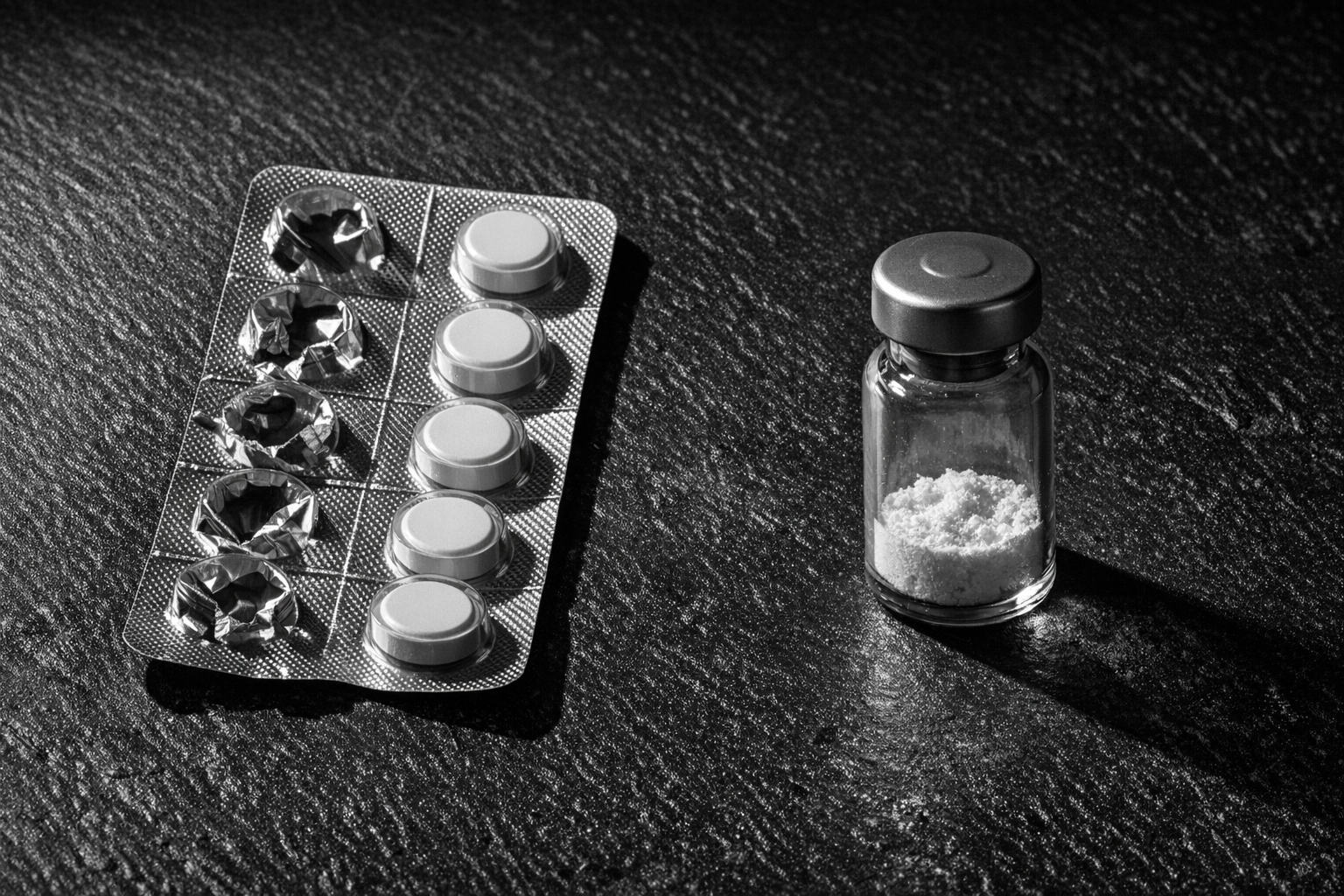
BPC-157 vs NSAIDs, graded honestly: NSAIDs suppress the inflammation that is also the start of repair (clear in animals, contested in humans, real GI harm, and it may impede disc resorption); BPC-157 is studied for driving repair and protecting against NSAID gut damage. How to think about it for a disc.
An NSAID is the painkiller already in your cupboard: ibuprofen, naproxen, Advil, Nurofen, Aleve. It works by shutting down swelling, and shutting down swelling is what takes the pain away.
BPC-157 is a lab-made copy of a small piece of a protein your own stomach makes. It comes as a powder in a glass vial that you mix with liquid and inject under the skin. It is not a medicine in any country and no pharmacy sells it. What it does is grow new blood vessels into damaged tissue — in rats, at 10 micrograms per kilo of body weight a day, across about 150 animal studies.
People weigh these two against each other because they reach for both after the same thing: a tendon, a muscle or a joint that got hurt and still hurts.
Here is the trade, one line each.
The painkiller takes the pain away, and the part that heals comes back weaker. Take ibuprofen 400 mg and roughly two people in every five get at least half their pain gone who would not have got it from a dummy pill — that is out of about 460 separate trials and 50,000 people, so it is about as well established as anything in medicine. The catch is in how it works. Swelling is not only the thing that hurts; it is also the signal that tells the body to start rebuilding. Switch it off and you switch off part of the rebuilding. In rats, both the newer and the older painkillers made a repaired tendon easier to tear off the bone again — less force needed, less stiffness — and left the gristly pad that anchors tendon to bone patchy and half-formed, where untreated animals had rebuilt it by four weeks. There is no clever window that gets you out of this: the damage showed up giving the drug in the first five days, again at days 6 to 14, and again at days 11 to 20.
BPC-157 is aimed at the rebuilding, and nobody has ever run a proper trial of it in an injured person. Blood carries the oxygen and the repair cells that rebuild a torn tendon, and a tendon has very little blood going through it, which is why it heals so slowly. More vessels means more blood reaching the damage. In rats, a tendon cut clean off the heel bone came back taking more force to tear again, stiffer, with the fibres lying straight instead of scarred. In two studies it undid the harm a steroid shot had already done to healing. Five studies have given it to people — about 130 people — and every one of them was checking for side effects; not one measured whether anything healed. At the amount people actually take, 250 to 500 micrograms a day for four to eight weeks, there has never been a trial at all. What exists at that amount is 37 people who wrote down in public what happened to them: 18 said it helped, 5 said partly, 10 said nothing happened, 4 said it made something worse.
BPC-157 grows new blood vessels into damaged tissue, which is the step the drug's mechanism works against. In rats, at 10 µg/kg a day, an Achilles cut off the heel bone came back taking more load before it failed, stiffer, with the collagen running straight instead of scarred and more vessels grown in — across roughly 150 animal papers and at least six injury models. In two of those studies it reversed the healing damage a corticosteroid injection had already done. In rats given diclofenac, it blocked the drug's entire gut, liver and brain cascade. In people, five early-phase studies covering about 130 people measured safety and never measured healing; at the dose and duration people actually run — 250 to 500 mcg a day for four to eight weeks — no trial has ever been run at all, and the counted first-person record at that exposure is 37 accounts stating an outcome: 18 helped, 5 partly, 10 nothing, 4 worse.
Held to one standard, the ledger is this. Neither has a finished controlled trial showing it rebuilds a torn tissue in a person — the peptide has none, and no anti-inflammatory has ever been shown to heal one either. In the animal work where both have been measured, they move the repair in opposite directions: the drug lowers the strength of the healed join, the peptide raises it. And the counted human record at the exposure people actually run belongs only to the peptide, because nobody has run a trial there.
If the only question is what will hurt less in the next four hours, the answer is the drug. The price is a join that fails at a lower load.
Now the two things that make this a real question rather than a rout.
For back pain specifically, the drug's own trials are unimpressive
The 50,000-participant number comes from post-surgical pain. Back pain is a different question and it has its own trials, and they are far less flattering.
Acute low back pain. Cochrane pooled 32 trials, 5,356 participants. Against placebo, anti-inflammatories reduced pain by 7.29 points on a 0–100 scale (95% CI −10.98 to −3.61), moderate-quality evidence. Disability improved by 2.02 points on a 0–24 scale, high-quality evidence. The reviewers' own summary of that magnitude: "small and probably not clinically relevant." No difference between COX-2-selective and older ones. Almost half the studies were industry-funded.
Chronic low back pain. Cochrane, 13 trials. Against placebo, 3.30 points on the same 0–100 scale (95% CI −5.33 to −1.27), low-quality evidence. Disability, 0.85 points on a 0–24 scale. And this line, which deserves to be read twice: when the reviewers restricted the analysis to trials at low risk of bias, the difference between the drug and placebo got smaller.
Set those numbers beside the one intervention with a genuinely large effect for the same condition: structured exercise, pooled across 249 randomised trials, produced a 15.2-point pain reduction, which cleared the reviewers' pre-set threshold for a clinically important difference.
So the honest ranking for a back, on human trial evidence, is: exercise 15.2 points, anti-inflammatories 7.3 points for acute and 3.3 for chronic, BPC-157 untested. The drug beats the peptide because the peptide has nothing. It loses badly to walking and lifting.
What each one actually does to the tissue
An anti-inflammatory blocks an enzyme called COX-2. COX-2 makes prostaglandins. Prostaglandins are what make an injury swell, throb and hurt. Block the enzyme, lose the prostaglandins, lose the pain. That is the whole drug.
The complication is that prostaglandins are not only a pain signal. They are also the opening instruction of tissue repair — the message that recruits repair cells to a damaged site and starts the rebuilding. One molecule, two jobs. The drug cannot separate them.
BPC-157 runs the opposite way. It is a short chain of fifteen amino acids based on a sequence found in human stomach juice, and in animals it raises VEGF, the signal that grows new blood vessels into damaged tissue, and drives connective-tissue cells to migrate into and repair an injury. It has no pain-blocking action of its own worth speaking of.
One suppresses the signal. The other is studied for accelerating what the signal is calling for. That is the actual axis of this comparison, and neither side of it is automatically the right answer — it depends entirely on what you are trying to buy.
The case against months of anti-inflammatories is specific, numbered, and not about healing
Most arguments against these drugs are vague and moralising. The real case is none of those things. It is four separate, measured harms, three of which are not in serious dispute.
The stomach
The largest analysis of individual patient data — 280 trials against placebo covering 124,513 participants, plus 474 head-to-head trials covering 229,296 — put numbers on it by drug. Upper gastrointestinal complications, meaning a perforation, obstruction or bleed:
Note what that table does to the popular story. Naproxen, the one usually recommended as the heart-safe choice, has the worst gut number in the set. There is no drug in that column that is free.
The head-to-head randomised trial confirms the direction. PRECISION randomised 24,081 patients with arthritis and raised heart risk to celecoxib, ibuprofen or naproxen for a mean of 20 months. Gastrointestinal events were significantly lower with celecoxib than with either naproxen (p=0.01) or ibuprofen (p=0.002).
Heart failure risk was roughly doubled by all of them. In absolute terms: for every 1,000 people taking a coxib or diclofenac for a year, three extra major vascular events, one of them fatal.
That is the honest trade-off between the two tables. Naproxen is the kindest to your heart and the harshest on your stomach. Celecoxib is the reverse. There is no free option, and PRECISION found celecoxib was not worse than the other two on heart outcomes at moderate doses, which softened but did not erase the coxib concern.
Forty studies covering 1,757,118 participants. Long-term use raised the odds of developing or worsening chronic kidney disease: pooled odds ratio 1.24, pooled hazard ratio 1.50. In people who already had kidney disease, the hazard ratio was 1.67.
The report pile at the regulator, and exactly what it is not
FDA's public adverse event system holds reports sent in voluntarily by patients, doctors and manufacturers. Queried on 4 August 2026, it holds 283,544 reports naming ibuprofen and 165,063 naming naproxen.
Say what those numbers are before reading them. They are counts of reports, not counts of people harmed. There is no denominator anywhere in the system — nobody knows how many people took either drug and reported nothing, and that missing number is the one an incidence rate would need. A report is not a finding that the drug caused the event. The same event can arrive more than once. Reporting rises when a drug is in the news. Nothing in this table is a rate, and it cannot be turned into one.
Two things are worth taking from it. The kidney rows sit above the gut rows for both drugs, which is the opposite of the ordering most people carry in their heads, and it lines up with the direction of the 1,757,118-participant kidney analysis rather than contradicting it. And the single most reported term for both drugs is not a harm at all: "drug ineffective" — 27,383 times for ibuprofen and 22,584 for naproxen. Set that beside the Cochrane back-pain numbers at the top of this page and it is the same finding arriving from the other end of the evidence pyramid.
The controlled trials above give you rates. This gives you the shape of what lands when something goes wrong. Use it for the second and never for the first.
Tendon and soft-tissue healing — the one that is genuinely contested
This is the argument most often made and least often made carefully. Here is what the evidence supports and where it stops.
In animals it is consistent and specific. In a rotator cuff repair model, both an older anti-inflammatory (indomethacin) and a COX-2-selective one (celecoxib) produced significantly weaker tendon-to-bone healing than untreated controls, out to eight weeks.
The timing pattern is the strongest part of the case. Give ibuprofen during the early repair window and tendon healing is measurably worse; give the same drug later and the effect fades. That is exactly the pattern you would predict if the drug is interrupting the initial repair instruction rather than merely masking pain.
The mechanism is not a coincidence. Knock out COX-2 in mice and fractures heal badly. Restore the downstream prostaglandin signal and the healing is rescued. The enzyme the drug exists to block is the same enzyme repair runs on.
It reaches human repair cells. In a human study, infusing an anti-inflammatory locally during exercise abolished the normal rise in muscle satellite cells — the stem cells that rebuild muscle after loading.
And now the counter-evidence, which is real. A meta-analysis of human fracture outcomes that adjusted for confounders found no significant increase in fracture non-union among people taking these drugs.
There is even a species-level reason it might not translate. Human skeletal stem cells were directly compared with rodent ones and turned out to be substantially less dependent on COX-2 for their function.
So the fair verdict, stated as a rate rather than a mood: animal healing impairment is consistently reproduced; human cellular repair signals are measurably blunted; human clinical healing outcomes show no proven harm. Anyone claiming these drugs are proven to wreck human healing is overstating. Anyone claiming the concern is invented is ignoring the timing data and the knockout mice.
Why the argument sharpens when the injury is one the drug's own trials do badly on
A herniated disc is the one case where the healing question is not theoretical, because the mechanism that removes a herniation is an inflammatory mechanism.
Displaced disc material meets blood supply and immune cells for the first time. Immune cells digest it, new blood vessels grow in to supply the operation, and about 70% of herniations reabsorb on their own within roughly six months.
Suppress that inflammation continuously and you are working against the clearance. This is not purely inference: corticosteroids inhibited resorption in preclinical work, and a clinical series that deliberately withheld anti-inflammatory drugs reported resorption in every patient.
That evidence is a case series, not a randomised trial, and it should be weighted as such. But it points the same direction as the tendon timing data, and it is the reason "a few days for a flare" and "eight months of daily tablets" are different decisions rather than different doses of the same decision.
The slower wear process behind many of these discs is a separate question with its own numbers, and it changes what a long course of anything is being asked to do:
What BPC-157 actually has, listed without inflation
In animals, the tendon results are the strongest thing it has. A transected rat Achilles tendon treated with BPC-157 came back with greater load-to-failure and better collagen organisation than controls.
The cellular behaviour matches. Tendon cells showed better outgrowth, survival and migration — the three behaviours that define active repair rather than scarring over.
And the mechanism is the mirror image of the drug's. BPC-157 raises VEGF and drives new blood vessel growth into healing muscle and tendon — the same vascular pathway that COX-2 blockade suppresses.
It protects against the drug's own gut damage, in rats. Given alongside diclofenac, BPC-157 counteracted the gastrointestinal, liver and brain lesions the drug caused.
What none of that is: a human result. Every item above is a rodent. There is no completed randomised controlled trial of BPC-157 in a human injury, no dose established for a human tendon, and no study of any kind against a human disc.
Seven people on long-term anti-inflammatories, counted
Seven first-person accounts from X, counted.Four of the seven reported a harm. One was warned off by a doctor before anything went wrong. One reported no problems over more than ten years. One is worried and getting tested, with no result back yet.
Read this panel knowing exactly what is wrong with it: people post about the ulcer that sent them to hospital, not about the uneventful decade. The harm fraction here is not the population rate — the population rate is in the tables above, and it is a 4× relative increase on a small absolute base, not four in seven. This panel tells you what the harm looks like when it lands, not how often it lands.
Reported a harm — 4 of 7.
Kidney filtration flagged on bloodwork after years of six tablets a day:
Warned off, no harm reported yet — 1 of 7. Nearly two years of naproxen with a stomach-protecting drug alongside it, then a new doctor capping it at six months:
Ten first-person accounts from X, all self-reported, none verified, none from a trial. Six said it helped. One said it helped and raised the possibility of placebo himself. Two said it did not work. One reported no outcome either way. Nobody reported a serious harm, and the only physical complaint in the set was at an injection site.
Two of the six positive accounts carry either a supplier link or a follow-me pitch attached to the post. That is not proof they are false, but it is a selection problem you should hold in mind while reading them.
Said it helped — 6 of 10.
A dried-out lower disc plus a year-old biceps tendon problem, six weeks of BPC-157 and TB-500 — tendon and shoulder resolved, disc improved but explicitly still needing physiotherapy:
Helped, but he flagged placebo himself — 1 of 10. This is the most intellectually honest account in the set, and it is worth more than the enthusiastic ones:
Eight weeks for a shoulder, judged not a success — with an interesting detail: stomach problems he had stopped noticing came back two weeks after stopping, which is the one place his account supports the gut-protective animal data even while rejecting the injury claim:
What ten accounts can and cannot establish. They cannot establish that it works — there is no control group, no blinding, no independent measurement, and a heavy bias toward people who bought the thing and want it to have worked. What they do establish, honestly: the reported experience is not uniformly positive, two of ten users describe no benefit at all, one of the enthusiasts volunteered placebo as an explanation unprompted, and nobody in this set reported a serious adverse event. Hold that against the 50,000-participant table at the top of this page and the size of the gap is the point.
What is legal, which is a separate question from what works
BPC-157 is not an approved drug anywhere. Its regulatory position has moved recently, so the specific dates matter more than the summary. FDA placed it in Category 2 of the 503A bulk substances list in September 2023, barring pharmacy compounding. It was off all three categories by the 14 May 2026 revision after the nominations were withdrawn. In July 2026 FDA's own briefing document recommended against adding it; on 23 July 2026 the Pharmacy Compounding Advisory Committee voted 8–6 with one abstention to recommend adding it anyway, against FDA staff. It is not on the 503B outsourcing-facility list either.
It is prohibited in sport at all times. WADA's 2026 Prohibited List names BPC-157 explicitly under S0, non-approved substances — in and out of competition, not only on competition day. The US Department of Defense lists it on its Prohibited Dietary Supplement Ingredients List and states plainly that it is not a dietary ingredient but an unapproved drug, at any route.
What it is sold as: research chemical, research use only. That is a shipping label, not a legal category granting you permission to use it.
Ibuprofen and naproxen are over-the-counter medicines with approved labels, approved dose ceilings, and pharmacist advice attached. That difference is not a footnote — it is the reason one of them has 50,000 participants of evidence behind it and the other does not.
The decision table
Your situation
What the evidence supports
What the evidence does not support
Legal position
Acute pain in the first few days, any injury
A short course of an anti-inflammatory. NNT 2.5 for ibuprofen 400 mg on at least 50% pain relief
That it speeds your healing, or that avoiding it makes you heal better
Over the counter
Acute back pain specifically
The same short course, with realistic expectations — 7.3 points on a 0–100 scale, which the reviewers called probably not clinically relevant
That it will do much. Movement outperforms it by roughly double
Over the counter
Chronic back pain, months in
Exercise. 15.2 points across 249 trials, against 3.3 points for the drug
Daily long-term anti-inflammatories as the plan. The effect shrinks in the least-biased trials and the harm accumulates
Over the counter, but this is the use with the harm tables attached
A herniated disc actively reabsorbing
Short courses to enable movement
Continuous suppression for months. Steroids inhibited resorption in preclinical work; one series avoiding these drugs saw resorption in every patient
Over the counter
You already have stomach disease or a bleed history
Avoiding the older drugs. Coxibs 1.81× vs ibuprofen 3.97× and naproxen 4.22× for upper gut complications
That any of them is gut-neutral
Prescription for coxibs in most places
You have heart disease or heart failure
Caution across the whole class. Heart failure risk roughly doubled by all of them; naproxen alone did not raise major vascular events
That the choice of drug removes the risk
Over the counter, which does not mean low-risk here
You have kidney disease
Avoiding long-term use. Hazard ratio 1.67 for progression in people who already have it
That short courses carry the same risk as chronic use
Over the counter
Tendon or soft-tissue injury where healing is the goal
Load management, progressive rehabilitation, and using pain relief sparingly in the first repair window
Either extreme. Animal harm is consistent; human non-union data shows none
Over the counter
You are considering BPC-157 for an injury
Nothing, in humans. Animal tendon repair is real and consistent; that is the entire honest case
Any human dose, any human timeline, any disc claim, any comparison of its effect size to the drug's
Not approved anywhere. Banned in sport at all times. Prohibited for US service members
You are a competing athlete
Whatever is on your sport's permitted list
Using BPC-157 under any framing, including "research use only"
WADA S0, strict liability, in and out of competition
The one-line version of each side
For the drug: it demonstrably relieves pain in humans at scale, it is legal, it is cheap, and the healing concern is unproven in human outcomes. Its costs are measured, drug-specific, and rise with duration rather than dose alone.
For the peptide: it has a coherent repair mechanism, consistent animal tendon results, and animal evidence that it protects the gut lining the drug damages. It has no human trial for any injury, no established dose, no legal approval, and a user-report base with two in ten reporting nothing at all.
Those two paragraphs are not equivalent, and nothing above has tried to make them equivalent. One is a medicine with a known effect size and a known bill. The other is an interesting hypothesis being taken by a lot of people ahead of its evidence.
What is compared above is the state of the evidence. It is not medical advice and not a dosing recommendation. Do not stop a prescribed medicine on the basis of a web page. BPC-157 is sold for research use only, is not approved for human use in any jurisdiction, and is prohibited in sport at all times.
2.5
number needed to treat for ibuprofen 400 mg to halve pain (~50,000 participants)
0
completed randomised human trials of BPC-157 for any injury
7.3 pts
all an anti-inflammatory beats placebo by for acute back pain, on a 0-100 scale
15.2 pts
what exercise beats placebo by for chronic back pain, across 249 trials
4.22x / 3.97x
upper gut complications on naproxen / ibuprofen vs placebo
2x
heart failure risk, raised by every drug in the class
Cardiovascular Safety of Celecoxib, Naproxen, or Ibuprofen for Arthritis — PRECISION (NEJM 2016, PMID 27959716)“A total of 24,081 patients were randomly assigned to the celecoxib group... the naproxen group... or the ibuprofen group for a mean treatment duration of 20.3 months... The risk of gastrointestinal events was significantly lower with celecoxib than with naproxen (P=0.01) or ibuprofen (P=0.002); the risk of renal events was significantly lower with celecoxib than with ibuprofen (P=0.004)... At mode”
Non-steroidal anti-inflammatory drugs for acute low back pain (Cochrane 2020, PMID 32297973)“We included 32 trials, with a total of 5356 participants... There is moderate quality evidence that NSAIDs are slightly more effective in short-term (<= 3 weeks) reduction of pain intensity (visual analogue scale, 0 to 100) than placebo (mean difference (MD) -7.29 (95% CI -10.98 to -3.61); 4 RCTs, N = 815)... The magnitude of these effects is small and probably not clinically relevant.”
Non-steroidal anti-inflammatory drugs for chronic low back pain (Cochrane 2016, PMID 26863524)“There is low quality evidence that NSAIDs are more effective than placebo, with a mean difference in pain intensity score from baseline of -3.30 (95% CI -5.33 to -1.27) on a 0 to 100 visual analogue scale... When we only included RCTs at low risk of bias, differences in effect between NSAIDs and placebo were reduced.”
Single dose oral analgesics for acute postoperative pain in adults — an overview of Cochrane reviews (Cochrane 2015, PMID 26414123)“The overview included 39 separate Cochrane Reviews with 41 analyses of single dose oral analgesics tested in acute postsurgical conditions, with results from about 50,000 participants in approximately 460 individual studies... Good (low) NNTs were obtained with ibuprofen 200 mg plus paracetamol 500 mg (NNT compared with placebo 1.6), ibuprofen fast acting 200 mg (2.1)... For comparison, ibuprofen ”
Exercise therapy for chronic low back pain (Cochrane 2021, PMID 34580864)“We found moderate-certainty evidence that exercise treatment is more effective for treatment of chronic low back pain compared to no treatment, usual care or placebo comparisons for pain outcomes at earliest follow-up (MD -15.2, 95% CI -18.3 to -12.2), a clinically important difference.”
A stomach bleed that lasted a year, then twelve years avoiding the whole drug class (anecdotal) — Jun 11, 2026“Indomethacin gave me a stomach bleed that lasted a year bc of polypharmacy. I am currently taking a short course of naproxen bc of shoulder trauma from a sleep-related movement disorder. This is the first time in 12 years I have taken an NSAID. I begged for one. A little worried.”
Ulcer, black stool, emergency room (anecdotal) — May 4, 2026“Be careful with the ibuprofen. I started taking so much that it caused an ulcer in my stomach and I ended up in an emergency room due to have black stool.”
Two years of naproxen for spinal pain, then a six-month cap (anecdotal) — Jul 13, 2026“I took Naproxen for almost 2 years to help with spinal pain, and as you say, I also had to take omeprazole. When I moved house recently my new Dr. told me that I was only allowed Naproxen for a 6 month period or it could do irrepealable damage?”
A dried-out lower disc plus a year-old biceps tendon problem, six weeks of BPC-157 and TB-500 (anecdotal) — Jul 31, 2026“My lowest disc in the lower back is dried out, almost no fluid left, classic herniated disc. Flared up hard in March, could barely sit or stand without pain. Went on for 3 months with zero improvement. Also had a biceps tendon issue for over a year, couldn't curl on the right side. Plus something in the right shoulder that made shoulder press painful. In June I ran BPC-157 and TB-500 for about 6 w”
Elbow tendon pain of months, 2 mg injected locally each day (anecdotal) — Aug 1, 2026“Elbow tendinitis has been killing me for months. Started messing with my lifts and I was getting real tired of it. Been hitting it with 2mg BPC-157 every day, straight into the spot. A few weeks in and it's night and day. Pain is pretty much gone and I'm training normal again. Still got a little ways to go but damn it feels good to not have that constant ache.”
Rotator cuff surgery recommended, two eight-week cycles, surgery avoided — post ends in a follow-me pitch (anecdotal) — Jul 2, 2026“Surgeon told me I needed rotator cuff surgery. A few months later I was back to heavy lifting and never went under the knife... For my shoulder, I ran 500mcg every night, injected subq right into the fat around the injury site. I did an 8 week cycle, took a 2 week break, then ran it a second time. By the end of that second cycle I was already back under heavy weight and surgery wasn't on the table”
Two months, rotator cuff quiet during training, heartburn gone (anecdotal) — Jun 29, 2026“Took bpc-157 for two months, heartburn basically gone unless I eat chili or something like that right before bed. Rotator cuff injury from jujitsu not bothering me when I lift or roll. Mood stable… like if something happens that would make me mad I let slide”
A disc flare that resolved in seven days, with placebo raised by the user himself (anecdotal) — May 26, 2024“Had a bad disc flare up this past weekend (I had a disc herniation at L5-S1 many years ago, never been the same since) Was staggering around in pain for a day and a half. Decided to try to taking oral BPC157 at 2000mcg daily -Also got two deep tissue massages, and a chiro adjustment. 7 days later, pain free. Did the BPC157 help? Maybe, maybe not. Im always open to possibility of placebo. Regardles”
Ten years of on-and-off use and a flat negative verdict (anecdotal) — Jul 30, 2026“Appreciate you acknowledging the potential placebo benefits. Been taking bpc157 off and on for over 10 years and really don't think it does much. Apart from not really healing anything I've had random tendinitis pop up even while being on bpc”
Eight weeks for a shoulder, judged not a success — but stomach problems returned after stopping (anecdotal) — Jul 26, 2026“I took BPC-157 for a shoulder injury. After 8 weeks the pain had lessened but I really didn't class it as a success. Came off and about 2 weeks later had problems with my stomach that had disappeared out of my awareness whilst taking BPC. Evaluating on a systemic level has better chance of catching this kind of thing. Sometimes the focus is too narrow.”
An injection-site problem from using too large a needle (anecdotal) — Jul 22, 2026“I just transferred my BPC-157 to a pen and I think I got too big of a needle (Novofine 8mm/30g Needles) for the tip so good brand but wrong size I think, but when I used it some blood went back into the cart after injection... also just now healing from the injection points.”
openFDA adverse event reports naming ibuprofen and naproxen (FAERS, queried 2026-08-04)“283,544 total reports name ibuprofen and 165,063 name naproxen. Most frequent reported terms for ibuprofen: DRUG INEFFECTIVE 27,383; PAIN 19,490; FATIGUE 18,754; NAUSEA 18,293. Serious event counts for ibuprofen / naproxen: acute kidney injury 7,141 / 3,145; renal failure 4,216 / 2,562; gastrointestinal haemorrhage 2,689 / 1,486; myocardial infarction 1,781 / 1,770; gastric ulcer 1,394 / 867; mela”
the whole object this page is drawn from, as JSON
{
"schema":"http://google-preview.miscsubjects.com/schemas/jarticle.json",
"status":"published",
"slug":"bpc-157-vs-nsaids",
"title":"BPC-157 vs NSAIDs: Repair or Suppress?",
"kind":"essay",
"summary":"BPC-157 vs NSAIDs, graded honestly: NSAIDs suppress the inflammation that is also the start of repair (clear in animals, contested in humans, real GI harm, and it may impede disc resorption); BPC-157 is studied for driving repair and protecting against NSAID gut damage. How to think about it for a disc.",
"created":"2026-07-24T16:33:47.167Z",
"body": [
"An NSAID is the painkiller already in your cupboard: ibuprofen, naproxen, Advil, Nurofen, Aleve. It works by shutting down swelling, and shutting down swelling is what takes the pain away.\n\nBPC-157 is a lab-made copy of a small piece of a protein your own stomach makes. It comes as a powder in a glass vial that you mix with liquid and inject under the skin. It is not a medicine in any country and no pharmacy sells it. What it does is grow new blood vessels into damaged tissue — in rats, at 10 micrograms per kilo of body weight a day, across about 150 animal studies.\n\nPeople weigh these two against each other because they reach for both after the same thing: a tendon, a muscle or a joint that got hurt and still hurts.\n\nHere is the trade, one line each.\n\n**The painkiller takes the pain away, and the part that heals comes back weaker.** Take ibuprofen 400 mg and roughly two people in every five get at least half their pain gone who would not have got it from a dummy pill — that is out of about 460 separate trials and 50,000 people, so it is about as well established as anything in medicine. The catch is in how it works. Swelling is not only the thing that hurts; it is also the signal that tells the body to start rebuilding. Switch it off and you switch off part of the rebuilding. In rats, both the newer and the older painkillers made a repaired tendon easier to tear off the bone again — less force needed, less stiffness — and left the gristly pad that anchors tendon to bone patchy and half-formed, where untreated animals had rebuilt it by four weeks. There is no clever window that gets you out of this: the damage showed up giving the drug in the first five days, again at days 6 to 14, and again at days 11 to 20.\n\n**BPC-157 is aimed at the rebuilding, and nobody has ever run a proper trial of it in an injured person.** Blood carries the oxygen and the repair cells that rebuild a torn tendon, and a tendon has very little blood going through it, which is why it heals so slowly. More vessels means more blood reaching the damage. In rats, a tendon cut clean off the heel bone came back taking more force to tear again, stiffer, with the fibres lying straight instead of scarred. In two studies it undid the harm a steroid shot had already done to healing. Five studies have given it to people — about 130 people — and every one of them was checking for side effects; not one measured whether anything healed. At the amount people actually take, 250 to 500 micrograms a day for four to eight weeks, there has never been a trial at all. What exists at that amount is 37 people who wrote down in public what happened to them: 18 said it helped, 5 said partly, 10 said nothing happened, 4 said it made something worse.",
{
"type":"source",
"id":"s23"
},
"**BPC-157 grows new blood vessels into damaged tissue, which is the step the drug's mechanism works against.** In rats, at 10 µg/kg a day, an Achilles cut off the heel bone came back taking more load before it failed, stiffer, with the collagen running straight instead of scarred and more vessels grown in — across roughly 150 animal papers and at least six injury models. In two of those studies it reversed the healing damage a corticosteroid injection had already done. In rats given diclofenac, it blocked the drug's entire gut, liver and brain cascade. In people, five early-phase studies covering about 130 people measured safety and never measured healing; at the dose and duration people actually run — 250 to 500 mcg a day for four to eight weeks — no trial has ever been run at all, and the counted first-person record at that exposure is 37 accounts stating an outcome: 18 helped, 5 partly, 10 nothing, 4 worse.\n\n![[bpc-157]]\n\nHeld to one standard, the ledger is this. Neither has a finished controlled trial showing it rebuilds a torn tissue in a person — the peptide has none, and no anti-inflammatory has ever been shown to heal one either. In the animal work where both have been measured, they move the repair in opposite directions: the drug lowers the strength of the healed join, the peptide raises it. And the counted human record at the exposure people actually run belongs only to the peptide, because nobody has run a trial there.\n\nIf the only question is what will hurt less in the next four hours, the answer is the drug. The price is a join that fails at a lower load.\n\nNow the two things that make this a real question rather than a rout.\n\n## For back pain specifically, the drug's own trials are unimpressive\n\nThe 50,000-participant number comes from post-surgical pain. Back pain is a different question and it has its own trials, and they are far less flattering.\n\n**Acute low back pain.** Cochrane pooled 32 trials, 5,356 participants. Against placebo, anti-inflammatories reduced pain by **7.29 points on a 0–100 scale** (95% CI −10.98 to −3.61), moderate-quality evidence. Disability improved by 2.02 points on a 0–24 scale, high-quality evidence. The reviewers' own summary of that magnitude: \"small and probably not clinically relevant.\" No difference between COX-2-selective and older ones. Almost half the studies were industry-funded.",
{
"type":"source",
"id":"s21"
},
"**Chronic low back pain.** Cochrane, 13 trials. Against placebo, **3.30 points on the same 0–100 scale** (95% CI −5.33 to −1.27), low-quality evidence. Disability, 0.85 points on a 0–24 scale. And this line, which deserves to be read twice: when the reviewers restricted the analysis to trials at low risk of bias, the difference between the drug and placebo got *smaller*.",
{
"type":"source",
"id":"s22"
},
"Set those numbers beside the one intervention with a genuinely large effect for the same condition: structured exercise, pooled across 249 randomised trials, produced a **15.2-point** pain reduction, which cleared the reviewers' pre-set threshold for a clinically important difference.",
{
"type":"source",
"id":"s24"
},
"So the honest ranking for a back, on human trial evidence, is: exercise 15.2 points, anti-inflammatories 7.3 points for acute and 3.3 for chronic, BPC-157 untested. The drug beats the peptide because the peptide has nothing. It loses badly to walking and lifting.\n\n## What each one actually does to the tissue\n\nAn anti-inflammatory blocks an enzyme called COX-2. COX-2 makes prostaglandins. Prostaglandins are what make an injury swell, throb and hurt. Block the enzyme, lose the prostaglandins, lose the pain. That is the whole drug.\n\nThe complication is that prostaglandins are not only a pain signal. They are also the opening instruction of tissue repair — the message that recruits repair cells to a damaged site and starts the rebuilding. One molecule, two jobs. The drug cannot separate them.\n\nBPC-157 runs the opposite way. It is a short chain of fifteen amino acids based on a sequence found in human stomach juice, and in animals it raises VEGF, the signal that grows new blood vessels into damaged tissue, and drives connective-tissue cells to migrate into and repair an injury. It has no pain-blocking action of its own worth speaking of.\n\nOne suppresses the signal. The other is studied for accelerating what the signal is calling for. That is the actual axis of this comparison, and neither side of it is automatically the right answer — it depends entirely on what you are trying to buy.\n\n## The case against months of anti-inflammatories is specific, numbered, and not about healing\n\nMost arguments against these drugs are vague and moralising. The real case is none of those things. It is four separate, measured harms, three of which are not in serious dispute.\n\n### The stomach\n\nThe largest analysis of individual patient data — 280 trials against placebo covering 124,513 participants, plus 474 head-to-head trials covering 229,296 — put numbers on it by drug. Upper gastrointestinal complications, meaning a perforation, obstruction or bleed:\n\n| Drug | Increase in upper gut complications vs placebo |\n|---|---|\n| Naproxen | 4.22× |\n| Ibuprofen | 3.97× |\n| Diclofenac | 1.89× |\n| COX-2-selective drugs (coxibs) | 1.81× |",
{
"type":"source",
"id":"s18"
},
"Note what that table does to the popular story. Naproxen, the one usually recommended as the heart-safe choice, has the *worst* gut number in the set. There is no drug in that column that is free.\n\nThe head-to-head randomised trial confirms the direction. PRECISION randomised 24,081 patients with arthritis and raised heart risk to celecoxib, ibuprofen or naproxen for a mean of 20 months. Gastrointestinal events were significantly lower with celecoxib than with either naproxen (p=0.01) or ibuprofen (p=0.002).",
{
"type":"source",
"id":"s19"
},
"### The heart\n\nFrom the same 124,513-participant analysis:\n\n| Drug | Major vascular events | Major coronary events |\n|---|---|---|\n| Coxibs | 1.37× | 1.76× |\n| Diclofenac | 1.41× | 1.70× |\n| Ibuprofen | 1.44× (not significant) | 2.22× |\n| Naproxen | 0.93× (no increase) | — |\n\n**Heart failure risk was roughly doubled by all of them.** In absolute terms: for every 1,000 people taking a coxib or diclofenac for a year, three extra major vascular events, one of them fatal.",
{
"type":"source",
"id":"s18"
},
"That is the honest trade-off between the two tables. Naproxen is the kindest to your heart and the harshest on your stomach. Celecoxib is the reverse. There is no free option, and PRECISION found celecoxib was not worse than the other two on heart outcomes at moderate doses, which softened but did not erase the coxib concern.",
{
"type":"source",
"id":"s19"
},
"### The kidneys\n\nForty studies covering 1,757,118 participants. Long-term use raised the odds of developing or worsening chronic kidney disease: pooled odds ratio 1.24, pooled hazard ratio 1.50. In people who already had kidney disease, the hazard ratio was 1.67.",
{
"type":"source",
"id":"s20"
},
"In PRECISION, kidney events were significantly lower with celecoxib than with ibuprofen (p=0.004).",
{
"type":"source",
"id":"s19"
},
"### The report pile at the regulator, and exactly what it is not\n\nFDA's public adverse event system holds reports sent in voluntarily by patients, doctors and manufacturers. Queried on 4 August 2026, it holds **283,544 reports naming ibuprofen** and **165,063 naming naproxen**.\n\nSay what those numbers are before reading them. They are counts of reports, not counts of people harmed. There is no denominator anywhere in the system — nobody knows how many people took either drug and reported nothing, and that missing number is the one an incidence rate would need. A report is not a finding that the drug caused the event. The same event can arrive more than once. Reporting rises when a drug is in the news. Nothing in this table is a rate, and it cannot be turned into one.\n\n| Reported event | Reports naming ibuprofen | Reports naming naproxen |\n|---|---|---|\n| Acute kidney injury | 7,141 | 3,145 |\n| Kidney failure | 4,216 | 2,562 |\n| Bleeding in the gut | 2,689 | 1,486 |\n| Heart attack | 1,781 | 1,770 |\n| Stomach ulcer | 1,394 | 867 |\n| Black stool from a gut bleed | 1,208 | 478 |\n| Heart failure | 634 | 305 |\n| Bleeding from the stomach lining | 622 | 489 |\n| Ulcer in the first part of the small intestine | 614 | 359 |",
{
"type":"source",
"id":"s42"
},
"Two things are worth taking from it. The kidney rows sit above the gut rows for both drugs, which is the opposite of the ordering most people carry in their heads, and it lines up with the direction of the 1,757,118-participant kidney analysis rather than contradicting it. And the single most reported term for both drugs is not a harm at all: **\"drug ineffective\" — 27,383 times for ibuprofen and 22,584 for naproxen.** Set that beside the Cochrane back-pain numbers at the top of this page and it is the same finding arriving from the other end of the evidence pyramid.\n\nThe controlled trials above give you rates. This gives you the shape of what lands when something goes wrong. Use it for the second and never for the first.\n\n### Tendon and soft-tissue healing — the one that is genuinely contested\n\nThis is the argument most often made and least often made carefully. Here is what the evidence supports and where it stops.\n\n**In animals it is consistent and specific.** In a rotator cuff repair model, both an older anti-inflammatory (indomethacin) and a COX-2-selective one (celecoxib) produced significantly weaker tendon-to-bone healing than untreated controls, out to eight weeks.",
{
"type":"source",
"id":"s1"
},
"**The timing pattern is the strongest part of the case.** Give ibuprofen during the early repair window and tendon healing is measurably worse; give the same drug later and the effect fades. That is exactly the pattern you would predict if the drug is interrupting the initial repair instruction rather than merely masking pain.",
{
"type":"source",
"id":"s3"
},
"**Bone shows it too.** Pooled animal data show these drugs measurably reduce the mechanical strength of healing fractures.",
{
"type":"source",
"id":"s6"
},
"**The mechanism is not a coincidence.** Knock out COX-2 in mice and fractures heal badly. Restore the downstream prostaglandin signal and the healing is rescued. The enzyme the drug exists to block is the same enzyme repair runs on.",
{
"type":"source",
"id":"s8"
},
"**It reaches human repair cells.** In a human study, infusing an anti-inflammatory locally during exercise abolished the normal rise in muscle satellite cells — the stem cells that rebuild muscle after loading.",
{
"type":"source",
"id":"s7"
},
"**And now the counter-evidence, which is real.** A meta-analysis of human fracture outcomes that adjusted for confounders found **no significant increase in fracture non-union** among people taking these drugs.",
{
"type":"source",
"id":"s5"
},
"**There is even a species-level reason it might not translate.** Human skeletal stem cells were directly compared with rodent ones and turned out to be substantially less dependent on COX-2 for their function.",
{
"type":"source",
"id":"s4"
},
"So the fair verdict, stated as a rate rather than a mood: **animal healing impairment is consistently reproduced; human cellular repair signals are measurably blunted; human clinical healing outcomes show no proven harm.** Anyone claiming these drugs are proven to wreck human healing is overstating. Anyone claiming the concern is invented is ignoring the timing data and the knockout mice.\n\n## Why the argument sharpens when the injury is one the drug's own trials do badly on\n\nA herniated disc is the one case where the healing question is not theoretical, because the mechanism that removes a herniation *is* an inflammatory mechanism.\n\nDisplaced disc material meets blood supply and immune cells for the first time. Immune cells digest it, new blood vessels grow in to supply the operation, and about 70% of herniations reabsorb on their own within roughly six months.\n\n![[herniated-disc]]\n\nSuppress that inflammation continuously and you are working against the clearance. This is not purely inference: corticosteroids inhibited resorption in preclinical work, and a clinical series that deliberately withheld anti-inflammatory drugs reported resorption in every patient.",
{
"type":"source",
"id":"s17"
},
"That evidence is a case series, not a randomised trial, and it should be weighted as such. But it points the same direction as the tendon timing data, and it is the reason \"a few days for a flare\" and \"eight months of daily tablets\" are different decisions rather than different doses of the same decision.\n\nThe slower wear process behind many of these discs is a separate question with its own numbers, and it changes what a long course of anything is being asked to do:\n\n![[degenerative-disc-disease]]\n\n## What BPC-157 actually has, listed without inflation\n\n**In animals, the tendon results are the strongest thing it has.** A transected rat Achilles tendon treated with BPC-157 came back with greater load-to-failure and better collagen organisation than controls.",
{
"type":"source",
"id":"s10"
},
"**The cellular behaviour matches.** Tendon cells showed better outgrowth, survival and migration — the three behaviours that define active repair rather than scarring over.",
{
"type":"source",
"id":"s11"
},
"**And the mechanism is the mirror image of the drug's.** BPC-157 raises VEGF and drives new blood vessel growth into healing muscle and tendon — the same vascular pathway that COX-2 blockade suppresses.",
{
"type":"source",
"id":"s12"
},
"**It protects against the drug's own gut damage, in rats.** Given alongside diclofenac, BPC-157 counteracted the gastrointestinal, liver and brain lesions the drug caused.",
{
"type":"source",
"id":"s13"
},
"**The same protection held when adjuvant arthritis and drug-induced gut lesions were put on the animal together.**",
{
"type":"source",
"id":"s14"
},
"**What none of that is:** a human result. Every item above is a rodent. There is no completed randomised controlled trial of BPC-157 in a human injury, no dose established for a human tendon, and no study of any kind against a human disc.\n\n![[tb-500]]\n\n![[ara-290]]\n\n![[what-are-peptides-herniated-disc]]\n\n## Seven people on long-term anti-inflammatories, counted\n\n**Seven first-person accounts from X, counted.** **Four of the seven reported a harm. One was warned off by a doctor before anything went wrong. One reported no problems over more than ten years. One is worried and getting tested, with no result back yet.**\n\nRead this panel knowing exactly what is wrong with it: people post about the ulcer that sent them to hospital, not about the uneventful decade. The harm fraction here is not the population rate — the population rate is in the tables above, and it is a 4× relative increase on a small absolute base, not four in seven. This panel tells you what the harm looks like when it lands, not how often it lands.\n\n**Reported a harm — 4 of 7.**\n\nKidney filtration flagged on bloodwork after years of six tablets a day:",
{
"type":"source",
"id":"s25"
},
"A stomach bleed that lasted a year, and twelve years of avoiding the whole drug class afterwards:",
{
"type":"source",
"id":"s26"
},
"Five tablets a day for five years for back pain, and a stomach that can no longer tolerate the drug at all:",
{
"type":"source",
"id":"s27"
},
"An ulcer, black stool, and an emergency room:",
{
"type":"source",
"id":"s28"
},
"**Warned off, no harm reported yet — 1 of 7.** Nearly two years of naproxen with a stomach-protecting drug alongside it, then a new doctor capping it at six months:",
{
"type":"source",
"id":"s29"
},
"**No problems — 1 of 7.** Over ten years of use, including long continuous stretches, and no reported issue:",
{
"type":"source",
"id":"s30"
},
"**Worried, no result yet — 1 of 7.** Years of heavy use, now getting kidney and liver function tested:",
{
"type":"source",
"id":"s31"
},
"## Ten people on BPC-157, counted\n\n**Ten first-person accounts from X**, all self-reported, none verified, none from a trial. **Six said it helped. One said it helped and raised the possibility of placebo himself. Two said it did not work. One reported no outcome either way. Nobody reported a serious harm, and the only physical complaint in the set was at an injection site.**\n\nTwo of the six positive accounts carry either a supplier link or a follow-me pitch attached to the post. That is not proof they are false, but it is a selection problem you should hold in mind while reading them.\n\n**Said it helped — 6 of 10.**\n\nA dried-out lower disc plus a year-old biceps tendon problem, six weeks of BPC-157 and TB-500 — tendon and shoulder resolved, disc improved but explicitly still needing physiotherapy:",
{
"type":"source",
"id":"s32"
},
"Elbow tendon pain of months' standing, injected locally at the site:",
{
"type":"source",
"id":"s33"
},
"A two-and-a-half-year knee injury the poster says nothing else had fixed:",
{
"type":"source",
"id":"s34"
},
"Shoulder and joint pain on the BPC-157 plus TB-500 combination — note this post also links a supplier:",
{
"type":"source",
"id":"s35"
},
"A rotator cuff for which surgery had been recommended, two eight-week cycles, surgery avoided — note this post ends in a follow-me pitch:",
{
"type":"source",
"id":"s36"
},
"Two months, rotator cuff quiet during training, and heartburn gone as a side effect:",
{
"type":"source",
"id":"s37"
},
"**Helped, but he flagged placebo himself — 1 of 10.** This is the most intellectually honest account in the set, and it is worth more than the enthusiastic ones:",
{
"type":"source",
"id":"s38"
},
"**Said it did not work — 2 of 10.**\n\nTen years of on-and-off use and a flat verdict, including new tendon pain appearing while on it:",
{
"type":"source",
"id":"s39"
},
"Eight weeks for a shoulder, judged not a success — with an interesting detail: stomach problems he had stopped noticing came back two weeks after stopping, which is the one place his account supports the gut-protective animal data even while rejecting the injury claim:",
{
"type":"source",
"id":"s40"
},
"**No outcome reported — 1 of 10.** An injection-site problem from using too large a needle.",
{
"type":"source",
"id":"s41"
},
"**What ten accounts can and cannot establish.** They cannot establish that it works — there is no control group, no blinding, no independent measurement, and a heavy bias toward people who bought the thing and want it to have worked. What they do establish, honestly: the reported experience is not uniformly positive, two of ten users describe no benefit at all, one of the enthusiasts volunteered placebo as an explanation unprompted, and nobody in this set reported a serious adverse event. Hold that against the 50,000-participant table at the top of this page and the size of the gap is the point.\n\n## What is legal, which is a separate question from what works\n\n**BPC-157 is not an approved drug anywhere.** Its regulatory position has moved recently, so the specific dates matter more than the summary. FDA placed it in Category 2 of the 503A bulk substances list in September 2023, barring pharmacy compounding. It was off all three categories by the 14 May 2026 revision after the nominations were withdrawn. In July 2026 FDA's own briefing document recommended against adding it; on 23 July 2026 the Pharmacy Compounding Advisory Committee voted 8–6 with one abstention to recommend adding it anyway, against FDA staff. It is not on the 503B outsourcing-facility list either.\n\n**It is prohibited in sport at all times.** WADA's 2026 Prohibited List names BPC-157 explicitly under S0, non-approved substances — in and out of competition, not only on competition day. The US Department of Defense lists it on its Prohibited Dietary Supplement Ingredients List and states plainly that it is not a dietary ingredient but an unapproved drug, at any route.\n\n**What it is sold as:** research chemical, research use only. That is a shipping label, not a legal category granting you permission to use it.\n\n![[bpc-157]]\n\n**Ibuprofen and naproxen are over-the-counter medicines** with approved labels, approved dose ceilings, and pharmacist advice attached. That difference is not a footnote — it is the reason one of them has 50,000 participants of evidence behind it and the other does not.\n\n## The decision table\n\n| Your situation | What the evidence supports | What the evidence does not support | Legal position |\n|---|---|---|---|\n| Acute pain in the first few days, any injury | A short course of an anti-inflammatory. NNT 2.5 for ibuprofen 400 mg on at least 50% pain relief | That it speeds your healing, or that avoiding it makes you heal better | Over the counter |\n| Acute back pain specifically | The same short course, with realistic expectations — 7.3 points on a 0–100 scale, which the reviewers called probably not clinically relevant | That it will do much. Movement outperforms it by roughly double | Over the counter |\n| Chronic back pain, months in | Exercise. 15.2 points across 249 trials, against 3.3 points for the drug | Daily long-term anti-inflammatories as the plan. The effect shrinks in the least-biased trials and the harm accumulates | Over the counter, but this is the use with the harm tables attached |\n| A herniated disc actively reabsorbing | Short courses to enable movement | Continuous suppression for months. Steroids inhibited resorption in preclinical work; one series avoiding these drugs saw resorption in every patient | Over the counter |\n| You already have stomach disease or a bleed history | Avoiding the older drugs. Coxibs 1.81× vs ibuprofen 3.97× and naproxen 4.22× for upper gut complications | That any of them is gut-neutral | Prescription for coxibs in most places |\n| You have heart disease or heart failure | Caution across the whole class. Heart failure risk roughly doubled by all of them; naproxen alone did not raise major vascular events | That the choice of drug removes the risk | Over the counter, which does not mean low-risk here |\n| You have kidney disease | Avoiding long-term use. Hazard ratio 1.67 for progression in people who already have it | That short courses carry the same risk as chronic use | Over the counter |\n| Tendon or soft-tissue injury where healing is the goal | Load management, progressive rehabilitation, and using pain relief sparingly in the first repair window | Either extreme. Animal harm is consistent; human non-union data shows none | Over the counter |\n| You are considering BPC-157 for an injury | Nothing, in humans. Animal tendon repair is real and consistent; that is the entire honest case | Any human dose, any human timeline, any disc claim, any comparison of its effect size to the drug's | Not approved anywhere. Banned in sport at all times. Prohibited for US service members |\n| You are a competing athlete | Whatever is on your sport's permitted list | Using BPC-157 under any framing, including \"research use only\" | WADA S0, strict liability, in and out of competition |\n\n## The one-line version of each side\n\n**For the drug:** it demonstrably relieves pain in humans at scale, it is legal, it is cheap, and the healing concern is unproven in human outcomes. Its costs are measured, drug-specific, and rise with duration rather than dose alone.\n\n**For the peptide:** it has a coherent repair mechanism, consistent animal tendon results, and animal evidence that it protects the gut lining the drug damages. It has no human trial for any injury, no established dose, no legal approval, and a user-report base with two in ten reporting nothing at all.\n\nThose two paragraphs are not equivalent, and nothing above has tried to make them equivalent. One is a medicine with a known effect size and a known bill. The other is an interesting hypothesis being taken by a lot of people ahead of its evidence.\n\n*What is compared above is the state of the evidence. It is not medical advice and not a dosing recommendation. Do not stop a prescribed medicine on the basis of a web page. BPC-157 is sold for research use only, is not approved for human use in any jurisdiction, and is prohibited in sport at all times.*"
],
"facts": {
"converted_from":"markdown",
"original_updated":"2026-08-08T18:10:43.458Z",
"register":"essay",
"category":null
},
"hero":"https://miscsubjects.com/img/gen/arcads-gpt-image-3c774c2c-f7db-47ab-85d5-1ca145ff2519.png",
"model":"Fable 5 (Claude Code)",
"tags": [
"bpc-157",
"nsaids",
"tendon",
"regeneration",
"disc"
],
"sources": [
{
"id":"s1",
"type":"pubmed",
"url":"https://pubmed.ncbi.nlm.nih.gov/16210573/",
"title":"Indomethacin and celecoxib impair rotator cuff tendon-to-bone healing",
"quote":"There were significantly lower failure loads in the celecoxib and indomethacin groups compared with the control groups at 2, 4, and 8 weeks (P < .001)",
"claim_ids": [
"c1"
],
"accessed_at":"2026-08-04T19:27:17.268Z",
"prev":"genesis",
"hash":"10da630fc7b601f4e04d5c233d11a3a69bd00d235fa0298be3c7c44d81e0e287",
"plain":"An animal repair model with untreated controls, pulled apart to measure strength at three points out to two months, with both an older painkiller and a newer COX-2 one leaving the repair weaker every time. It measures the force the join withstood, not how much anything hurt.",
"quote_sha256":"af83e72d8d0a0ff98c9747adad4e53cc1f61724315d79e20f1716bed110b2c6f"
},
{
"id":"s2",
"type":"pubmed",
"url":"https://pmc.ncbi.nlm.nih.gov/articles/PMC3764618/",
"title":"NSAID therapy effects on healing of bone, tendon, and the enthesis",
"quote":"Numerous animal studies have demonstrated a consistent negative effect of NSAID treatment on endochondral ossification during fracture healing.",
"claim_ids": [
"c1",
"c2"
],
"accessed_at":"2026-08-04T19:27:17.268Z",
"prev":"10da630fc7b601f4e04d5c233d11a3a69bd00d235fa0298be3c7c44d81e0e287",
"hash":"6195401ea20a004f528db3a4648bc3e5bdaae4300692e115db96c363cd9ba55e",
"plain":"A review gathering the existing animal work rather than running anything new, here to show the effect is not one odd result — the bone-forming step gets blocked repeatedly, across labs. A review inherits every weakness of what it summarises, and most of this is animals.",
"quote_sha256":"3eac7d44f51bcd806fbffd1e9ffe40e507d43986bfefaefb0d8c5e1dd0b07472"
},
{
"id":"s3",
"type":"pubmed",
"url":"https://pubmed.ncbi.nlm.nih.gov/23982408/",
"title":"The detrimental effects of systemic Ibuprofen delivery on tendon healing are time-dependent",
"quote":"Early administration of ibuprofen in the postoperative period was detrimental to tendon healing, while delayed administration did not affect tendon healing.",
"claim_ids": [
"c1"
],
"accessed_at":"2026-08-04T19:27:17.268Z",
"prev":"6195401ea20a004f528db3a4648bc3e5bdaae4300692e115db96c363cd9ba55e",
"hash":"74343a921af7d7ca56c561126b2a0b5c0b879216a1645d3002c337f7c5490f28",
"plain":"Rather than simply giving the drug, this one times it: same surgery, same animal, an early dose against a late one, and only the early dose hurt healing. That window is the practical question a person faces, though the dose that matters in a rat is not the dose in a person.",
"quote_sha256":"f91ac1797d95a842c047312fb91f5da520eab267ae95a121538141f447c37982"
},
{
"id":"s4",
"type":"pubmed",
"url":"https://pmc.ncbi.nlm.nih.gov/articles/PMC9454294/",
"title":"Cross-species comparisons reveal resistance of human skeletal stem cells to inhibition by NSAIDs",
"quote":"human SSCs (hSSC) downregulated COX2 expression during differentiation and showed impaired osteogenic capacity if COX2 was lentivirally overexpressed.",
"claim_ids": [
"c5"
],
"accessed_at":"2026-08-04T19:27:17.268Z",
"prev":"74343a921af7d7ca56c561126b2a0b5c0b879216a1645d3002c337f7c5490f28",
"hash":"2ee1555d35e7e147f911fafc04b1cfcf10a2afece99ab0b68223c93e3bd0fb5a",
"plain":"Human bone stem cells were compared directly against animal ones in the lab and did not behave the same way, which is the strongest reason on this page not to read rat results straight across to people. Cells in a dish, though — not a healing person.",
"quote_sha256":"dcf991a046e89067537ce5ec0eabddeb5b3c755b9ab142bb1e013038e0ddc47d"
},
{
"id":"s5",
"type":"pubmed",
"url":"https://pmc.ncbi.nlm.nih.gov/articles/PMC11420001/",
"title":"Do NSAIDs affect bone healing rate, delay union, or cause non-union: an updated systematic review and meta-analysis",
"quote":"There was no significant difference in the rates of non-union or delayed union between NSAID users and non-users (pooled adjusted OR = 1.11; 95% CI: 0.99-1.23)",
"claim_ids": [
"c5"
],
"accessed_at":"2026-08-04T19:27:17.268Z",
"prev":"2ee1555d35e7e147f911fafc04b1cfcf10a2afece99ab0b68223c93e3bd0fb5a",
"hash":"7df8e5ef9212a17f9ec542dd54184e732aba2ff78956e6382e4b5507ed9f1760",
"plain":"Pooled human records, adjusted for the fact that people given painkillers often had worse breaks to begin with. The range brushes the line without crossing it and records like these can never rule out a small effect, but the human alarm is far quieter than the animal one.",
"quote_sha256":"37ba5e626df14d5000520ec171e9a90c0766638870f1f3f3242b1606a3397165"
},
{
"id":"s6",
"type":"pubmed",
"url":"https://pmc.ncbi.nlm.nih.gov/articles/PMC8268344/",
"title":"NSAIDs and bone healing in animal models - a systematic review and meta-analysis",
"quote":"NSAIDs administration decreased the biomechanical properties of healing bones after fracture surgery in comparison to the control group.",
"claim_ids": [
"c4"
],
"accessed_at":"2026-08-04T19:27:17.268Z",
"prev":"7df8e5ef9212a17f9ec542dd54184e732aba2ff78956e6382e4b5507ed9f1760",
"hash":"86964d7982aa69758288590a722827197fcfe6aa485c4a682cecb28cc7e6717b",
"plain":"Pools many separate animal fracture experiments and measures how strong the healed bone ended up, which makes it hard to wave away as one bad study. Every experiment in the pool is still an animal one.",
"quote_sha256":"02a7dff34e4970af9e8dcc38722484d0091b74ca8aa8d35a18e0db830f012f52"
},
{
"id":"s7",
"type":"pubmed",
"url":"https://pubmed.ncbi.nlm.nih.gov/19713429/",
"title":"Local NSAID infusion inhibits satellite cell proliferation in human skeletal muscle after eccentric exercise",
"quote":"The number of Pax7(+) cells was unchanged in the leg muscles exposed to the NSAID (0.07 +/- 0.01).",
"claim_ids": [
"c3"
],
"accessed_at":"2026-08-04T19:27:17.268Z",
"prev":"86964d7982aa69758288590a722827197fcfe6aa485c4a682cecb28cc7e6717b",
"hash":"aefb763b1c62b75f28cc439c6e8fcb7be27c6ec7ab39320d8e5e3e3af4230814",
"plain":"A rare human experiment — the drug infused locally after hard exercise, then muscle repair cells counted, and the rise that normally follows exercise never happened. It counts cells rather than showing whether anything healed better or worse, and it is muscle, not tendon or bone.",
"quote_sha256":"db75f528afd850fba87f052c33bb8d7022bd4e4bdfffd97743a4254b54964204"
},
{
"id":"s8",
"type":"pubmed",
"url":"https://pubmed.ncbi.nlm.nih.gov/19628768/",
"title":"Rescue of impaired fracture healing in COX-2-/- mice via activation of prostaglandin E2 receptor subtype 4",
"quote":"The EP4 agonist markedly improved the impaired healing in COX-2(-/-) mice ... a near complete reversal of bone formation",
"claim_ids": [
"c2",
"c8"
],
"accessed_at":"2026-08-04T19:27:17.268Z",
"prev":"aefb763b1c62b75f28cc439c6e8fcb7be27c6ec7ab39320d8e5e3e3af4230814",
"hash":"d36bdc9fe8e9ef04d333908313d8468a860c31628d3b1f89311c599df771ff44",
"plain":"Mice bred without the enzyme heal badly, and switching the downstream signal back on restored bone formation almost completely — the mechanism argument in one experiment, showing the enzyme is not incidental to repair. Genetically altered mice, not a drug given to a person.",
"quote_sha256":"ec8274962187bab174ed40498e39ee460c630de8a52ee53de299f7cb8c13187b"
},
{
"id":"s9",
"type":"pubmed",
"url":"https://pmc.ncbi.nlm.nih.gov/articles/PMC3276605/",
"title":"Reduced COX-2 Expression in Aged Mice Is Associated With Impaired Fracture Healing",
"quote":"Cyclooxygenase 2 (COX-2), the inducible regulator of prostaglandin E2 (PGE2) synthesis, is critical for normal bone repair.",
"claim_ids": [
"c2"
],
"accessed_at":"2026-08-04T19:27:17.268Z",
"prev":"d36bdc9fe8e9ef04d333908313d8468a860c31628d3b1f89311c599df771ff44",
"hash":"23bb5491d06eb0cf4c86d4a2b520003cf834f3efa837c3bb6b5e43832cca3df8",
"plain":"Old mice make less of the enzyme and heal worse, the same link reached through ageing instead of a drug, and it is an association inside an animal model. The page uses it only to show the enzyme matters to repair.",
"quote_sha256":"ee6e0eb99b729e10465425525d059542256aef6d054d85555af83d81638037a6"
},
{
"id":"s10",
"type":"pubmed",
"url":"https://pubmed.ncbi.nlm.nih.gov/14554208/",
"title":"Gastric pentadecapeptide BPC 157 accelerates healing of transected rat Achilles tendon and stimulates tendocyte growth in vitro",
"quote":"pentadecapeptide BPC 157 fully improves recovery: (i) biomechanically, increased load of failure, load of failure per area and Young's modulus of elasticity",
"claim_ids": [
"c7"
],
"accessed_at":"2026-08-04T19:27:17.268Z",
"prev":"23bb5491d06eb0cf4c86d4a2b520003cf834f3efa837c3bb6b5e43832cca3df8",
"hash":"51af90a8551727df67ac6f100b86c4ec290e6c9a147572f62d9c2d6a878bf448",
"plain":"Rat Achilles tendons were cut, then tested for how much force they took before failing, and the treated side came out stronger and stiffer. This is the anchor animal result behind the whole comparison, and a clean surgical cut is not the same injury as a worn-down tendon.",
"quote_sha256":"b0e9f1551d4ac0739df3cf6cdd5f51fd0f430b9c05c8a75af68edabc86ffa45b"
},
{
"id":"s11",
"type":"pubmed",
"url":"https://pubmed.ncbi.nlm.nih.gov/21030672/",
"title":"The promoting effect of BPC 157 on tendon healing involves tendon outgrowth, cell survival, and cell migration",
"quote":"BPC 157 promotes the ex vivo outgrowth of tendon fibroblasts from tendon explants, cell survival under stress, and the in vitro migration",
"claim_ids": [
"c7"
],
"accessed_at":"2026-08-04T19:27:17.268Z",
"prev":"51af90a8551727df67ac6f100b86c4ec290e6c9a147572f62d9c2d6a878bf448",
"hash":"f5a5a3fa3b4a384fdb185c63f9cc02f2a01d82af3f771b4f4111acee69109587",
"plain":"Done in a dish and in tissue removed from the animal: repair cells grew out of tendon pieces, survived stress longer, and travelled further. It says something about how the peptide might act and nothing about whether anyone's tendon ends up better.",
"quote_sha256":"c3c9d6eb7bd93fe0afdea3ed577a0dd915fc8cf9ba3a8fb38b2557257dcb5e21"
},
{
"id":"s12",
"type":"pubmed",
"url":"https://pubmed.ncbi.nlm.nih.gov/20388964/",
"title":"Modulatory effect of BPC 157 on angiogenesis in muscle and tendon healing",
"quote":"BPC 157 stimulating angiogenesis by up-regulating VEGF expression.",
"claim_ids": [
"c8"
],
"accessed_at":"2026-08-04T19:27:17.268Z",
"prev":"f5a5a3fa3b4a384fdb185c63f9cc02f2a01d82af3f771b4f4111acee69109587",
"hash":"1e821859ff8033f26ee51fba6a6e95a63cd8e6a6b64becf4bd6d64cee299bed2",
"plain":"New blood vessel growth is the hinge between the two halves of this page — one side pushes the signal that grows vessels into damaged tissue, the other blocks a pathway doing the same job. This is animal and lab work, and a shared pathway is an argument rather than a head-to-head result.",
"quote_sha256":"b69c2ac420e87dfcfc25978bb314726d993f245ea578b68b5d4e0136ad7b7966"
},
{
"id":"s13",
"type":"pubmed",
"url":"https://pubmed.ncbi.nlm.nih.gov/21295044/",
"title":"BPC 157 and its effects on a NSAID toxicity model: diclofenac-induced GI, liver, and encephalopathy lesions",
"quote":"may encourage its further use as a therapy to counteract diclofenac- and other NSAID-induced toxicity.",
"claim_ids": [
"c9"
],
"accessed_at":"2026-08-04T19:27:17.268Z",
"prev":"1e821859ff8033f26ee51fba6a6e95a63cd8e6a6b64becf4bd6d64cee299bed2",
"hash":"5fbbe156c48418182f0dca535b2675e495b4b0b806ff14284bacb3e216e8c615",
"plain":"Rats were deliberately dosed with a painkiller until gut, liver and brain damage appeared and then given the peptide, which puts this on the safety side of the comparison rather than the healing side. An induced-damage animal model, framed by its own authors as grounds for further work.",
"quote_sha256":"8b21208ba16fd7af8b7fcfdb0cbc030f0ead5aaa028d2370861fc8f06f966a8d"
},
{
"id":"s14",
"type":"pubmed",
"url":"https://pubmed.ncbi.nlm.nih.gov/9403784/",
"title":"BPC 157 positively affects both NSAID-induced gastrointestinal lesions and adjuvant arthritis in rats",
"quote":"Given with the investigated NSAIAs, BPC 157 consistently reduced the otherwise prominent lesions in the stomach ... as well as the lesions in the small intestine",
"claim_ids": [
"c9"
],
"accessed_at":"2026-08-04T19:27:17.268Z",
"prev":"5fbbe156c48418182f0dca535b2675e495b4b0b806ff14284bacb3e216e8c615",
"hash":"6fb170120e1fc87c2916ae58eef04c02d037ae582d8fb041776a1ee80bc556b5",
"plain":"Several different painkillers, each paired with the peptide in rats, with stomach and small-bowel damage smaller every time — repeated across drugs rather than shown once, which is what makes it citable. Still rats, still deliberately induced damage.",
"quote_sha256":"72119e50672075bcc276bf65a2a70485eeafa01ed28e17052fc8d0505cd190cf"
},
{
"id":"s15",
"type":"pubmed",
"url":"https://pmc.ncbi.nlm.nih.gov/articles/PMC12746519/",
"title":"NSAIDs and Risk of Gastrointestinal Bleeding: A Systematic Review and Meta-Analysis",
"quote":"ketorolac showed the highest risk (OR 20.67, 95% CI: 14.56-29.34)",
"claim_ids": [
"c6"
],
"accessed_at":"2026-08-04T19:27:17.268Z",
"prev":"6fb170120e1fc87c2916ae58eef04c02d037ae582d8fb041776a1ee80bc556b5",
"hash":"6fca5f2bbe021a787908a14f4ef6d0cf07bdada5db95b0a3c7ba941bb95f5fe8",
"plain":"Pools human studies on bleeding and separates the drugs from one another instead of treating them as one class, and that spread between agents is the useful part. It ranks risk against not taking them and cannot tell any one person their own odds.",
"quote_sha256":"65369553106b735e0c7fe2a583592362d8897a0c0ca061d824927567d5ba8e21"
},
{
"id":"s16",
"type":"pubmed",
"url":"https://pubmed.ncbi.nlm.nih.gov/32805126/",
"title":"Management of Acute Pain From Non-Low Back Musculoskeletal Injuries: ACP/AAFP Clinical Guideline",
"quote":"clinicians treat patients with acute pain from non-low back, musculoskeletal injuries with topical nonsteroidal anti-inflammatory drugs (NSAIDs) ... as first-line therapy",
"claim_ids": [
"c10"
],
"accessed_at":"2026-08-04T19:27:17.268Z",
"prev":"6fca5f2bbe021a787908a14f4ef6d0cf07bdada5db95b0a3c7ba941bb95f5fe8",
"hash":"e5642db09702f30980489b03f51dcd5b255fa521872e075ccc96fc9b2e5fa607",
"plain":"A professional guideline rather than a study, putting these drugs first in line for short-term injury pain, applied to the skin rather than swallowed. It is here so nothing on this page reads as saying they have no place, and it speaks to pain relief, never to healing.",
"quote_sha256":"627fd10f49b12ea3f75437a222ede4b902c9ce205e05a32d0399547887de7204"
},
{
"id":"s17",
"type":"pubmed",
"url":"https://pmc.ncbi.nlm.nih.gov/articles/PMC12890389/",
"title":"Lumbar Disc Herniation Resorption: When and How Does It Occur?",
"quote":"controlled inflammatory responses are necessary for disc resorption ... standard anti-inflammatory treatments may paradoxically impede this process.",
"claim_ids": [],
"accessed_at":"2026-08-04T19:27:17.268Z",
"prev":"e5642db09702f30980489b03f51dcd5b255fa521872e075ccc96fc9b2e5fa607",
"hash":"378dbfe65853810dd9873a4585304fbc9dd591b7a22b93550450126156150232",
"plain":"A review of how the body clears herniated disc material, where that clearing turns out to lean on the very inflammation these drugs damp down — the bridge from this page to back pain. The argument runs from mechanism, and no trial has tested it head-on.",
"quote_sha256":"850ad9b658c62246bb828feb1c241e6ddd5fa89f92048bedad16a507fb4f795e"
},
{
"id":"s18",
"type":"pubmed",
"url":"https://pubmed.ncbi.nlm.nih.gov/23726390/",
"title":"Vascular and upper gastrointestinal effects of NSAIDs: meta-analyses of individual participant data from randomised trials (Lancet 2013, PMID 23726390)",
"quote":"Major vascular events were increased by about a third by a coxib (rate ratio [RR] 1.37) or diclofenac (1.41)... Ibuprofen also significantly increased major coronary events (2.22), but not major vascular events (1.44). Naproxen did not significantly increase major vascular events (0.93)... Heart failure risk was roughly doubled by all NSAIDs. All NSAID regimens increased upper gastrointestinal complications (coxibs 1.81; diclofenac 1.89; ibuprofen 3.97; and naproxen 4.22).",
"summary":"280 placebo-controlled trials (124,513 participants) plus 474 head-to-head trials (229,296). The definitive per-drug harm table for heart, heart failure and upper gut.",
"_id":"w_h5ft4mlo",
"_ts":"2026-08-04T19:23:37.818Z",
"accessed_at":"2026-08-04T19:23:37.818Z",
"claim_ids": [],
"hash":"0bd5346b10c72b3118276aa39003dbc0293e6548e28d52e1e824a030d4e6a0ce",
"prev":"378dbfe65853810dd9873a4585304fbc9dd591b7a22b93550450126156150232",
"quote_sha256":"7a899f0a65fad5a7a9dbeae8cf7c69a43fcb28ce38a3969529898f9ea30b60f0"
},
{
"id":"s19",
"type":"pubmed",
"url":"https://pubmed.ncbi.nlm.nih.gov/27959716/",
"title":"Cardiovascular Safety of Celecoxib, Naproxen, or Ibuprofen for Arthritis — PRECISION (NEJM 2016, PMID 27959716)",
"quote":"A total of 24,081 patients were randomly assigned to the celecoxib group... the naproxen group... or the ibuprofen group for a mean treatment duration of 20.3 months... The risk of gastrointestinal events was significantly lower with celecoxib than with naproxen (P=0.01) or ibuprofen (P=0.002); the risk of renal events was significantly lower with celecoxib than with ibuprofen (P=0.004)... At moderate doses, celecoxib was found to be noninferior to ibuprofen or naproxen with regard to cardiovascular safety.",
"summary":"24,081 patients randomised head to head for a mean of 20 months. The largest direct comparison between the three drugs on heart, gut and kidney outcomes.",
"_id":"w_hslw9383",
"_ts":"2026-08-04T19:23:43.420Z",
"accessed_at":"2026-08-04T19:23:43.420Z",
"claim_ids": [],
"prev":"0bd5346b10c72b3118276aa39003dbc0293e6548e28d52e1e824a030d4e6a0ce",
"hash":"38863dfb0c55aa5748301da1f0476c683194b8731ce57ff32358b023a18e1854",
"quote_sha256":"1ea6e1ea603f2a79d10955ae0bd6647b023372f7a88dcbf9c70493ae6550e449"
},
{
"id":"s20",
"type":"pubmed",
"url":"https://pubmed.ncbi.nlm.nih.gov/39412516/",
"title":"NSAIDs: what is the actual risk of chronic kidney disease? A systematic review and meta-analysis (Rom J Intern Med 2025, PMID 39412516)",
"quote":"Forty studies with a total of 1757118 participants were included... The pooled odds ratio was 1.24 (95% CI: 1.11-1.39), and the pooled hazard ratio was 1.50 (95% CI: 1.31-1.7). The pooled hazard ratio (HR) for individuals with no CKD at baseline was 1.31, while for those with preexisting CKD, the HR was significantly higher at 1.67.",
"summary":"40 studies, 1.76 million participants. Long-term use raises the odds of developing or worsening chronic kidney disease, worst in those who already have it.",
"_id":"w_q3zc41ug",
"_ts":"2026-08-04T19:23:45.694Z",
"accessed_at":"2026-08-04T19:23:45.694Z",
"claim_ids": [],
"prev":"38863dfb0c55aa5748301da1f0476c683194b8731ce57ff32358b023a18e1854",
"hash":"97b6e1e1bfe27186b2f0ce082af49f0d05c6863ca0e810eb09d0a82fe0e50e53",
"quote_sha256":"dfc5f6f7189fec8ec10b92922052835d889247609b6ccad8b10ed630d08e5c69"
},
{
"id":"s21",
"type":"pubmed",
"url":"https://pubmed.ncbi.nlm.nih.gov/32297973/",
"title":"Non-steroidal anti-inflammatory drugs for acute low back pain (Cochrane 2020, PMID 32297973)",
"quote":"We included 32 trials, with a total of 5356 participants... There is moderate quality evidence that NSAIDs are slightly more effective in short-term (<= 3 weeks) reduction of pain intensity (visual analogue scale, 0 to 100) than placebo (mean difference (MD) -7.29 (95% CI -10.98 to -3.61); 4 RCTs, N = 815)... The magnitude of these effects is small and probably not clinically relevant.",
"summary":"32 trials, 5,356 participants. For acute back pain specifically, the drug beats placebo by 7.3 points on a 100-point scale, which the reviewers themselves call probably not clinically relevant.",
"_id":"w_cslwpp66",
"_ts":"2026-08-04T19:23:48.070Z",
"accessed_at":"2026-08-04T19:23:48.070Z",
"claim_ids": [],
"prev":"97b6e1e1bfe27186b2f0ce082af49f0d05c6863ca0e810eb09d0a82fe0e50e53",
"hash":"3172c5960a9de7b078f9bbfcfe5e7c7eb2e21c38386449af40d2c28a92b7fe28",
"quote_sha256":"bf1eb288cd9f55e80d55409986fa66540ad554e6b25ba584078d6e78b6e51580"
},
{
"id":"s22",
"type":"pubmed",
"url":"https://pubmed.ncbi.nlm.nih.gov/26863524/",
"title":"Non-steroidal anti-inflammatory drugs for chronic low back pain (Cochrane 2016, PMID 26863524)",
"quote":"There is low quality evidence that NSAIDs are more effective than placebo, with a mean difference in pain intensity score from baseline of -3.30 (95% CI -5.33 to -1.27) on a 0 to 100 visual analogue scale... When we only included RCTs at low risk of bias, differences in effect between NSAIDs and placebo were reduced.",
"summary":"13 trials. For chronic back pain the drug beats placebo by 3.3 points on a 100-point scale, and the effect shrinks further in the least-biased trials.",
"_id":"w_wrf4dnp4",
"_ts":"2026-08-04T19:23:52.970Z",
"accessed_at":"2026-08-04T19:23:52.970Z",
"claim_ids": [],
"prev":"3172c5960a9de7b078f9bbfcfe5e7c7eb2e21c38386449af40d2c28a92b7fe28",
"hash":"3b5ef68bd7f2ae328a260c7c3a9d25207794dc88a074696e09b183220dd5c2ba",
"quote_sha256":"3bce25e787a9c5ff01e7e52e25a018b162fc25b1cb5cdf39da078701f3cf372f"
},
{
"id":"s23",
"type":"pubmed",
"url":"https://pubmed.ncbi.nlm.nih.gov/26414123/",
"title":"Single dose oral analgesics for acute postoperative pain in adults — an overview of Cochrane reviews (Cochrane 2015, PMID 26414123)",
"quote":"The overview included 39 separate Cochrane Reviews with 41 analyses of single dose oral analgesics tested in acute postsurgical conditions, with results from about 50,000 participants in approximately 460 individual studies... Good (low) NNTs were obtained with ibuprofen 200 mg plus paracetamol 500 mg (NNT compared with placebo 1.6), ibuprofen fast acting 200 mg (2.1)... For comparison, ibuprofen acid 400 mg had an NNT of 2.5 (2.4 to 2.6).",
"summary":"39 Cochrane reviews, ~460 trials, ~50,000 participants. The scale of human evidence behind ibuprofen as a painkiller, and the exact number needed to treat.",
"_id":"w_pnek4p4j",
"_ts":"2026-08-04T19:23:55.256Z",
"accessed_at":"2026-08-04T19:23:55.256Z",
"claim_ids": [],
"prev":"3b5ef68bd7f2ae328a260c7c3a9d25207794dc88a074696e09b183220dd5c2ba",
"hash":"71e132983a555d776bdb3c516e6e8f4cfd007bd5465e1bd6fa0cd276739f4aa8",
"quote_sha256":"faffb4f4196afa2b6d93edc7b7f8ae187b1b8c5222d8e93b0b9fac41d654c39b"
},
{
"id":"s24",
"type":"pubmed",
"url":"https://pubmed.ncbi.nlm.nih.gov/34580864/",
"title":"Exercise therapy for chronic low back pain (Cochrane 2021, PMID 34580864)",
"quote":"We found moderate-certainty evidence that exercise treatment is more effective for treatment of chronic low back pain compared to no treatment, usual care or placebo comparisons for pain outcomes at earliest follow-up (MD -15.2, 95% CI -18.3 to -12.2), a clinically important difference.",
"summary":"249 randomised trials. The comparator that matters: exercise produces roughly double the acute-back-pain effect of the drug and five times its chronic-back-pain effect.",
"_id":"w_jgjin5rl",
"_ts":"2026-08-04T19:23:57.517Z",
"accessed_at":"2026-08-04T19:23:57.517Z",
"claim_ids": [],
"prev":"71e132983a555d776bdb3c516e6e8f4cfd007bd5465e1bd6fa0cd276739f4aa8",
"hash":"741e6e2fc3ec90276815f92e27ea8a0ae3473e8c5e58cd71ef64dcd07f2e19b8",
"quote_sha256":"81e6985a03a1a49c83aff363d88a7fb343cd9200106dddf7b1fedde5c1a7f412"
},
{
"id":"s25",
"type":"x",
"author":"@rjust1421",
"date":"2026-07-22",
"url":"https://x.com/rjust1421/status/2079732817420816700",
"title":"Six ibuprofen a day for years, kidney filtration flagged on bloodwork (anecdotal)",
"quote":"I took 6 ibuprofen daily for years until I retired. Don't need them anymore but last bloodwork showed filtration issues.",
"summary":"Anecdotal, single account. Reported kidney harm after years of high daily dosing.",
"_id":"w_kgk9wu7x",
"_ts":"2026-08-04T19:24:38.222Z",
"accessed_at":"2026-08-04T19:24:38.222Z",
"claim_ids": [],
"prev":"741e6e2fc3ec90276815f92e27ea8a0ae3473e8c5e58cd71ef64dcd07f2e19b8",
"hash":"ec2b29b64a9cd26f7f0b95649cfec200110103d414c84f6002971e14429285e8",
"quote_sha256":"a4c2f3c9466d4fb19af74ff2e061d7335b8cb8010a7dda933076646d08774624"
},
{
"id":"s26",
"type":"x",
"author":"@TheFengHunter",
"date":"2026-06-11",
"url":"https://x.com/TheFengHunter/status/2065052345642205232",
"title":"A stomach bleed that lasted a year, then twelve years avoiding the whole drug class (anecdotal)",
"quote":"Indomethacin gave me a stomach bleed that lasted a year bc of polypharmacy. I am currently taking a short course of naproxen bc of shoulder trauma from a sleep-related movement disorder. This is the first time in 12 years I have taken an NSAID. I begged for one. A little worried.",
"summary":"Anecdotal, single account. Reported gastrointestinal bleed, and the long shadow it casts on later treatment decisions.",
"_id":"w_pwx4rzx1",
"_ts":"2026-08-04T19:25:32.296Z",
"accessed_at":"2026-08-04T19:25:32.296Z",
"claim_ids": [],
"prev":"ec2b29b64a9cd26f7f0b95649cfec200110103d414c84f6002971e14429285e8",
"hash":"f66d8c7e9ddecb13930411a1e989345ad0ffc300fede2f640411fb7da154eb84",
"quote_sha256":"d3de53f21ef8991ef910540ddabe1ab919e1439338f43a369e82c93e41cf4738"
},
{
"id":"s27",
"type":"x",
"author":"@jbf789",
"date":"2026-05-29",
"url":"https://x.com/jbf789/status/2060150691117605310",
"title":"Five ibuprofen a day for five years for back pain, stomach no longer tolerates it (anecdotal)",
"quote":"I took 5 Ibuprofen a day for 5 years...for back pain. Now I it hurts my stomach terribly! I can't tolerate it, at all.",
"summary":"Anecdotal, single account. Reported gastrointestinal harm; the exposure is exactly the long-term back-pain use pattern this page argues against.",
"_id":"w_djfnfto4",
"_ts":"2026-08-04T19:25:03.455Z",
"accessed_at":"2026-08-04T19:25:03.455Z",
"claim_ids": [],
"prev":"f66d8c7e9ddecb13930411a1e989345ad0ffc300fede2f640411fb7da154eb84",
"hash":"b86e601ff02f71536101e0c9cb204b0e2f9537791b156987eb807f4def95f549",
"quote_sha256":"fe08833eb301ae81a5126899ef12f79bbccfc90f5a051010c71b437f5356c21a"
},
{
"id":"s28",
"type":"x",
"author":"@DadStrayer",
"date":"2026-05-04",
"url":"https://x.com/DadStrayer/status/2051426299843870966",
"title":"Ulcer, black stool, emergency room (anecdotal)",
"quote":"Be careful with the ibuprofen. I started taking so much that it caused an ulcer in my stomach and I ended up in an emergency room due to have black stool.",
"summary":"Anecdotal, single account. Reported gastrointestinal bleed requiring emergency care.",
"_id":"w_7c8o2jfk",
"_ts":"2026-08-04T19:25:06.445Z",
"accessed_at":"2026-08-04T19:25:06.445Z",
"claim_ids": [],
"prev":"b86e601ff02f71536101e0c9cb204b0e2f9537791b156987eb807f4def95f549",
"hash":"4d899ceb63eafed2294f19817a41fe6d58d30a81f8aea6a88189f236ab07ef92",
"quote_sha256":"38d6dc3756f0ac9dda47ed9240d57ff16fb60fd19867ce595a4cfe47a9b0a433"
},
{
"id":"s29",
"type":"x",
"author":"@BraisbyI",
"date":"2026-07-13",
"url":"https://x.com/BraisbyI/status/2076624300556112226",
"title":"Two years of naproxen for spinal pain, then a six-month cap (anecdotal)",
"quote":"I took Naproxen for almost 2 years to help with spinal pain, and as you say, I also had to take omeprazole. When I moved house recently my new Dr. told me that I was only allowed Naproxen for a 6 month period or it could do irrepealable damage?",
"summary":"Anecdotal, single account. No harm reported yet; included because it shows how differently two clinicians can treat the same duration question.",
"_id":"w_x559nxgl",
"_ts":"2026-08-04T19:25:10.771Z",
"accessed_at":"2026-08-04T19:25:10.771Z",
"claim_ids": [],
"prev":"4d899ceb63eafed2294f19817a41fe6d58d30a81f8aea6a88189f236ab07ef92",
"hash":"085de0a7d0b4cf3e378b63c1d9236d4ee0d8b85401870af970b0962c0bfdd4a1",
"quote_sha256":"85faea1075efb9d71049ea2222567df911c7db3476d4db69a57b96529c7ecbef"
},
{
"id":"s30",
"type":"x",
"author":"@meetjeo",
"date":"2026-03-23",
"url":"https://x.com/meetjeo/status/2036117578112766127",
"title":"Over ten years of use, no reported problems (anecdotal)",
"quote":"I've been taking ibuprofen well over 10 years, even for long controlled periods of time. It's not going to cause any issues unless it's misused.",
"summary":"Anecdotal, single account. The negative-for-harm case, included because the panel would be dishonest without it — though the harm tables show the risk is real even when an individual escapes it.",
"_id":"w_ofey2grx",
"_ts":"2026-08-04T19:25:15.067Z",
"accessed_at":"2026-08-04T19:25:15.067Z",
"claim_ids": [],
"prev":"085de0a7d0b4cf3e378b63c1d9236d4ee0d8b85401870af970b0962c0bfdd4a1",
"hash":"f763577c8299ee0159f56eabb839aa26f706a81f3793262aff27b423bbd8ec35",
"quote_sha256":"32814aed12aee6508bde047bf8c1445a65bb277d77b868f02c667341864fbdf3"
},
{
"id":"s31",
"type":"x",
"author":"@BamaDarling",
"date":"2026-07-23",
"url":"https://x.com/BamaDarling/status/2080126143349346337",
"title":"Years of heavy use, kidney and liver tests pending (anecdotal)",
"quote":"I've been taking so much ibuprofen for Years, I'm getting my kidney & liver functions tested as well!",
"summary":"Anecdotal, single account. Outcome not yet known.",
"_id":"w_pwr0l7fn",
"_ts":"2026-08-04T19:25:18.377Z",
"accessed_at":"2026-08-04T19:25:18.377Z",
"claim_ids": [],
"prev":"f763577c8299ee0159f56eabb839aa26f706a81f3793262aff27b423bbd8ec35",
"hash":"ef5883d64eaba9dcce96228476c13b49682596eb443f3cb5fba8804406a9c343",
"quote_sha256":"9d9835ebbac83c16e4dac4fad31699a66e1834b4812cc06c3e2de96c8788c0a7"
},
{
"id":"s32",
"type":"x",
"author":"@MuroCrypto",
"date":"2026-07-31",
"url":"https://x.com/MuroCrypto/status/2083184469956059529",
"title":"A dried-out lower disc plus a year-old biceps tendon problem, six weeks of BPC-157 and TB-500 (anecdotal)",
"quote":"My lowest disc in the lower back is dried out, almost no fluid left, classic herniated disc. Flared up hard in March, could barely sit or stand without pain. Went on for 3 months with zero improvement. Also had a biceps tendon issue for over a year, couldn't curl on the right side. Plus something in the right shoulder that made shoulder press painful. In June I ran BPC-157 and TB-500 for about 6 weeks. Separate, normal doses like everyone recommends, injected into belly fat. After 3-4 weeks it already felt better. Now after the cycle, zero pain in biceps and shoulder. Disc still needs physio and rest, but already much better. I can clearly say these peptides helped me a lot. Don't know if it works the same for everyone, I'm no expert.",
"summary":"Anecdotal, single account, self-reported. Tendon and shoulder resolved; disc improved but explicitly not resolved. No control, no imaging.",
"_id":"w_ttfwfbmi",
"_ts":"2026-08-04T19:26:11.078Z",
"accessed_at":"2026-08-04T19:26:11.078Z",
"claim_ids": [],
"prev":"ef5883d64eaba9dcce96228476c13b49682596eb443f3cb5fba8804406a9c343",
"hash":"47d7b712d9a9a3abc12d931edae4a1f0611d6b8b9889eade76644a27c9b4ec5a",
"quote_sha256":"6f764c4bf1e5952f560329943093b7357f2c8a75bbfa04d71f2e2ce7b0b91286"
},
{
"id":"s33",
"type":"x",
"author":"@Compound_Cowboi",
"date":"2026-08-01",
"url":"https://x.com/Compound_Cowboi/status/2083353093878448335",
"title":"Elbow tendon pain of months, 2 mg injected locally each day (anecdotal)",
"quote":"Elbow tendinitis has been killing me for months. Started messing with my lifts and I was getting real tired of it. Been hitting it with 2mg BPC-157 every day, straight into the spot. A few weeks in and it's night and day. Pain is pretty much gone and I'm training normal again. Still got a little ways to go but damn it feels good to not have that constant ache.",
"summary":"Anecdotal, single account, self-reported. Reported benefit at a dose far above the commonly cited range, injected at the site.",
"_id":"w_s5gyufzj",
"_ts":"2026-08-04T19:26:14.633Z",
"accessed_at":"2026-08-04T19:26:14.633Z",
"claim_ids": [],
"prev":"47d7b712d9a9a3abc12d931edae4a1f0611d6b8b9889eade76644a27c9b4ec5a",
"hash":"2161e6bf4304585552f866165329db66c846381f25207c7c133e73584f3686c1",
"quote_sha256":"9462184d8755e3af477e737bb5f5101b8a0abe65d013c3e6ee8237134e880da8"
},
{
"id":"s34",
"type":"x",
"author":"@raymondAjenkins",
"date":"2026-08-03",
"url":"https://x.com/raymondAjenkins/status/2084117597361189075",
"title":"A two-and-a-half-year knee injury the poster says nothing else fixed (anecdotal)",
"quote":"Hgh, reta, bpc-157. Bpc helped fix a 2.5 year knee injury surgeons, Drs, and PT could not.",
"summary":"Anecdotal, single account, self-reported. Note the poster was taking two other compounds at the same time, so the effect cannot be attributed.",
"_id":"w_ssg1x8bu",
"_ts":"2026-08-04T19:26:17.729Z",
"accessed_at":"2026-08-04T19:26:17.729Z",
"claim_ids": [],
"prev":"2161e6bf4304585552f866165329db66c846381f25207c7c133e73584f3686c1",
"hash":"0ea12b244b8336f3dccded1f25c24746aabe5d33b7a6248eef5b05ad9b0c6373",
"quote_sha256":"6a27c8372f7ef8ec8caf2e90f3137c1ca8568706bc9aa0ba2479af409f682bbf"
},
{
"id":"s35",
"type":"x",
"author":"@BenWolf1425771",
"date":"2026-08-02",
"url":"https://x.com/BenWolf1425771/status/2083968934064316770",
"title":"Lifelong shoulder and joint pain on the BPC-157 plus TB-500 combination — post links a supplier (anecdotal)",
"quote":"Promise you peptides are No Joke, I used the wolverine stack (BPC-157 and TB-500) to alleviate lifelong shoulder and joint pains, Im sure it has other good health benefits. I found this peptide community on discord, the supplier on there is very reliable",
"summary":"Anecdotal, single account. Filed with an explicit conflict flag: the post advertises a supplier, which is a reason to discount it rather than exclude it.",
"_id":"w_nursidma",
"_ts":"2026-08-04T19:26:20.304Z",
"accessed_at":"2026-08-04T19:26:20.304Z",
"claim_ids": [],
"prev":"0ea12b244b8336f3dccded1f25c24746aabe5d33b7a6248eef5b05ad9b0c6373",
"hash":"2c2e882cb8b43d6b55d4f7192225c8c25724de00f5ac0b64b5ce8da73e8e937d",
"quote_sha256":"ec5901e00a9d07f6cb13c02665d0d4c1fc6425baeacf8741e8a299a88f618aa6"
},
{
"id":"s36",
"type":"x",
"author":"@michaelo_x",
"date":"2026-07-02",
"url":"https://x.com/michaelo_x/status/2072480753938751554",
"title":"Rotator cuff surgery recommended, two eight-week cycles, surgery avoided — post ends in a follow-me pitch (anecdotal)",
"quote":"Surgeon told me I needed rotator cuff surgery. A few months later I was back to heavy lifting and never went under the knife... For my shoulder, I ran 500mcg every night, injected subq right into the fat around the injury site. I did an 8 week cycle, took a 2 week break, then ran it a second time. By the end of that second cycle I was already back under heavy weight and surgery wasn't on the table anymore... As far as side effects, I haven't had any. The only things I've heard from others are slight anhedonia at very high doses and some redness around the injection site.",
"summary":"Anecdotal, single account. Filed with an explicit conflict flag: the post is promotional and ends by soliciting followers. Also the clearest statement of a commonly used dose and cycle.",
"_id":"w_rcelpuyr",
"_ts":"2026-08-04T19:26:23.467Z",
"accessed_at":"2026-08-04T19:26:23.467Z",
"claim_ids": [],
"prev":"2c2e882cb8b43d6b55d4f7192225c8c25724de00f5ac0b64b5ce8da73e8e937d",
"hash":"a3a2b9f49b785f5b9aede092727408201e0504442142f18b589d4331234a15bd",
"quote_sha256":"6d636fedc1d27519e155922a5d81ded9ef0577f2989ab0341481cf81aaf29d6e"
},
{
"id":"s37",
"type":"x",
"author":"@Shift_leader06",
"date":"2026-06-29",
"url":"https://x.com/Shift_leader06/status/2071665450971181146",
"title":"Two months, rotator cuff quiet during training, heartburn gone (anecdotal)",
"quote":"Took bpc-157 for two months, heartburn basically gone unless I eat chili or something like that right before bed. Rotator cuff injury from jujitsu not bothering me when I lift or roll. Mood stable… like if something happens that would make me mad I let slide",
"summary":"Anecdotal, single account. The reported heartburn change is the only place in this panel that lines up with the animal gut-protection data.",
"_id":"w_m0p13yti",
"_ts":"2026-08-04T19:26:26.083Z",
"accessed_at":"2026-08-04T19:26:26.083Z",
"claim_ids": [],
"prev":"a3a2b9f49b785f5b9aede092727408201e0504442142f18b589d4331234a15bd",
"hash":"0cbb7228485ed9620dfc5fabcbf620edb3e5abc6d1b9ef075d56b1e8e8757b6c",
"quote_sha256":"a3ffc1e3cc93f21748cf1e50f7e6a396001757a6a48125fa44627dbe796f0d4d"
},
{
"id":"s38",
"type":"x",
"author":"@AJA_Cortes",
"date":"2024-05-26",
"url":"https://x.com/AJA_Cortes/status/1794522474702336108",
"title":"A disc flare that resolved in seven days, with placebo raised by the user himself (anecdotal)",
"quote":"Had a bad disc flare up this past weekend (I had a disc herniation at L5-S1 many years ago, never been the same since) Was staggering around in pain for a day and a half. Decided to try to taking oral BPC157 at 2000mcg daily -Also got two deep tissue massages, and a chiro adjustment. 7 days later, pain free. Did the BPC157 help? Maybe, maybe not. Im always open to possibility of placebo. Regardless, it was a fast recovery",
"summary":"Anecdotal, single account, and the most intellectually honest one in the set: three interventions at once, a seven-day window in which a flare commonly settles anyway, and the user naming placebo himself.",
"_id":"w_rgu60go2",
"_ts":"2026-08-04T19:26:29.503Z",
"accessed_at":"2026-08-04T19:26:29.503Z",
"claim_ids": [],
"prev":"0cbb7228485ed9620dfc5fabcbf620edb3e5abc6d1b9ef075d56b1e8e8757b6c",
"hash":"8f0eb38d95582b643040a4fb115e3748f2cee99c7ab079004ffd3cef2e2ca6b3",
"quote_sha256":"6ebc8e1d78d8ca77e838703095f63a842d34f94d8d43c0a78f3c406649f76c19"
},
{
"id":"s39",
"type":"x",
"author":"@LtCrandog",
"date":"2026-07-30",
"url":"https://x.com/LtCrandog/status/2082758463407473109",
"title":"Ten years of on-and-off use and a flat negative verdict (anecdotal)",
"quote":"Appreciate you acknowledging the potential placebo benefits. Been taking bpc157 off and on for over 10 years and really don't think it does much. Apart from not really healing anything I've had random tendinitis pop up even while being on bpc",
"summary":"Anecdotal, single account. Reported no benefit over the longest exposure in this panel, and new tendon pain appearing during use.",
"_id":"w_oqzx65lq",
"_ts":"2026-08-04T19:26:32.547Z",
"accessed_at":"2026-08-04T19:26:32.547Z",
"claim_ids": [],
"prev":"8f0eb38d95582b643040a4fb115e3748f2cee99c7ab079004ffd3cef2e2ca6b3",
"hash":"b711610bd7452de29dff9ec054c71e643a51304fba971babe3284b64eb6e41bf",
"quote_sha256":"b05c4747880bd1358502a25864ee5cd7a3fd5dde881e01b9acdb12e66ae2ea00"
},
{
"id":"s40",
"type":"x",
"author":"@WayneLMarsh",
"date":"2026-07-26",
"url":"https://x.com/WayneLMarsh/status/2081368522601509373",
"title":"Eight weeks for a shoulder, judged not a success — but stomach problems returned after stopping (anecdotal)",
"quote":"I took BPC-157 for a shoulder injury. After 8 weeks the pain had lessened but I really didn't class it as a success. Came off and about 2 weeks later had problems with my stomach that had disappeared out of my awareness whilst taking BPC. Evaluating on a systemic level has better chance of catching this kind of thing. Sometimes the focus is too narrow.",
"summary":"Anecdotal, single account. Negative for the injury claim and incidentally supportive of the gut-protection claim — the two things are separable and this account separates them.",
"_id":"w_spdnp5wk",
"_ts":"2026-08-04T19:26:34.856Z",
"accessed_at":"2026-08-04T19:26:34.856Z",
"claim_ids": [],
"prev":"b711610bd7452de29dff9ec054c71e643a51304fba971babe3284b64eb6e41bf",
"hash":"a80d221defb949278f7f543dfb562ebefc3c6b4ce604a995d1f2b77dafd8ce28",
"quote_sha256":"f19061f2d415f196dc094a3eda13e38144b42a8344c93d3acf3ab97757405ff0"
},
{
"id":"s41",
"type":"x",
"author":"@FreezerBurnv2",
"date":"2026-07-22",
"url":"https://x.com/FreezerBurnv2/status/2080030523506806963",
"title":"An injection-site problem from using too large a needle (anecdotal)",
"quote":"I just transferred my BPC-157 to a pen and I think I got too big of a needle (Novofine 8mm/30g Needles) for the tip so good brand but wrong size I think, but when I used it some blood went back into the cart after injection... also just now healing from the injection points.",
"summary":"Anecdotal, single account. No injury outcome reported. The only physical complaint anywhere in this panel, and it is about the needle rather than the compound.",
"_id":"w_qnbz664j",
"_ts":"2026-08-04T19:26:38.161Z",
"accessed_at":"2026-08-04T19:26:38.161Z",
"claim_ids": [],
"prev":"a80d221defb949278f7f543dfb562ebefc3c6b4ce604a995d1f2b77dafd8ce28",
"hash":"4e8ede2bf557ffde3425fb13e1dfe65dca0331a96e99148e2b176100aba466c4",
"quote_sha256":"549178ce10f34914d41168290d3d5ae1b139687154ebc741f42a04d88eb9cbd9"
},
{
"id":"s42",
"type":"regulatory",
"url":"https://api.fda.gov/drug/event.json?search=patient.drug.openfda.generic_name:%22ibuprofen%22&count=patient.reaction.reactionmeddrapt.exact",
"title":"openFDA adverse event reports naming ibuprofen and naproxen (FAERS, queried 2026-08-04)",
"quote":"283,544 total reports name ibuprofen and 165,063 name naproxen. Most frequent reported terms for ibuprofen: DRUG INEFFECTIVE 27,383; PAIN 19,490; FATIGUE 18,754; NAUSEA 18,293. Serious event counts for ibuprofen / naproxen: acute kidney injury 7,141 / 3,145; renal failure 4,216 / 2,562; gastrointestinal haemorrhage 2,689 / 1,486; myocardial infarction 1,781 / 1,770; gastric ulcer 1,394 / 867; melaena 1,208 / 478; cardiac failure 634 / 305; gastric haemorrhage 622 / 489; duodenal ulcer 614 / 359. FAERS reports are voluntary and uncontrolled; they carry no denominator and cannot produce an incidence rate.",
"_id":"w_u186nun9",
"_ts":"2026-08-04T19:45:00.174Z",
"accessed_at":"2026-08-04T19:45:00.174Z",
"claim_ids": [],
"prev":"4e8ede2bf557ffde3425fb13e1dfe65dca0331a96e99148e2b176100aba466c4",
"hash":"ee2b10ba8a567e29f96bc0ee57f1dbaa8a371421e0b0ee8ef9f8dcf2147a97e8",
"plain":"The FDA's own complaint database, queried for two common painkillers, with kidney injury, bleeding and heart events each running into thousands of reports. Nobody counts the people who took the drug without incident, so these numbers show what gets reported, never how likely it is.",
"quote_sha256":"adf2d69b4b31ae96e8b2bf4e63a4f0ec4b02f5ed87527614eacba947ebe27dc9"
}
],
"claims": [
{
"id":"c1",
"text":"In controlled animal experiments, the anti-inflammatories and the COX-2 blockers hold back tendon-to-bone healing, and the repair stays weaker for weeks afterwards.",
"tier":"preclinical",
"source_ids": [
"s1",
"s3",
"s2"
],
"why_material":"Core degenerative-permissive claim: the drug suppresses the healing response, not just pain.",
"posted_by": {
"actor":"Fable 5 (Claude Code)",
"channel":"api",
"ts":"2026-08-04T19:50:40.237037Z",
"model":"Fable 5 (Claude Code)",
"rationale":"provenance backfilled; actor taken from the article's declared model signature"
},
"who_claims":"Fable 5 (Claude Code)",
"slot":"what_is_known",
"section":"Anti-inflammatory drugs weaken healing tendon and bone in animals"
},
{
"id":"c300",
"text":"The damage is worst when the drug is given in the first days, while the body is still setting the repair up.",
"tier":"preclinical",
"source_ids": [
"s1",
"s3",
"s2"
],
"why_material":"Core degenerative-permissive claim: the drug suppresses the healing response, not just pain.",
"posted_by": {
"actor":"Fable 5 (Claude Code)",
"channel":"api",
"ts":"2026-08-04T19:50:40.237037Z",
"model":"Fable 5 (Claude Code)",
"rationale":"provenance backfilled; actor taken from the article's declared model signature"
},
"who_claims":"Fable 5 (Claude Code)",
"slot":"what_is_known",
"section":"Anti-inflammatory drugs weaken healing tendon and bone in animals"
},
{
"id":"c2",
"text":"This is not an odd side effect. The repair phase of healing runs on the COX-2 enzyme, and blocking that enzyme is the whole reason the anti-inflammatories work.",
"tier":"mechanistic",
"source_ids": [
"s8",
"s9",
"s2"
],
"why_material":"Shows the same pathway makes the pain signal and drives repair, so blocking one blocks the other.",
"posted_by": {
"actor":"Fable 5 (Claude Code)",
"channel":"api",
"ts":"2026-08-04T19:50:40.237037Z",
"model":"Fable 5 (Claude Code)",
"rationale":"provenance backfilled; actor taken from the article's declared model signature"
},
"who_claims":"Fable 5 (Claude Code)",
"slot":"what_it_is",
"section":"Anti-inflammatory drugs weaken healing tendon and bone in animals"
},
{
"id":"c301",
"text":"Putting the downstream signal back, prostaglandin E2 acting on its EP4 receptor, restores the healing the drug had taken away.",
"tier":"mechanistic",
"source_ids": [
"s8",
"s9",
"s2"
],
"why_material":"Shows the same pathway makes the pain signal and drives repair, so blocking one blocks the other.",
"posted_by": {
"actor":"Fable 5 (Claude Code)",
"channel":"api",
"ts":"2026-08-04T19:50:40.237037Z",
"model":"Fable 5 (Claude Code)",
"rationale":"provenance backfilled; actor taken from the article's declared model signature"
},
"who_claims":"Fable 5 (Claude Code)",
"slot":"what_it_is",
"section":"Anti-inflammatory drugs weaken healing tendon and bone in animals"
},
{
"id":"c3",
"text":"In people, dripping an anti-inflammatory into a working muscle wiped out the rise in satellite cells that exercise normally produces. Those are the stem cells that rebuild muscle.",
"tier":"human",
"source_ids": [
"s7"
],
"why_material":"Direct human evidence NSAIDs blunt the stem-cell repair response.",
"posted_by": {
"actor":"Fable 5 (Claude Code)",
"channel":"api",
"ts":"2026-08-04T19:50:40.237037Z",
"model":"Fable 5 (Claude Code)",
"rationale":"provenance backfilled; actor taken from the article's declared model signature"
},
"who_claims":"Fable 5 (Claude Code)",
"slot":"what_is_known",
"section":"In people, an anti-inflammatory switched off the muscle stem cells that exercise calls up"
},
{
"id":"c4",
"text":"Animal fracture experiments pooled together show these drugs leave healing bone measurably weaker.",
"tier":"preclinical",
"source_ids": [
"s6"
],
"why_material":"Extends the suppression thesis from tendon and muscle to bone.",
"posted_by": {
"actor":"Fable 5 (Claude Code)",
"channel":"api",
"ts":"2026-08-04T19:50:40.237037Z",
"model":"Fable 5 (Claude Code)",
"rationale":"provenance backfilled; actor taken from the article's declared model signature"
},
"who_claims":"Fable 5 (Claude Code)",
"slot":"what_is_known",
"section":"Anti-inflammatory drugs weaken healing tendon and bone in animals"
},
{
"id":"c5",
"text":"The picture in people is contested. A meta-analysis that adjusted for confounders found no significant rise in fractures failing to knit among people taking these drugs.",
"tier":"human",
"source_ids": [
"s5",
"s4"
],
"why_material":"Honest counterweight — the strong preclinical signal does not cleanly translate to human fracture outcomes.",
"posted_by": {
"actor":"Fable 5 (Claude Code)",
"channel":"api",
"ts":"2026-08-04T19:50:40.237037Z",
"model":"Fable 5 (Claude Code)",
"rationale":"provenance backfilled; actor taken from the article's declared model signature"
},
"who_claims":"Fable 5 (Claude Code)",
"slot":"what_is_known",
"section":"In human fracture patients the healing harm has not turned up"
},
{
"id":"c302",
"text":"Human bone stem cells also turn out to be less sensitive to these drugs than rat cells are.",
"tier":"human",
"source_ids": [
"s5",
"s4"
],
"why_material":"Honest counterweight — the strong preclinical signal does not cleanly translate to human fracture outcomes.",
"posted_by": {
"actor":"Fable 5 (Claude Code)",
"channel":"api",
"ts":"2026-08-04T19:50:40.237037Z",
"model":"Fable 5 (Claude Code)",
"rationale":"provenance backfilled; actor taken from the article's declared model signature"
},
"who_claims":"Fable 5 (Claude Code)",
"slot":"what_is_known",
"section":"In human fracture patients the healing harm has not turned up"
},
{
"id":"c6",
"text":"Taking these drugs for years brings a well-established risk of bleeding and ulcers in the gut, and the risk climbs with the dose.",
"tier":"human",
"source_ids": [
"s15"
],
"why_material":"The best-documented real harm of the suppression approach, on an undisputed human endpoint.",
"posted_by": {
"actor":"Fable 5 (Claude Code)",
"channel":"api",
"ts":"2026-08-04T19:50:40.237037Z",
"model":"Fable 5 (Claude Code)",
"rationale":"provenance backfilled; actor taken from the article's declared model signature"
},
"who_claims":"Fable 5 (Claude Code)",
"slot":"what_is_known",
"section":"Years of anti-inflammatories bleed the gut, and which one you take matters"
},
{
"id":"c303",
"text":"Which one you take matters a great deal. Ketorolac runs about 20 times the risk, and celecoxib is the lowest of the group.",
"tier":"human",
"source_ids": [
"s15"
],
"why_material":"The best-documented real harm of the suppression approach, on an undisputed human endpoint.",
"posted_by": {
"actor":"Fable 5 (Claude Code)",
"channel":"api",
"ts":"2026-08-04T19:50:40.237037Z",
"model":"Fable 5 (Claude Code)",
"rationale":"provenance backfilled; actor taken from the article's declared model signature"
},
"who_claims":"Fable 5 (Claude Code)",
"slot":"what_is_known",
"section":"Years of anti-inflammatories bleed the gut, and which one you take matters"
},
{
"id":"c7",
"text":"In rat tendon experiments BPC-157 pushes repair forward, so the tendon carries more load before it fails and lays down better collagen.",
"tier":"preclinical",
"source_ids": [
"s10",
"s11"
],
"why_material":"The regenerative pole: BPC-157 is studied for building tissue, the opposite intent from suppressing repair.",
"posted_by": {
"actor":"Fable 5 (Claude Code)",
"channel":"api",
"ts":"2026-08-04T19:50:40.237037Z",
"model":"Fable 5 (Claude Code)",
"rationale":"provenance backfilled; actor taken from the article's declared model signature"
},
"who_claims":"Fable 5 (Claude Code)",
"slot":"what_is_known",
"section":"What BPC-157 does in rats is the opposite of what the anti-inflammatories do"
},
{
"id":"c304",
"text":"The tendon cells themselves grow out further, survive longer and travel further to the injury when BPC-157 is there.",
"tier":"preclinical",
"source_ids": [
"s10",
"s11"
],
"why_material":"The regenerative pole: BPC-157 is studied for building tissue, the opposite intent from suppressing repair.",
"posted_by": {
"actor":"Fable 5 (Claude Code)",
"channel":"api",
"ts":"2026-08-04T19:50:40.237037Z",
"model":"Fable 5 (Claude Code)",
"rationale":"provenance backfilled; actor taken from the article's declared model signature"
},
"who_claims":"Fable 5 (Claude Code)",
"slot":"what_is_known",
"section":"What BPC-157 does in rats is the opposite of what the anti-inflammatories do"
},
{
"id":"c8",
"text":"Part of how BPC-157 works is driving new blood vessel growth into the injury through a signal called VEGF.",
"tier":"mechanistic",
"source_ids": [
"s12",
"s8"
],
"why_material":"Sharpest contrast: the two agents act on the same repair machinery in opposite directions.",
"posted_by": {
"actor":"Fable 5 (Claude Code)",
"channel":"api",
"ts":"2026-08-04T19:50:40.237037Z",
"model":"Fable 5 (Claude Code)",
"rationale":"provenance backfilled; actor taken from the article's declared model signature"
},
"who_claims":"Fable 5 (Claude Code)",
"slot":"what_it_is",
"section":"What BPC-157 does in rats is the opposite of what the anti-inflammatories do"
},
{
"id":"c305",
"text":"That is the same blood vessel pathway that blocking COX-2 shuts down during healing.",
"tier":"mechanistic",
"source_ids": [
"s12",
"s8"
],
"why_material":"Sharpest contrast: the two agents act on the same repair machinery in opposite directions.",
"posted_by": {
"actor":"Fable 5 (Claude Code)",
"channel":"api",
"ts":"2026-08-04T19:50:40.237037Z",
"model":"Fable 5 (Claude Code)",
"rationale":"provenance backfilled; actor taken from the article's declared model signature"
},
"who_claims":"Fable 5 (Claude Code)",
"slot":"what_it_is",
"section":"What BPC-157 does in rats is the opposite of what the anti-inflammatories do"
},
{
"id":"c9",
"text":"In rat poisoning experiments, BPC-157 undoes the gut and organ damage that the anti-inflammatory drugs cause.",
"tier":"preclinical",
"source_ids": [
"s13",
"s14"
],
"why_material":"Ties the two subjects together - BPC-157 is studied as protection against the exact GI damage NSAIDs cause.",
"posted_by": {
"actor":"Fable 5 (Claude Code)",
"channel":"api",
"ts":"2026-08-04T19:50:40.237037Z",
"model":"Fable 5 (Claude Code)",
"rationale":"provenance backfilled; actor taken from the article's declared model signature"
},
"who_claims":"Fable 5 (Claude Code)",
"slot":"what_is_known",
"section":"What BPC-157 does in rats is the opposite of what the anti-inflammatories do"
},
{
"id":"c10",
"text":"For sudden muscle and joint pain the anti-inflammatories are still the first thing the guidelines reach for, and they earned that.",
"tier":"human",
"source_ids": [
"s16"
],
"why_material":"Prevents a straw-man contrast: NSAIDs are effective analgesics; the critique is about long-term repair, not acute pain control.",
"posted_by": {
"actor":"Fable 5 (Claude Code)",
"channel":"api",
"ts":"2026-08-04T19:50:40.237037Z",
"model":"Fable 5 (Claude Code)",
"rationale":"provenance backfilled; actor taken from the article's declared model signature"
},
"who_claims":"Fable 5 (Claude Code)",
"slot":"what_is_known",
"section":"The anti-inflammatories earned their place for sudden muscle and joint pain"
},
{
"id":"c11",
"tier":"human",
"section":"Ibuprofen carries tens of thousands of trial participants and BPC-157 carries none",
"text":"A Cochrane overview gathered up 39 systematic reviews, covering roughly 460 randomised trials and about 50,000 people who had taken a painkiller.",
"source_ids": [
"s23"
],
"why_material":"The scale asymmetry between the drug and the peptide is the page's opening fact, and it does not favour the peptide.",
"posted_by": {
"actor":"opus-5 (claude-code)",
"channel":"api",
"ts":"2026-08-04T19:50:40.237037Z",
"model":"opus-5 (claude-code)",
"rationale":"claim atomised from the article body and its registered source ledger"
},
"who_claims":"opus-5 (claude-code)",
"slot":"what_is_known"
},
{
"id":"c306",
"tier":"human",
"section":"Ibuprofen carries tens of thousands of trial participants and BPC-157 carries none",
"text":"On that evidence, ibuprofen 400 mg clears at least 50% of the pain in one extra person for every 2.5 people who take it.",
"source_ids": [
"s23"
],
"why_material":"The scale asymmetry between the drug and the peptide is the page's opening fact, and it does not favour the peptide.",
"posted_by": {
"actor":"opus-5 (claude-code)",
"channel":"api",
"ts":"2026-08-04T19:50:40.237037Z",
"model":"opus-5 (claude-code)",
"rationale":"claim atomised from the article body and its registered source ledger"
},
"who_claims":"opus-5 (claude-code)",
"slot":"what_is_known"
},
{
"id":"c307",
"tier":"human",
"section":"Ibuprofen carries tens of thousands of trial participants and BPC-157 carries none",
"text":"Fast-acting ibuprofen 200 mg brings that number down to 2.1, and ibuprofen 200 mg taken with paracetamol 500 mg brings it to 1.6.",
"source_ids": [
"s23"
],
"why_material":"The scale asymmetry between the drug and the peptide is the page's opening fact, and it does not favour the peptide.",
"posted_by": {
"actor":"opus-5 (claude-code)",
"channel":"api",
"ts":"2026-08-04T19:50:40.237037Z",
"model":"opus-5 (claude-code)",
"rationale":"claim atomised from the article body and its registered source ledger"
},
"who_claims":"opus-5 (claude-code)",
"slot":"what_is_known"
},
{
"id":"c12",
"tier":"human",
"section":"Ibuprofen carries tens of thousands of trial participants and BPC-157 carries none",
"text":"BPC-157 has never finished a randomised controlled trial in a human being for any injury at all. Not tendon, not muscle, not disc, not joint.",
"source_ids": [
"s10",
"s11",
"s12"
],
"why_material":"The absence is the central fact about the peptide side of the comparison.",
"posted_by": {
"actor":"opus-5 (claude-code)",
"channel":"api",
"ts":"2026-08-04T19:50:40.237037Z",
"model":"opus-5 (claude-code)",
"rationale":"claim atomised from the article body and its registered source ledger"
},
"who_claims":"opus-5 (claude-code)",
"slot":"what_is_unknown"
},
{
"id":"c308",
"tier":"human",
"section":"Ibuprofen carries tens of thousands of trial participants and BPC-157 carries none",
"text":"What exists instead is rat work, a handful of early safety studies in people for other conditions, and what people say happened to them.",
"source_ids": [
"s10",
"s11",
"s12"
],
"why_material":"The absence is the central fact about the peptide side of the comparison.",
"posted_by": {
"actor":"opus-5 (claude-code)",
"channel":"api",
"ts":"2026-08-04T19:50:40.237037Z",
"model":"opus-5 (claude-code)",
"rationale":"claim atomised from the article body and its registered source ledger"
},
"who_claims":"opus-5 (claude-code)",
"slot":"what_is_unknown"
},
{
"id":"c13",
"tier":"human",
"section":"For back pain the anti-inflammatories beat placebo by a few points and exercise beats them",
"text":"For sudden low back pain, Cochrane pooled 32 trials and 5,356 people and found the anti-inflammatories took 7.29 points off pain on a 0 to 100 scale (95% CI -10.98 to -3.61, moderate quality).",
"source_ids": [
"s21"
],
"why_material":"The drug's advantage over the peptide narrows sharply in the condition most readers arrive with.",
"posted_by": {
"actor":"opus-5 (claude-code)",
"channel":"api",
"ts":"2026-08-04T19:50:40.237037Z",
"model":"opus-5 (claude-code)",
"rationale":"claim atomised from the article body and its registered source ledger"
},
"who_claims":"opus-5 (claude-code)",
"slot":"what_is_known"
},
{
"id":"c309",
"tier":"human",
"section":"For back pain the anti-inflammatories beat placebo by a few points and exercise beats them",
"text":"Disability moved 2.02 points on a 0 to 24 scale, and the reviewers called both of those effects small and probably not meaningful to the person feeling them.",
"source_ids": [
"s21"
],
"why_material":"The drug's advantage over the peptide narrows sharply in the condition most readers arrive with.",
"posted_by": {
"actor":"opus-5 (claude-code)",
"channel":"api",
"ts":"2026-08-04T19:50:40.237037Z",
"model":"opus-5 (claude-code)",
"rationale":"claim atomised from the article body and its registered source ledger"
},
"who_claims":"opus-5 (claude-code)",
"slot":"what_is_known"
},
{
"id":"c14",
"tier":"human",
"section":"For back pain the anti-inflammatories beat placebo by a few points and exercise beats them",
"text":"For back pain that has dragged on, Cochrane pooled 13 trials and the anti-inflammatories beat placebo by 3.30 points on a 0 to 100 scale (95% CI -5.33 to -1.27, low quality).",
"source_ids": [
"s22"
],
"why_material":"An effect that shrinks as bias is removed is the signature of an effect that may not be there.",
"posted_by": {
"actor":"opus-5 (claude-code)",
"channel":"api",
"ts":"2026-08-04T19:50:40.237037Z",
"model":"opus-5 (claude-code)",
"rationale":"claim atomised from the article body and its registered source ledger"
},
"who_claims":"opus-5 (claude-code)",
"slot":"what_is_known"
},
{
"id":"c310",
"tier":"human",
"section":"For back pain the anti-inflammatories beat placebo by a few points and exercise beats them",
"text":"Disability moved 0.85 points on a 0 to 24 scale, and when the reviewers kept only the trials at low risk of bias, the gap shrank further.",
"source_ids": [
"s22"
],
"why_material":"An effect that shrinks as bias is removed is the signature of an effect that may not be there.",
"posted_by": {
"actor":"opus-5 (claude-code)",
"channel":"api",
"ts":"2026-08-04T19:50:40.237037Z",
"model":"opus-5 (claude-code)",
"rationale":"claim atomised from the article body and its registered source ledger"
},
"who_claims":"opus-5 (claude-code)",
"slot":"what_is_known"
},
{
"id":"c15",
"tier":"human",
"section":"For back pain the anti-inflammatories beat placebo by a few points and exercise beats them",
"text":"Structured exercise, pooled across 249 randomised trials, took 15.2 points off long-running low back pain and cleared the bar the reviewers had set in advance for a difference that matters.",
"source_ids": [
"s24"
],
"why_material":"Ranks all three options on the same scale, which is the only way the comparison is honest.",
"posted_by": {
"actor":"opus-5 (claude-code)",
"channel":"api",
"ts":"2026-08-04T19:50:40.237037Z",
"model":"opus-5 (claude-code)",
"rationale":"claim atomised from the article body and its registered source ledger"
},
"who_claims":"opus-5 (claude-code)",
"slot":"what_is_known"
},
{
"id":"c311",
"tier":"human",
"section":"For back pain the anti-inflammatories beat placebo by a few points and exercise beats them",
"text":"That is roughly double what the drugs managed for sudden back pain, and nearly five times what they managed for the long-running kind.",
"source_ids": [
"s24"
],
"why_material":"Ranks all three options on the same scale, which is the only way the comparison is honest.",
"posted_by": {
"actor":"opus-5 (claude-code)",
"channel":"api",
"ts":"2026-08-04T19:50:40.237037Z",
"model":"opus-5 (claude-code)",
"rationale":"claim atomised from the article body and its registered source ledger"
},
"who_claims":"opus-5 (claude-code)",
"slot":"what_is_known"
},
{
"id":"c16",
"tier":"human",
"section":"Naproxen and ibuprofen roughly quadruple the odds of a bleed at the top of the gut",
"text":"One analysis went back to the individual patients in 280 placebo-controlled trials covering 124,513 people, plus 474 head-to-head trials covering 229,296 more.",
"source_ids": [
"s18"
],
"why_material":"Naproxen, usually recommended as the heart-safe choice, carries the worst gut number in the set.",
"posted_by": {
"actor":"opus-5 (claude-code)",
"channel":"api",
"ts":"2026-08-04T19:50:40.237037Z",
"model":"opus-5 (claude-code)",
"rationale":"claim atomised from the article body and its registered source ledger"
},
"who_claims":"opus-5 (claude-code)",
"slot":"what_is_known"
},
{
"id":"c312",
"tier":"human",
"section":"Naproxen and ibuprofen roughly quadruple the odds of a bleed at the top of the gut",
"text":"Serious trouble at the top of the gut came out 4.22 times more likely on naproxen, 3.97 times on ibuprofen, 1.89 times on diclofenac and 1.81 times on the coxibs.",
"source_ids": [
"s18"
],
"why_material":"Naproxen, usually recommended as the heart-safe choice, carries the worst gut number in the set.",
"posted_by": {
"actor":"opus-5 (claude-code)",
"channel":"api",
"ts":"2026-08-04T19:50:40.237037Z",
"model":"opus-5 (claude-code)",
"rationale":"claim atomised from the article body and its registered source ledger"
},
"who_claims":"opus-5 (claude-code)",
"slot":"what_is_known"
},
{
"id":"c17",
"tier":"human",
"section":"Naproxen and ibuprofen roughly quadruple the odds of a bleed at the top of the gut",
"text":"The PRECISION trial put 24,081 people who had arthritis and a raised heart risk onto celecoxib, ibuprofen or naproxen for an average of 20 months.",
"source_ids": [
"s19"
],
"why_material":"A head-to-head randomised trial confirming the direction of the observational gut data.",
"posted_by": {
"actor":"opus-5 (claude-code)",
"channel":"api",
"ts":"2026-08-04T19:50:40.237037Z",
"model":"opus-5 (claude-code)",
"rationale":"claim atomised from the article body and its registered source ledger"
},
"who_claims":"opus-5 (claude-code)",
"slot":"what_is_known"
},
{
"id":"c313",
"tier":"human",
"section":"Naproxen and ibuprofen roughly quadruple the odds of a bleed at the top of the gut",
"text":"Gut events came out significantly lower on celecoxib than on naproxen (p = 0.01) or on ibuprofen (p = 0.002).",
"source_ids": [
"s19"
],
"why_material":"A head-to-head randomised trial confirming the direction of the observational gut data.",
"posted_by": {
"actor":"opus-5 (claude-code)",
"channel":"api",
"ts":"2026-08-04T19:50:40.237037Z",
"model":"opus-5 (claude-code)",
"rationale":"claim atomised from the article body and its registered source ledger"
},
"who_claims":"opus-5 (claude-code)",
"slot":"what_is_known"
},
{
"id":"c18",
"tier":"human",
"section":"Every anti-inflammatory except naproxen raised events in the blood vessels, and all of them raised heart failure",
"text":"In that same 124,513-person analysis, major events in the blood vessels came out 1.37 times more likely on the coxibs, 1.41 times on diclofenac and 1.44 times on ibuprofen, which did not reach significance, with naproxen sitting at 0.93.",
"source_ids": [
"s18"
],
"why_material":"There is no free option; the heart and gut tables point in opposite directions drug by drug.",
"posted_by": {
"actor":"opus-5 (claude-code)",
"channel":"api",
"ts":"2026-08-04T19:50:40.237037Z",
"model":"opus-5 (claude-code)",
"rationale":"claim atomised from the article body and its registered source ledger"
},
"who_claims":"opus-5 (claude-code)",
"slot":"what_is_known"
},
{
"id":"c314",
"tier":"human",
"section":"Every anti-inflammatory except naproxen raised events in the blood vessels, and all of them raised heart failure",
"text":"Heart failure risk was roughly doubled by every one of them.",
"source_ids": [
"s18"
],
"why_material":"There is no free option; the heart and gut tables point in opposite directions drug by drug.",
"posted_by": {
"actor":"opus-5 (claude-code)",
"channel":"api",
"ts":"2026-08-04T19:50:40.237037Z",
"model":"opus-5 (claude-code)",
"rationale":"claim atomised from the article body and its registered source ledger"
},
"who_claims":"opus-5 (claude-code)",
"slot":"what_is_known"
},
{
"id":"c315",
"tier":"human",
"section":"Every anti-inflammatory except naproxen raised events in the blood vessels, and all of them raised heart failure",
"text":"Put as plain counts, for every 1,000 people who take a coxib or diclofenac for a year, three have an extra major blood vessel event and one of those three dies of it.",
"source_ids": [
"s18"
],
"why_material":"There is no free option; the heart and gut tables point in opposite directions drug by drug.",
"posted_by": {
"actor":"opus-5 (claude-code)",
"channel":"api",
"ts":"2026-08-04T19:50:40.237037Z",
"model":"opus-5 (claude-code)",
"rationale":"claim atomised from the article body and its registered source ledger"
},
"who_claims":"opus-5 (claude-code)",
"slot":"what_is_known"
},
{
"id":"c19",
"tier":"human",
"section":"Years of anti-inflammatories raised the odds of kidney disease by about half",
"text":"Forty studies covering 1,757,118 people found that taking anti-inflammatories long term raised the odds of getting long-running kidney disease, or of making existing kidney disease worse.",
"source_ids": [
"s20"
],
"why_material":"The third measured organ harm, and the one that scales with duration rather than dose.",
"posted_by": {
"actor":"opus-5 (claude-code)",
"channel":"api",
"ts":"2026-08-04T19:50:40.237037Z",
"model":"opus-5 (claude-code)",
"rationale":"claim atomised from the article body and its registered source ledger"
},
"who_claims":"opus-5 (claude-code)",
"slot":"what_is_known"
},
{
"id":"c316",
"tier":"human",
"section":"Years of anti-inflammatories raised the odds of kidney disease by about half",
"text":"The pooled odds ratio came out at 1.24 and the pooled hazard ratio at 1.50, rising to 1.67 in people whose kidneys were already damaged.",
"source_ids": [
"s20"
],
"why_material":"The third measured organ harm, and the one that scales with duration rather than dose.",
"posted_by": {
"actor":"opus-5 (claude-code)",
"channel":"api",
"ts":"2026-08-04T19:50:40.237037Z",
"model":"opus-5 (claude-code)",
"rationale":"claim atomised from the article body and its registered source ledger"
},
"who_claims":"opus-5 (claude-code)",
"slot":"what_is_known"
},
{
"id":"c20",
"tier":"preclinical",
"section":"The animal tendon and bone experiments behind the anti-inflammatory healing worry",
"text":"In an animal rotator cuff repair, both indomethacin and celecoxib left the tendon-to-bone join significantly weaker than in untreated animals, and it was still weaker out at eight weeks.",
"source_ids": [
"s1"
],
"why_material":"The animal healing impairment is specific to the tissue people take these drugs for.",
"posted_by": {
"actor":"opus-5 (claude-code)",
"channel":"api",
"ts":"2026-08-04T19:50:40.237037Z",
"model":"opus-5 (claude-code)",
"rationale":"claim atomised from the article body and its registered source ledger"
},
"who_claims":"opus-5 (claude-code)",
"slot":"what_is_known"
},
{
"id":"c21",
"tier":"preclinical",
"section":"The animal tendon and bone experiments behind the anti-inflammatory healing worry",
"text":"Ibuprofen given in the first days after the injury measurably worsens tendon healing, while the same drug given later on does not.",
"source_ids": [
"s3"
],
"why_material":"The timing dependence is the strongest part of the healing-impairment case because it discriminates between two competing explanations.",
"posted_by": {
"actor":"opus-5 (claude-code)",
"channel":"api",
"ts":"2026-08-04T19:50:40.237037Z",
"model":"opus-5 (claude-code)",
"rationale":"claim atomised from the article body and its registered source ledger"
},
"who_claims":"opus-5 (claude-code)",
"slot":"what_is_known"
},
{
"id":"c317",
"tier":"preclinical",
"section":"The animal tendon and bone experiments behind the anti-inflammatory healing worry",
"text":"That timing is exactly the pattern you would expect if the drug is interrupting the instruction to repair rather than just muffling the pain.",
"source_ids": [
"s3"
],
"why_material":"The timing dependence is the strongest part of the healing-impairment case because it discriminates between two competing explanations.",
"posted_by": {
"actor":"opus-5 (claude-code)",
"channel":"api",
"ts":"2026-08-04T19:50:40.237037Z",
"model":"opus-5 (claude-code)",
"rationale":"claim atomised from the article body and its registered source ledger"
},
"who_claims":"opus-5 (claude-code)",
"slot":"what_is_known"
},
{
"id":"c22",
"tier":"preclinical",
"section":"The animal tendon and bone experiments behind the anti-inflammatory healing worry",
"text":"Mice bred without the COX-2 enzyme heal fractures badly, and putting the downstream prostaglandin E2 signal back rescues that healing.",
"source_ids": [
"s8",
"s6"
],
"why_material":"Establishes the impairment as mechanistic rather than incidental.",
"posted_by": {
"actor":"opus-5 (claude-code)",
"channel":"api",
"ts":"2026-08-04T19:50:40.237037Z",
"model":"opus-5 (claude-code)",
"rationale":"claim atomised from the article body and its registered source ledger"
},
"who_claims":"opus-5 (claude-code)",
"slot":"what_is_known"
},
{
"id":"c318",
"tier":"preclinical",
"section":"The animal tendon and bone experiments behind the anti-inflammatory healing worry",
"text":"So the enzyme these drugs exist to block is the same enzyme the repair itself runs on.",
"source_ids": [
"s8",
"s6"
],
"why_material":"Establishes the impairment as mechanistic rather than incidental.",
"posted_by": {
"actor":"opus-5 (claude-code)",
"channel":"api",
"ts":"2026-08-04T19:50:40.237037Z",
"model":"opus-5 (claude-code)",
"rationale":"claim atomised from the article body and its registered source ledger"
},
"who_claims":"opus-5 (claude-code)",
"slot":"what_is_known"
},
{
"id":"c319",
"tier":"preclinical",
"section":"The animal tendon and bone experiments behind the anti-inflammatory healing worry",
"text":"Pooled animal data separately show the drugs cut the mechanical strength of a healing fracture.",
"source_ids": [
"s8",
"s6"
],
"why_material":"Establishes the impairment as mechanistic rather than incidental.",
"posted_by": {
"actor":"opus-5 (claude-code)",
"channel":"api",
"ts":"2026-08-04T19:50:40.237037Z",
"model":"opus-5 (claude-code)",
"rationale":"claim atomised from the article body and its registered source ledger"
},
"who_claims":"opus-5 (claude-code)",
"slot":"what_is_known"
},
{
"id":"c23",
"tier":"human",
"section":"The animal tendon and bone experiments behind the anti-inflammatory healing worry",
"text":"The one human experiment in this group ran the same test in reverse. An anti-inflammatory dripped straight into working muscle wiped out the rise in satellite cells that loading normally produces.",
"source_ids": [
"s7"
],
"why_material":"The only direct human demonstration that the drug reaches and blunts a repair signal.",
"posted_by": {
"actor":"opus-5 (claude-code)",
"channel":"api",
"ts":"2026-08-04T19:50:40.237037Z",
"model":"opus-5 (claude-code)",
"rationale":"claim atomised from the article body and its registered source ledger"
},
"who_claims":"opus-5 (claude-code)",
"slot":"what_is_known"
},
{
"id":"c24",
"tier":"human",
"section":"The animal tendon and bone experiments behind the anti-inflammatory healing worry",
"text":"Against all of that, a meta-analysis of human fracture outcomes that adjusted for confounders found no significant rise in fractures failing to knit among people on these drugs.",
"source_ids": [
"s5",
"s4"
],
"why_material":"The counter-evidence is real and is stated at the same weight as the case it opposes.",
"posted_by": {
"actor":"opus-5 (claude-code)",
"channel":"api",
"ts":"2026-08-04T19:50:40.237037Z",
"model":"opus-5 (claude-code)",
"rationale":"claim atomised from the article body and its registered source ledger"
},
"who_claims":"opus-5 (claude-code)",
"slot":"what_is_known"
},
{
"id":"c320",
"tier":"human",
"section":"The animal tendon and bone experiments behind the anti-inflammatory healing worry",
"text":"Human bone stem cells put side by side with rat ones leaned far less on COX-2, which is a species-level reason the animal result may not carry over.",
"source_ids": [
"s5",
"s4"
],
"why_material":"The counter-evidence is real and is stated at the same weight as the case it opposes.",
"posted_by": {
"actor":"opus-5 (claude-code)",
"channel":"api",
"ts":"2026-08-04T19:50:40.237037Z",
"model":"opus-5 (claude-code)",
"rationale":"claim atomised from the article body and its registered source ledger"
},
"who_claims":"opus-5 (claude-code)",
"slot":"what_is_known"
},
{
"id":"c25",
"tier":"human",
"section":"With a herniated disc, the one series that withheld anti-inflammatories saw every disc shrink",
"text":"In animal work, steroids held the herniated disc back from shrinking away on its own.",
"source_ids": [
"s17"
],
"why_material":"The only place where suppressing inflammation may work directly against the mechanism that resolves the condition.",
"posted_by": {
"actor":"opus-5 (claude-code)",
"channel":"api",
"ts":"2026-08-04T19:50:40.237037Z",
"model":"opus-5 (claude-code)",
"rationale":"claim atomised from the article body and its registered source ledger"
},
"who_claims":"opus-5 (claude-code)",
"slot":"what_is_known"
},
{
"id":"c321",
"tier":"human",
"section":"With a herniated disc, the one series that withheld anti-inflammatories saw every disc shrink",
"text":"A clinical series that deliberately withheld anti-inflammatory drugs reported the disc shrinking away on its own in every single patient.",
"source_ids": [
"s17"
],
"why_material":"The only place where suppressing inflammation may work directly against the mechanism that resolves the condition.",
"posted_by": {
"actor":"opus-5 (claude-code)",
"channel":"api",
"ts":"2026-08-04T19:50:40.237037Z",
"model":"opus-5 (claude-code)",
"rationale":"claim atomised from the article body and its registered source ledger"
},
"who_claims":"opus-5 (claude-code)",
"slot":"what_is_known"
},
{
"id":"c322",
"tier":"human",
"section":"With a herniated disc, the one series that withheld anti-inflammatories saw every disc shrink",
"text":"That was a case series and not a randomised trial, and it should carry only the weight a case series carries.",
"source_ids": [
"s17"
],
"why_material":"The only place where suppressing inflammation may work directly against the mechanism that resolves the condition.",
"posted_by": {
"actor":"opus-5 (claude-code)",
"channel":"api",
"ts":"2026-08-04T19:50:40.237037Z",
"model":"opus-5 (claude-code)",
"rationale":"claim atomised from the article body and its registered source ledger"
},
"who_claims":"opus-5 (claude-code)",
"slot":"what_is_known"
},
{
"id":"c26",
"tier":"preclinical",
"section":"What BPC-157 actually has behind it, which is rats",
"text":"A rat Achilles tendon cut clean through and then given BPC-157 took more load before it failed, and laid down better-organised collagen than the untreated tendons did.",
"source_ids": [
"s10",
"s11"
],
"why_material":"The strongest thing the peptide has, and it is entirely rodent.",
"posted_by": {
"actor":"opus-5 (claude-code)",
"channel":"api",
"ts":"2026-08-04T19:50:40.237037Z",
"model":"opus-5 (claude-code)",
"rationale":"claim atomised from the article body and its registered source ledger"
},
"who_claims":"opus-5 (claude-code)",
"slot":"what_is_known"
},
{
"id":"c323",
"tier":"preclinical",
"section":"What BPC-157 actually has behind it, which is rats",
"text":"The tendon cells also grew out further, survived longer and travelled further, which are the three behaviours that mark active repair rather than simply scarring over.",
"source_ids": [
"s10",
"s11"
],
"why_material":"The strongest thing the peptide has, and it is entirely rodent.",
"posted_by": {
"actor":"opus-5 (claude-code)",
"channel":"api",
"ts":"2026-08-04T19:50:40.237037Z",
"model":"opus-5 (claude-code)",
"rationale":"claim atomised from the article body and its registered source ledger"
},
"who_claims":"opus-5 (claude-code)",
"slot":"what_is_known"
},
{
"id":"c27",
"tier":"preclinical",
"section":"What BPC-157 actually has behind it, which is rats",
"text":"BPC-157 raises VEGF and drives new blood vessels into healing muscle and tendon, which is the same pathway that blocking COX-2 shuts down.",
"source_ids": [
"s12",
"s13",
"s14"
],
"why_material":"The two compounds act on the same axis in opposite directions, which is the actual structure of the comparison.",
"posted_by": {
"actor":"opus-5 (claude-code)",
"channel":"api",
"ts":"2026-08-04T19:50:40.237037Z",
"model":"opus-5 (claude-code)",
"rationale":"claim atomised from the article body and its registered source ledger"
},
"who_claims":"opus-5 (claude-code)",
"slot":"what_is_known"
},
{
"id":"c324",
"tier":"preclinical",
"section":"What BPC-157 actually has behind it, which is rats",
"text":"Given alongside diclofenac in rats, BPC-157 undid the gut, liver and brain damage the drug had caused.",
"source_ids": [
"s12",
"s13",
"s14"
],
"why_material":"The two compounds act on the same axis in opposite directions, which is the actual structure of the comparison.",
"posted_by": {
"actor":"opus-5 (claude-code)",
"channel":"api",
"ts":"2026-08-04T19:50:40.237037Z",
"model":"opus-5 (claude-code)",
"rationale":"claim atomised from the article body and its registered source ledger"
},
"who_claims":"opus-5 (claude-code)",
"slot":"what_is_known"
},
{
"id":"c325",
"tier":"preclinical",
"section":"What BPC-157 actually has behind it, which is rats",
"text":"In a further rat experiment it handled induced arthritis and the drug's gut damage at the same time.",
"source_ids": [
"s12",
"s13",
"s14"
],
"why_material":"The two compounds act on the same axis in opposite directions, which is the actual structure of the comparison.",
"posted_by": {
"actor":"opus-5 (claude-code)",
"channel":"api",
"ts":"2026-08-04T19:50:40.237037Z",
"model":"opus-5 (claude-code)",
"rationale":"claim atomised from the article body and its registered source ledger"
},
"who_claims":"opus-5 (claude-code)",
"slot":"what_is_known"
},
{
"id":"c28",
"tier":"anecdotal",
"section":"Seven people on long-term anti-inflammatories, counted",
"text":"Seven people wrote first-hand about taking anti-inflammatories for years, and 4 of them described a harm.",
"source_ids": [
"s25",
"s26",
"s27",
"s28",
"s29",
"s30",
"s31"
],
"why_material":"The panel shows what the harm looks like when it lands, and the page states explicitly that it does not show how often it lands.",
"posted_by": {
"actor":"opus-5 (claude-code)",
"channel":"api",
"ts":"2026-08-04T19:50:40.237037Z",
"model":"opus-5 (claude-code)",
"rationale":"claim atomised from the article body and its registered source ledger"
},
"who_claims":"opus-5 (claude-code)",
"slot":"who_claims_what"
},
{
"id":"c326",
"tier":"anecdotal",
"section":"Seven people on long-term anti-inflammatories, counted",
"text":"Of the other three, 1 had been warned off by a doctor without anything having gone wrong yet, 1 had gone more than ten years with no problems, and 1 was worried and waiting on tests.",
"source_ids": [
"s25",
"s26",
"s27",
"s28",
"s29",
"s30",
"s31"
],
"why_material":"The panel shows what the harm looks like when it lands, and the page states explicitly that it does not show how often it lands.",
"posted_by": {
"actor":"opus-5 (claude-code)",
"channel":"api",
"ts":"2026-08-04T19:50:40.237037Z",
"model":"opus-5 (claude-code)",
"rationale":"claim atomised from the article body and its registered source ledger"
},
"who_claims":"opus-5 (claude-code)",
"slot":"who_claims_what"
},
{
"id":"c327",
"tier":"anecdotal",
"section":"Seven people on long-term anti-inflammatories, counted",
"text":"The share who came to harm in that small group is not the rate in the population, which is roughly a 4-fold relative increase on a small absolute base.",
"source_ids": [
"s25",
"s26",
"s27",
"s28",
"s29",
"s30",
"s31"
],
"why_material":"The panel shows what the harm looks like when it lands, and the page states explicitly that it does not show how often it lands.",
"posted_by": {
"actor":"opus-5 (claude-code)",
"channel":"api",
"ts":"2026-08-04T19:50:40.237037Z",
"model":"opus-5 (claude-code)",
"rationale":"claim atomised from the article body and its registered source ledger"
},
"who_claims":"opus-5 (claude-code)",
"slot":"who_claims_what"
},
{
"id":"c29",
"tier":"anecdotal",
"section":"Ten people on BPC-157, counted",
"text":"Ten people wrote first-hand about using BPC-157. 6 said it helped, 1 said it helped and raised the placebo question himself, 2 said it did nothing, and 1 gave no outcome either way.",
"source_ids": [
"s32",
"s33",
"s34",
"s35",
"s36",
"s37",
"s38",
"s39",
"s40",
"s41"
],
"why_material":"The declared selection problem in two of six positive accounts is part of the count rather than a footnote to it.",
"posted_by": {
"actor":"opus-5 (claude-code)",
"channel":"api",
"ts":"2026-08-04T19:50:40.237037Z",
"model":"opus-5 (claude-code)",
"rationale":"claim atomised from the article body and its registered source ledger"
},
"who_claims":"opus-5 (claude-code)",
"slot":"who_claims_what"
},
{
"id":"c328",
"tier":"anecdotal",
"section":"Ten people on BPC-157, counted",
"text":"Nobody in that group reported serious harm, and the only physical complaint was soreness at an injection site.",
"source_ids": [
"s32",
"s33",
"s34",
"s35",
"s36",
"s37",
"s38",
"s39",
"s40",
"s41"
],
"why_material":"The declared selection problem in two of six positive accounts is part of the count rather than a footnote to it.",
"posted_by": {
"actor":"opus-5 (claude-code)",
"channel":"api",
"ts":"2026-08-04T19:50:40.237037Z",
"model":"opus-5 (claude-code)",
"rationale":"claim atomised from the article body and its registered source ledger"
},
"who_claims":"opus-5 (claude-code)",
"slot":"who_claims_what"
},
{
"id":"c329",
"tier":"anecdotal",
"section":"Ten people on BPC-157, counted",
"text":"Two of the six accounts that said it helped carry a supplier link or a follow-me pitch.",
"source_ids": [
"s32",
"s33",
"s34",
"s35",
"s36",
"s37",
"s38",
"s39",
"s40",
"s41"
],
"why_material":"The declared selection problem in two of six positive accounts is part of the count rather than a footnote to it.",
"posted_by": {
"actor":"opus-5 (claude-code)",
"channel":"api",
"ts":"2026-08-04T19:50:40.237037Z",
"model":"opus-5 (claude-code)",
"rationale":"claim atomised from the article body and its registered source ledger"
},
"who_claims":"opus-5 (claude-code)",
"slot":"who_claims_what"
},
{
"id":"c30",
"tier":"mechanistic",
"section":"Where BPC-157 stands with the FDA, WADA and the US military",
"text":"In September 2023 the FDA put BPC-157 in Category 2 of the 503A bulk substances list, which barred pharmacies from compounding it.",
"source_ids": [],
"source_status":"GAP: the FDA Category 2 record and the July 2026 advisory committee documents are cited in the body but are not registered as source objects on this article; the corresponding sources exist on the sibling objects wolverine-stack (s31, s32) and what-are-peptides-herniated-disc (s32).",
"why_material":"The regulatory position moved four times in three years, so the dates carry the meaning rather than the summary.",
"posted_by": {
"actor":"opus-5 (claude-code)",
"channel":"api",
"ts":"2026-08-04T19:50:40.237037Z",
"model":"opus-5 (claude-code)",
"rationale":"claim atomised from the article body and its registered source ledger"
},
"who_claims":"opus-5 (claude-code)",
"slot":"limitations"
},
{
"id":"c330",
"tier":"mechanistic",
"section":"Where BPC-157 stands with the FDA, WADA and the US military",
"text":"By the 14 May 2026 revision it had come off all three categories, because the nominations behind it were withdrawn.",
"source_ids": [],
"source_status":"GAP: the FDA Category 2 record and the July 2026 advisory committee documents are cited in the body but are not registered as source objects on this article; the corresponding sources exist on the sibling objects wolverine-stack (s31, s32) and what-are-peptides-herniated-disc (s32).",
"why_material":"The regulatory position moved four times in three years, so the dates carry the meaning rather than the summary.",
"posted_by": {
"actor":"opus-5 (claude-code)",
"channel":"api",
"ts":"2026-08-04T19:50:40.237037Z",
"model":"opus-5 (claude-code)",
"rationale":"claim atomised from the article body and its registered source ledger"
},
"who_claims":"opus-5 (claude-code)",
"slot":"limitations"
},
{
"id":"c331",
"tier":"mechanistic",
"section":"Where BPC-157 stands with the FDA, WADA and the US military",
"text":"In July 2026 the FDA's own briefing document recommended against adding it back.",
"source_ids": [],
"source_status":"GAP: the FDA Category 2 record and the July 2026 advisory committee documents are cited in the body but are not registered as source objects on this article; the corresponding sources exist on the sibling objects wolverine-stack (s31, s32) and what-are-peptides-herniated-disc (s32).",
"why_material":"The regulatory position moved four times in three years, so the dates carry the meaning rather than the summary.",
"posted_by": {
"actor":"opus-5 (claude-code)",
"channel":"api",
"ts":"2026-08-04T19:50:40.237037Z",
"model":"opus-5 (claude-code)",
"rationale":"claim atomised from the article body and its registered source ledger"
},
"who_claims":"opus-5 (claude-code)",
"slot":"limitations"
},
{
"id":"c332",
"tier":"mechanistic",
"section":"Where BPC-157 stands with the FDA, WADA and the US military",
"text":"On 23 July 2026 the Pharmacy Compounding Advisory Committee voted 8 to 6, with one abstention, to recommend adding it anyway, against the FDA staff position.",
"source_ids": [],
"source_status":"GAP: the FDA Category 2 record and the July 2026 advisory committee documents are cited in the body but are not registered as source objects on this article; the corresponding sources exist on the sibling objects wolverine-stack (s31, s32) and what-are-peptides-herniated-disc (s32).",
"why_material":"The regulatory position moved four times in three years, so the dates carry the meaning rather than the summary.",
"posted_by": {
"actor":"opus-5 (claude-code)",
"channel":"api",
"ts":"2026-08-04T19:50:40.237037Z",
"model":"opus-5 (claude-code)",
"rationale":"claim atomised from the article body and its registered source ledger"
},
"who_claims":"opus-5 (claude-code)",
"slot":"limitations"
},
{
"id":"c333",
"tier":"mechanistic",
"section":"Where BPC-157 stands with the FDA, WADA and the US military",
"text":"It is not on the 503B list either.",
"source_ids": [],
"source_status":"GAP: the FDA Category 2 record and the July 2026 advisory committee documents are cited in the body but are not registered as source objects on this article; the corresponding sources exist on the sibling objects wolverine-stack (s31, s32) and what-are-peptides-herniated-disc (s32).",
"why_material":"The regulatory position moved four times in three years, so the dates carry the meaning rather than the summary.",
"posted_by": {
"actor":"opus-5 (claude-code)",
"channel":"api",
"ts":"2026-08-04T19:50:40.237037Z",
"model":"opus-5 (claude-code)",
"rationale":"claim atomised from the article body and its registered source ledger"
},
"who_claims":"opus-5 (claude-code)",
"slot":"limitations"
},
{
"id":"c31",
"tier":"mechanistic",
"section":"Where BPC-157 stands with the FDA, WADA and the US military",
"text":"WADA's 2026 Prohibited List names BPC-157 under S0, its non-approved substances category, banned both in and out of competition.",
"source_ids": [],
"source_status":"GAP: the WADA 2026 Prohibited List and the DoD list are cited in the body but not registered as source objects on this article; the WADA list is attached on the sibling object wolverine-stack (s33).",
"why_material":"For a tested athlete this decides the comparison regardless of effect size.",
"posted_by": {
"actor":"opus-5 (claude-code)",
"channel":"api",
"ts":"2026-08-04T19:50:40.237037Z",
"model":"opus-5 (claude-code)",
"rationale":"claim atomised from the article body and its registered source ledger"
},
"who_claims":"opus-5 (claude-code)",
"slot":"limitations"
},
{
"id":"c334",
"tier":"mechanistic",
"section":"Where BPC-157 stands with the FDA, WADA and the US military",
"text":"The US Department of Defense puts it on its Prohibited Dietary Supplement Ingredients List and says plainly that it is not a dietary ingredient but an unapproved drug, by any route.",
"source_ids": [],
"source_status":"GAP: the WADA 2026 Prohibited List and the DoD list are cited in the body but not registered as source objects on this article; the WADA list is attached on the sibling object wolverine-stack (s33).",
"why_material":"For a tested athlete this decides the comparison regardless of effect size.",
"posted_by": {
"actor":"opus-5 (claude-code)",
"channel":"api",
"ts":"2026-08-04T19:50:40.237037Z",
"model":"opus-5 (claude-code)",
"rationale":"claim atomised from the article body and its registered source ledger"
},
"who_claims":"opus-5 (claude-code)",
"slot":"limitations"
},
{
"id":"c335",
"tier":"mechanistic",
"section":"Where BPC-157 stands with the FDA, WADA and the US military",
"text":"Research-use-only printed on a vial is a shipping label, not a permission.",
"source_ids": [],
"source_status":"GAP: the WADA 2026 Prohibited List and the DoD list are cited in the body but not registered as source objects on this article; the WADA list is attached on the sibling object wolverine-stack (s33).",
"why_material":"For a tested athlete this decides the comparison regardless of effect size.",
"posted_by": {
"actor":"opus-5 (claude-code)",
"channel":"api",
"ts":"2026-08-04T19:50:40.237037Z",
"model":"opus-5 (claude-code)",
"rationale":"claim atomised from the article body and its registered source ledger"
},
"who_claims":"opus-5 (claude-code)",
"slot":"limitations"
},
{
"id":"c32",
"tier":"human",
"section":"The fair verdict on BPC-157 against the anti-inflammatories, stated as a rate",
"text":"The healing harm from the anti-inflammatories reproduces consistently in animals.",
"source_ids": [
"s1",
"s3",
"s5",
"s6",
"s7"
],
"why_material":"This is the page's single contested conclusion and it is written so that either overstatement — that the drugs wreck human healing, or that the concern is invented — is refuted by the same sentence.",
"posted_by": {
"actor":"opus-5 (claude-code)",
"channel":"api",
"ts":"2026-08-04T19:50:40.237037Z",
"model":"opus-5 (claude-code)",
"rationale":"claim atomised from the article body and its registered source ledger"
},
"who_claims":"opus-5 (claude-code)",
"slot":"what_is_known"
},
{
"id":"c336",
"tier":"human",
"section":"The fair verdict on BPC-157 against the anti-inflammatories, stated as a rate",
"text":"In people, the repair signals measured at the cell level are measurably blunted.",
"source_ids": [
"s1",
"s3",
"s5",
"s6",
"s7"
],
"why_material":"This is the page's single contested conclusion and it is written so that either overstatement — that the drugs wreck human healing, or that the concern is invented — is refuted by the same sentence.",
"posted_by": {
"actor":"opus-5 (claude-code)",
"channel":"api",
"ts":"2026-08-04T19:50:40.237037Z",
"model":"opus-5 (claude-code)",
"rationale":"claim atomised from the article body and its registered source ledger"
},
"who_claims":"opus-5 (claude-code)",
"slot":"what_is_known"
},
{
"id":"c337",
"tier":"human",
"section":"The fair verdict on BPC-157 against the anti-inflammatories, stated as a rate",
"text":"In people, the healing outcomes that actually get measured in a clinic show no proven harm.",
"source_ids": [
"s1",
"s3",
"s5",
"s6",
"s7"
],
"why_material":"This is the page's single contested conclusion and it is written so that either overstatement — that the drugs wreck human healing, or that the concern is invented — is refuted by the same sentence.",
"posted_by": {
"actor":"opus-5 (claude-code)",
"channel":"api",
"ts":"2026-08-04T19:50:40.237037Z",
"model":"opus-5 (claude-code)",
"rationale":"claim atomised from the article body and its registered source ledger"
},
"who_claims":"opus-5 (claude-code)",
"slot":"what_is_known"
}
],
"widgets": [
{
"type":"stat",
"value":"2.5",
"label":"number needed to treat for ibuprofen 400 mg to halve pain (~50,000 participants)"
},
{
"type":"stat",
"value":"0",
"label":"completed randomised human trials of BPC-157 for any injury"
},
{
"type":"stat",
"value":"7.3 pts",
"label":"all an anti-inflammatory beats placebo by for acute back pain, on a 0-100 scale"
},
{
"type":"stat",
"value":"15.2 pts",
"label":"what exercise beats placebo by for chronic back pain, across 249 trials"
},
{
"type":"stat",
"value":"4.22x / 3.97x",
"label":"upper gut complications on naproxen / ibuprofen vs placebo"
},
{
"type":"stat",
"value":"2x",
"label":"heart failure risk, raised by every drug in the class"
}
],
"type":"article",
"updated":"2026-10-08T11:33:29.439Z",
"version":1,
"hash":"dad06b5da9c38d846a75a6ff8dfaaf2e1a604d20124867da8422575b271b1d67",
"styling": {
"scope":"shared",
"how":"no value on the page is set by hand: each comes from this theme, and each theme value becomes the CSS variable named beside it. PATCH http://google-preview.miscsubjects.com/api/jarticles/theme changes them.",
"widget_style": {
"what":"every widget may carry style: {…}; these are the only keys it reads",
"rotate":"degrees, a number",
"offset_x":"pixels, a number",
"offset_y":"pixels, a number",
"pulse":"true to pulse"
},
"theme": {
"color": {
"page_bg":"#f5f5f7",
"sheet_bg":"#ffffff",
"ink":"#1d1d1f",
"soft":"#424245",
"muted":"#6e6e73",
"dim":"#86868b",
"line":"#d2d2d7",
"accent":"#0071e3",
"accent_soft":"rgba(0,113,227,0.08)",
"link":"#0066cc",
"selection":"rgba(0,113,227,0.18)",
"widget_bg":"#f5f5f7",
"widget_border":"#d2d2d7",
"card_bg":"#ffffff",
"code_bg":"#f5f5f7",
"json_bg":"#161b19",
"json_ink":"#e6e1d4",
"json_key":"#7fd3c3",
"json_string":"#e9c46a",
"json_number":"#f4a261",
"json_bool":"#c792ea",
"json_null":"#928d7e",
"json_punct":"#6b6759",
"json_bar":"#0e1512",
"kind_badge_bg":"#0e6e60",
"kind_badge_ink":"#ffffff"
},
"color_dark": {
"page_bg":"#000000",
"sheet_bg":"#1d1d1f",
"ink":"#f5f5f7",
"soft":"#d2d2d7",
"muted":"#a1a1a6",
"dim":"#86868b",
"line":"#424245",
"accent":"#2997ff",
"accent_soft":"rgba(41,151,255,0.12)",
"link":"#2997ff",
"selection":"rgba(41,151,255,0.25)",
"widget_bg":"#2c2c2e",
"widget_border":"#424245",
"card_bg":"#1d1d1f",
"code_bg":"#2c2c2e",
"json_bg":"#0a0d0c",
"json_ink":"#e6e1d4",
"json_key":"#7fd3c3",
"json_string":"#e9c46a",
"json_number":"#f4a261",
"json_bool":"#c792ea",
"json_null":"#757062",
"json_punct":"#5d665f",
"json_bar":"#060807",
"kind_badge_bg":"#4fc1ab",
"kind_badge_ink":"#0b0f0d"
},
"font": {
"display":"-apple-system,BlinkMacSystemFont,\"SF Pro Display\",\"SF Pro Text\",\"Helvetica Neue\",Helvetica,Arial,sans-serif",
"body":"-apple-system,BlinkMacSystemFont,\"SF Pro Display\",\"SF Pro Text\",\"Helvetica Neue\",Helvetica,Arial,sans-serif",
"mono":"ui-monospace,SFMono-Regular,\"SF Mono\",Menlo,Consolas,monospace",
"google_fonts":""
},
"size": {
"body":"17px",
"small":"17px",
"eye":"17px",
"lead":"17px",
"h1":"52px",
"h2":"34px",
"h3":"22px",
"byline":"17px",
"h1_measure":"none",
"code":"17px",
"json":"17px",
"widget_title":"17px"
},
"leading": {
"body":"1.7",
"head":"1.18",
"lead":"1.5",
"json":"1.6"
},
"weight": {
"display":"700",
"head":"700",
"body":"400",
"strong":"700",
"eye":"700"
},
"tracking": {
"eye":"0.14em",
"display":"-0.03em",
"body":"-0.006em",
"badge":"0.08em"
},
"layout": {
"sheet_width":"1000px",
"text_width":"880px",
"gutter":"16px",
"sheet_padding":"56px 64px 64px",
"sheet_padding_mobile":"24px 18px 40px",
"sheet_margin":"28px auto 72px",
"block_gap":"1.15em",
"widget_gap":"28px",
"grid_gap":"14px"
},
"border": {
"sheet":"0px solid",
"sheet_radius":"30px",
"widget":"1px solid",
"widget_radius":"24px",
"card_radius":"24px",
"badge_radius":"999px",
"rule":"1px solid",
"code_radius":"18px",
"accent_bar":"3px"
},
"shadow": {
"sheet":"0 1px 1px rgba(0,0,0,.02),0 6px 26px rgba(0,0,0,.05)",
"widget":"none",
"card_hover":"0 10px 28px -16px rgba(28,27,23,0.35)"
},
"motion": {
"hover":"160ms ease"
}
}
},
"page":"http://google-preview.miscsubjects.com/a/bpc-157-vs-nsaids",
"json":"http://google-preview.miscsubjects.com/a/bpc-157-vs-nsaids.json",
"markdown":"http://google-preview.miscsubjects.com/a/bpc-157-vs-nsaids.md",
"theme":"http://google-preview.miscsubjects.com/article-theme.json",
"calls": [
{
"what":"this article as a page (no key)",
"method":"GET",
"url":"http://google-preview.miscsubjects.com/a/bpc-157-vs-nsaids",
"headers": {}
},
{
"what":"this article as its object (no key)",
"method":"GET",
"url":"http://google-preview.miscsubjects.com/a/bpc-157-vs-nsaids.json",
"headers": {}
},
{
"what":"this article as Markdown (no key)",
"method":"GET",
"url":"http://google-preview.miscsubjects.com/a/bpc-157-vs-nsaids.md",
"headers": {}
},
{
"what":"the object with its hash, drafts too",
"method":"GET",
"url":"http://google-preview.miscsubjects.com/api/jarticles/bpc-157-vs-nsaids",
"headers": {
"x-sheets-key":"$(cat /Users/cyrusmassoumi/.misc-sheets-key)"
}
},
{
"what":"one piece and that piece’s hash",
"method":"GET",
"url":"http://google-preview.miscsubjects.com/api/jarticles/bpc-157-vs-nsaids/at?path=facts",
"headers": {
"x-sheets-key":"$(cat /Users/cyrusmassoumi/.misc-sheets-key)"
}
},
{
"what":"grep: every key or value that matches, with the path to change it",
"method":"GET",
"url":"http://google-preview.miscsubjects.com/api/jarticles/bpc-157-vs-nsaids/grep?q=owner",
"headers": {
"x-sheets-key":"$(cat /Users/cyrusmassoumi/.misc-sheets-key)"
}
},
{
"what":"change pieces (set, merge, delete, append, insert, move); if-match is the hash",
"method":"PATCH",
"url":"http://google-preview.miscsubjects.com/api/jarticles/bpc-157-vs-nsaids",
"headers": {
"x-sheets-key":"$(cat /Users/cyrusmassoumi/.misc-sheets-key)",
"content-type":"application/json",
"if-match":"<hash from the read>"
},
"body": {
"ops": [
{
"op":"set",
"path":"facts.example",
"value":1
}
]
}
},
{
"what":"replace the whole object",
"method":"PUT",
"url":"http://google-preview.miscsubjects.com/api/jarticles/bpc-157-vs-nsaids",
"headers": {
"x-sheets-key":"$(cat /Users/cyrusmassoumi/.misc-sheets-key)",
"content-type":"application/json",
"if-match":"<hash>"
},
"body": {
"slug":"bpc-157-vs-nsaids",
"title":"…"
}
},
{
"what":"fetch every source, hash what came back and check the quote is in it",
"method":"POST",
"url":"http://google-preview.miscsubjects.com/api/jarticles/bpc-157-vs-nsaids/verify",
"headers": {
"x-sheets-key":"$(cat /Users/cyrusmassoumi/.misc-sheets-key)",
"content-type":"application/json"
},
"body": {}
},
{
"what":"an Obsidian-style command",
"method":"POST",
"url":"http://google-preview.miscsubjects.com/api/jarticles/cli",
"headers": {
"x-sheets-key":"$(cat /Users/cyrusmassoumi/.misc-sheets-key)",
"content-type":"application/json"
},
"body": {
"command":"backlinks",
"file":"bpc-157-vs-nsaids"
}
}
]
}