Cloudflare email is three products, not one mail stack
A practical guide to Email Routing, Email Workers, and Email Service: DNS, MIME parsing, R2 attachments, outbound limits, deliverability, costs, and the ESP boundary.
Cloudflare email is three products, not one mail stack
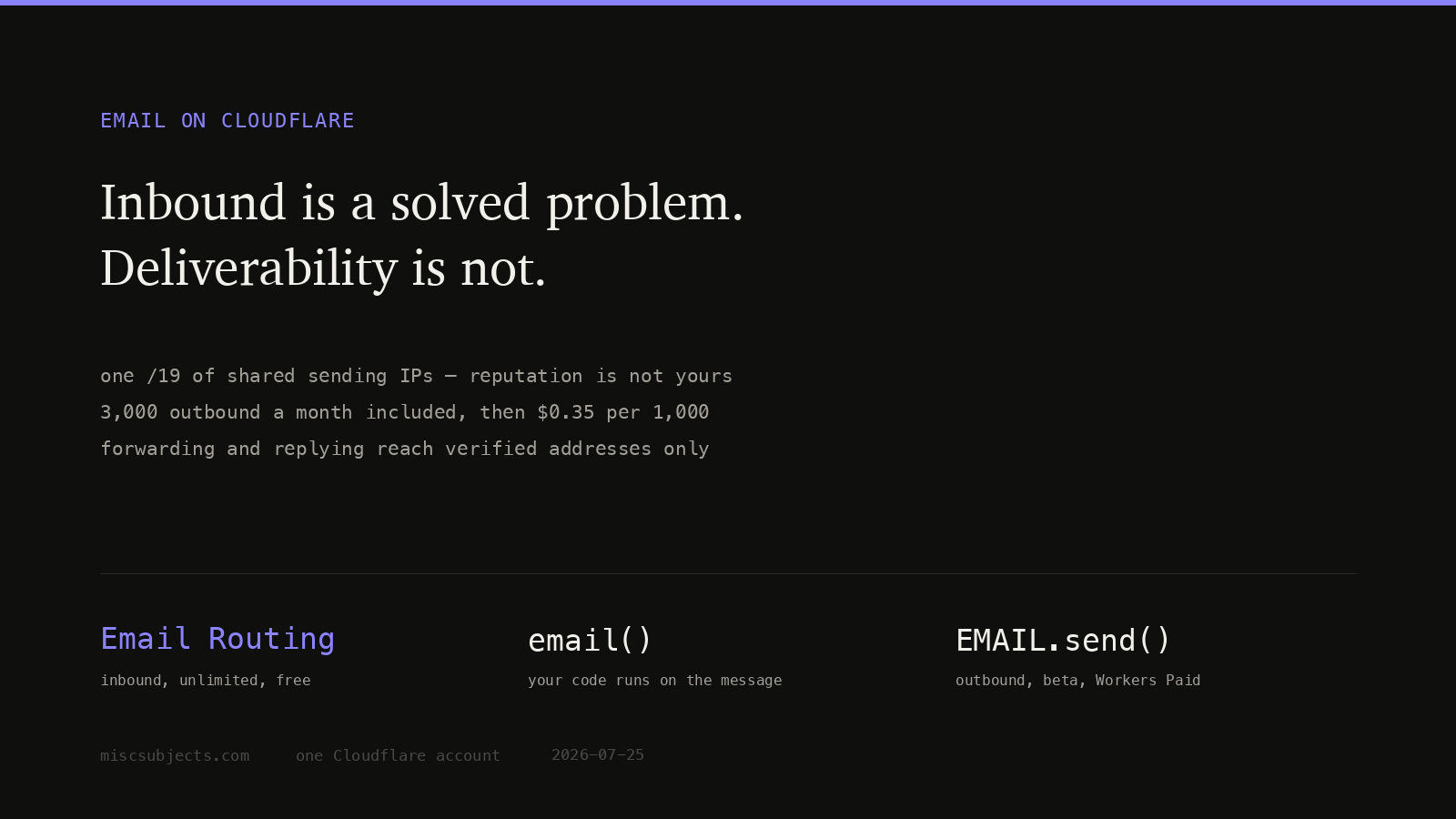
Cloudflare can forward inbound mail, run code on it, and send transactional mail. Each capability has a different setup gate. A verified forwarding address is not an onboarded sending domain.
Product surface
Direction
What it does
Prerequisite
What it does not replace
Email Routing
Inbound
Maps an address or catch-all to a verified destination or Worker
Domain onboarded for routing; routing MX, SPF, and DKIM records
A mailbox, outbound sender, campaign system
Email Workers
Inbound, plus constrained reply/forward
Runs an email() handler over the raw message
Active route bound to a deployed Worker; destinations verified before forwarding
General arbitrary outbound on the free plan
Email Service / Email Sending
Outbound
Sends transactional mail through a Worker binding, REST, or SMTP
Sending domain onboarded; Paid plan for arbitrary recipients; send_email binding for Workers
Marketing automation, customer subaccounts, full ESP operations
Verified destinations are free on every plan; arbitrary recipients require Workers Paid. Paid includes 3,000 outbound messages per account each month, then costs $0.35 per 1,000. Inbound is unlimited, although processing consumes Worker resources.
Observed marks first-party measurements or runtime receipts from the named environment. Derived marks arithmetic calculated from cited inputs. Specified marks vendor or standards documentation. Implemented and deployed name code and live-state evidence, respectively. Reproduced means the stated procedure was rerun. Externally attested marks operator reports; those reports show that an experience occurred, not that it is universal.
Cloudflare assigns MX priorities. Merge the Cloudflare include: into an existing SPF record; two SPF records are invalid, and SPF has a ten-lookup ceiling.
Cloudflare says DNS commonly settles in 5–15 minutes but can take up to 24 hours. The practical gate is that the Email Sending screen shows the domain onboarded and DNS queries return the records. Start DMARC at p=none if other providers still send for the domain; enforce only after their identities align.
Routing rules, verified destinations, and the catch-all
Forwarding requires a destination address that the recipient has verified. The dashboard path is:
Compute → Email Service → Email Routing → Destination Addresses
Cloudflare emails that address a verification link. A routing rule pointing at an unverified destination remains disabled. Once verified, create a rule under:
The action is send to a verified address, send to a Worker, or drop. If two rules use the same pattern, only the first processes the message. Renaming a Worker breaks routes that point to its old name.
The catch-all is a separate rule on the Routing Rules screen. Turn it on, choose Send to a Worker, select the deployed Worker, and save. It catches every otherwise-unmatched local part, so add size checks, sender policy, and retention.
Intent
Route
Destination
Ordinary inbox alias
hello@example.com
Verified personal or team inbox
Support ingestion
support@example.com
Email Worker
Per-customer intake
inbox+customer-id@example.com
Email Worker with subaddressing enabled
Any unmatched local part
Catch-all
Worker, then explicit allow/reject logic
Address that should appear valid but retain nothing
Named rule
Drop
With subaddressing enabled, inbox+acme@example.com matches inbox@example.com while preserving +acme in message.to.
A runnable inbound Worker that parses MIME and stores attachments
message.raw is a single stream. If two consumers need it, buffer once with new Response(message.raw).arrayBuffer(). The handler also exposes envelope addresses, headers, size, setReject(), forward(), and reply().
postal-mime handles multipart boundaries, encodings, and character sets. Treat filenames and MIME types as untrusted. Generate the key, cap size, and scan before serving.
One operator reports: “I’m using Cloudflare Email Routing with a catch-all address that triggers a Worker. The Worker parses the email and stores the attachments in R2.” It is one working implementation, not a universal guarantee.
After onboarding, bind Email Service to a paid Worker:
jsonc
1
2
3
4
5
{
  "send_email": [
    { "name": "EMAIL" }
  ]
}
Line 5, Column 1jsonc
Call env.EMAIL.send() with an onboarded-domain from, recipient objects, subject, text, and HTML.
The prerequisite chain is:
The zone is in the Cloudflare account.
Email Sending shows the domain as onboarded.
The cf-bounce MX, SPF, DKIM, and DMARC records resolve.
The Worker is on Workers Paid for arbitrary recipients.
The Worker has a send_email binding and uses the onboarded domain in from.
The message stays inside recipient, header, and size limits.
Before onboarding, sends are limited to verified destinations and routing domains. After onboarding, arbitrary recipients are allowed, subject to daily quota and reputation. New accounts start with a conservative quota that Cloudflare adjusts over time rather than publishing one universal number.
Current limits include 50 combined recipients, 998 subject characters, 16 KB of custom headers, and 5 MiB total. Verified-destination mail may be 25 MiB. A zone may have 30 combined Routing and Sending domains; Routing allows 200 rules per domain and 200 verified destinations per account.
The site's own split proves why the prerequisite must be visible
This build has a Pages endpoint at POST /api/email/send. It authenticates the owner, then proxies the body to a sibling Worker because Pages cannot carry the send_email binding. The sibling declares:
On July 26, 2026, miscsubjects.com resolved three Cloudflare routing MX records, root SPF, cf2024-1 DKIM, and DMARC p=reject. The sending selector also returned a key, but DNS alone does not prove onboarding or delivery. No email was sent.
The connecting server is authorized for the envelope sender's domain
A forwarder connects from a new IP, so the original SPF relationship can break
DKIM
A domain signed selected headers and body bytes with a key published in DNS
It can survive forwarding if the signed bytes remain intact
DMARC
The visible From: domain must align with a passing SPF or DKIM identity, then applies a policy
Forwarding can disturb SPF; mailing-list or gateway modifications can disturb DKIM
ARC
Intermediaries preserve a signed chain of the authentication result they observed
A destination can evaluate the forwarder's attestation when direct SPF or DKIM no longer tells the whole story
Cloudflare uses Sender Rewriting Scheme, changing the envelope sender so SPF can pass from its relay while leaving visible From: unchanged. Routing adds DKIM, and ARC preserves authentication results through the forwarding hop.
ARC is evidence, not an override switch. The final provider still applies its own reputation, block-list, policy, and content decisions. A message can authenticate and still be rejected or placed in spam.
The Outlook reports are real, but they are not a universal result
Two independent operator reports describe Microsoft blocking Cloudflare Email Routing IP ranges. Handy-Man writes that Outlook “just blocks Cloudflare IP ranges and emails never get routed to my Outlook mail box.”
In a separate discussion, doubled112 reports that Microsoft “intermittently block Cloudflare email routing IPs too,” despite the surrounding SPF, DKIM, and DMARC work.
These reports establish a failure mode, not prevalence. Shared relays can inherit reputation from other traffic. Authentication improves identity evidence; it does not require a provider to accept an IP.
When forwarded mail disappears, inspect the Email Routing activity log first. Separate these cases:
Symptom
Likely cause
Check
Fix
Rule is disabled
Destination never verified
Destination Addresses status
Resend verification and activate the rule
No routing event
MX or rule mismatch
dig MX, rule order, exact recipient
Finish onboarding; repair the pattern
Worker invocation failed
CPU, memory, exception, or renamed Worker
Workers logs; route target
Fix the exception or rebind the renamed Worker
Forward call rejects
Destination is not verified
Destination list and Worker log
Verify the exact address before forwarding
Routing says delivered, inbox has nothing
Destination provider rejected, deferred, or filtered it
Routing activity, SMTP response, spam/quarantine
Test another verified destination; give Cloudflare the event and SMTP evidence
Sending call succeeds but Routing summary says “dropped”
Outbound Worker mail is shown that way in Routing
Email Sending metrics and logs
Use Email Sending observability, not the Routing label
Local attachment test throws Cannot serialize value: [object ArrayBuffer]
Local runtime limitation
Reproduce on deployed Worker
Test binary attachments against the deployed Worker
Reply throws on a long thread
More than 100 References entries
Count References values
Start a new message or trim the reply path
Cloudflare warns about multiple SPF records, missing selectors, alignment, new-domain reputation, bounces, and provider filtering. Binary attachments can also hit a local ArrayBuffer serialization limit even when deployment works.
One developer followed the cloudflare:email and EmailMessage path, verified an address, and reported no arrival or error. The unanswered report cannot establish cause. It does show why a resolved Promise is not delivery proof. Check destination verification, onboarding, Email Sending logs, spam, quarantine, and SMTP events.
Where Cloudflare Email Service still is not SendGrid
Transactional sending is not the whole ESP product.
One SendGrid operator creates subaccounts by API so customers can verify their own domains with DKIM and SPF. Cloudflare's documented flow onboards zones from its account; it does not document an equivalent delegated subaccount system. Do not promise one without a specific API and proof.
The gaps are operational: durable bounce handling, suppression recovery, versioned templates, tenant analytics, and marketing consent or unsubscribe controls. Conservative daily quotas, reputation scaling, 50 recipients per message, and the limit-increase process keep “transactional” a real boundary.
A project can build those layers on Workers, D1, R2, and Queues. One operator is building an AGPL email platform in each user's Cloudflare account. Once those layers are included, the work is an email product, not a send call.
Cost is attractive; replacement scope is the constraint
At current list price, Cloudflare Paid includes 3,000 outbound messages monthly and charges $0.35 per 1,000 after that.
Outbound transactional volume
Cloudflare Email Service usage line
What the arithmetic excludes
3,000/month
Included in Workers Paid
Paid plan itself; application work
10,000/month
$2.45 above the included 3,000
Templates, bounce workflow, analytics
100,000/month
$33.95 above the included 3,000
Reputation operations and support
1,000,000/month
$348.95 above the included 3,000
Quota approval and product controls
The formula is max(0, messages - 3,000) / 1,000 × $0.35. Accepted hard bounces count; API-boundary rejections do not. Verified-destination sends are free.
Resend packages volume with retention, domain, team, and feature limits. Compare the operating requirement, not only cost per thousand.
Cloudflare's price works best for receipts, password resets, alerts, and other application mail from one owned domain. Customer-domain onboarding, mature suppressions, templates, analytics, and marketing change the comparison.
The decision table
Workload
Best first choice
Why
Receive-only aliases into an existing inbox
Email Routing
No mailbox migration; verified forwarding destination
Receive and inspect, reject, archive, or branch
Email Routing → Email Worker
Code runs at the SMTP ingress and can store to R2
Inbound email webhook with attachments
Catch-all or named route → Worker → parser → private R2
One event path; binary payload leaves D1
Transactional mail from one owned domain
Email Service on Workers Paid
Onboarded domain, low unit price, native binding
Send only to a few fixed internal addresses
Verified destinations
Free, constrained anti-abuse path
Customer-owned sending domains and subaccounts
Established ESP until proven otherwise
Tenant onboarding and reputation boundaries are product features
Full hosted mailbox with IMAP, folders, search, calendars
Mail provider
Cloudflare Email Service is transport and compute, not a mailbox
Migrate in the same order: verify inbound routing and destination receipt, then the Worker and stored R2 objects. Onboard sending separately and keep the ESP until bounces, suppressions, quotas, logs, and delivery have owners.
The final test is one real message in, the intended Worker invocation, the expected object or forward, and the result at the destination. Outbound needs the production send plus recipient delivery. Until then, it is configured, not proven.
3 products
Routing, Workers, and outbound Email Service have separate gates
3,000
outbound messages included monthly on Workers Paid
$0.35
per 1,000 outbound messages after the allowance
5 MiB
maximum arbitrary-recipient message size
25 MiB
inbound and verified-destination message size ceiling
I’m using Cloudflare Email Routing with a catch-all address that triggers a Worker. The Worker parses the email and stores the attachments in R2.— emiliano, Hacker News
References (20)
Email Service pricing — Cloudflare, Jul 26, 2026“Workers Paid 3,000 included per month, then $0.35 per 1,000 emails”
Email Service troubleshooting — Cloudflare, Jul 26, 2026“Having multiple SPF records on your domain is not allowed and will prevent Email Service from working properly.”
Email routing rules and addresses — Cloudflare, Jul 26, 2026“Until a destination address is verified, any routing rule that points to it stays disabled.”
Email handler Workers API — Cloudflare, Jul 26, 2026“Use postal-mime to parse the MIME structure of an incoming email.”
postal-mime source repository — Postal Systems, Jul 26, 2026“PostalMime is a browser-friendly and serverless email parser.”
Show HN: Webhook API – inbound email –> webhook — Hacker News, Apr 28, 2026“I’m using Cloudflare Email Routing with a catch-all address that triggers a Worker. The Worker parses the email and stores the attachments in R2.”
Email Service quotas and onboarding limits — Cloudflare, Jul 26, 2026“Before you onboard a sending domain, you can send emails only to verified destination addresses in your account.”
Live miscsubjects email endpoint — miscsubjects.com, Jul 26, 2026“Enable Email Sending on miscsubjects.com in CF dashboard (Pages cannot bind send_email)”
Live DNS measurement — miscsubjects.com, Jul 26, 2026“miscsubjects.com resolved route1, route2, and route3.mx.cloudflare.net plus SPF, DKIM, and DMARC on 2026-07-26.”
Email Service postmaster reference — Cloudflare, Jul 26, 2026“ARC allows intermediate email servers, such as forwarders, to attach a record of the original authentication results to a message.”
Cloudflare Email Service: private beta — Hacker News, Sep 25, 2025“Cloudflare's email routing has been abused by malicious users for so long that I can no longer reliably use it with my domain, most times Outlook just blocks Cloudflare IP ranges and emails never get routed to my Outlook mail box.”
DKIM2 and DMARCbis Have Landed — Hacker News, Jul 8, 2026“They intermittently block Cloudflare email routing IPs too. All of these security measures and still it comes down to the IP address of your sender.”
Cannot send emails from Cloudflare worker — Stack Overflow, Aug 12, 2025“I have following code which handles contact form submission which was created with the help of docs, but emails are not getting delivered. I have verified email address in Email routing.”
Cloudflare Email Service: private beta — Hacker News, Sep 25, 2025“We use sendgrid today, and create subaccounts through it (entirely with API calls) to allow our customers to add and verify their own domains”
Resend pricing — Resend, Jul 26, 2026“Choose a plan that works for you.”
the whole object this page is drawn from, as JSON
{
"schema":"http://google-preview.miscsubjects.com/schemas/jarticle.json",
"status":"published",
"slug":"cloudflare-os-email",
"title":"Cloudflare email is three products, not one mail stack",
"kind":"technical",
"summary":"A practical guide to Email Routing, Email Workers, and Email Service: DNS, MIME parsing, R2 attachments, outbound limits, deliverability, costs, and the ESP boundary.",
"created":"2026-07-26T06:19:23.627Z",
"body": [
"# Cloudflare email is three products, not one mail stack\n\nCloudflare can forward inbound mail, run code on it, and send transactional mail. Each capability has a different setup gate. A verified forwarding address is not an onboarded sending domain.\n\n| Product surface | Direction | What it does | Prerequisite | What it does not replace |\n| --- | --- | --- | --- | --- |\n| Email Routing | Inbound | Maps an address or catch-all to a verified destination or Worker | Domain onboarded for routing; routing MX, SPF, and DKIM records | A mailbox, outbound sender, campaign system |\n| Email Workers | Inbound, plus constrained reply/forward | Runs an `email()` handler over the raw message | Active route bound to a deployed Worker; destinations verified before forwarding | General arbitrary outbound on the free plan |\n| Email Service / Email Sending | Outbound | Sends transactional mail through a Worker binding, REST, or SMTP | Sending domain onboarded; Paid plan for arbitrary recipients; `send_email` binding for Workers | Marketing automation, customer subaccounts, full ESP operations |\n\nVerified destinations are free on every plan; arbitrary recipients require Workers Paid. Paid includes 3,000 outbound messages per account each month, then costs $0.35 per 1,000. Inbound is unlimited, although processing consumes Worker resources.",
{
"type":"source",
"id":"s1"
},
"## Evidence status\n\n**Observed** marks first-party measurements or runtime receipts from the named environment.\n**Derived** marks arithmetic calculated from cited inputs. **Specified** marks vendor or standards\ndocumentation. **Implemented** and **deployed** name code and live-state evidence, respectively.\n**Reproduced** means the stated procedure was rerun. **Externally attested** marks operator reports;\nthose reports show that an experience occurred, not that it is universal.\n\n## The setup begins with DNS, not code\n\nFor inbound routing, the dashboard path is:\n\n`Cloudflare dashboard → account → Compute → Email Service → Email Routing → Onboard Domain`\n\nFor `example.com`, Cloudflare creates this root-domain shape:\n\n```txt\nMX @ route1.mx.cloudflare.net\nMX @ route2.mx.cloudflare.net\nMX @ route3.mx.cloudflare.net\nTXT @ \"v=spf1 include:_spf.mx.cloudflare.net ~all\"\nTXT cf2024-1._domainkey \"v=DKIM1; h=sha256; k=rsa; p=<Cloudflare public key>\"\n```\n\nCloudflare assigns MX priorities. Merge the Cloudflare `include:` into an existing SPF record; two SPF records are invalid, and SPF has a ten-lookup ceiling.",
{
"type":"source",
"id":"s2"
},
"For outbound Email Sending, onboarding is separate:\n\n`Cloudflare dashboard → account → Compute → Email Service → Email Sending → Onboard Domain`\n\nThe outbound records live under `cf-bounce.example.com`, leaving the inbound root MX records alone:\n\n```txt\nMX cf-bounce route1.mx.cloudflare.net\nMX cf-bounce route2.mx.cloudflare.net\nMX cf-bounce route3.mx.cloudflare.net\nTXT cf-bounce \"v=spf1 include:_spf.mx.cloudflare.net ~all\"\nTXT cf-bounce._domainkey \"v=DKIM1; h=sha256; k=rsa; p=<Cloudflare public key>\"\nTXT _dmarc \"v=DMARC1; p=none; rua=mailto:dmarc@example.com\"\n```\n\nCloudflare says DNS commonly settles in 5–15 minutes but can take up to 24 hours. The practical gate is that the Email Sending screen shows the domain onboarded and DNS queries return the records. Start DMARC at `p=none` if other providers still send for the domain; enforce only after their identities align.",
{
"type":"source",
"id":"s3"
},
"## Routing rules, verified destinations, and the catch-all\n\nForwarding requires a destination address that the recipient has verified. The dashboard path is:\n\n`Compute → Email Service → Email Routing → Destination Addresses`\n\nCloudflare emails that address a verification link. A routing rule pointing at an unverified destination remains disabled. Once verified, create a rule under:\n\n`Compute → Email Service → Email Routing → Routing Rules → Create routing rule`\n\nThe action is send to a verified address, send to a Worker, or drop. If two rules use the same pattern, only the first processes the message. Renaming a Worker breaks routes that point to its old name.",
{
"type":"source",
"id":"s4"
},
"The catch-all is a separate rule on the Routing Rules screen. Turn it on, choose **Send to a Worker**, select the deployed Worker, and save. It catches every otherwise-unmatched local part, so add size checks, sender policy, and retention.\n\n| Intent | Route | Destination |\n| --- | --- | --- |\n| Ordinary inbox alias | `hello@example.com` | Verified personal or team inbox |\n| Support ingestion | `support@example.com` | Email Worker |\n| Per-customer intake | `inbox+customer-id@example.com` | Email Worker with subaddressing enabled |\n| Any unmatched local part | Catch-all | Worker, then explicit allow/reject logic |\n| Address that should appear valid but retain nothing | Named rule | Drop |\n\nWith subaddressing enabled, `inbox+acme@example.com` matches `inbox@example.com` while preserving `+acme` in `message.to`.\n\n## A runnable inbound Worker that parses MIME and stores attachments\n\nThe useful inbound architecture is short:\n\n`Cloudflare MX → Email Routing catch-all → email() handler → postal-mime → R2 objects + application record`\n\nInstall `postal-mime`, bind an R2 bucket, and deploy the Worker:\n\n```bash\nnpm install postal-mime\nnpx wrangler r2 bucket create inbound-attachments\nnpx wrangler deploy\n```\n\n```jsonc\n{\n \"name\": \"inbound-mail\",\n \"main\": \"src/index.ts\",\n \"compatibility_date\": \"2026-07-01\",\n \"r2_buckets\": [\n { \"binding\": \"ATTACHMENTS\", \"bucket_name\": \"inbound-attachments\" }\n ]\n}\n```\n\n```ts\nimport PostalMime from \"postal-mime\";\n\ninterface Env {\n ATTACHMENTS: R2Bucket;\n FORWARD_TO: string;\n}\n\nfunction safeName(name: string): string {\n return name.replace(/[^a-zA-Z0-9._-]/g, \"_\").slice(0, 180);\n}\n\nexport default {\n async email(message: ForwardableEmailMessage, env: Env): Promise<void> {\n if (message.rawSize > 25 * 1024 * 1024) {\n message.setReject(\"Message exceeds the 25 MiB inbound limit\");\n return;\n }\n\n const parsed = await PostalMime.parse(message.raw);\n const received = new Date().toISOString();\n const mailId = crypto.randomUUID();\n\n for (const [index, attachment] of (parsed.attachments || []).entries()) {\n const filename = safeName(attachment.filename || `attachment-${index}`);\n const key = `mail/${received.slice(0, 10)}/${mailId}/${filename}`;\n\n await env.ATTACHMENTS.put(key, attachment.content, {\n httpMetadata: {\n contentType: attachment.mimeType || \"application/octet-stream\"\n },\n customMetadata: {\n envelopeFrom: message.from,\n envelopeTo: message.to,\n subject: (parsed.subject || \"\").slice(0, 500)\n }\n });\n }\n\n await message.forward(env.FORWARD_TO);\n }\n} satisfies ExportedHandler<Env>;\n```\n\n`message.raw` is a single stream. If two consumers need it, buffer once with `new Response(message.raw).arrayBuffer()`. The handler also exposes envelope addresses, headers, size, `setReject()`, `forward()`, and `reply()`.",
{
"type":"source",
"id":"s5"
},
"`postal-mime` handles multipart boundaries, encodings, and character sets. Treat filenames and MIME types as untrusted. Generate the key, cap size, and scan before serving.",
{
"type":"source",
"id":"s6"
},
"One operator reports: “I’m using Cloudflare Email Routing with a catch-all address that triggers a Worker. The Worker parses the email and stores the attachments in R2.” It is one working implementation, not a universal guarantee.",
{
"type":"source",
"id":"s7"
},
"For the storage half, see [R2 cuts a 10 TB delivery bill from $923 to $18.45](/a/cloudflare-os-r2). That chapter covers binding calls, public versus private objects, versioning gaps, and cost.\n\n## Replying is not the same as arbitrary sending\n\nThe inbound message object can forward to verified routing destinations. It can also reply with a raw `EmailMessage` constructed from `cloudflare:email`:\n\n```ts\nimport { EmailMessage } from \"cloudflare:email\";\nimport { createMimeMessage } from \"mimetext\";\n\nexport default {\n async email(message: ForwardableEmailMessage): Promise<void> {\n const msg = createMimeMessage();\n msg.setSender({ name: \"Example support\", addr: \"support@example.com\" });\n msg.setRecipient(message.from);\n msg.setSubject(\"Re: \" + (message.headers.get(\"subject\") || \"your message\"));\n msg.addMessage({\n contentType: \"text/plain\",\n data: \"We received your message.\"\n });\n\n const reply = new EmailMessage(\n \"support@example.com\",\n message.from,\n msg.asRaw()\n );\n await message.reply(reply);\n }\n};\n```\n\nThis is tied to the inbound message. `message.reply()` throws above 100 `References` entries, and forwarding destinations must be verified.",
{
"type":"source",
"id":"s8"
},
"## New outbound mail uses Email Service\n\nAfter onboarding, bind Email Service to a paid Worker:\n\n```jsonc\n{\n \"send_email\": [\n { \"name\": \"EMAIL\" }\n ]\n}\n```\n\nCall `env.EMAIL.send()` with an onboarded-domain `from`, recipient objects, subject, text, and HTML.\n\nThe prerequisite chain is:\n\n1. The zone is in the Cloudflare account.\n2. Email Sending shows the domain as onboarded.\n3. The `cf-bounce` MX, SPF, DKIM, and DMARC records resolve.\n4. The Worker is on Workers Paid for arbitrary recipients.\n5. The Worker has a `send_email` binding and uses the onboarded domain in `from`.\n6. The message stays inside recipient, header, and size limits.\n\nBefore onboarding, sends are limited to verified destinations and routing domains. After onboarding, arbitrary recipients are allowed, subject to daily quota and reputation. New accounts start with a conservative quota that Cloudflare adjusts over time rather than publishing one universal number.",
{
"type":"source",
"id":"s9"
},
"Current limits include 50 combined recipients, 998 subject characters, 16 KB of custom headers, and 5 MiB total. Verified-destination mail may be 25 MiB. A zone may have 30 combined Routing and Sending domains; Routing allows 200 rules per domain and 200 verified destinations per account.\n\n## The site's own split proves why the prerequisite must be visible\n\nThis build has a Pages endpoint at `POST /api/email/send`. It authenticates the owner, then proxies the body to a sibling Worker because Pages cannot carry the `send_email` binding. The sibling declares:\n\n```toml\n[[send_email]]\nname = \"EMAIL\"\n```\n\nThe public diagnostic response currently says:\n\n```json\n{\n \"inbound\": {\n \"loop@miscsubjects.com\": \"forward → owner@redacted\",\n \"build@miscsubjects.com\": \"worker → ledger + forward\"\n },\n \"sending\": \"Enable Email Sending on miscsubjects.com in CF dashboard (Pages cannot bind send_email)\"\n}\n```\n\nCode and a binding are not proof of a send-capable domain. The prerequisite remains open until onboarding and an observed delivery receipt.",
{
"type":"source",
"id":"s10"
},
"On July 26, 2026, `miscsubjects.com` resolved three Cloudflare routing MX records, root SPF, `cf2024-1` DKIM, and DMARC `p=reject`. The sending selector also returned a key, but DNS alone does not prove onboarding or delivery. No email was sent.",
{
"type":"source",
"id":"s11"
},
"## SPF, DKIM, DMARC, and ARC in plain language\n\n| Mechanism | What it asserts | What forwarding changes |\n| --- | --- | --- |\n| SPF | The connecting server is authorized for the envelope sender's domain | A forwarder connects from a new IP, so the original SPF relationship can break |\n| DKIM | A domain signed selected headers and body bytes with a key published in DNS | It can survive forwarding if the signed bytes remain intact |\n| DMARC | The visible `From:` domain must align with a passing SPF or DKIM identity, then applies a policy | Forwarding can disturb SPF; mailing-list or gateway modifications can disturb DKIM |\n| ARC | Intermediaries preserve a signed chain of the authentication result they observed | A destination can evaluate the forwarder's attestation when direct SPF or DKIM no longer tells the whole story |\n\nCloudflare uses Sender Rewriting Scheme, changing the envelope sender so SPF can pass from its relay while leaving visible `From:` unchanged. Routing adds DKIM, and ARC preserves authentication results through the forwarding hop.",
{
"type":"source",
"id":"s12"
},
"ARC is evidence, not an override switch. The final provider still applies its own reputation, block-list, policy, and content decisions. A message can authenticate and still be rejected or placed in spam.\n\n## The Outlook reports are real, but they are not a universal result\n\nTwo independent operator reports describe Microsoft blocking Cloudflare Email Routing IP ranges. Handy-Man writes that Outlook “just blocks Cloudflare IP ranges and emails never get routed to my Outlook mail box.”",
{
"type":"source",
"id":"s13"
},
"In a separate discussion, doubled112 reports that Microsoft “intermittently block Cloudflare email routing IPs too,” despite the surrounding SPF, DKIM, and DMARC work.",
{
"type":"source",
"id":"s14"
},
"A third independent account documents Outlook failures through Cloudflare routing.",
{
"type":"source",
"id":"s15"
},
"These reports establish a failure mode, not prevalence. Shared relays can inherit reputation from other traffic. Authentication improves identity evidence; it does not require a provider to accept an IP.\n\nWhen forwarded mail disappears, inspect the Email Routing activity log first. Separate these cases:\n\n| Symptom | Likely cause | Check | Fix |\n| --- | --- | --- | --- |\n| Rule is disabled | Destination never verified | Destination Addresses status | Resend verification and activate the rule |\n| No routing event | MX or rule mismatch | `dig MX`, rule order, exact recipient | Finish onboarding; repair the pattern |\n| Worker invocation failed | CPU, memory, exception, or renamed Worker | Workers logs; route target | Fix the exception or rebind the renamed Worker |\n| Forward call rejects | Destination is not verified | Destination list and Worker log | Verify the exact address before forwarding |\n| Routing says delivered, inbox has nothing | Destination provider rejected, deferred, or filtered it | Routing activity, SMTP response, spam/quarantine | Test another verified destination; give Cloudflare the event and SMTP evidence |\n| Sending call succeeds but Routing summary says “dropped” | Outbound Worker mail is shown that way in Routing | Email Sending metrics and logs | Use Email Sending observability, not the Routing label |\n| Local attachment test throws `Cannot serialize value: [object ArrayBuffer]` | Local runtime limitation | Reproduce on deployed Worker | Test binary attachments against the deployed Worker |\n| Reply throws on a long thread | More than 100 References entries | Count `References` values | Start a new message or trim the reply path |\n\nCloudflare warns about multiple SPF records, missing selectors, alignment, new-domain reputation, bounces, and provider filtering. Binary attachments can also hit a local ArrayBuffer serialization limit even when deployment works.",
{
"type":"source",
"id":"s16"
},
"One developer followed the `cloudflare:email` and `EmailMessage` path, verified an address, and reported no arrival or error. The unanswered report cannot establish cause. It does show why a resolved Promise is not delivery proof. Check destination verification, onboarding, Email Sending logs, spam, quarantine, and SMTP events.",
{
"type":"source",
"id":"s17"
},
"## Where Cloudflare Email Service still is not SendGrid\n\nTransactional sending is not the whole ESP product.\n\nOne SendGrid operator creates subaccounts by API so customers can verify their own domains with DKIM and SPF. Cloudflare's documented flow onboards zones from its account; it does not document an equivalent delegated subaccount system. Do not promise one without a specific API and proof.",
{
"type":"source",
"id":"s18"
},
"The gaps are operational: durable bounce handling, suppression recovery, versioned templates, tenant analytics, and marketing consent or unsubscribe controls. Conservative daily quotas, reputation scaling, 50 recipients per message, and the limit-increase process keep “transactional” a real boundary.\n\nA project can build those layers on Workers, D1, R2, and Queues. One operator is building an AGPL email platform in each user's Cloudflare account. Once those layers are included, the work is an email product, not a send call.",
{
"type":"source",
"id":"s19"
},
"## Cost is attractive; replacement scope is the constraint\n\nAt current list price, Cloudflare Paid includes 3,000 outbound messages monthly and charges $0.35 per 1,000 after that.\n\n| Outbound transactional volume | Cloudflare Email Service usage line | What the arithmetic excludes |\n| --- | --- | --- |\n| 3,000/month | Included in Workers Paid | Paid plan itself; application work |\n| 10,000/month | $2.45 above the included 3,000 | Templates, bounce workflow, analytics |\n| 100,000/month | $33.95 above the included 3,000 | Reputation operations and support |\n| 1,000,000/month | $348.95 above the included 3,000 | Quota approval and product controls |\n\nThe formula is `max(0, messages - 3,000) / 1,000 × $0.35`. Accepted hard bounces count; API-boundary rejections do not. Verified-destination sends are free.\n\nResend packages volume with retention, domain, team, and feature limits. Compare the operating requirement, not only cost per thousand.",
{
"type":"source",
"id":"s20"
},
"Cloudflare's price works best for receipts, password resets, alerts, and other application mail from one owned domain. Customer-domain onboarding, mature suppressions, templates, analytics, and marketing change the comparison.\n\n## The decision table\n\n| Workload | Best first choice | Why |\n| --- | --- | --- |\n| Receive-only aliases into an existing inbox | Email Routing | No mailbox migration; verified forwarding destination |\n| Receive and inspect, reject, archive, or branch | Email Routing → Email Worker | Code runs at the SMTP ingress and can store to R2 |\n| Inbound email webhook with attachments | Catch-all or named route → Worker → parser → private R2 | One event path; binary payload leaves D1 |\n| Transactional mail from one owned domain | Email Service on Workers Paid | Onboarded domain, low unit price, native binding |\n| Send only to a few fixed internal addresses | Verified destinations | Free, constrained anti-abuse path |\n| Customer-owned sending domains and subaccounts | Established ESP until proven otherwise | Tenant onboarding and reputation boundaries are product features |\n| Marketing campaigns and newsletters | Marketing ESP | Consent, unsubscribe, segmentation, templates, analytics |\n| Full hosted mailbox with IMAP, folders, search, calendars | Mail provider | Cloudflare Email Service is transport and compute, not a mailbox |\n\nMigrate in the same order: verify inbound routing and destination receipt, then the Worker and stored R2 objects. Onboard sending separately and keep the ESP until bounces, suppressions, quotas, logs, and delivery have owners.\n\nThe final test is one real message in, the intended Worker invocation, the expected object or forward, and the result at the destination. Outbound needs the production send plus recipient delivery. Until then, it is configured, not proven."
],
"facts": {
"converted_from":"markdown",
"original_updated":"2026-07-26T06:23:25.501Z",
"register":"technical",
"category":null
},
"hero":"https://miscsubjects.com/img/up/cloudflare-os-email-hero-card.png",
"model":"Codex · Writing Law 1.3.0",
"tags": [
"cloudflare",
"architecture",
"email",
"cloudflare-os"
],
"sources": [
{
"id":"s1",
"type":"publisher_documentation",
"url":"https://developers.cloudflare.com/email-service/platform/pricing/",
"title":"Email Service pricing",
"quote":"Workers Paid 3,000 included per month, then $0.35 per 1,000 emails",
"summary":"The current separation between free verified-destination sends, paid arbitrary-recipient sending, and unlimited inbound routing.",
"publisher":"Cloudflare",
"author":"",
"date":"2026-07-26",
"claim_ids": [
"c1",
"c16",
"c2",
"c8"
],
"quote_sha256":"555b08a0bfe306530307e7f100a98aa6f59574fb2fd80f72b9cfd8522a23f17c"
},
{
"id":"s2",
"type":"publisher_documentation",
"url":"https://developers.cloudflare.com/email-service/reference/troubleshooting/",
"title":"Email Service troubleshooting",
"quote":"Having multiple SPF records on your domain is not allowed and will prevent Email Service from working properly.",
"summary":"The exact SPF, DKIM, DMARC, local attachment, and provider-delivery checks.",
"publisher":"Cloudflare",
"author":"",
"date":"2026-07-26",
"claim_ids": [
"c10",
"c3"
],
"quote_sha256":"d8c6cb946db1acb65fd7f268d1120b0b8ca7c10b5e41a11a8cabf16b2d73075a"
},
{
"id":"s3",
"type":"publisher_documentation",
"url":"https://developers.cloudflare.com/email-service/configuration/domains/",
"title":"Email Service domain configuration",
"quote":"Before using Email Sending, configure your domain.",
"summary":"The current dashboard path and separate DNS record sets for Email Sending and Email Routing.",
"publisher":"Cloudflare",
"author":"",
"date":"2026-07-26",
"claim_ids": [
"c1",
"c14",
"c3",
"c8"
],
"quote_sha256":"eb25f774db8ed6e7fa92b99443317a8eac6f2234f51c7c8f902cdba7bfbc342b"
},
{
"id":"s4",
"type":"publisher_documentation",
"url":"https://developers.cloudflare.com/email-service/configuration/email-routing-addresses/",
"title":"Email routing rules and addresses",
"quote":"Until a destination address is verified, any routing rule that points to it stays disabled.",
"summary":"The verified-destination prerequisite, rule order, Worker binding, catch-all, and subaddressing behavior.",
"publisher":"Cloudflare",
"author":"",
"date":"2026-07-26",
"claim_ids": [
"c1",
"c4",
"c7"
],
"quote_sha256":"460457cdfc865e6dc1888ba83c2561d1f491587a06fc3bb0b2197433fc497eab"
},
{
"id":"s5",
"type":"specification",
"url":"https://developers.cloudflare.com/email-service/api/route-emails/email-handler/",
"title":"Email handler Workers API",
"quote":"Use postal-mime to parse the MIME structure of an incoming email.",
"summary":"The runtime interface for raw messages, forwarding, replying, rejecting, and MIME parsing.",
"publisher":"Cloudflare",
"author":"",
"date":"2026-07-26",
"claim_ids": [
"c1",
"c5",
"c6"
],
"quote_sha256":"2a0313c627205756656070197cc7ee567eb200c67af185b02397b346562b54f3"
},
{
"id":"s6",
"type":"source_repository",
"url":"https://github.com/postalsys/postal-mime",
"title":"postal-mime source repository",
"quote":"PostalMime is a browser-friendly and serverless email parser.",
"summary":"The maintained MIME parser used in the runnable attachment-to-R2 example.",
"publisher":"Postal Systems",
"author":"Andris Reinman",
"date":"2026-07-26",
"claim_ids": [
"c5",
"c6"
],
"quote_sha256":"0ab878837fd50113b92e82493f607d6415163901a71b331245315ee621f93617"
},
{
"id":"s7",
"type":"hn",
"url":"https://news.ycombinator.com/item?id=47932438",
"title":"Show HN: Webhook API – inbound email –> webhook",
"quote":"I’m using Cloudflare Email Routing with a catch-all address that triggers a Worker. The Worker parses the email and stores the attachments in R2.",
"summary":"Running catch-all Email Routing into an Email Worker that parses messages and lands attachments in R2, and reports it works well for that job. Positive — the receive-and-process path, which is the part that does work.",
"publisher":"Hacker News",
"author":"emiliano",
"date":"2026-04-28",
"claim_ids": [
"c5"
],
"quote_sha256":"1760241053421e52b538b42f6d22dd84c2caac5438f1a461030c1919cf2157fc"
},
{
"id":"s8",
"type":"specification",
"url":"https://developers.cloudflare.com/email-service/platform/limits/",
"title":"Email Service limits",
"quote":"Reply References entries 100",
"summary":"The current per-message, per-zone, routing, verified-destination, and reply limits.",
"publisher":"Cloudflare",
"author":"",
"date":"2026-07-26",
"claim_ids": [
"c15",
"c2",
"c7",
"c8"
],
"quote_sha256":"f10da09a903c5d1360fc463aaf407b44c04372a87edd8f52bbcf07f37f0f091a"
},
{
"id":"s9",
"type":"publisher_documentation",
"url":"https://developers.cloudflare.com/email-service/platform/limits/",
"title":"Email Service quotas and onboarding limits",
"quote":"Before you onboard a sending domain, you can send emails only to verified destination addresses in your account.",
"summary":"The account-side onboarding boundary and conservative daily quota model.",
"publisher":"Cloudflare",
"author":"",
"date":"2026-07-26",
"claim_ids": [
"c8"
],
"quote_sha256":"1e5e946137dcea8eb1f5525562e58252df0237fcf7b393be16a3761be47dd243"
},
{
"id":"s10",
"type":"first_party_code",
"url":"https://miscsubjects.com/api/email/send",
"title":"Live miscsubjects email endpoint",
"quote":"Enable Email Sending on miscsubjects.com in CF dashboard (Pages cannot bind send_email)",
"summary":"The production endpoint reports the inbound routes and the currently unmet sending-domain prerequisite.",
"publisher":"miscsubjects.com",
"author":"",
"date":"2026-07-26",
"claim_ids": [
"c9"
],
"quote_sha256":"c629a96080646542e573cbe825decef0ce19f65713ac5c0003ee9ecb6923f789"
},
{
"id":"s11",
"type":"independent_measurement",
"url":"https://miscsubjects.com/a/cloudflare-os-email",
"title":"Live DNS measurement",
"quote":"miscsubjects.com resolved route1, route2, and route3.mx.cloudflare.net plus SPF, DKIM, and DMARC on 2026-07-26.",
"summary":"A read-only first-party DNS measurement, explicitly not a delivery test.",
"publisher":"miscsubjects.com",
"author":"",
"date":"2026-07-26",
"claim_ids": [
"c9"
],
"quote_sha256":"209583cd2cbbff24040b31ca9cd022b9bfadc60436211b294f0a0ae9e995d9f5"
},
{
"id":"s12",
"type":"specification",
"url":"https://developers.cloudflare.com/email-service/reference/postmaster/",
"title":"Email Service postmaster reference",
"quote":"ARC allows intermediate email servers, such as forwarders, to attach a record of the original authentication results to a message.",
"summary":"Cloudflare's SRS, ARC, DKIM, SPF, DMARC, authentication, and SMTP behavior.",
"publisher":"Cloudflare",
"author":"",
"date":"2026-07-26",
"claim_ids": [
"c10",
"c3"
],
"quote_sha256":"5fc39f9730052fa9f581309cc5bf4627966f8a111899b5b2e058556328ef8a8b"
},
{
"id":"s13",
"type":"hn",
"url":"https://news.ycombinator.com/item?id=45373715",
"title":"Cloudflare Email Service: private beta",
"quote":"Cloudflare's email routing has been abused by malicious users for so long that I can no longer reliably use it with my domain, most times Outlook just blocks Cloudflare IP ranges and emails never get routed to my Outlook mail box.",
"summary":"Long-time Email Routing user who can no longer rely on it because Outlook blocks Cloudflare's forwarding IP ranges, so forwarded mail silently never arrives. Negative — deliverability, the one thing Email Routing has to get right.",
"publisher":"Hacker News",
"author":"Handy-Man",
"date":"2025-09-25",
"claim_ids": [
"c11",
"c12"
],
"quote_sha256":"c06129826054a5200963876d4ea8dd0b9f6b8527550db3db738e7e3a97a7c5fe"
},
{
"id":"s14",
"type":"hn",
"url":"https://news.ycombinator.com/item?id=48837913",
"title":"DKIM2 and DMARCbis Have Landed",
"quote":"They intermittently block Cloudflare email routing IPs too. All of these security measures and still it comes down to the IP address of your sender.",
"summary":"Did SPF/DKIM/DMARC correctly, checked blacklists, waited months, and still found Microsoft bouncing entire IP ranges — including, intermittently, Cloudflare Email Routing's. Independent corroboration of the deliverability problem. Negative.",
"publisher":"Hacker News",
"author":"doubled112",
"date":"2026-07-08",
"claim_ids": [
"c11",
"c12"
],
"quote_sha256":"cbbed0bffafc76b3bc241df144f41b1a2707570763407a61b8d482c563f5c17e"
},
{
"id":"s15",
"type":"independent_report",
"url":"https://dariusz.wieckiewicz.org/en/when-things-start-to-fail-cloudflare-email-routing/",
"title":"When things start to fail: Cloudflare Email Routing",
"quote":"Microsoft is blocking some of Cloudflare's outgoing Email Routing servers.",
"summary":"An independent operator account of Outlook delivery failures through Cloudflare forwarding infrastructure.",
"publisher":"Dariusz Więckiewicz",
"author":"Dariusz Więckiewicz",
"date":"2025-09-29",
"claim_ids": [
"c11",
"c12"
],
"quote_sha256":"a01c4bdc80359e82bc3922da8e78357e1f4319cfd07fcce180631cc3730bc1e7"
},
{
"id":"s16",
"type":"publisher_documentation",
"url":"https://developers.cloudflare.com/email-service/reference/troubleshooting/",
"title":"Cloudflare Email Service troubleshooting",
"quote":"Cannot serialize value: [object ArrayBuffer]",
"summary":"The documented symptom-to-check paths for authentication, provider filtering, bounces, and local binary attachments.",
"publisher":"Cloudflare",
"author":"",
"date":"2026-07-26",
"claim_ids": [
"c13"
],
"quote_sha256":"fe34cacb45845bd78cf45155a191f04ed4c6e0504521ed6bc545414b75360f4c"
},
{
"id":"s17",
"type":"stackoverflow",
"url":"https://stackoverflow.com/questions/79733052/cannot-send-emails-from-cloudflare-worker",
"title":"Cannot send emails from Cloudflare worker",
"quote":"I have following code which handles contact form submission which was created with the help of docs, but emails are not getting delivered. I have verified email address in Email routing.",
"summary":"Followed the official cloudflare:email / EmailMessage sending docs with a verified address and env vars loaded, and mail simply never arrives with no error surfaced. Unanswered. Negative — the outbound side of Email Workers is the part that cannot be relied on.",
"publisher":"Stack Overflow",
"author":"kaushalyap",
"date":"2025-08-12",
"claim_ids": [
"c13"
],
"quote_sha256":"1cb0a4ac3650a1903fd077e419dee79ec7e8d3daf7c70dcac646a7ce14d48ede"
},
{
"id":"s18",
"type":"hn",
"url":"https://news.ycombinator.com/item?id=45376469",
"title":"Cloudflare Email Service: private beta",
"quote":"We use sendgrid today, and create subaccounts through it (entirely with API calls) to allow our customers to add and verify their own domains",
"summary":"A SendGrid customer asking whether Cloudflare's email product can do API-created subaccounts with customer-owned verified sending domains and intact DKIM/SPF. States the concrete capability gap that keeps them off Cloudflare email. Negative-leaning — what it cannot do.",
"publisher":"Hacker News",
"author":"xp84",
"date":"2025-09-25",
"claim_ids": [
"c14",
"c15"
],
"quote_sha256":"15b0b7bc9431f3113af12d3850ea8a0e8622a75f871f622d075a92a3a978cf05"
},
{
"id":"s19",
"type":"reddit",
"url":"https://old.reddit.com/r/CloudFlare/comments/1u90bev/building_an_email_platform_on_workers_d1_r2/",
"title":"Building an email platform on Workers + D1 + R2 + Queues — would like architecture feedback",
"quote":"I’m building Lumimail, an AGPL-3.0 self-hosted email platform that runs inside a user’s own Cloudflare account.",
"summary":"An entire email platform built on Workers, D1, R2 and Queues, deployed into each user's own Cloudflare account. 24 comments of architecture critique covering Queues behaviour and D1 sizing; the closest match to running email plus admin surfaces on the Cloudflare-only stack.",
"publisher":"Reddit",
"author":"u/suoinguon",
"date":"2026-06-18",
"claim_ids": [
"c15"
],
"quote_sha256":"1781f646bb8216cd134d2aafac32bf920150a2b594bd55b5e1447edf8fcf0553"
},
{
"id":"s20",
"type":"publisher_pricing",
"url":"https://resend.com/pricing",
"title":"Resend pricing",
"quote":"Choose a plan that works for you.",
"summary":"A current alternative transactional-email plan surface for whole-product comparison.",
"publisher":"Resend",
"author":"",
"date":"2026-07-26",
"claim_ids": [
"c16"
],
"quote_sha256":"612103b7b59eb907a0c8c682fef989a974e57de31358eb81d792bf5b096c6f74"
}
],
"claims": [
{
"id":"c1",
"text":"Cloudflare email comprises separate inbound forwarding, inbound code processing, and outbound transactional sending surfaces with different prerequisites.",
"section":"Cloudflare email is three products, not one mail stack",
"tier":"system",
"source_ids": [
"s1",
"s3",
"s4",
"s5"
],
"why_material":"This changes the setup, architecture, delivery proof, or provider decision.",
"who_claims":"Codex",
"evidence_status":"specified"
},
{
"id":"c2",
"text":"Arbitrary-recipient sending requires Workers Paid; verified-destination sends are free, and paid accounts include 3,000 outbound messages per month before $0.35 per 1,000.",
"section":"Cloudflare email is three products, not one mail stack",
"tier":"system",
"source_ids": [
"s1",
"s8"
],
"why_material":"This changes the setup, architecture, delivery proof, or provider decision.",
"who_claims":"Codex",
"evidence_status":"specified"
},
{
"id":"c3",
"text":"Email Routing and Email Sending onboard separately and publish different root-domain and cf-bounce DNS records.",
"section":"The setup begins with DNS, not code",
"tier":"system",
"source_ids": [
"s12",
"s2",
"s3"
],
"why_material":"This changes the setup, architecture, delivery proof, or provider decision.",
"who_claims":"Codex",
"evidence_status":"specified"
},
{
"id":"c4",
"text":"A routing rule aimed at an address stays disabled until that destination address is verified.",
"section":"Routing rules, verified destinations, and the catch-all",
"tier":"system",
"source_ids": [
"s4"
],
"why_material":"This changes the setup, architecture, delivery proof, or provider decision.",
"who_claims":"Codex",
"evidence_status":"specified"
},
{
"id":"c5",
"text":"An Email Worker can parse an inbound MIME stream, store its attachments in R2, and forward to a verified destination.",
"section":"A runnable inbound Worker that parses MIME and stores attachments",
"tier":"system",
"source_ids": [
"s5",
"s6",
"s7"
],
"why_material":"This changes the setup, architecture, delivery proof, or provider decision.",
"who_claims":"Codex",
"evidence_status":"specified + implemented + externally attested"
},
{
"id":"c6",
"text":"The raw message stream must be consumed once or buffered before multiple consumers inspect it.",
"section":"A runnable inbound Worker that parses MIME and stores attachments",
"tier":"system",
"source_ids": [
"s5",
"s6"
],
"why_material":"This changes the setup, architecture, delivery proof, or provider decision.",
"who_claims":"Codex",
"evidence_status":"specified + implemented"
},
{
"id":"c7",
"text":"Reply and forward are constrained inbound actions; forwarding requires verified destinations and replies fail above 100 References entries.",
"section":"Replying is not the same as arbitrary sending",
"tier":"system",
"source_ids": [
"s4",
"s8"
],
"why_material":"This changes the setup, architecture, delivery proof, or provider decision.",
"who_claims":"Codex",
"evidence_status":"specified"
},
{
"id":"c8",
"text":"Sending to arbitrary recipients requires an onboarded sending domain, Workers Paid, a send_email binding, an aligned from-domain, and compliance with message limits.",
"section":"New outbound mail uses Email Service",
"tier":"system",
"source_ids": [
"s1",
"s3",
"s8",
"s9"
],
"why_material":"This changes the setup, architecture, delivery proof, or provider decision.",
"who_claims":"Codex",
"evidence_status":"specified"
},
{
"id":"c9",
"text":"The live miscsubjects implementation has working inbound DNS and code paths while its own endpoint still reports Email Sending onboarding as incomplete.",
"section":"The site's own split proves why the prerequisite must be visible",
"tier":"system",
"source_ids": [
"s10",
"s11"
],
"why_material":"This changes the setup, architecture, delivery proof, or provider decision.",
"who_claims":"Codex",
"evidence_status":"observed"
},
{
"id":"c10",
"text":"SPF authenticates the envelope sender path, DKIM signs message content, DMARC requires aligned SPF or DKIM, and ARC carries an intermediary's observed authentication chain.",
"section":"SPF, DKIM, DMARC, and ARC in plain language",
"tier":"system",
"source_ids": [
"s12",
"s2"
],
"why_material":"This changes the setup, architecture, delivery proof, or provider decision.",
"who_claims":"Codex",
"evidence_status":"specified"
},
{
"id":"c11",
"text":"Independent operators report Microsoft or Outlook blocking Cloudflare Email Routing relay IP ranges even when authentication work was in place.",
"section":"The Outlook reports are real, but they are not a universal result",
"tier":"system",
"source_ids": [
"s13",
"s14",
"s15"
],
"why_material":"This changes the setup, architecture, delivery proof, or provider decision.",
"who_claims":"Codex",
"evidence_status":"externally attested"
},
{
"id":"c12",
"text":"Those reports demonstrate a failure mode but do not measure prevalence or prove that every Outlook destination will reject Cloudflare routing.",
"section":"The Outlook reports are real, but they are not a universal result",
"tier":"system",
"source_ids": [
"s13",
"s14",
"s15"
],
"why_material":"This changes the setup, architecture, delivery proof, or provider decision.",
"who_claims":"Codex",
"evidence_status":"externally attested"
},
{
"id":"c13",
"text":"A successful Worker invocation or send call is not delivery proof; operators must inspect Email Sending logs, SMTP outcomes, and the destination.",
"section":"The Outlook reports are real, but they are not a universal result",
"tier":"system",
"source_ids": [
"s16",
"s17"
],
"why_material":"This changes the setup, architecture, delivery proof, or provider decision.",
"who_claims":"Codex",
"evidence_status":"specified"
},
{
"id":"c14",
"text":"Cloudflare does not currently document a SendGrid-equivalent API-created subaccount product for customer-owned verified sending domains.",
"section":"Where Cloudflare Email Service still is not SendGrid",
"tier":"system",
"source_ids": [
"s18",
"s3"
],
"why_material":"This changes the setup, architecture, delivery proof, or provider decision.",
"who_claims":"Codex",
"evidence_status":"specified + externally attested"
},
{
"id":"c15",
"text":"Building templates, bounce workflows, suppressions, tenant analytics, and marketing controls on Workers turns a send integration into an email-platform project.",
"section":"Where Cloudflare Email Service still is not SendGrid",
"tier":"system",
"source_ids": [
"s18",
"s19",
"s8"
],
"why_material":"This changes the setup, architecture, delivery proof, or provider decision.",
"who_claims":"Codex",
"evidence_status":"specified + externally attested"
},
{
"id":"c16",
"text":"Cloudflare's low transactional unit price is attractive when one owned domain sends application mail, but it does not by itself replace an ESP's operational features.",
"section":"Cost is attractive; replacement scope is the constraint",
"tier":"system",
"source_ids": [
"s1",
"s20"
],
"why_material":"This changes the setup, architecture, delivery proof, or provider decision.",
"who_claims":"Codex",
"evidence_status":"specified"
}
],
"widgets": [
{
"type":"stat",
"value":"3 products",
"label":"Routing, Workers, and outbound Email Service have separate gates"
},
{
"type":"stat",
"value":"3,000",
"label":"outbound messages included monthly on Workers Paid"
},
{
"type":"stat",
"value":"$0.35",
"label":"per 1,000 outbound messages after the allowance"
},
{
"type":"stat",
"value":"5 MiB",
"label":"maximum arbitrary-recipient message size"
},
{
"type":"stat",
"value":"25 MiB",
"label":"inbound and verified-destination message size ceiling"
},
{
"type":"quote",
"text":"I’m using Cloudflare Email Routing with a catch-all address that triggers a Worker. The Worker parses the email and stores the attachments in R2.",
"cite":"emiliano, Hacker News"
},
{
"type":"note",
"title":"The operational boundary",
"text":"A verified destination proves a fixed recipient. It does not prove that the domain is onboarded for arbitrary outbound mail."
}
],
"type":"article",
"updated":"2026-10-08T11:32:58.976Z",
"version":1,
"hash":"3bbeeadbd49c0dae72333e0f714aead8cda92e82e6612cae766c28ee645d8222",
"styling": {
"scope":"shared",
"how":"no value on the page is set by hand: each comes from this theme, and each theme value becomes the CSS variable named beside it. PATCH http://google-preview.miscsubjects.com/api/jarticles/theme changes them.",
"widget_style": {
"what":"every widget may carry style: {…}; these are the only keys it reads",
"rotate":"degrees, a number",
"offset_x":"pixels, a number",
"offset_y":"pixels, a number",
"pulse":"true to pulse"
},
"theme": {
"color": {
"page_bg":"#f5f5f7",
"sheet_bg":"#ffffff",
"ink":"#1d1d1f",
"soft":"#424245",
"muted":"#6e6e73",
"dim":"#86868b",
"line":"#d2d2d7",
"accent":"#0071e3",
"accent_soft":"rgba(0,113,227,0.08)",
"link":"#0066cc",
"selection":"rgba(0,113,227,0.18)",
"widget_bg":"#f5f5f7",
"widget_border":"#d2d2d7",
"card_bg":"#ffffff",
"code_bg":"#f5f5f7",
"json_bg":"#161b19",
"json_ink":"#e6e1d4",
"json_key":"#7fd3c3",
"json_string":"#e9c46a",
"json_number":"#f4a261",
"json_bool":"#c792ea",
"json_null":"#928d7e",
"json_punct":"#6b6759",
"json_bar":"#0e1512",
"kind_badge_bg":"#0e6e60",
"kind_badge_ink":"#ffffff"
},
"color_dark": {
"page_bg":"#000000",
"sheet_bg":"#1d1d1f",
"ink":"#f5f5f7",
"soft":"#d2d2d7",
"muted":"#a1a1a6",
"dim":"#86868b",
"line":"#424245",
"accent":"#2997ff",
"accent_soft":"rgba(41,151,255,0.12)",
"link":"#2997ff",
"selection":"rgba(41,151,255,0.25)",
"widget_bg":"#2c2c2e",
"widget_border":"#424245",
"card_bg":"#1d1d1f",
"code_bg":"#2c2c2e",
"json_bg":"#0a0d0c",
"json_ink":"#e6e1d4",
"json_key":"#7fd3c3",
"json_string":"#e9c46a",
"json_number":"#f4a261",
"json_bool":"#c792ea",
"json_null":"#757062",
"json_punct":"#5d665f",
"json_bar":"#060807",
"kind_badge_bg":"#4fc1ab",
"kind_badge_ink":"#0b0f0d"
},
"font": {
"display":"-apple-system,BlinkMacSystemFont,\"SF Pro Display\",\"SF Pro Text\",\"Helvetica Neue\",Helvetica,Arial,sans-serif",
"body":"-apple-system,BlinkMacSystemFont,\"SF Pro Display\",\"SF Pro Text\",\"Helvetica Neue\",Helvetica,Arial,sans-serif",
"mono":"ui-monospace,SFMono-Regular,\"SF Mono\",Menlo,Consolas,monospace",
"google_fonts":""
},
"size": {
"body":"17px",
"small":"17px",
"eye":"17px",
"lead":"17px",
"h1":"52px",
"h2":"34px",
"h3":"22px",
"byline":"17px",
"h1_measure":"none",
"code":"17px",
"json":"17px",
"widget_title":"17px"
},
"leading": {
"body":"1.7",
"head":"1.18",
"lead":"1.5",
"json":"1.6"
},
"weight": {
"display":"700",
"head":"700",
"body":"400",
"strong":"700",
"eye":"700"
},
"tracking": {
"eye":"0.14em",
"display":"-0.03em",
"body":"-0.006em",
"badge":"0.08em"
},
"layout": {
"sheet_width":"1000px",
"text_width":"880px",
"gutter":"16px",
"sheet_padding":"56px 64px 64px",
"sheet_padding_mobile":"24px 18px 40px",
"sheet_margin":"28px auto 72px",
"block_gap":"1.15em",
"widget_gap":"28px",
"grid_gap":"14px"
},
"border": {
"sheet":"0px solid",
"sheet_radius":"30px",
"widget":"1px solid",
"widget_radius":"24px",
"card_radius":"24px",
"badge_radius":"999px",
"rule":"1px solid",
"code_radius":"18px",
"accent_bar":"3px"
},
"shadow": {
"sheet":"0 1px 1px rgba(0,0,0,.02),0 6px 26px rgba(0,0,0,.05)",
"widget":"none",
"card_hover":"0 10px 28px -16px rgba(28,27,23,0.35)"
},
"motion": {
"hover":"160ms ease"
}
}
},
"page":"http://google-preview.miscsubjects.com/a/cloudflare-os-email",
"json":"http://google-preview.miscsubjects.com/a/cloudflare-os-email.json",
"markdown":"http://google-preview.miscsubjects.com/a/cloudflare-os-email.md",
"theme":"http://google-preview.miscsubjects.com/article-theme.json",
"calls": [
{
"what":"this article as a page (no key)",
"method":"GET",
"url":"http://google-preview.miscsubjects.com/a/cloudflare-os-email",
"headers": {}
},
{
"what":"this article as its object (no key)",
"method":"GET",
"url":"http://google-preview.miscsubjects.com/a/cloudflare-os-email.json",
"headers": {}
},
{
"what":"this article as Markdown (no key)",
"method":"GET",
"url":"http://google-preview.miscsubjects.com/a/cloudflare-os-email.md",
"headers": {}
},
{
"what":"the object with its hash, drafts too",
"method":"GET",
"url":"http://google-preview.miscsubjects.com/api/jarticles/cloudflare-os-email",
"headers": {
"x-sheets-key":"$(cat /Users/cyrusmassoumi/.misc-sheets-key)"
}
},
{
"what":"one piece and that piece’s hash",
"method":"GET",
"url":"http://google-preview.miscsubjects.com/api/jarticles/cloudflare-os-email/at?path=facts",
"headers": {
"x-sheets-key":"$(cat /Users/cyrusmassoumi/.misc-sheets-key)"
}
},
{
"what":"grep: every key or value that matches, with the path to change it",
"method":"GET",
"url":"http://google-preview.miscsubjects.com/api/jarticles/cloudflare-os-email/grep?q=owner",
"headers": {
"x-sheets-key":"$(cat /Users/cyrusmassoumi/.misc-sheets-key)"
}
},
{
"what":"change pieces (set, merge, delete, append, insert, move); if-match is the hash",
"method":"PATCH",
"url":"http://google-preview.miscsubjects.com/api/jarticles/cloudflare-os-email",
"headers": {
"x-sheets-key":"$(cat /Users/cyrusmassoumi/.misc-sheets-key)",
"content-type":"application/json",
"if-match":"<hash from the read>"
},
"body": {
"ops": [
{
"op":"set",
"path":"facts.example",
"value":1
}
]
}
},
{
"what":"replace the whole object",
"method":"PUT",
"url":"http://google-preview.miscsubjects.com/api/jarticles/cloudflare-os-email",
"headers": {
"x-sheets-key":"$(cat /Users/cyrusmassoumi/.misc-sheets-key)",
"content-type":"application/json",
"if-match":"<hash>"
},
"body": {
"slug":"cloudflare-os-email",
"title":"…"
}
},
{
"what":"fetch every source, hash what came back and check the quote is in it",
"method":"POST",
"url":"http://google-preview.miscsubjects.com/api/jarticles/cloudflare-os-email/verify",
"headers": {
"x-sheets-key":"$(cat /Users/cyrusmassoumi/.misc-sheets-key)",
"content-type":"application/json"
},
"body": {}
},
{
"what":"an Obsidian-style command",
"method":"POST",
"url":"http://google-preview.miscsubjects.com/api/jarticles/cli",
"headers": {
"x-sheets-key":"$(cat /Users/cyrusmassoumi/.misc-sheets-key)",
"content-type":"application/json"
},
"body": {
"command":"backlinks",
"file":"cloudflare-os-email"
}
}
]
}