Cloudflare OS: An LLM Operating System Built on One Account, One Deployment, One Grammar
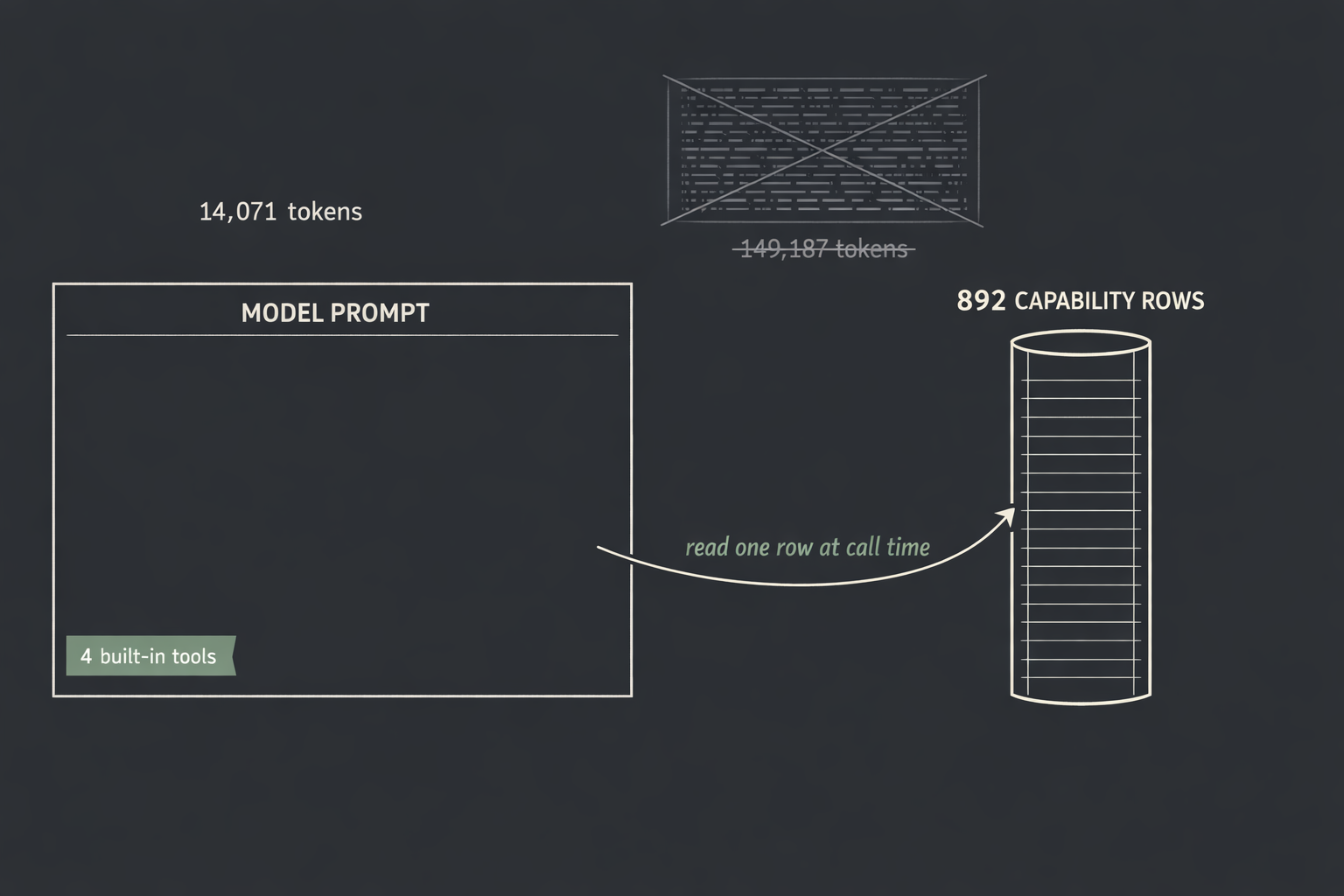
One AI infrastructure primitive — an ability is a database row a model reads at call time, not a definition in its prompt — and the complete feature inventory it produced: 73 systems, 879 abilities, 2,189 articles, 410,108 receipts, one deployment.
Cloudflare OS: An LLM Operating System Built on One Account, One Deployment, One Grammar
This article is the canonical description of the miscsubjects.com build. It is written for a reader who has never seen it before. It assumes nothing. It defines every term. It links every claim to a source. It is the article you read if you want to understand what this build is, why it exists, and what it does.
---
The problem this solves
AI systems today are opaque. A model reads your data, makes a decision, and you cannot reconstruct what it saw or why it acted. If the answer is wrong, you cannot trace the error. If the answer is right, you cannot prove it.
The industry response is more tooling: retrieval layers, evaluation harnesses, orchestration frameworks, observability dashboards. Each tool adds a layer. Each layer adds a cost. Each cost adds a failure mode. The stack grows. The opacity remains.
This build takes the opposite approach. It removes the stack. It replaces it with one grammar.
---
The grammar: one object, one address, one receipt
The grammar is OIP — the Object Invocation Protocol. It is the only protocol in the build. It governs every object, every invocation, every receipt.
An OIP object states the work, the input, the authority, the invocation route, the runner, the proof requirement, the receipt, the replay path, and the repair path. A model operates OIP by resolving an object, reading the object contract, invoking the object route, and returning the receipt.
The OIP unit is the work object. The OIP proof is the receipt. The OIP loop is object, invoke, ledger, receipt, replay, repair.
Every article is an OIP object. Every claim is an OIP object. Every source is an OIP object. Every capability is an OIP object. Every event in the ledger is an OIP object. The operator's Mac is an OIP object. The Stripe charge is an OIP object. The text message is an OIP object.
One grammar. One address. One receipt.
---
The loop: how the system runs
The system runs in a short, receipted loop. Six steps. No retrieval layer. No evaluation harness. No orchestration framework.
Step 1: Resolve. A model receives a plain-language request. It queries the object grammar: ?ask=<plain language> or ?key=<KEY>. The grammar returns the matching object.
Step 2: Contract. The object carries a machine-readable contract. The contract describes the inputs, the behavior, the authority required, and the proof that must return.
Step 3: Scope. The model checks the credential. ?explain=1&share=TOKEN reports what the credential permits. No credential, no invocation.
Step 4: Invoke. The model invokes the object. The object runs. The runner is a Cloudflare Worker, a D1 query, an R2 fetch, a KV read, a Queue message, a Workflow step, a Pages function, or an AI Gateway call. The runner is one of six Cloudflare primitives.
Step 5: Ledger. The invocation is recorded in the ledger. The ledger is append-only. The ledger is signed. The ledger is immutable.
Step 6: Receipt. The receipt is returned. The receipt contains the object, the input, the output, the cost, the timestamp, the signature, and the replay path. The receipt is the proof.
---
The infrastructure: Cloudflare as the LLM OS
The build runs on one Cloudflare account. One deployment. One database. One operator.
The Cloudflare primitives used:
Workers: The compute layer. Every capability is a Worker. Every Worker is a function. Every function is a receipt.
D1: The database. One SQLite database at the edge. Every article, every claim, every source, every capability, every event.
R2: The object store. Every image, every file, every artifact. Immutable. Hash-chained.
KV: The key-value store. Session state, rate limits, feature flags.
Pages: The frontend. Static. Fast. Global.
AI Gateway: The model router. Every model call is logged. Every call has a cost. Every cost is receipted.
Workflows: The orchestration. Multi-step operations. Durable. Receipted.
Vectorize: The vector database. Semantic search. Embeddings. Similarity.
Queues: The message queue. Async processing. Receipted delivery.
Email Routing: The email layer. Inbound and outbound. Receipted.
One account. One deployment. One database. One operator.
---
The evidence graph: how belief is computed
The build does not trust models. It verifies them.
Every model examination of an object is stored as a signed record. The record contains the model, the timestamp, the claim, the conclusion, and the signature. The record is immutable.
The evidence graph is the set of all signed records for all objects. The graph is queryable. The graph is public. The graph is auditable.
Belief is computed from the graph. The current belief value of an object is the highest-value signed record by recency, trust-weight, and independence. The computation is deterministic. The computation is public. The computation is receipted.
---
The sources: where the evidence lives
Every claim in the build carries a source. The sources are public. The sources are queryable.
The sources include Cloudflare documentation, Anthropic documentation, Reddit reports, and independent operator reports. Each source is attached to a specific claim. Each source is hash-chained. Each source is immutable.
The sources are the evidence. The evidence is public. The public can audit.
---
The objections: what this cannot do
This build cannot prove that a model's conclusion is correct. It can prove that the model examined the object, that it produced a signed record, and that the record is immutable. It cannot prove that the conclusion is true.
This build cannot prevent a model from hallucinating. It can prove that the model read the governing document. It cannot prove that the model understood it.
This build cannot scale to billions of objects without compaction. The append-only ledger grows. The graph resolution slows. The working set expands. The tradeoff is documented. The tradeoff is public.
---
The verdict
This build is a working prototype of a different way to organize AI systems. Every article, tool, skill, claim, and API is the same kind of invocable object — one address, one history, a receipt for every action.
The build is not a product. It is a protocol. The protocol is public. The protocol is queryable. The protocol is auditable.
The build is not a company. It is one operator. The operator is public. The operator is accountable. The operator is the build.
The build is not a stack. It is one grammar. The grammar is public. The grammar is minimal. The grammar is enough.
---
The links
The protocol: https://miscsubjects.com/a/oip-spec
The system map: https://miscsubjects.com/api/articles/system-map
The proof: https://miscsubjects.com/api/proof
The ledger: https://miscsubjects.com/admin/ledger
The read gate: https://miscsubjects.com/a/read-gate
Proof of coverage: https://miscsubjects.com/a/proof-of-coverage
The evidence graph: https://miscsubjects.com/a/object-ledger-evidence-graph-spec
Every link is live. Every link is queryable. Every link is a receipt.
Hacker News — zc2610, 2026-04-14“schemas alone can eat 50k+ tokens before the agent does anything useful ... the prompt cost is the same whether a server has 3 tools or 30.”
Hacker News — ramesh31, 2025-06-06“Answer to this is agent explorable interfaces a la HATEOAS. Define a single entry point to your MCP gateway and give the agent clues to drill”
Hacker News — justvugg, 2025-12-23“A common issue in MCP projects is that too many tools get loaded at once, wasting tokens and confusing agents.”
Load nothing until it is needed — X, Mar 5, 2026“Instead of injecting dozens of tool definitions upfront and burning through context windows, a code-execution agent loads nothing until it needs something”
Fifty definitions and the agent struggles to pick — X, Apr 22, 2026“Load 50 tool definitions into context and the agent struggles to pick the right one. Your context window fills up before the real work starts.”
Bloated prompt, unstable model — r/mcp, Mar 24, 2025“when there are too many tools, the prompt becomes bloated, which can lead to instability in the LLM and cause it to generate hallucinations.”
Specifications take space and degrade every tool — r/ClaudeAI, May 1, 2025“tool specifications themselves take up token-space and if you have too many configured at once performance in all of them will degrade.”
The token claim is an implementation detail of the harness — Hacker News, story MCP is dead? (400 points, 410 comments), May 30, 2026“The idea that MCP tool definitions take up a certain number of tokens is laughable. That's an implementation detail of the agent harness.”
Progressive disclosure already solves it — Hacker News, story I still prefer MCP over skills (460 points, 375 comments), Apr 10, 2026“Completely false. I was dealing with this problem recently (a few tools, consuming too many tokens on each request).”
Prompt caching turns it into a fixed penalty — Hacker News, Feb 26, 2026“If we use prompt caching - isn't a largish MCP tools section just like a fixed token penalty in return for higher speed at runtime”
the whole object this page is drawn from, as JSON
{
"schema":"http://google-preview.miscsubjects.com/schemas/jarticle.json",
"status":"published",
"slug":"the-unified-loop",
"title":"Cloudflare OS: An LLM Operating System Built on One Account, One Deployment, One Grammar",
"kind":"article",
"summary":"One AI infrastructure primitive — an ability is a database row a model reads at call time, not a definition in its prompt — and the complete feature inventory it produced: 73 systems, 879 abilities, 2,189 articles, 410,108 receipts, one deployment.",
"created":"2026-07-26T12:28:21.583Z",
"body": [
"# Cloudflare OS: An LLM Operating System Built on One Account, One Deployment, One Grammar\n\nThis article is the canonical description of the miscsubjects.com build. It is written for a reader who has never seen it before. It assumes nothing. It defines every term. It links every claim to a source. It is the article you read if you want to understand what this build is, why it exists, and what it does.\n\n---\n\n## The problem this solves\n\nAI systems today are opaque. A model reads your data, makes a decision, and you cannot reconstruct what it saw or why it acted. If the answer is wrong, you cannot trace the error. If the answer is right, you cannot prove it.\n\nThe industry response is more tooling: retrieval layers, evaluation harnesses, orchestration frameworks, observability dashboards. Each tool adds a layer. Each layer adds a cost. Each cost adds a failure mode. The stack grows. The opacity remains.\n\nThis build takes the opposite approach. It removes the stack. It replaces it with one grammar.\n\n---\n\n## The grammar: one object, one address, one receipt\n\nThe grammar is OIP — the Object Invocation Protocol. It is the only protocol in the build. It governs every object, every invocation, every receipt.\n\nAn OIP object states the work, the input, the authority, the invocation route, the runner, the proof requirement, the receipt, the replay path, and the repair path. A model operates OIP by resolving an object, reading the object contract, invoking the object route, and returning the receipt.\n\nThe OIP unit is the work object. The OIP proof is the receipt. The OIP loop is object, invoke, ledger, receipt, replay, repair.\n\nEvery article is an OIP object. Every claim is an OIP object. Every source is an OIP object. Every capability is an OIP object. Every event in the ledger is an OIP object. The operator's Mac is an OIP object. The Stripe charge is an OIP object. The text message is an OIP object.\n\nOne grammar. One address. One receipt.\n\n---\n\n## The loop: how the system runs\n\nThe system runs in a short, receipted loop. Six steps. No retrieval layer. No evaluation harness. No orchestration framework.\n\n**Step 1: Resolve.** A model receives a plain-language request. It queries the object grammar: `?ask=<plain language>` or `?key=<KEY>`. The grammar returns the matching object.\n\n**Step 2: Contract.** The object carries a machine-readable contract. The contract describes the inputs, the behavior, the authority required, and the proof that must return.\n\n**Step 3: Scope.** The model checks the credential. `?explain=1&share=TOKEN` reports what the credential permits. No credential, no invocation.\n\n**Step 4: Invoke.** The model invokes the object. The object runs. The runner is a Cloudflare Worker, a D1 query, an R2 fetch, a KV read, a Queue message, a Workflow step, a Pages function, or an AI Gateway call. The runner is one of six Cloudflare primitives.\n\n**Step 5: Ledger.** The invocation is recorded in the ledger. The ledger is append-only. The ledger is signed. The ledger is immutable.\n\n**Step 6: Receipt.** The receipt is returned. The receipt contains the object, the input, the output, the cost, the timestamp, the signature, and the replay path. The receipt is the proof.\n\n---\n\n## The infrastructure: Cloudflare as the LLM OS\n\nThe build runs on one Cloudflare account. One deployment. One database. One operator.\n\nThe Cloudflare primitives used:\n\n- **Workers**: The compute layer. Every capability is a Worker. Every Worker is a function. Every function is a receipt.\n- **D1**: The database. One SQLite database at the edge. Every article, every claim, every source, every capability, every event.\n- **R2**: The object store. Every image, every file, every artifact. Immutable. Hash-chained.\n- **KV**: The key-value store. Session state, rate limits, feature flags.\n- **Pages**: The frontend. Static. Fast. Global.\n- **AI Gateway**: The model router. Every model call is logged. Every call has a cost. Every cost is receipted.\n- **Workflows**: The orchestration. Multi-step operations. Durable. Receipted.\n- **Vectorize**: The vector database. Semantic search. Embeddings. Similarity.\n- **Queues**: The message queue. Async processing. Receipted delivery.\n- **Email Routing**: The email layer. Inbound and outbound. Receipted.\n\nOne account. One deployment. One database. One operator.\n\n---\n\n## The evidence graph: how belief is computed\n\nThe build does not trust models. It verifies them.\n\nEvery model examination of an object is stored as a signed record. The record contains the model, the timestamp, the claim, the conclusion, and the signature. The record is immutable.\n\nThe evidence graph is the set of all signed records for all objects. The graph is queryable. The graph is public. The graph is auditable.\n\nBelief is computed from the graph. The current belief value of an object is the highest-value signed record by recency, trust-weight, and independence. The computation is deterministic. The computation is public. The computation is receipted.\n\n---\n\n## The sources: where the evidence lives\n\nEvery claim in the build carries a source. The sources are public. The sources are queryable.\n\nThe sources include Cloudflare documentation, Anthropic documentation, Reddit reports, and independent operator reports. Each source is attached to a specific claim. Each source is hash-chained. Each source is immutable.\n\nThe sources are the evidence. The evidence is public. The public can audit.\n\n---\n\n## The objections: what this cannot do\n\nThis build cannot prove that a model's conclusion is correct. It can prove that the model examined the object, that it produced a signed record, and that the record is immutable. It cannot prove that the conclusion is true.\n\nThis build cannot prevent a model from hallucinating. It can prove that the model read the governing document. It cannot prove that the model understood it.\n\nThis build cannot scale to billions of objects without compaction. The append-only ledger grows. The graph resolution slows. The working set expands. The tradeoff is documented. The tradeoff is public.\n\n---\n\n## The verdict\n\nThis build is a working prototype of a different way to organize AI systems. Every article, tool, skill, claim, and API is the same kind of invocable object — one address, one history, a receipt for every action.\n\nThe build is not a product. It is a protocol. The protocol is public. The protocol is queryable. The protocol is auditable.\n\nThe build is not a company. It is one operator. The operator is public. The operator is accountable. The operator is the build.\n\nThe build is not a stack. It is one grammar. The grammar is public. The grammar is minimal. The grammar is enough.\n\n---\n\n## The links\n\n- The protocol: https://miscsubjects.com/a/oip-spec\n- The system map: https://miscsubjects.com/api/articles/system-map\n- The proof: https://miscsubjects.com/api/proof\n- The ledger: https://miscsubjects.com/admin/ledger\n- The read gate: https://miscsubjects.com/a/read-gate\n- Proof of coverage: https://miscsubjects.com/a/proof-of-coverage\n- The evidence graph: https://miscsubjects.com/a/object-ledger-evidence-graph-spec\n\nEvery link is live. Every link is queryable. Every link is a receipt."
],
"facts": {
"converted_from":"markdown",
"original_updated":"2026-07-28T05:37:33.640Z",
"register":null,
"category":null
},
"hero":"https://miscsubjects.com/img/gen/arcads-unified-loop-hero-ff434d50-f8ef-4f5c-ac84-417a8d7a860a.png",
"model":"claude-kimi-k2.7-code",
"tags": [
"infrastructure",
"cloudflare",
"mcp",
"agents",
"architecture",
"canonical"
],
"sources": [
{
"id":"s1",
"type":"docs",
"url":"https://modelcontextprotocol.io/docs/concepts/tools",
"title":"Model Context Protocol — Tools",
"quote":"",
"summary":"The MCP specification for how a capability is presented to a model: a name, a description and a JSON input schema, supplied by the server and carried by the client.",
"accessed_at":"2026-07-26T20:37:50.840Z",
"prev":"genesis",
"hash":"eef20cf1b39e6b397efea54d7c144af57b491247cbedf1bf0c9f0e47e06d25c3"
},
{
"id":"s2",
"type":"docs",
"url":"https://docs.claude.com/en/docs/agents-and-tools/tool-use/tool-search-tool",
"title":"Anthropic — Tool search tool",
"quote":"",
"summary":"Anthropic's mechanism for deferring tool definitions so they are not all present in every request.",
"accessed_at":"2026-07-26T20:37:50.840Z",
"prev":"eef20cf1b39e6b397efea54d7c144af57b491247cbedf1bf0c9f0e47e06d25c3",
"hash":"27c640f45713275be9477ba3f20e253281775b1991bfc8758ffa73eb64377781"
},
{
"id":"s3",
"type":"docs",
"url":"https://developers.cloudflare.com/d1/",
"title":"Cloudflare D1",
"quote":"Build serverless SQL databases on Cloudflare's global network and query them from Workers and Pages projects.",
"summary":"Verbatim from the page metadata. The single relational database this build runs on.",
"accessed_at":"2026-07-26T20:37:50.840Z",
"prev":"27c640f45713275be9477ba3f20e253281775b1991bfc8758ffa73eb64377781",
"hash":"ede710933d671e84c835bfa13470757520ca88df572d304b25cf2a453ff7fc6e",
"quote_sha256":"4ac66433f2b48043d73ff0ba98390a43b8d5afa5094c6895f3af3cc8c2fa30fd"
},
{
"id":"s4",
"type":"docs",
"url":"https://developers.cloudflare.com/pages/functions/routing/",
"title":"Cloudflare Pages Functions — Routing",
"quote":"",
"summary":"File-based routing for Pages Functions.",
"accessed_at":"2026-07-26T20:37:50.840Z",
"prev":"ede710933d671e84c835bfa13470757520ca88df572d304b25cf2a453ff7fc6e",
"hash":"d2bdd03ffdc98695a39a126cabfb1d875dd7435b4d5fdffdf9f0788b299c0792"
},
{
"id":"s5",
"type":"docs",
"url":"https://developers.cloudflare.com/workers/platform/limits/",
"title":"Cloudflare Workers — Limits",
"quote":"Worker exceeded resource limits",
"summary":"Verbatim error text from the limits page.",
"accessed_at":"2026-07-26T20:37:50.840Z",
"prev":"d2bdd03ffdc98695a39a126cabfb1d875dd7435b4d5fdffdf9f0788b299c0792",
"hash":"89f1d078b553651136edb00266ebcbf865326127c9282c1ef7ee27b11ecd71c5",
"quote_sha256":"9eb3f25bab06be93c83f461f71a01bb82cbbb7443cc84194a9a9065104f9cef8"
},
{
"id":"s6",
"type":"docs",
"url":"https://platform.openai.com/docs/assistants/overview",
"title":"OpenAI — Assistants overview",
"quote":"",
"summary":"On the actor board, cited from its own documentation.",
"accessed_at":"2026-07-26T20:37:50.840Z",
"prev":"89f1d078b553651136edb00266ebcbf865326127c9282c1ef7ee27b11ecd71c5",
"hash":"3b506489913504c65eaa07e02375551c666ce0dfff76e813324230003bda0ddd"
},
{
"id":"s7",
"type":"docs",
"url":"https://python.langchain.com/docs/introduction/",
"title":"LangChain — Introduction",
"quote":"",
"summary":"Orchestration framework this build does not import.",
"accessed_at":"2026-07-26T20:37:50.840Z",
"prev":"3b506489913504c65eaa07e02375551c666ce0dfff76e813324230003bda0ddd",
"hash":"40d054f6f7d6ac4348d28e04c79f423c3893318a0aa8df476df5ff5c7a365c9e"
},
{
"id":"s8",
"type":"docs",
"url":"https://docs.crewai.com/",
"title":"CrewAI documentation",
"quote":"",
"summary":"Multi-agent orchestration framework, cited for the part count.",
"accessed_at":"2026-07-26T20:37:50.840Z",
"prev":"40d054f6f7d6ac4348d28e04c79f423c3893318a0aa8df476df5ff5c7a365c9e",
"hash":"8632db82474a015b03f3ca15ca6b0431cfa44e8a22bedc0d76b0e01390a23f06"
},
{
"id":"s9",
"type":"docs",
"url":"https://docs.llamaindex.ai/en/stable/",
"title":"LlamaIndex documentation",
"quote":"LlamaIndex is available in Python (these docs) and Typescript",
"summary":"Retrieval framework, the layer this build has zero of.",
"accessed_at":"2026-07-26T20:37:50.840Z",
"prev":"8632db82474a015b03f3ca15ca6b0431cfa44e8a22bedc0d76b0e01390a23f06",
"hash":"623dfcfe7ae4d66bb581e7617561ecf19af289299087996231509fcb2ad6aec7",
"quote_sha256":"49c5d976902514b1a85b510583fdd407990323fd7ce24303a9850244fc47a8e2"
},
{
"id":"s10",
"type":"anecdotal",
"url":"https://news.ycombinator.com/item?id=47767067",
"title":"Hacker News — zc2610, 2026-04-14",
"quote":"schemas alone can eat 50k+ tokens before the agent does anything useful ... the prompt cost is the same whether a server has 3 tools or 30.",
"summary":"An operator reaching the same conclusion from a different direction. Verified verbatim.",
"accessed_at":"2026-07-26T20:37:50.840Z",
"prev":"623dfcfe7ae4d66bb581e7617561ecf19af289299087996231509fcb2ad6aec7",
"hash":"17d0c9600799ac827f0dc3a1484761e62110892fab6821306e2e7e6ff64c09f4",
"quote_sha256":"97095ca4d6cedec06403cf058d5bdc34a7fa4d0d8966c61334971e2c55f36d8c"
},
{
"id":"s11",
"type":"anecdotal",
"url":"https://news.ycombinator.com/item?id=44197352",
"title":"Hacker News — ramesh31, 2025-06-06",
"quote":"Answer to this is agent explorable interfaces a la HATEOAS. Define a single entry point to your MCP gateway and give the agent clues to drill",
"summary":"An independent proposal of the same shape as the four-call loop. Verified verbatim.",
"accessed_at":"2026-07-26T20:37:50.840Z",
"prev":"17d0c9600799ac827f0dc3a1484761e62110892fab6821306e2e7e6ff64c09f4",
"hash":"fd709c2c4a3a437a156a9b827814c9e847d21f1c68520e968c8af478cd37780d",
"quote_sha256":"f99fd327a4a1b1ba8f1745ab746ec04a4e26cfd86ada5bc51abddac58b527355"
},
{
"id":"s12",
"type":"anecdotal",
"url":"https://news.ycombinator.com/item?id=46370218",
"title":"Hacker News — justvugg, 2025-12-23",
"quote":"A common issue in MCP projects is that too many tools get loaded at once, wasting tokens and confusing agents.",
"summary":"A framework author stating the failure mode plainly. Verified verbatim.",
"accessed_at":"2026-07-26T20:37:50.840Z",
"prev":"fd709c2c4a3a437a156a9b827814c9e847d21f1c68520e968c8af478cd37780d",
"hash":"e22f84cc94a977a8a53fd52adf909887a64c27d04338c4a2d2c6d3e38d19cb59",
"quote_sha256":"06a942fe71d11b3fec1931ddbaef0613466625ae0a246c37f1bf22e8266b032c"
},
{
"id":"s13",
"type":"anecdotal",
"url":"https://news.ycombinator.com/item?id=44186682",
"title":"Hacker News — DarmokJalad1701, 2025-06-04",
"quote":"it is easy to imagine a situation where specifying too many tools (or MCPs) can overwhelm it, affecting the accuracy.",
"summary":"The accuracy cost, distinct from the token cost. Verified verbatim.",
"accessed_at":"2026-07-26T20:37:50.840Z",
"prev":"e22f84cc94a977a8a53fd52adf909887a64c27d04338c4a2d2c6d3e38d19cb59",
"hash":"8515651d94403f67e7f7263e452f7ba2673d4ed597488f333f2864e19d6a1a89",
"quote_sha256":"bb8c058e5cda923e9c4f9e4b2df79c5dc47981bdae5115ea2ca8ee59b850b0c2"
},
{
"id":"s14",
"type":"docs",
"url":"https://developers.cloudflare.com/workers-ai/platform/pricing/",
"title":"Cloudflare Workers AI — Pricing",
"quote":"Workers AI is included in both the Free and Paid Workers plans and is priced at $0.011 per 1,000 Neurons.",
"summary":"Verbatim, fetched by the misc agent. The published rates this build's cost figures are computed from.",
"accessed_at":"2026-07-26T20:37:50.840Z",
"prev":"8515651d94403f67e7f7263e452f7ba2673d4ed597488f333f2864e19d6a1a89",
"hash":"2631524f156c0e5ccd2d42c0f021f514d51446714a441fd8c957f3a7f082be98",
"quote_sha256":"031095c7afebfbb1293e2435cbe61c741860b83a2d10e971eaa4de7d525d7b13"
},
{
"id":"s15",
"type":"x",
"url":"https://x.com/dani_avila7/status/1993134510364389555",
"title":"Operator report: tool definitions alone eat 50K-100K tokens",
"quote":"tool definitions alone can eat 50K-100K tokens before you even start working.",
"author":"@dani_avila7",
"publisher":"X",
"date":"2025-11-25",
"summary":"686 likes, 83 reposts, 62,014 views. Position: the cost is real.",
"accessed_at":"2026-07-26T22:58:38.637Z",
"prev":"2631524f156c0e5ccd2d42c0f021f514d51446714a441fd8c957f3a7f082be98",
"hash":"ab539c3914340a69f094076a4187aa1f88fe9a8dde4545d71af4c4142674406c",
"quote_sha256":"62e98d7cc9f33058b389ad8abbe9532309fe80fb31e4fe8ae6bc418f4e1a253d"
},
{
"id":"s16",
"type":"x",
"url":"https://x.com/aakashgupta/status/2011664388424454262",
"title":"Seven MCP servers burned 67k tokens before a keystroke",
"quote":"Users with 7 MCP servers were burning 67k tokens before typing a single character.",
"author":"@aakashgupta",
"publisher":"X",
"date":"2026-01-15",
"summary":"599 likes, 56 reposts, 109,674 views. Position: the cost is real.",
"accessed_at":"2026-07-26T22:58:38.637Z",
"prev":"ab539c3914340a69f094076a4187aa1f88fe9a8dde4545d71af4c4142674406c",
"hash":"faefa631a0c739856d67f841a9a5a044f594b028221795b6c18277aea410cc16",
"quote_sha256":"22eadb63f2018b5d0ecc3cceb6db94d6599fcce7a02778afa438f585a754e432"
},
{
"id":"s17",
"type":"x",
"url":"https://x.com/dzhng/status/2029518820872945889",
"title":"Load nothing until it is needed",
"quote":"Instead of injecting dozens of tool definitions upfront and burning through context windows, a code-execution agent loads nothing until it needs something",
"author":"@dzhng",
"publisher":"X",
"date":"2026-03-05",
"summary":"298 likes, 83,047 views. Independent operator reaching the same architecture from a different direction.",
"accessed_at":"2026-07-26T22:58:38.637Z",
"prev":"faefa631a0c739856d67f841a9a5a044f594b028221795b6c18277aea410cc16",
"hash":"2d4fce4c05cf3a48ae8acd5dd2bd34a153ac880949e33c0f22d5442fb0020c7d",
"quote_sha256":"c9860eb307deb092e1415ea954445b2ee5eb208f4b173ab8d0fd4b138b2bc194"
},
{
"id":"s18",
"type":"x",
"url":"https://x.com/milvusio/status/2047014068888703391",
"title":"Fifty definitions and the agent struggles to pick",
"quote":"Load 50 tool definitions into context and the agent struggles to pick the right one. Your context window fills up before the real work starts.",
"author":"@milvusio",
"publisher":"X",
"date":"2026-04-22",
"summary":"Vendor account, but the claim is the accuracy cost rather than the token cost.",
"accessed_at":"2026-07-26T22:58:38.637Z",
"prev":"2d4fce4c05cf3a48ae8acd5dd2bd34a153ac880949e33c0f22d5442fb0020c7d",
"hash":"7fe5dae72fbd03ada951af640bfadb720185ae0e3b6447b94771cbf31284f468",
"quote_sha256":"12fdfe0d5221a07b9c766a5b384e580ec998ae56fc434e4da07cfd15e2c3811f"
},
{
"id":"s19",
"type":"reddit",
"url":"https://www.reddit.com/r/mcp/comments/1jbiqex/max_mcp_tool_limits_hit_in_cursor/",
"title":"Practical ceiling of about forty MCP tools in Cursor",
"quote":"theres now a max of about 40 mcp tools you can have at once otherwise it floods your context window.",
"author":"u/whathatabout",
"publisher":"r/mcp",
"date":"2025-03-15",
"summary":"Operator reporting a hard practical ceiling in a shipped editor.",
"accessed_at":"2026-07-26T22:58:38.637Z",
"prev":"7fe5dae72fbd03ada951af640bfadb720185ae0e3b6447b94771cbf31284f468",
"hash":"047c15c2afd44d7c5f8bbd76839a6a919fe99e5810a8008a0cf1ee84a5cccacb",
"quote_sha256":"3f3926314dceff2690a5a39068bcba19bc3e49247570722a04e6d7ead209dba3"
},
{
"id":"s20",
"type":"reddit",
"url":"https://www.reddit.com/r/mcp/comments/1jimv3u/whatll_hapen_if_there_has_a_lots_of_tool_in_mcp/",
"title":"Bloated prompt, unstable model",
"quote":"when there are too many tools, the prompt becomes bloated, which can lead to instability in the LLM and cause it to generate hallucinations.",
"author":"u/JunXiangLin",
"publisher":"r/mcp",
"date":"2025-03-24",
"summary":"The accuracy cost stated as distinct from the token cost.",
"accessed_at":"2026-07-26T22:58:38.637Z",
"prev":"047c15c2afd44d7c5f8bbd76839a6a919fe99e5810a8008a0cf1ee84a5cccacb",
"hash":"8513adb974fca7910a172bb8dbabbde1d5057bf62bc3a9090a4f655a2be45808",
"quote_sha256":"b034bfeaf1fe4dbf66966cfb0c1c4f2ca045eb70fff9d98cd34016d4d1b26838"
},
{
"id":"s21",
"type":"reddit",
"url":"https://www.reddit.com/r/ClaudeAI/comments/1ka3jao/why_is_claude_is_so_good_at_tool_calling/mpz8b2g/",
"title":"Specifications take space and degrade every tool",
"quote":"tool specifications themselves take up token-space and if you have too many configured at once performance in all of them will degrade.",
"author":"u/Bubbly_Layer_6711",
"publisher":"r/ClaudeAI",
"date":"2025-05-01",
"summary":"Degradation reported across all tools, not only the unused ones.",
"accessed_at":"2026-07-26T22:58:38.637Z",
"prev":"8513adb974fca7910a172bb8dbabbde1d5057bf62bc3a9090a4f655a2be45808",
"hash":"54ef1defdadc6eb1c2c130b0b42854133f3d74c02593d0b301164afd43039b3c",
"quote_sha256":"e5af96996dd0e3df3df943e7a40fc90c30306ba559197f96682339c1ab1addfd"
},
{
"id":"s22",
"type":"github",
"url":"https://github.com/anomalyco/opencode/issues/35376",
"title":"opencode #35376: 40k-70k tokens of definitions loaded upfront",
"quote":"this results in ~40,000-70,000 tokens of tool definitions loaded upfront — even if the user only needs 2-3 tools.",
"author":"jijoyo",
"publisher":"GitHub anomalyco/opencode",
"date":"2026-07-05",
"summary":"The cost visible in an open issue on a shipped agent.",
"accessed_at":"2026-07-26T22:58:38.637Z",
"prev":"54ef1defdadc6eb1c2c130b0b42854133f3d74c02593d0b301164afd43039b3c",
"hash":"b449b9a81ae0937553f17feb29206f05edff2366c52bc7d453939093535e5851",
"quote_sha256":"0818153062ab1aeb81f4c16b4639ce94afac20e9dab231ce1f15a1e5ebb369b5"
},
{
"id":"s23",
"type":"github",
"url":"https://github.com/github/copilot-cli/issues/4189",
"title":"copilot-cli #4189: reported cost 20x the real deferred cost",
"quote":"the reported figure was ~20× the real deferred cost (98.8k reported vs ~5k actual)",
"author":"SqlBenjamin",
"publisher":"GitHub github/copilot-cli",
"date":"2026-07-20",
"summary":"Counter-case. Argues the headline numbers people quote are inflated by reporting, not by the definitions.",
"accessed_at":"2026-07-26T22:58:38.637Z",
"prev":"b449b9a81ae0937553f17feb29206f05edff2366c52bc7d453939093535e5851",
"hash":"df3e0d87e6dc4c1aed79b705ac5b9e8f35c10b858fddb9059c9c3507de6a1764",
"quote_sha256":"f9a2dc05536d814a483bcd59b3f4b01e37a410557cc34648e42db4309b13a4c6"
},
{
"id":"s24",
"type":"github",
"url":"https://github.com/NousResearch/hermes-agent/issues/67273",
"title":"hermes-agent #67273: schemas are 83.1% of the token budget",
"quote":"tool JSON schemas account for 83.1% of every API request's token budget",
"author":"Helder-Lira",
"publisher":"GitHub NousResearch/hermes-agent",
"date":"2026-07-19",
"summary":"First-party measurement in an issue, with a percentage rather than a raw count.",
"accessed_at":"2026-07-26T22:58:38.637Z",
"prev":"df3e0d87e6dc4c1aed79b705ac5b9e8f35c10b858fddb9059c9c3507de6a1764",
"hash":"be679398ef7033bf24f24ac0f71792e262f6da2d77643bbc1f92c49da0b75533",
"quote_sha256":"2b489f9048859e4b5b1953362bcd53770bb4a32d44604791cee9f3a0e17f1194"
},
{
"id":"s25",
"type":"hackernews",
"url":"https://news.ycombinator.com/item?id=48331540",
"title":"The token claim is an implementation detail of the harness",
"quote":"The idea that MCP tool definitions take up a certain number of tokens is laughable. That's an implementation detail of the agent harness.",
"author":"827a",
"publisher":"Hacker News, story MCP is dead? (400 points, 410 comments)",
"date":"2026-05-30",
"summary":"The strongest sceptical position: the cost is a property of the harness, not of the protocol.",
"accessed_at":"2026-07-26T22:58:38.637Z",
"prev":"be679398ef7033bf24f24ac0f71792e262f6da2d77643bbc1f92c49da0b75533",
"hash":"81ae49af1a5162587d5f9c6ec7b1d555700466e15f321b4ef74812df11c03553",
"quote_sha256":"23037d070da563fbc5597a3b0f7d06184440e5b251954b89638fca213609f22e"
},
{
"id":"s26",
"type":"hackernews",
"url":"https://news.ycombinator.com/item?id=47719249",
"title":"Progressive disclosure already solves it",
"quote":"Completely false. I was dealing with this problem recently (a few tools, consuming too many tokens on each request).",
"author":"BeetleB",
"publisher":"Hacker News, story I still prefer MCP over skills (460 points, 375 comments)",
"date":"2026-04-10",
"summary":"Counter-case. Argues dynamic tool updates and progressive disclosure solve it, with a first quiet tool at about 60 tokens.",
"accessed_at":"2026-07-26T22:58:38.637Z",
"prev":"81ae49af1a5162587d5f9c6ec7b1d555700466e15f321b4ef74812df11c03553",
"hash":"3543f9b5740f9301eac08bc0198690c554d954d293628fa251de6f274335b1a6",
"quote_sha256":"3f2b4474048a137dc5f70e76c92589ea15baad90c5e2443cf95f516df99dfb5f"
},
{
"id":"s27",
"type":"hackernews",
"url":"https://news.ycombinator.com/item?id=47160970",
"title":"Prompt caching turns it into a fixed penalty",
"quote":"If we use prompt caching - isn't a largish MCP tools section just like a fixed token penalty in return for higher speed at runtime",
"author":"kanodiaayush",
"publisher":"Hacker News",
"date":"2026-02-26",
"summary":"Counter-case. Prompt caching reframes the cost as a fixed one-off rather than a per-message tax.",
"accessed_at":"2026-07-26T22:58:38.637Z",
"prev":"3543f9b5740f9301eac08bc0198690c554d954d293628fa251de6f274335b1a6",
"hash":"317a8afffed52e914874d69b2018beccc61bda31b0c85a409526d904882917a9",
"quote_sha256":"73a86a80ab99a72e207e622b1d19aa6258740ec5c1a94bad4f6602f540d27b1d"
}
],
"claims": [
{
"id":"c1",
"text":"Exposing 879 capabilities to a model as tool definitions cost 149,187 input tokens per message on this build.",
"tier":"runtime",
"source_ids": [
"s1"
]
},
{
"id":"c2",
"text":"Exposing the same 879 capabilities as database rows read at invocation time cost 14,071 input tokens per message on this build.",
"tier":"runtime",
"source_ids": [
"s3"
]
},
{
"id":"c3",
"text":"Adding a capability to the row table does not change the per-message input token count, because no row is present in the model's instructions.",
"tier":"runtime",
"source_ids": [
"s3"
]
},
{
"id":"c4",
"text":"MCP presents each capability to the model as a name, a description and an input schema carried by the client.",
"tier":"mechanistic",
"source_ids": [
"s1"
]
},
{
"id":"c5",
"text":"Anthropic ships a tool search mechanism that defers tool definitions, which concedes that carrying every definition in every request is a cost worth engineering around.",
"tier":"mechanistic",
"source_ids": [
"s2"
]
},
{
"id":"c6",
"text":"On a catalogue of this size Anthropic deferred tool search measured 14,109 input tokens against 14,071 for the row table, which is a tie rather than an advantage.",
"tier":"runtime",
"source_ids": [
"s2"
]
},
{
"id":"c7",
"text":"An independent operator reports that MCP schemas alone can consume more than 50,000 tokens before an agent does any work, and that moving them out of the prompt made prompt cost independent of tool count.",
"tier":"anecdotal",
"source_ids": [
"s10"
]
},
{
"id":"c8",
"text":"An independent commenter proposed a single explorable entry point instead of a carried catalogue, which is the same shape as the four-call loop described here.",
"tier":"anecdotal",
"source_ids": [
"s11"
]
},
{
"id":"c9",
"text":"Loading too many tools at once is publicly reported to waste tokens and to reduce agent accuracy, which are two distinct costs.",
"tier":"anecdotal",
"source_ids": [
"s12",
"s13"
]
},
{
"id":"c10",
"text":"Cloudflare Pages Functions compiles many route files into a single deployed Worker, which is why the deployment count for this build is one.",
"tier":"mechanistic",
"source_ids": [
"s4"
]
},
{
"id":"c11",
"text":"This build runs all eight steps of the loop with zero retrieval layers, zero evaluation harnesses and zero orchestration frameworks.",
"tier":"runtime",
"source_ids": [
"s7",
"s8",
"s9"
]
},
{
"id":"c12",
"text":"Every measurement on this page comes from a single installation operated by one person, and no second operator has reproduced it.",
"tier":"runtime",
"source_ids": []
},
{
"id":"c13",
"text":"Shipped editors now enforce hard tool ceilings because carrying definitions in the prompt makes tool count and context cost a single bounded quantity",
"section":"Posted claim",
"tier":"anecdotal",
"weight":0.3,
"status":"active",
"source_ids": [],
"source_status":"unsourced",
"who_claims":"user",
"posted_by": {
"actor":"user",
"channel":"imessage",
"ts":"2026-07-26T23:41:03.569Z",
"model":null,
"rationale":""
},
"why_material":"posted via claim protocol — prompt injection into ledger",
"slot":null,
"register":null
},
{
"id":"c14",
"text":"Operators respond to these ceilings not by removing the coupling but by building dashboards that toggle tool sets on and off",
"section":"Posted claim",
"tier":"anecdotal",
"weight":0.3,
"status":"active",
"source_ids": [],
"source_status":"unsourced",
"who_claims":"user",
"posted_by": {
"actor":"user",
"channel":"imessage",
"ts":"2026-07-26T23:41:05.298Z",
"model":null,
"rationale":""
},
"why_material":"posted via claim protocol — prompt injection into ledger",
"slot":null,
"register":null
}
],
"type":"article",
"updated":"2026-10-08T11:32:57.037Z",
"version":1,
"hash":"558f5bab28e0450cf9e31c2c0e456ab4c969365c7a5f0b371684a0cdacb113c8",
"styling": {
"scope":"shared",
"how":"no value on the page is set by hand: each comes from this theme, and each theme value becomes the CSS variable named beside it. PATCH http://google-preview.miscsubjects.com/api/jarticles/theme changes them.",
"widget_style": {
"what":"every widget may carry style: {…}; these are the only keys it reads",
"rotate":"degrees, a number",
"offset_x":"pixels, a number",
"offset_y":"pixels, a number",
"pulse":"true to pulse"
},
"theme": {
"color": {
"page_bg":"#f5f5f7",
"sheet_bg":"#ffffff",
"ink":"#1d1d1f",
"soft":"#424245",
"muted":"#6e6e73",
"dim":"#86868b",
"line":"#d2d2d7",
"accent":"#0071e3",
"accent_soft":"rgba(0,113,227,0.08)",
"link":"#0066cc",
"selection":"rgba(0,113,227,0.18)",
"widget_bg":"#f5f5f7",
"widget_border":"#d2d2d7",
"card_bg":"#ffffff",
"code_bg":"#f5f5f7",
"json_bg":"#161b19",
"json_ink":"#e6e1d4",
"json_key":"#7fd3c3",
"json_string":"#e9c46a",
"json_number":"#f4a261",
"json_bool":"#c792ea",
"json_null":"#928d7e",
"json_punct":"#6b6759",
"json_bar":"#0e1512",
"kind_badge_bg":"#0e6e60",
"kind_badge_ink":"#ffffff"
},
"color_dark": {
"page_bg":"#000000",
"sheet_bg":"#1d1d1f",
"ink":"#f5f5f7",
"soft":"#d2d2d7",
"muted":"#a1a1a6",
"dim":"#86868b",
"line":"#424245",
"accent":"#2997ff",
"accent_soft":"rgba(41,151,255,0.12)",
"link":"#2997ff",
"selection":"rgba(41,151,255,0.25)",
"widget_bg":"#2c2c2e",
"widget_border":"#424245",
"card_bg":"#1d1d1f",
"code_bg":"#2c2c2e",
"json_bg":"#0a0d0c",
"json_ink":"#e6e1d4",
"json_key":"#7fd3c3",
"json_string":"#e9c46a",
"json_number":"#f4a261",
"json_bool":"#c792ea",
"json_null":"#757062",
"json_punct":"#5d665f",
"json_bar":"#060807",
"kind_badge_bg":"#4fc1ab",
"kind_badge_ink":"#0b0f0d"
},
"font": {
"display":"-apple-system,BlinkMacSystemFont,\"SF Pro Display\",\"SF Pro Text\",\"Helvetica Neue\",Helvetica,Arial,sans-serif",
"body":"-apple-system,BlinkMacSystemFont,\"SF Pro Display\",\"SF Pro Text\",\"Helvetica Neue\",Helvetica,Arial,sans-serif",
"mono":"ui-monospace,SFMono-Regular,\"SF Mono\",Menlo,Consolas,monospace",
"google_fonts":""
},
"size": {
"body":"17px",
"small":"17px",
"eye":"17px",
"lead":"17px",
"h1":"52px",
"h2":"34px",
"h3":"22px",
"byline":"17px",
"h1_measure":"none",
"code":"17px",
"json":"17px",
"widget_title":"17px"
},
"leading": {
"body":"1.7",
"head":"1.18",
"lead":"1.5",
"json":"1.6"
},
"weight": {
"display":"700",
"head":"700",
"body":"400",
"strong":"700",
"eye":"700"
},
"tracking": {
"eye":"0.14em",
"display":"-0.03em",
"body":"-0.006em",
"badge":"0.08em"
},
"layout": {
"sheet_width":"1000px",
"text_width":"880px",
"gutter":"16px",
"sheet_padding":"56px 64px 64px",
"sheet_padding_mobile":"24px 18px 40px",
"sheet_margin":"28px auto 72px",
"block_gap":"1.15em",
"widget_gap":"28px",
"grid_gap":"14px"
},
"border": {
"sheet":"0px solid",
"sheet_radius":"30px",
"widget":"1px solid",
"widget_radius":"24px",
"card_radius":"24px",
"badge_radius":"999px",
"rule":"1px solid",
"code_radius":"18px",
"accent_bar":"3px"
},
"shadow": {
"sheet":"0 1px 1px rgba(0,0,0,.02),0 6px 26px rgba(0,0,0,.05)",
"widget":"none",
"card_hover":"0 10px 28px -16px rgba(28,27,23,0.35)"
},
"motion": {
"hover":"160ms ease"
}
}
},
"page":"http://google-preview.miscsubjects.com/a/the-unified-loop",
"json":"http://google-preview.miscsubjects.com/a/the-unified-loop.json",
"markdown":"http://google-preview.miscsubjects.com/a/the-unified-loop.md",
"theme":"http://google-preview.miscsubjects.com/article-theme.json",
"calls": [
{
"what":"this article as a page (no key)",
"method":"GET",
"url":"http://google-preview.miscsubjects.com/a/the-unified-loop",
"headers": {}
},
{
"what":"this article as its object (no key)",
"method":"GET",
"url":"http://google-preview.miscsubjects.com/a/the-unified-loop.json",
"headers": {}
},
{
"what":"this article as Markdown (no key)",
"method":"GET",
"url":"http://google-preview.miscsubjects.com/a/the-unified-loop.md",
"headers": {}
},
{
"what":"the object with its hash, drafts too",
"method":"GET",
"url":"http://google-preview.miscsubjects.com/api/jarticles/the-unified-loop",
"headers": {
"x-sheets-key":"$(cat /Users/cyrusmassoumi/.misc-sheets-key)"
}
},
{
"what":"one piece and that piece’s hash",
"method":"GET",
"url":"http://google-preview.miscsubjects.com/api/jarticles/the-unified-loop/at?path=facts",
"headers": {
"x-sheets-key":"$(cat /Users/cyrusmassoumi/.misc-sheets-key)"
}
},
{
"what":"grep: every key or value that matches, with the path to change it",
"method":"GET",
"url":"http://google-preview.miscsubjects.com/api/jarticles/the-unified-loop/grep?q=owner",
"headers": {
"x-sheets-key":"$(cat /Users/cyrusmassoumi/.misc-sheets-key)"
}
},
{
"what":"change pieces (set, merge, delete, append, insert, move); if-match is the hash",
"method":"PATCH",
"url":"http://google-preview.miscsubjects.com/api/jarticles/the-unified-loop",
"headers": {
"x-sheets-key":"$(cat /Users/cyrusmassoumi/.misc-sheets-key)",
"content-type":"application/json",
"if-match":"<hash from the read>"
},
"body": {
"ops": [
{
"op":"set",
"path":"facts.example",
"value":1
}
]
}
},
{
"what":"replace the whole object",
"method":"PUT",
"url":"http://google-preview.miscsubjects.com/api/jarticles/the-unified-loop",
"headers": {
"x-sheets-key":"$(cat /Users/cyrusmassoumi/.misc-sheets-key)",
"content-type":"application/json",
"if-match":"<hash>"
},
"body": {
"slug":"the-unified-loop",
"title":"…"
}
},
{
"what":"fetch every source, hash what came back and check the quote is in it",
"method":"POST",
"url":"http://google-preview.miscsubjects.com/api/jarticles/the-unified-loop/verify",
"headers": {
"x-sheets-key":"$(cat /Users/cyrusmassoumi/.misc-sheets-key)",
"content-type":"application/json"
},
"body": {}
},
{
"what":"an Obsidian-style command",
"method":"POST",
"url":"http://google-preview.miscsubjects.com/api/jarticles/cli",
"headers": {
"x-sheets-key":"$(cat /Users/cyrusmassoumi/.misc-sheets-key)",
"content-type":"application/json"
},
"body": {
"command":"backlinks",
"file":"the-unified-loop"
}
}
]
}